Landmarks in Singapore
Marina Bay's engineered towers stand a few streets from a Hindu temple built in 1827.
Singapore's landmarks fall into two clusters built a century and a half apart. Around Marina Bay, modern development carries large twenty-first-century structures: the three-tower resort of Marina Bay Sands, the rounded twin halls of the Esplanade, the Helix pedestrian bridge, the ArtScience Museum, and the tree-shaped structures of Supertree Grove. Away from the bay, older buildings show the colonial and immigrant city: the Sri Mariamman Temple, built in 1827 in the Dravidian style for the Tamil community, and the 1887 Raffles Hotel on Beach Road. The contrast is mostly one of material and scale, masonry and colonnades against steel, glass and cantilevered concrete, rather than of function, since hotels, temples and performance venues appear on both sides of it.
Marina Bay Sands
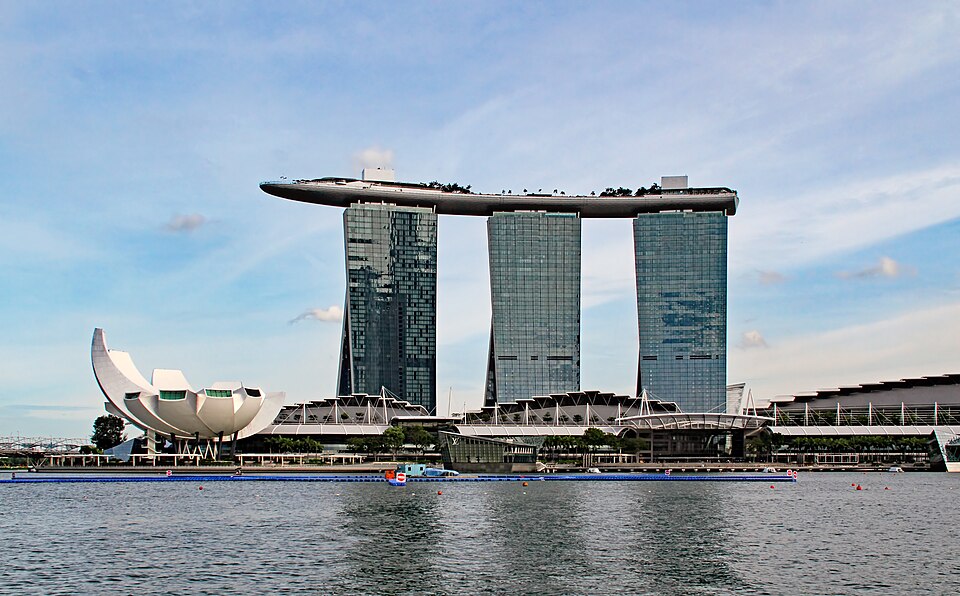
2010 · Moshe Safdie
Three slab towers rise to a single raised platform, a continuous skywalk that overhangs one tower by more than sixty metres and carries an infinity pool along its length.
Marina Bay Sands is an integrated resort combining a 1,850-room hotel, a convention centre, a shopping mall, a museum, a theatre and a casino with 500 tables. It opened in 2010 as the most expensive standalone casino property built to that point, at a cost of about US$6.88 billion. Its three towers are topped by the Sands SkyPark, a platform spanning their length that carries a 150-metre infinity pool and overhangs the north tower by 66.5 metres. It was designed by Moshe Safdie and built by Ssangyong Engineering and Construction.
- Its shopping mall once housed the world's first floating Apple store.
- It was originally due to open in 2009, a year before it actually did.
- The Sands SkyPark sits on what was, at the time, the world's largest public cantilevered platform.
Photo: Tony Hisgett from Birmingham, UK (CC BY 2.0)
Merlion
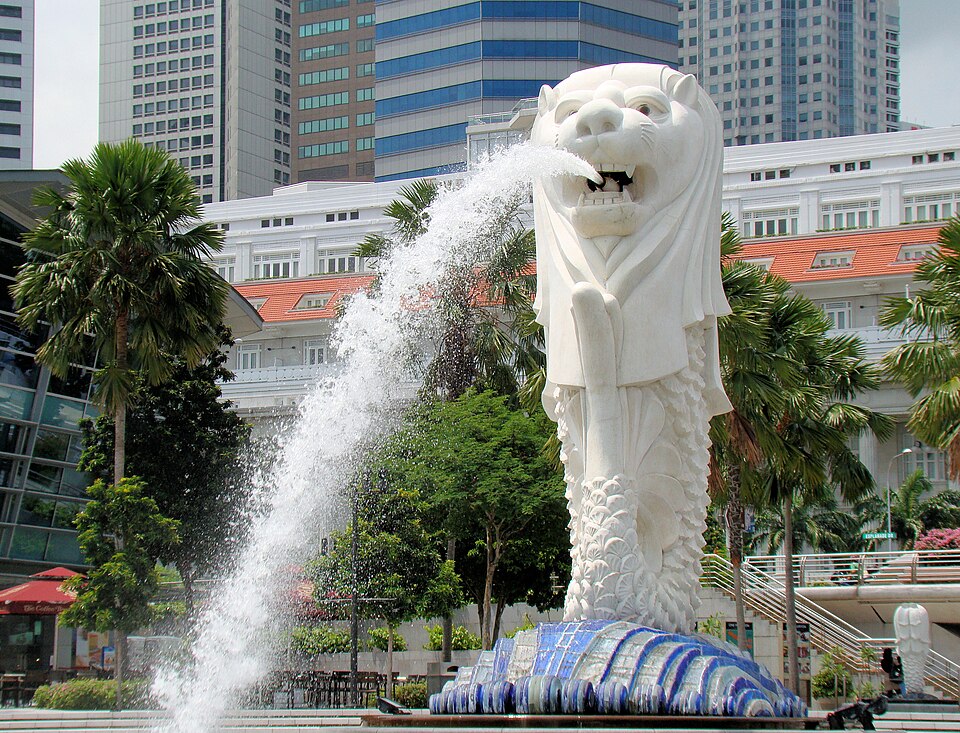
1972
A statue combining a lion's head with a fish's tail and body, functioning as a fountain that spouts water into a basin below it.
The Merlion is a hybrid creature, lion's head and fish's body, used as an emblem of Singapore and its people. The fish body recalls the city's start as a fishing village called Temasek, or 'sea town'; the lion head recalls its former name, Singapura, meaning 'lion city'. The symbol was designed by Alec Fraser-Brunner for the Singapore Tourism Board's logo, used from 1964 and trademarked from 1966. Though the board later changed its logo, the Merlion symbol remains legally protected and appears widely on approved souvenirs.
- The name blends 'mer', for sea, with 'lion'.
- It served as the Singapore Tourism Board's official logo from 1964 to 1997, though the symbol itself remains legally protected today.
Photo: Bjørn Christian Tørrissen (CC BY-SA 3.0)
Supertree Grove
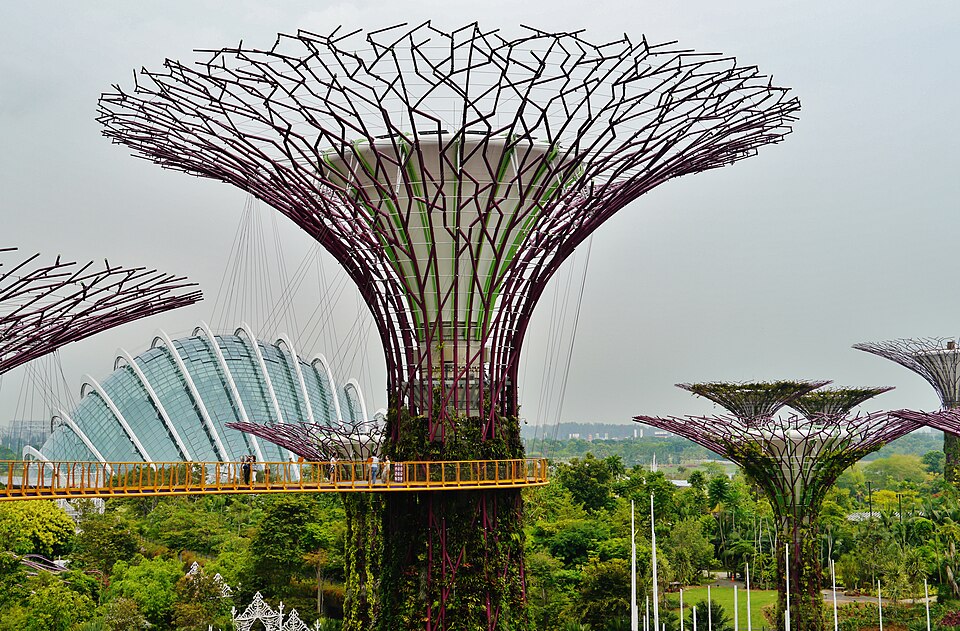
2012
A cluster of tall, tree-shaped structures grouped within a landscaped garden, plain built forms by day and transformed into a coordinated light and sound display after dark.
Supertree Grove groups a set of permanent, tree-shaped structures within a landscaped garden, completed in 2012. By day the structures stand as built forms across the grove; after dark, a light and sound display plays across them, a show that is rights-protected separately from the structures themselves. As a garden landmark, it combines built structure with planting rather than presenting either alone.
- The nightly light and sound display across the grove is rights-protected separately from the structures themselves.
Photo: Zairon (CC BY-SA 4.0)
Esplanade – Theatres on the Bay
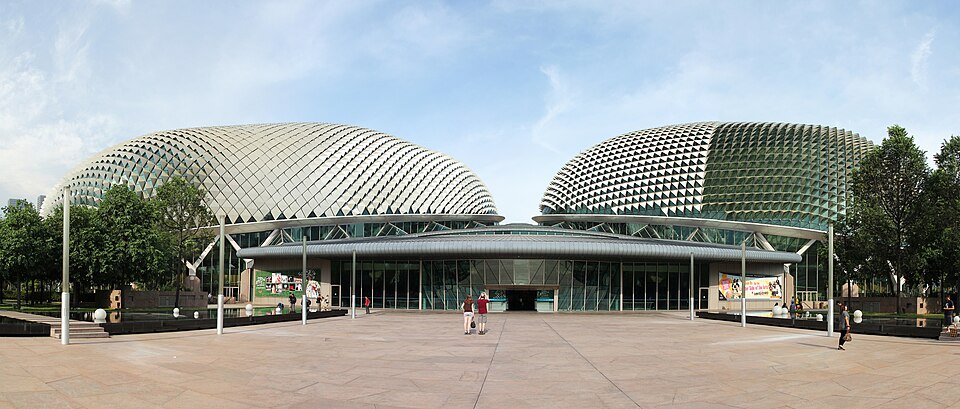
2002 · DP Architects
Two large rounded structures with a spiked, dome-like silhouette close enough to a tropical fruit's rind that the building is nicknamed after one.
Esplanade - Theatres on the Bay is a performing arts centre near the mouth of the Singapore River, named after the adjoining Esplanade Park. It consists of two rounded structures: one containing a concert hall with about 1,600 seats, the other a theatre seating around 2,000. Designed by DP Architects and opened in 2002, its spiked roof panels have given the building its popular nickname, 'The Durian'.
Photo: Donaldytong. (CC BY-SA 3.0)
Raffles Hotel
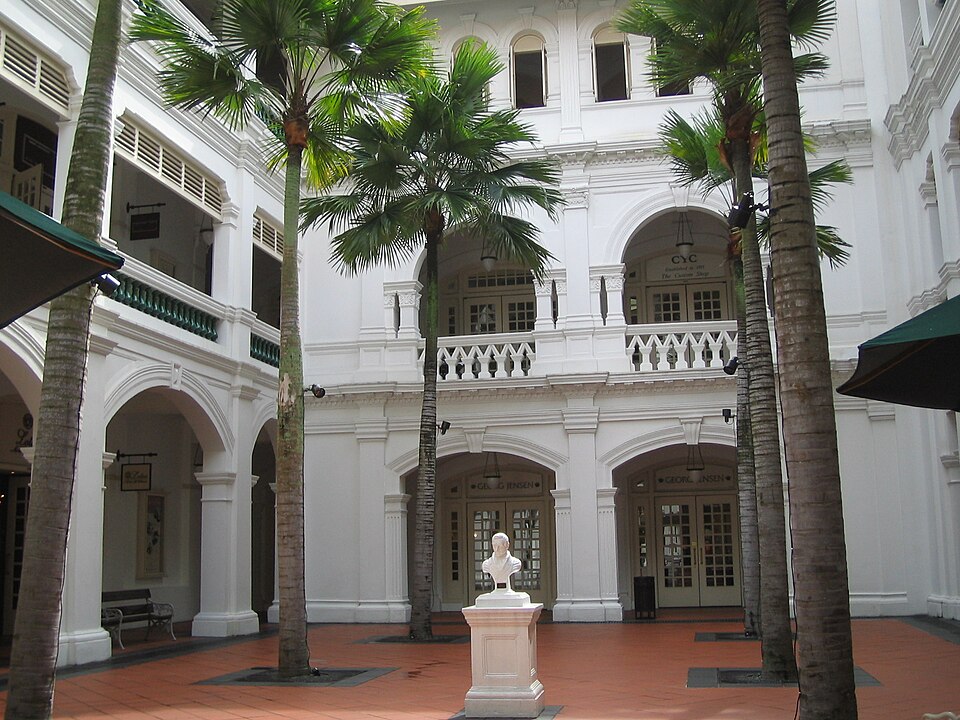
1887 · Regent Alfred John Bidwell
A low-rise colonial-era hotel at a single downtown address, distinguished less by one dramatic feature than by having operated under the same name continuously since 1887.
Raffles Hotel is a luxury hotel at 1 Beach Road, established in 1887 by the Armenian Sarkies Brothers and designed by Regent Alfred John Bidwell. It was named after the British colonial official credited with founding modern Singapore and was declared a national monument in 1987. The hotel is the flagship property of Raffles Hotels & Resorts, managed by AccorHotels since Accor's acquisition of FRHI Hotels & Resorts, and has been owned since 2010 by Katara Hospitality, a Qatar state-owned hospitality group.
- It was declared a national monument in 1987, exactly a century after it opened.
- It has been owned since 2010 by Katara Hospitality, a hospitality group owned by the government of Qatar.
Photo: Terence Ong (CC BY 2.5)
Sri Mariamman Temple
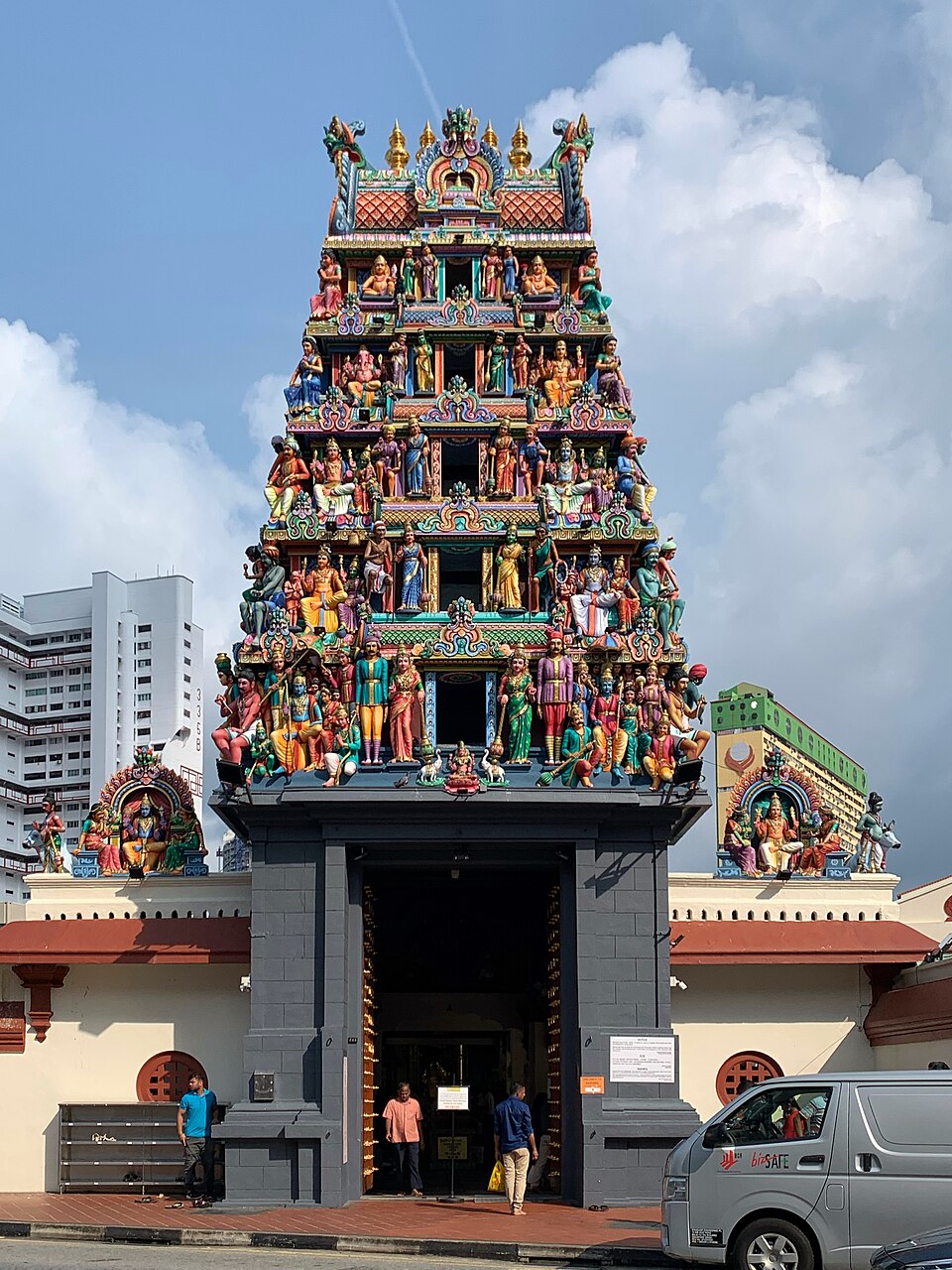
1827
A Hindu temple in the Dravidian style, identified by its gopuram, a tall entrance tower marking the temple's street-facing entrance.
Sri Mariamman Temple is Singapore's first and oldest Hindu temple, an agamic temple built in the Dravidian style at 244 South Bridge Road in Chinatown. It was founded in 1827 by Naraina Pillai, a government clerk from Penang who arrived with Stamford Raffles in 1819 and went on to found the island's first construction company. The temple serves the city's Tamil Hindu community and is managed by the Hindu Endowments Board. Recognised for its architectural and historical significance, it has been gazetted a national monument.
- Its founder, Naraina Pillai, arrived in Singapore in 1819 aboard Stamford Raffles' second visit to the island.
- Pillai went on to found the island's first construction company.
Photo: Chainwit. (CC BY-SA 4.0)
Helix Bridge
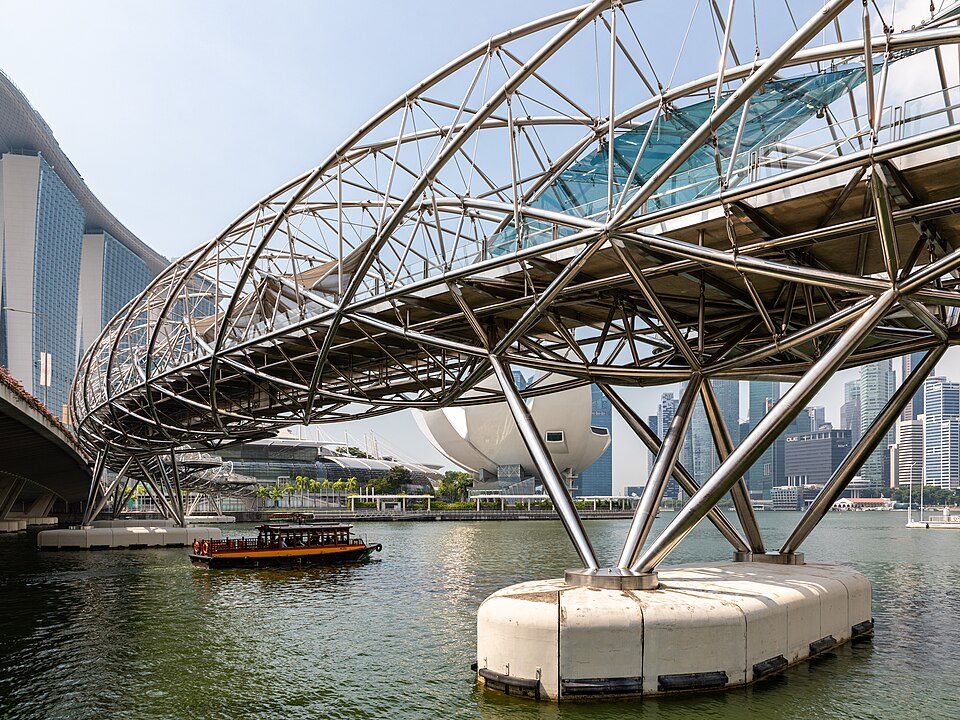
2010
A pedestrian bridge whose two intertwining spiral frames form a helix shape, unlike the straight or arched form of a typical bridge.
The Helix Bridge, officially The Helix and known at first as the Double Helix Bridge, is a pedestrian crossing joining Marina Centre and Marina South within the Marina Bay area. It opened in two stages: a partial opening on 24 April 2010, when only half the span was ready because construction was still under way at the neighbouring integrated resort, followed by full completion on 18 July of the same year.
- It opened in two stages, under three months apart, because construction at the neighbouring resort had delayed the second half.
Photo: Dietmar Rabich (CC BY-SA 4.0)
ArtScience Museum
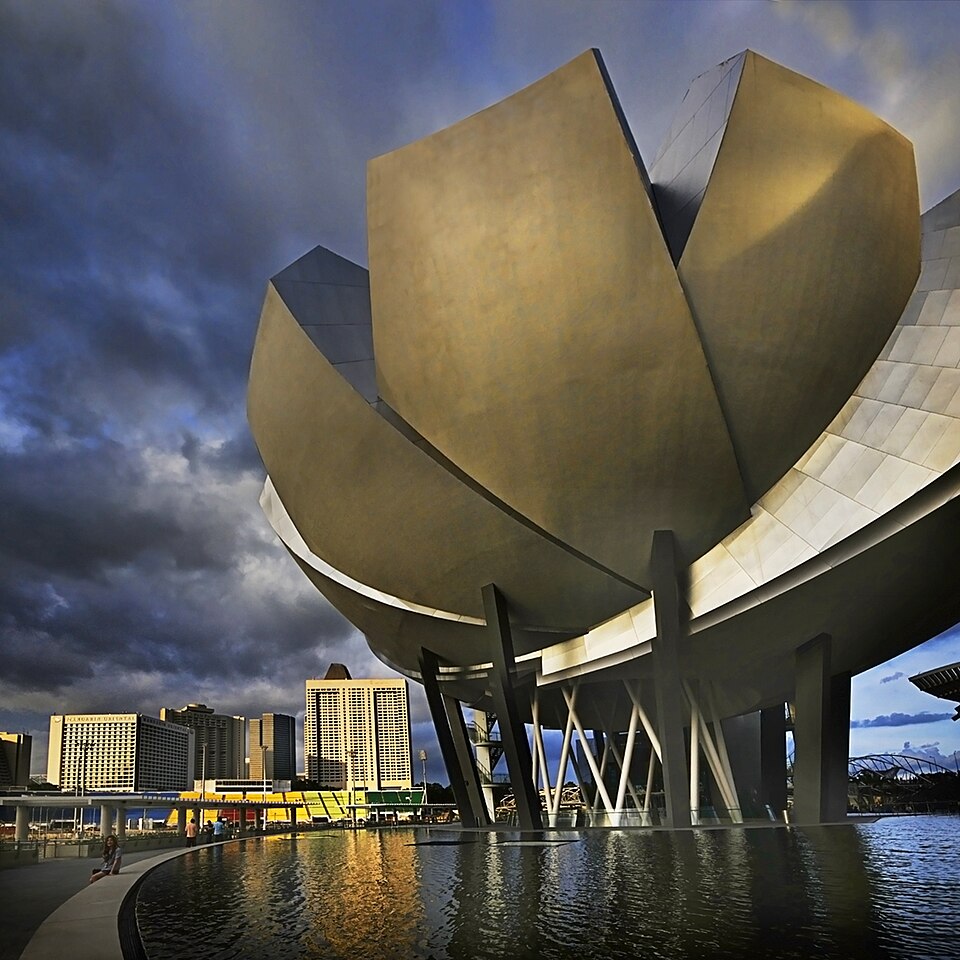
2011
A museum housed within a larger resort complex, notable less for its own exterior than for its programme: touring exhibitions from other institutions alongside a permanent exhibition made in partnership with the art collective teamLab.
The ArtScience Museum is a museum within the Marina Bay Sands integrated resort, in the Downtown Core of the Central Area. It opened on 17 February 2011, inaugurated by Prime Minister Lee Hsien Loong, and is the largest private museum in Singapore. Its programme mainly consists of touring exhibitions curated by other institutions, alongside a permanent exhibition developed together with the art collective teamLab, addressing the overlap of art, science, culture and technology.
- It is Singapore's largest private museum.
Photo: William Cho (CC BY-SA 2.0)
Jewel Changi Airport
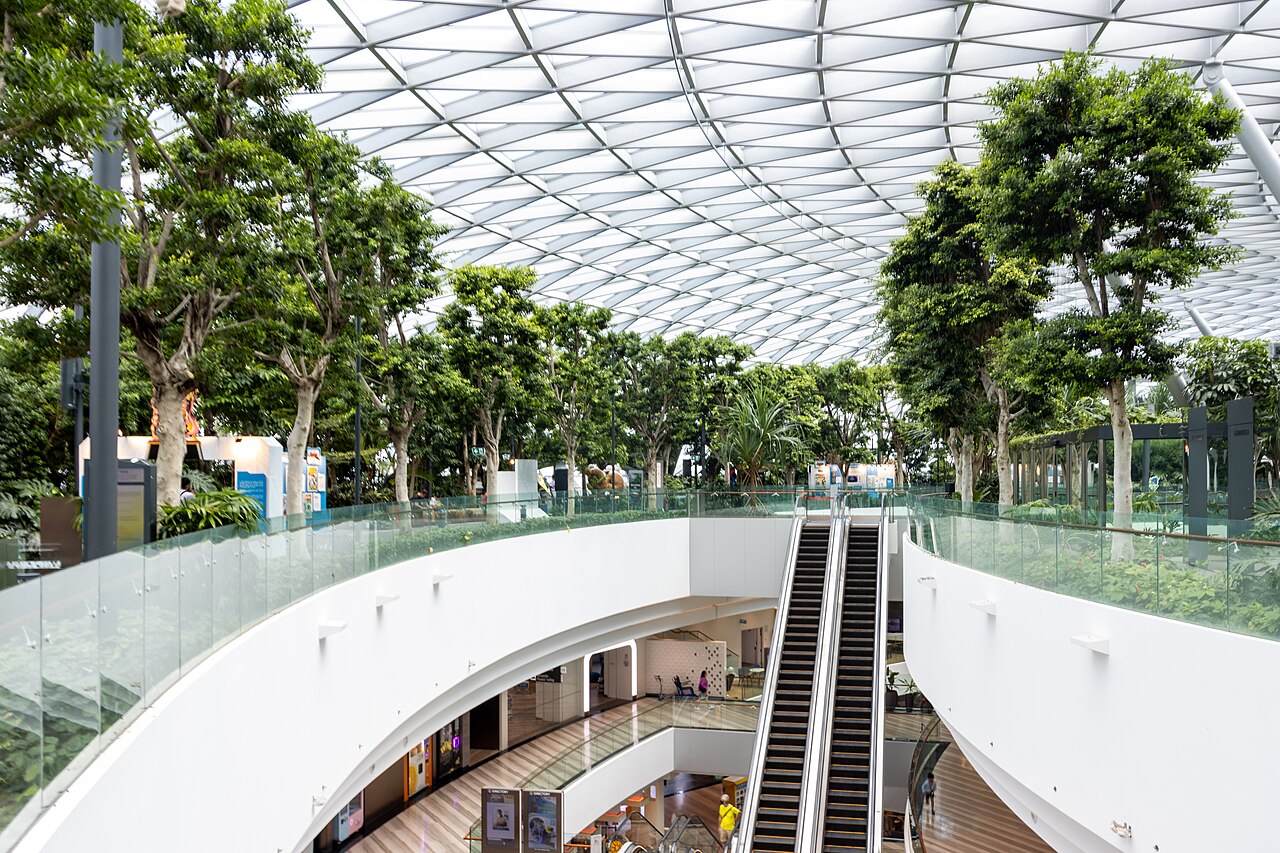
2019 · Moshe Safdie
A toroidal glass-and-steel dome enclosing a terraced indoor forest, with a waterfall pouring through a circular oculus in its roof and lit by a nightly show projected onto the falling water.
Jewel Changi Airport is a nature-themed retail and entertainment complex linking three airport terminals, built over what had been an open-air car park. Its toroidal glass-and-steel dome, led by architect Moshe Safdie, encloses the Rain Vortex, the world's tallest indoor waterfall, set within a five-storey indoor forest. Recirculating rainwater falls forty metres through an oculus in the roof to a basement pool, with a nightly light-and-sound show projected onto it. Opened in 2019, the complex also holds gardens, a hotel and around 300 shops and restaurants spread across ten storeys.
- It was built over what had been an open-air car park in front of the airport's terminal building.
- The two companies behind its construction are both ultimately owned by the same state investment fund, though no government money paid for the project.
- Within six months of its soft opening it had already drawn more visitors than its target for the whole first year.
Photo: Photograph by Mike Peel (www.mikepeel.net). (CC BY-SA 4.0)
Lau Pa Sat
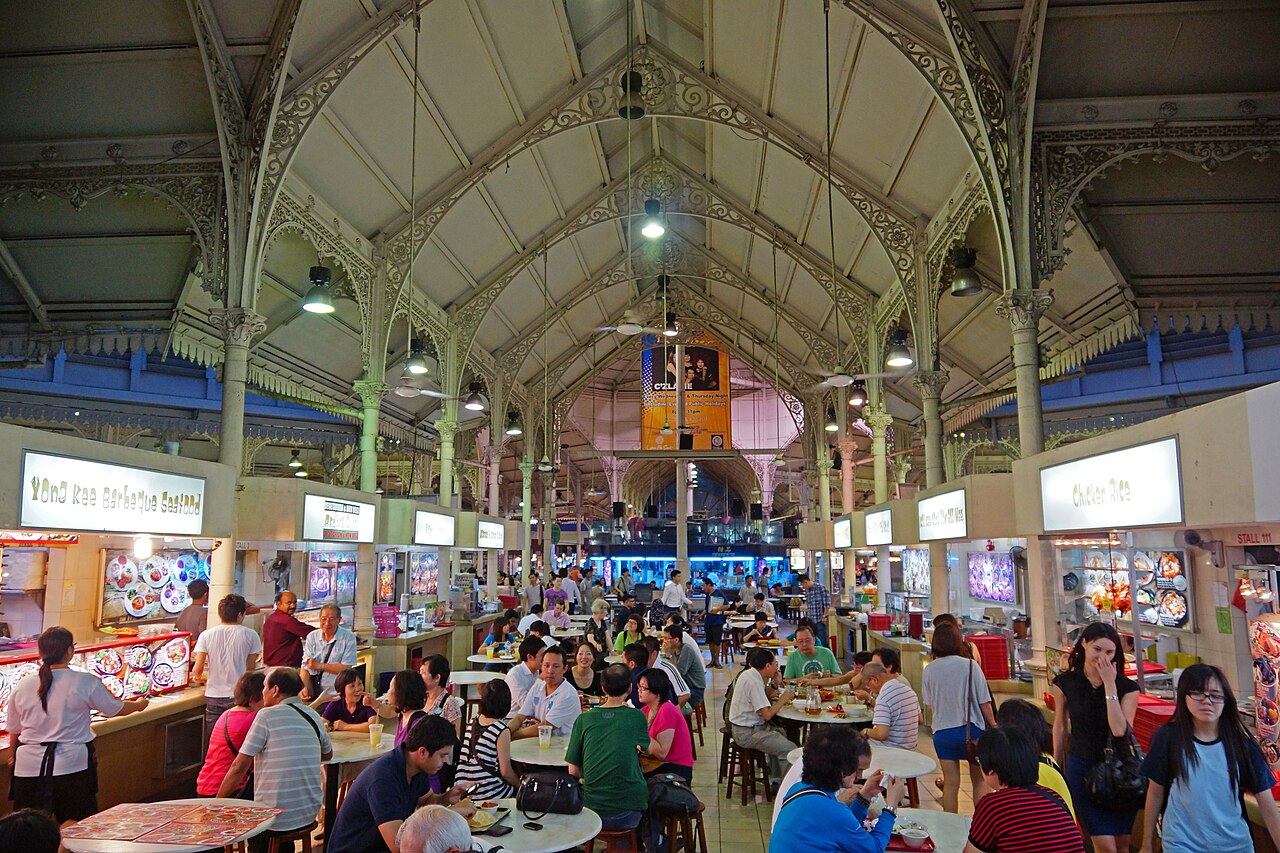
1824–1894 · James MacRitchie
An octagonal building ringed by ornate cast-iron columns supporting a low roof, with a central clock tower marking the spot where the market's original fountain once stood.
Lau Pa Sat is a historic market building in the Downtown Core, first built in 1824 as a fish market on the Telok Ayer waterfront and rebuilt twice before land reclamation forced its relocation to the present site, completed in 1894. Designed by municipal engineer James MacRitchie, who adopted the octagonal plan first used by architect George Drumgoole Coleman for the market's 1838 rebuild, the building stands on cast-iron columns shipped from Glasgow. One of the oldest Victorian structures in Southeast Asia, it now operates as a hawker centre serving local food beneath its original ironwork.
- Its cast-iron columns were shipped from the same Glasgow foundry that supplied the ironwork for a nearby historic bridge.
- A cast-iron fountain that once stood at its centre went missing for decades before being rediscovered in pieces in 1989 during a hotel restoration.
- Its Hokkien name, meaning 'old market', distinguished it from a since-vanished rival that locals called the 'new market'.
Photo: Allie_Caulfield. (CC BY 2.0)
Singapore Flyer
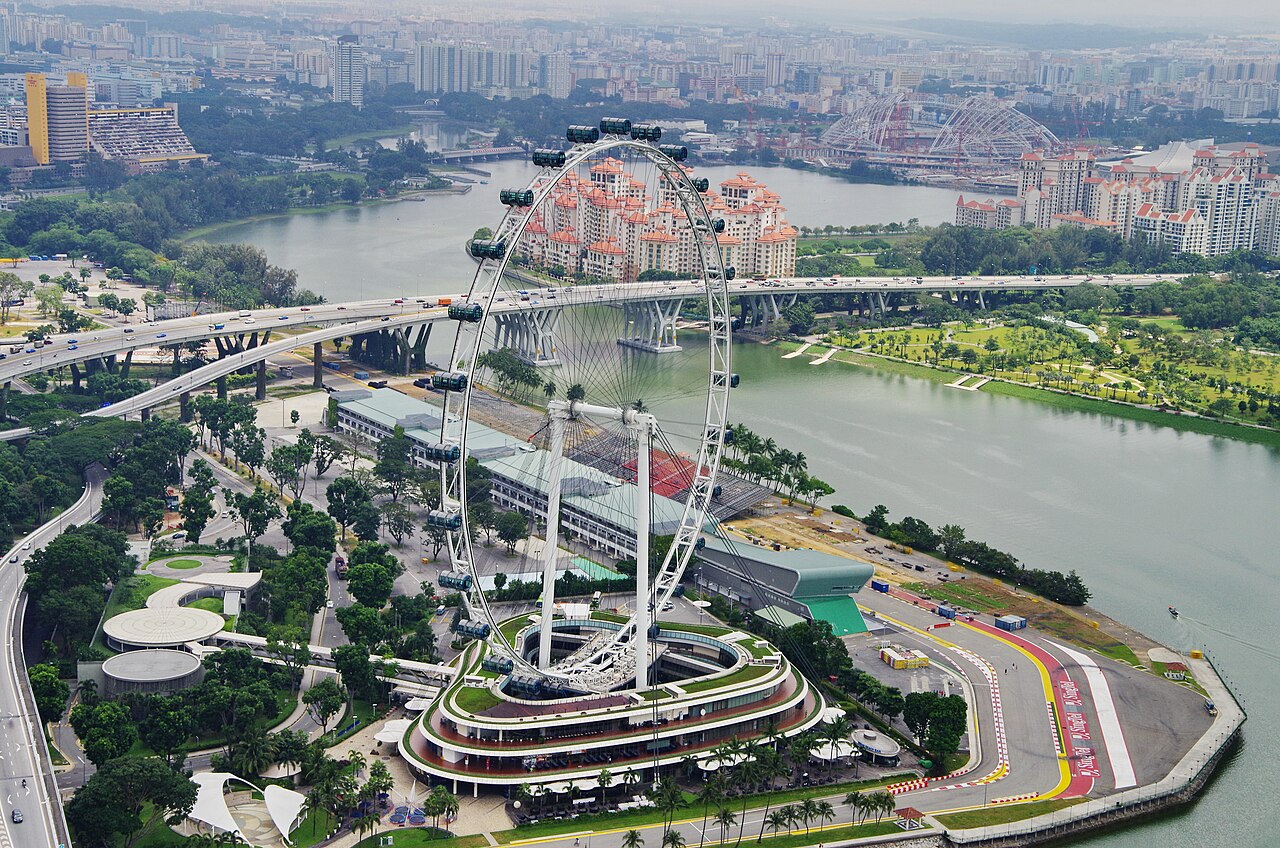
2008 · Arup and Mitsubishi Heavy Industries
A large Ferris wheel whose capsules hang outboard of the rim rather than within its spokes, rotating above a three-storey terminal building at its base.
The Singapore Flyer is an observation wheel that opened in 2008 with 28 air-conditioned capsules mounted outboard of its rim, each holding up to 28 passengers, above a three-storey terminal building. Designed by Arup and Mitsubishi Heavy Industries, it stood 165 metres tall, the world's tallest Ferris wheel until the High Roller in Las Vegas surpassed it by 2.6 metres in 2014. Financial trouble forced it into receivership in 2013, and it was sold the following year to a company that also runs tourist attractions in China.
- Its wheel initially rotated anti-clockwise but was reversed within months, on the advice of feng shui masters.
- An electrical fire in its control room in 2008 stranded 173 passengers, ten of whom had to be evacuated by rope.
- It was placed under receivership in 2013 before being sold the following year to a company that also runs aquariums in China.
Photo: Balou46 (CC BY-SA 3.0)
Sultan Mosque
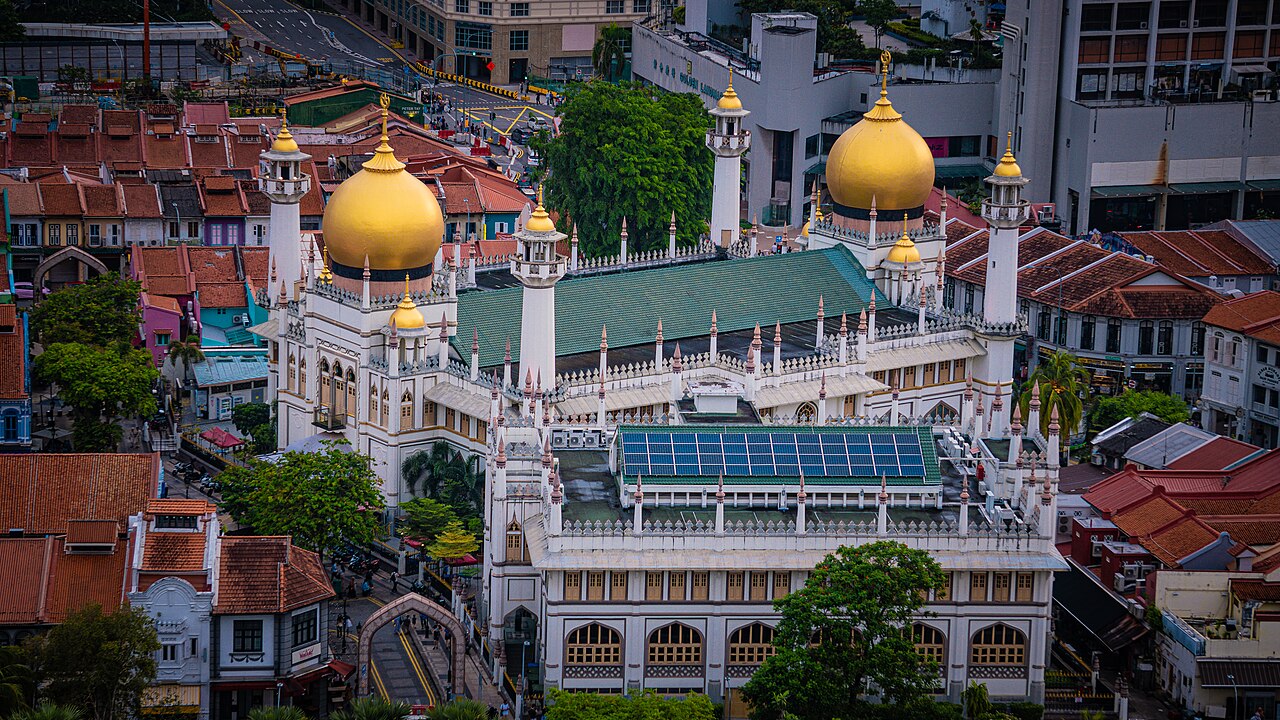
1826–1932 · Denis Santry
Two identical golden onion domes, one over the main prayer hall entrance and one over a mausoleum behind it, each ringed at its base with bottle caps donated by the poor.
The Sultan Mosque is a mosque in the Kampong Glam area, first built in 1826 for the Muslim community at the request of a Johor sultan, with funding contributed by Stamford Raffles. Dilapidation later prompted a full reconstruction, completed by 1932 to a design by Denis Santry of Swan & MacLaren in the Indo-Saracenic style. Two golden onion domes mark the building, one over the main prayer hall and the other over a mausoleum for the sultan's descendants. It became the centre of the 1950 Maria Hertogh riots and was gazetted a national monument in 1975.
- Each dome's base is ringed with bottle caps donated by the poor, after the sultan asked that every member of the community contribute regardless of wealth.
- In 1950 rioters took refuge inside the mosque, and colonial police entered only after obtaining permission from a Muslim religious judge.
- In 1968 a Saudi king donated funds toward its restoration.
Photo: Robert Sim (CC BY-SA 4.0)
Victoria Theatre and Concert Hall
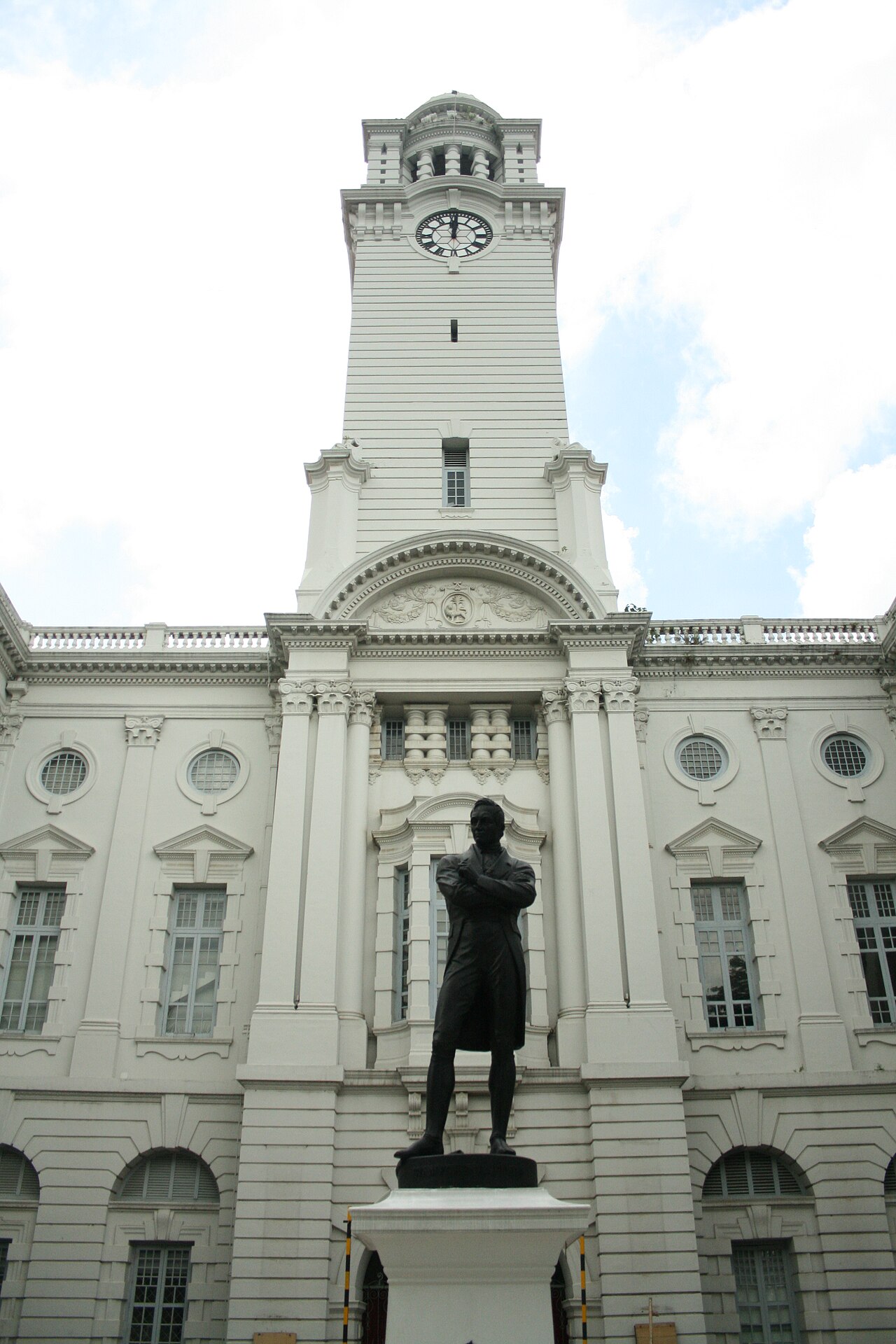
1862–1909 · R. A. J. Bidwell
Two joined civic buildings linked by a corridor beneath a tall clock tower topped with a cupola, its clock face visible from four directions.
The Victoria Theatre and Concert Hall is a performing arts complex of two joined buildings and a clock tower. Its older half began as the Town Hall, designed by municipal engineer John Bennett and completed in 1862; a second hall built in memory of Queen Victoria was added between 1903 and 1905 to a plan modified by R. A. J. Bidwell, and a 54-metre clock tower joined the two in 1906. The renovated complex reopened in 1909, staging The Pirates of Penzance. It later hosted war-crimes trials and election counts before closing for renovation in 2010 and reopening in 2014.
- It briefly served as a hospital for bombing victims during the Battle of Singapore in the Second World War.
- It hosted Japanese war crimes trials in 1946 and 1947, and the founding of a major political party in 1954.
- The country's national song was performed here for the first time in 1958, and its first television broadcasts were launched from the same hall in 1963.
Photo: Diego Delso (CC BY 3.0)
Gardens by the Bay
An urban park spanning 105 hectares beside the Marina Reservoir, first announced by Prime Minister Lee Hsien Loong in 2005. Its largest section, the 54-hectare Bay South Garden, holds the Flower Dome, the largest glass greenhouse in the world.
National Gallery
A national museum in the Civic District, combining the former Supreme Court and former City Hall buildings into the largest visual arts venue in Singapore at 64,000 square metres. Its collection of more than 9,000 items focuses on Singaporean and Southeast Asian art.
Botanic Gardens
A tropical garden at the fringe of Orchard Road, founded in 1859 and the only tropical garden ever honored as a UNESCO World Heritage Site. Its first scientific director, Henry Nicholas Ridley, pioneered rubber extraction techniques that fueled the region's early 20th-century rubber boom.
The Fullerton Hotel
A five-star hotel near the mouth of the Singapore River, originally built in 1924 as the General Post Office to mark the British colony's centennial. Designed by Major P.H. Keys after winning an architectural competition, it was designated a national monument in 2015.
National Museum of Singapore
The oldest museum in the country, tracing its history to 1849 as the Raffles Library and Museum. It moved to its permanent site on Stamford Road in 1887, and has carried its present name, first given in 1965, since 2006.
Supreme Court
A set of courts comprising the Court of Appeal and the High Court, hearing both civil and criminal matters. Since 2021, the High Court has been split into a General Division and an Appellate Division to manage a growing volume of civil appeals.
Cathedral of the Good Shepherd
The oldest Catholic church in Singapore, built in 1847 with architecture echoing London's St Paul's, Covent Garden and St Martin-in-the-Fields. Seat of the Archdiocese of Singapore, it holds the relics of Saint Laurent-Marie-Joseph Imbert and is the resting place of Bishop Edouard Gasnier.
Fort Canning Hill
A hill about 48 metres high in the Central Area, the highest elevation within walking distance of the civic district. Its long history is intertwined with the country's, and it remains popular for exhibitions, concerts and outdoor recreation.
Capitol Theatre
A historic cinema and theatre adjoined to the four-storey Capitol Building. It was considered one of the finest theatres in the country during the 1930s.
Armenian Church
The oldest surviving Christian church in the country, completed in 1835 and consecrated the following year as a parish of the Armenian Apostolic Church. A national monument since 1973, it still holds regular Armenian and Oriental Orthodox services.
Church of the Nativity of the Blessed Virgin Mary
A Roman Catholic church in Hougang, in Singapore's Serangoon District. It is known as the oldest Catholic church serving the Teochew community there.
Singapore Cable Car
An aerial gondola lift from Mount Faber to Sentosa across Keppel Harbour, opened on 15 February 1974. It was the second harbor-spanning ropeway system in the world, after Barcelona's Port Vell Aerial Tramway, and offers panoramic views of the central business district.
Singapore Indoor Stadium
An indoor arena in Kallang with a maximum capacity of 15,000, seating 12,000 when fully configured. It hosts concerts and sports from badminton to esports, and in 2022 staged The International, the Dota 2 world championship with esports' largest single-tournament prize pool.
Singapore Conference Hall
A five-storey modernist building on Shenton Way, capped with a cantilevered V-shaped roof and completed in October 1965. Built to fulfil a 1959 election promise to house Singapore's trade unions, it was the first post-colonial building gazetted as a national monument.
East Coast Park
The largest park in Singapore at 185 hectares, opened in the 1970s on land reclaimed along the southeastern coast. Built entirely on reclaimed land with a man-made, breakwater-protected beach, it offers barbecue pits, chalets, and a perimeter cycling track over 15 kilometres long.
Gedung Kuning
A Malay historical residence known as the Yellow Mansion, once an annexe to the neighboring Istana Kampong Glam palace. It became the private home of merchant Haji Yusoff and four generations of his family before its 2004 refurbishment.
Exchange Building
A landmark on Collyer Quay, completed in 1879 on the former site of Fort Fullerton, housing the Singapore Exchange's trading rooms and the Singapore Chamber of Commerce. It was demolished in 1926 to make way for the new General Post Office.
Stamford House
A historic building at the corner of Stamford Road and Hill Street, originally known as the Oranje Building and once home to a shopping mall. Redeveloped alongside the adjoining Capitol Building, it reopened as the Capitol Kempinski Hotel Singapore in October 2018.
Fort Pasir Panjang
A 19th-century coastal artillery fort, also known as Labrador Battery, one of 11 built by the British to defend the passage into Keppel Harbour. It played a limited role in the 1942 Battle of Pasir Panjang and was gazetted a WWII heritage site in 1995.
Rail Corridor
A 24-kilometre greenway created from the former Singapore–Kranji Railway, which once linked the island to Peninsular Malaysia. Following the original route from Woodlands through Bukit Timah and Queenstown to Bukit Merah, it was converted into a trail after the tracks were removed.
History
Singapore's built history begins with Temasek, an early maritime trading settlement later folded into successive regional trading empires. Its modern city dates to 1819, when Stamford Raffles set up a British trading post; the Sri Mariamman Temple followed in 1827, raised for the Tamil workers who arrived with that trade. Direct British rule began in 1867 under the Straits Settlements, and colonial-era building continued through the century, producing structures such as the 1887 Raffles Hotel. Japan occupied the city from 1942 to 1945, after which British colonial rule resumed. Self-government arrived in 1959, a short-lived federation with Malaysia followed in 1963, and full independence came in 1965. The Marina Bay skyline belongs mostly to the decades after that: the Esplanade opened in 2002, and Marina Bay Sands, the Helix Bridge, the ArtScience Museum and Supertree Grove all followed between 2010 and 2012.