Landmarks in Kuala Lumpur
Colonial masonry around Merdeka Square sits a few kilometres from 1990s postmodern towers.
Kuala Lumpur's landmarks fall into a few distinct groups rather than one continuous skyline. Around the old administrative core, colonial-era buildings from the 1880s to the 1910s mix Eastern and Western forms in a single facade, used for government offices and the railway station alike. A few kilometres away in the newer business district, the Petronas Towers and KL Tower rose in the 1990s, when Malaysia's economic growth briefly produced the tallest building on Earth. Religious buildings sit apart from both clusters: the National Mosque, a 1965 exercise in reinforced concrete built for a newly independent country, and the Thean Hou Temple, a hilltop temple raised by the Hainanese community in the 1980s. Further out at Gombak, Batu Caves adds a natural limestone hill with its own Hindu shrines.
Petronas Towers
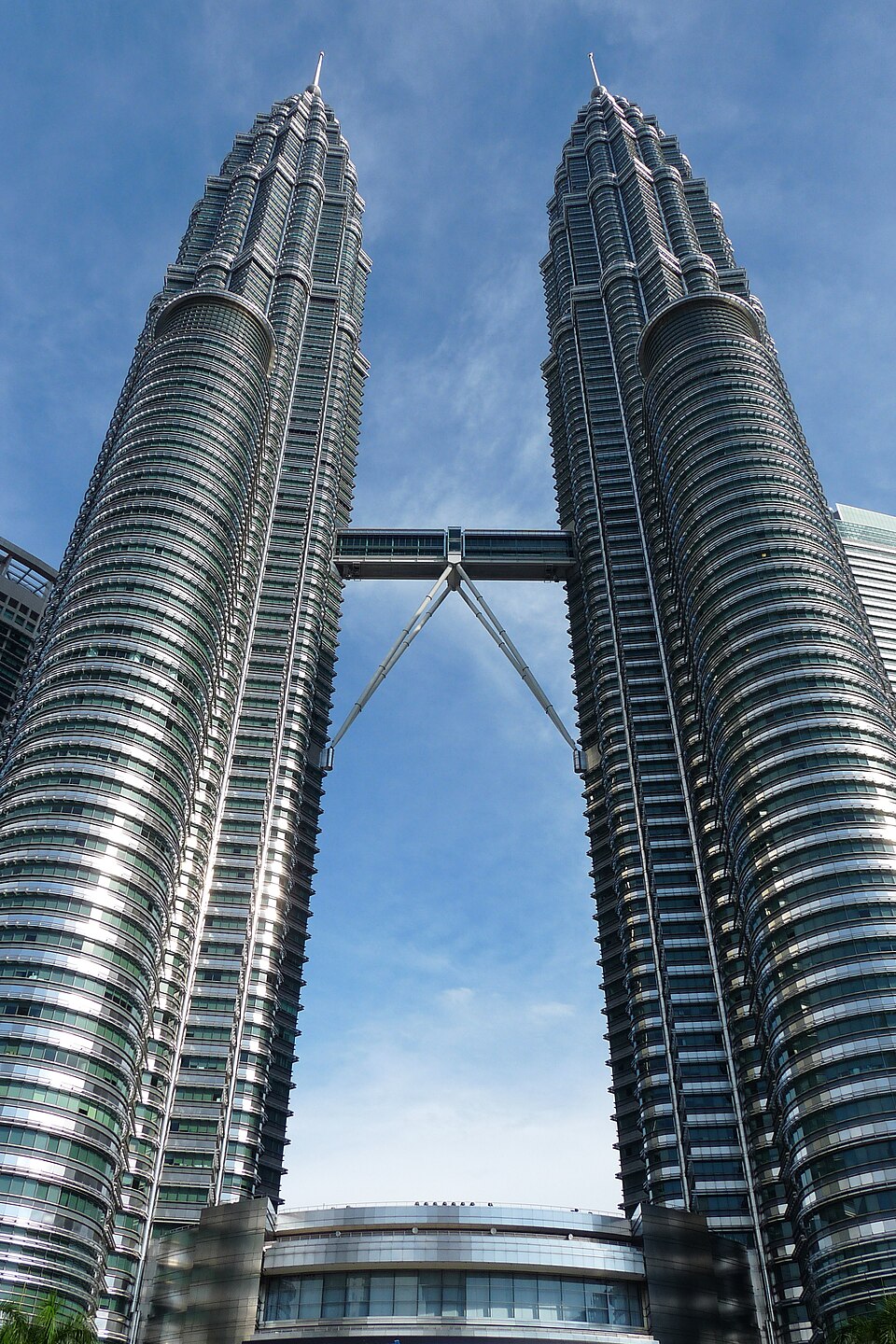
1998 · César Pelli
An interlinked pair of towers, matched in height and each rising 88 storeys, still the tallest twin structures anywhere even though the world's-tallest title itself has since moved elsewhere.
The Petronas Towers are an interlinked pair of 88-storey towers designed by César Pelli with Adamson Associates, rising 451.9 metres. They were the world's tallest buildings from 1998 until 2004, when Taipei 101 overtook them, and remain the tallest twin structures anywhere. They stand alongside the KL Tower as one of the city's major landmarks and are visible from many points across it.
- The towers stand taller than the original World Trade Center towers in New York City.
- Malaysia's own tallest-building title passed from the towers to the nearby Merdeka 118 in 2019.
Photo: AwOiSoAk KaOsIoWa (CC BY-SA 3.0)
Kuala Lumpur Tower
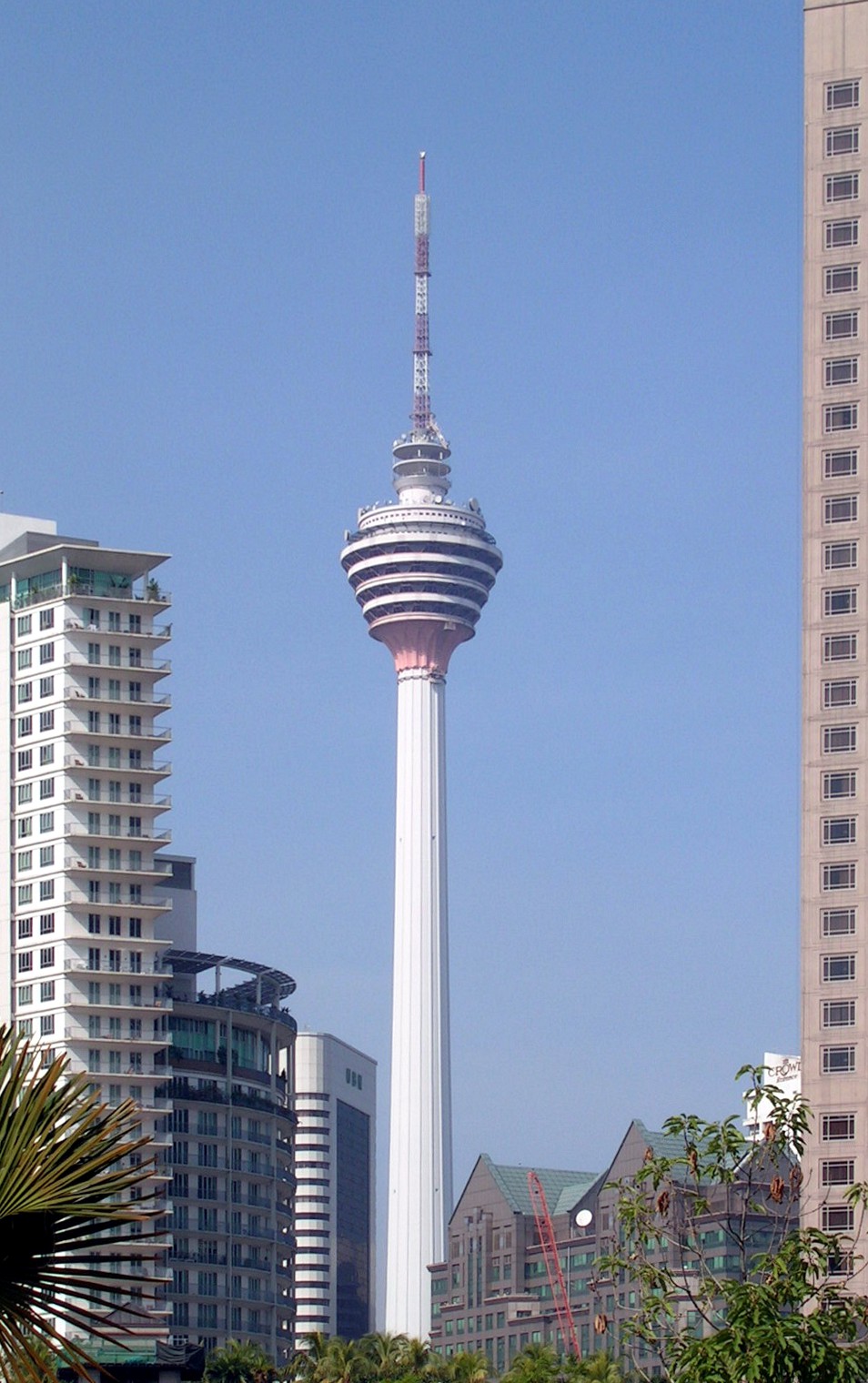
1996
A telecommunications tower topped by an antenna reaching 421 metres, with a pod near the summit, its roof at 336.5 metres, that holds a revolving restaurant and also serves as an observatory for sighting the new moon.
The KL Tower is a telecommunications tower whose antenna reaches 421 metres, making it the world's seventh-tallest structure of its kind. A pod near the top, with its roof at 336.5 metres, holds a revolving restaurant with panoramic views, reached by lift alongside an internal stairwell. It doubles as an Islamic falak observatory, used to sight the crescent moon that marks the start of Ramadan, Syawal and Zulhijjah, and remains the highest public viewpoint in the city.
- Each year, runners race up the tower's internal stairwell to the top.
Photo: Formulax (CC BY-SA 2.0)
Sultan Abdul Samad Building
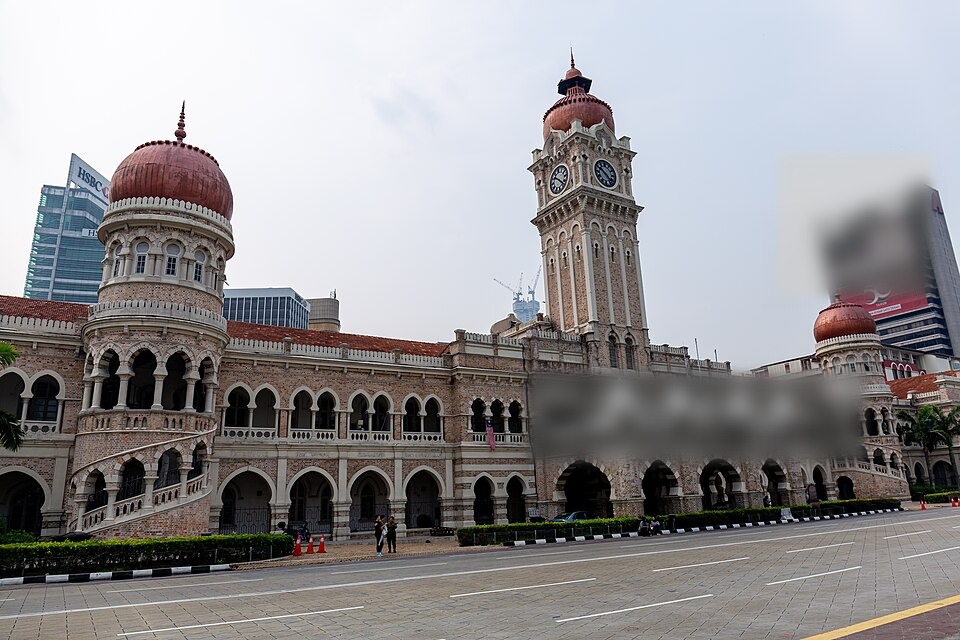
1897 · Arthur Charles Alfred Norman
A late colonial-era government building in a style drawing on Islamic architectural forms, fronting a large ceremonial square opposite the Royal Selangor Club.
Completed in 1897 to a design by Arthur Charles Alfred Norman, this building first served as offices of the British colonial administration and was known simply as Government Offices. It took its present name in 1974, after Sultan Abdul Samad, the ruling Sultan of Selangor when construction began. It later housed Malaysia's Federal Court, Court of Appeal and High Court, all since relocated, followed by government ministries. Restored in 2026, it now holds galleries, exhibition spaces and cafés, and is protected as a national historic building.
- The superior courts once housed here moved out in stages: to Putrajaya in the early 2000s and to Segambut in 2007.
Photo: Own work (CC0)
National Mosque of Malaysia
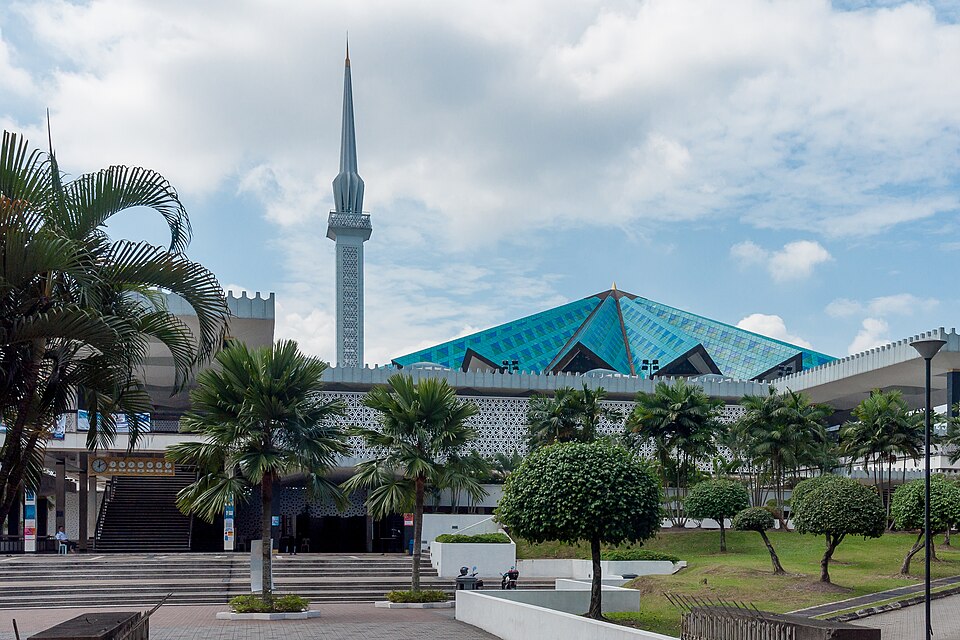
1965
A folded, sixteen-pointed star-shaped concrete roof, umbrella-like in profile, paired with a single minaret whose cap folds over like a closed umbrella, set among reflecting pools and gardens.
Completed in 1965, the National Mosque of Malaysia was built in reinforced concrete as a deliberately modern statement for a country then newly independent. Its main roof folds into a sixteen-pointed star reminiscent of an open umbrella, echoed by a 73-metre minaret capped like a folded one; the folded-plate concrete roof was chosen to achieve the wide spans needed for a main hall that holds 15,000 people. Reflecting pools and fountains run through 13 acres of gardens around it. It is protected as a national historic building.
Photo: CEphoto, Uwe Aranas (CC BY-SA 3.0)
Thean Hou Temple
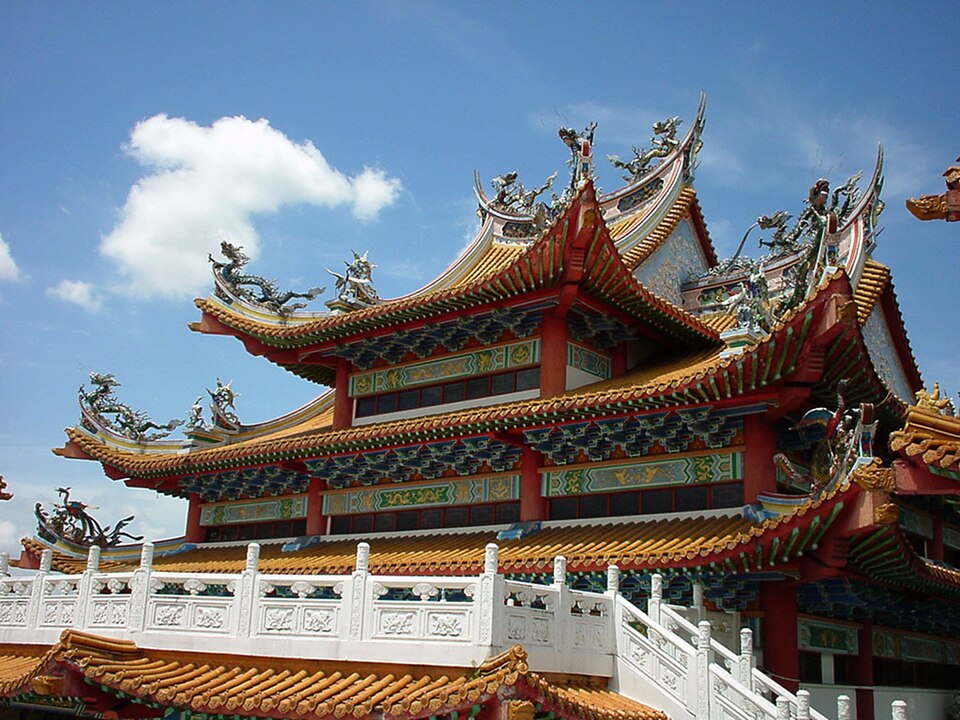
1987
A six-tiered temple building rising up a hillside on a plot of just 1.67 acres, overlooking the road below from its hilltop grounds.
Completed in 1987 and formally opened two years later, the Thean Hou Temple is a six-tiered temple dedicated to Mazu, the Chinese sea goddess, built on 1.67 acres atop Robson Heights. It was raised by the Hainanese community and remains owned and run by the Selangor and Federal Territory Hainan Association. Among the largest temples of its kind in Southeast Asia, it looks down over Jalan Syed Putra from its hilltop site.
- It occupies just 1.67 acres of land, yet ranks among the largest temples in Southeast Asia.
Photo: Acred99 (CC BY-SA 3.0)
Batu Caves
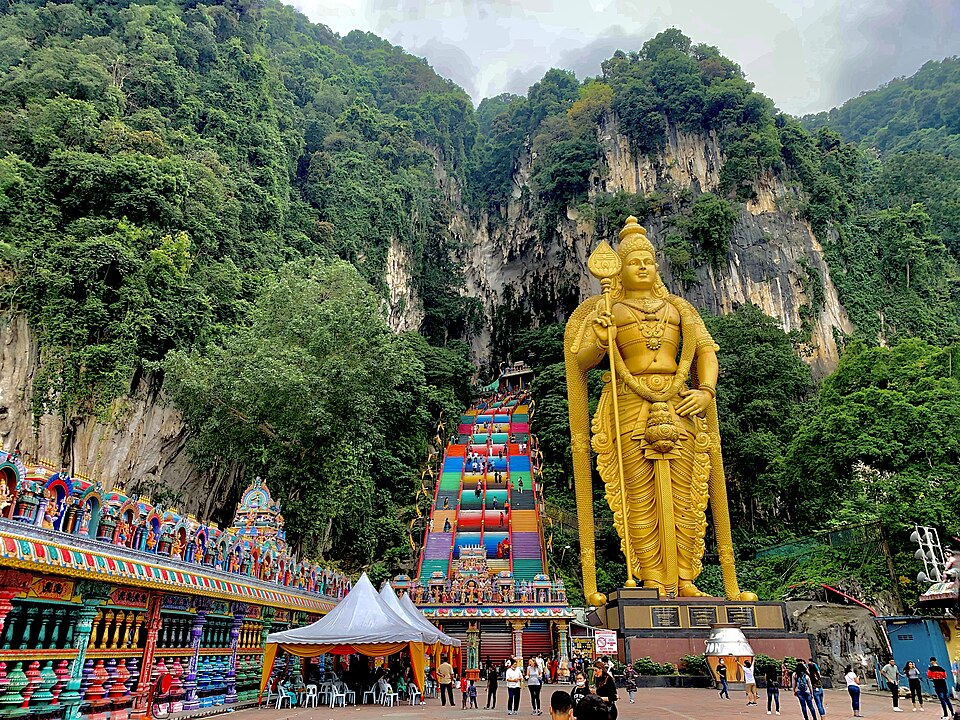
A 43-metre statue of the Hindu deity Murugan stands before a series of caves in a 325-metre limestone hill about 13 kilometres north of Kuala Lumpur.
Batu Caves is a series of limestone caves inside a 325-metre-tall limestone hill in Gombak, Selangor, about 13 kilometres north of Kuala Lumpur. The complex holds numerous Hindu temples, the best known a shrine to Murugan, and is the focal point of the Tamil Hindu festival of Thaipusam in Malaysia. A 43-metre statue of Murugan stands at the site, among the tallest statues of the deity anywhere.
- The limestone hill housing the caves is known geologically as a mogote, a steep, free-standing formation.
Photo: Chainwit. (CC BY-SA 4.0)
Kuala Lumpur Railway Station
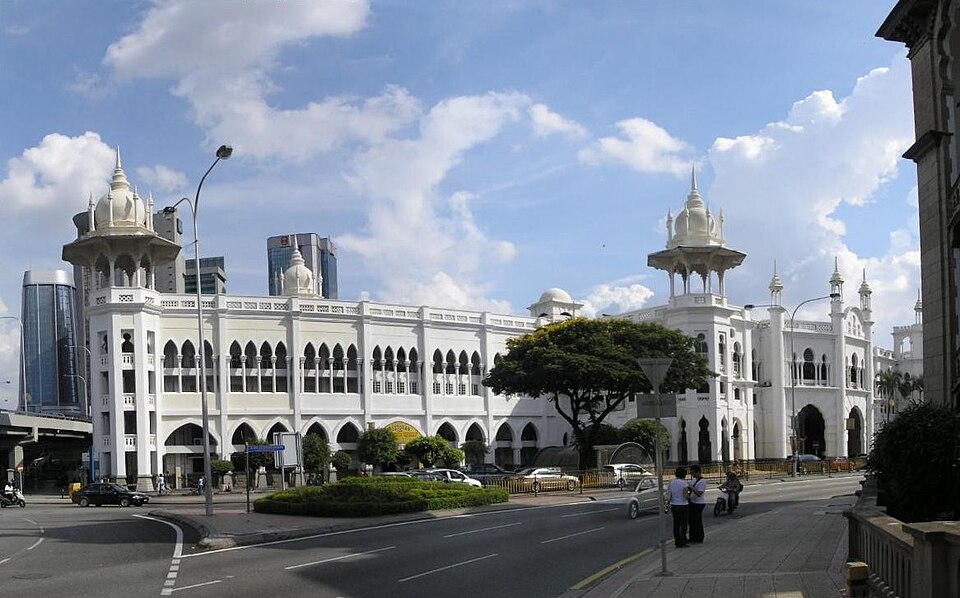
1886
A railway station notable for mixing Eastern and Western architectural styles, standing close to a similarly designed railway administration building, a mosque and another government complex, with a metro and light-rail interchange 400 metres away across a river.
The station now standing here began construction in 1910 and was completed in 1917, replacing an earlier station on the same site. It served as the hub of the Federated Malay States Railways and its successor Keretapi Tanah Melayu until Kuala Lumpur Sentral took over most of that role in 2001. The building is noted for combining Eastern and Western architectural elements and stands near the similarly styled Railway Administration Building, the National Mosque and the Dayabumi Complex. It is protected as a national historic building.
- An integrated metro and light-rail station 400 metres away, across the Klang River, is still marked as a connecting station on official transit maps.
- The road it stands on, once called Victory Avenue, formed part of a route named Damansara Road.
Photo: Gryffindor (Public domain)
Jamek Mosque
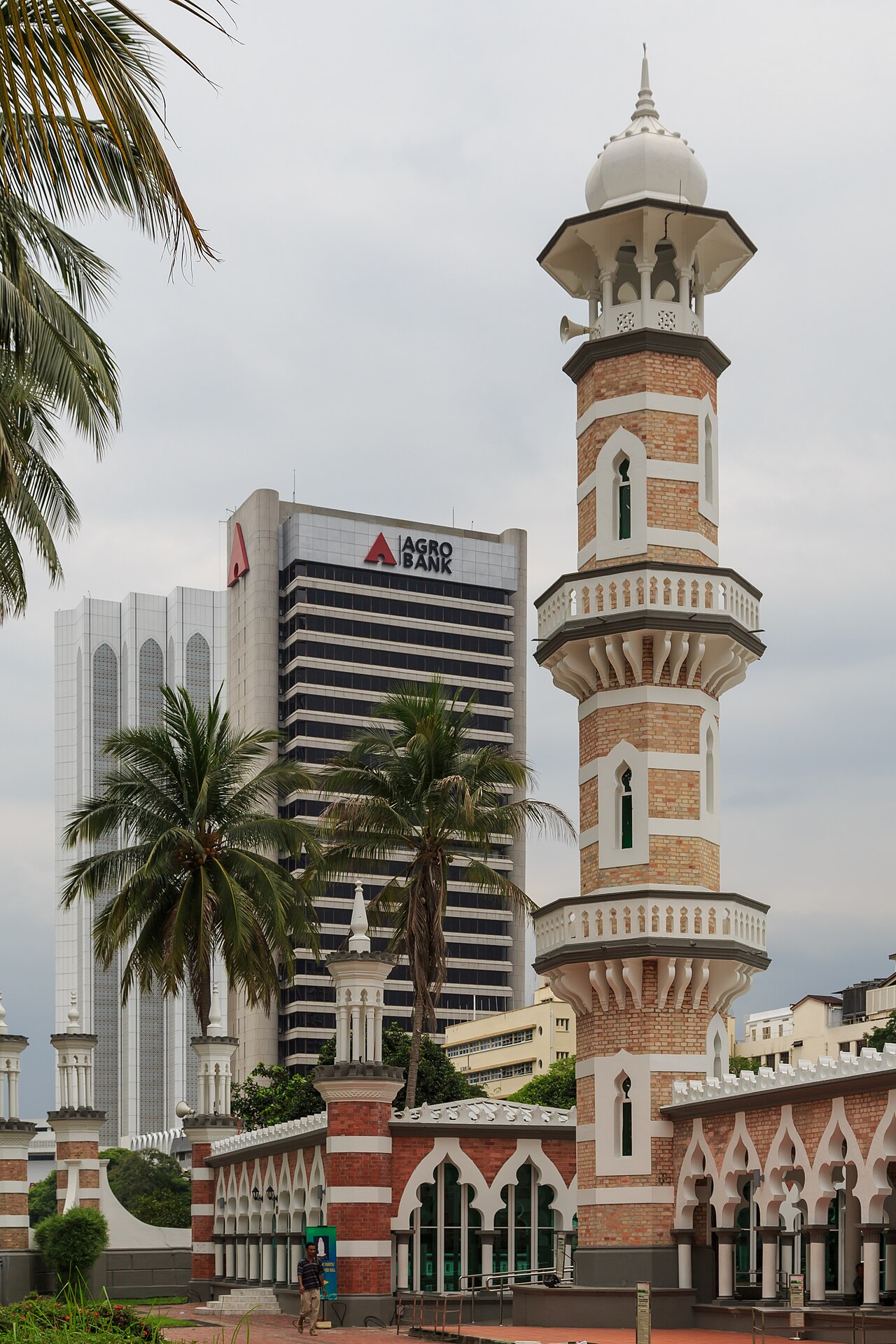
1909 · Arthur Benison Hubback
Two minarets banded in alternating pink and white brick and plaster, a pattern once nicknamed 'blood and bandage', rise beside three domes at a riverbank site where two waterways meet, the largest dome reaching 21.3 metres.
Jamek Mosque was designed by British architect Arthur Benison Hubback and completed in 1909 on the site of an old Malay burial ground at the meeting point of the Klang and Gombak rivers, replacing two smaller mosques that had served the area. Built in an Indo-Saracenic style loosely drawing on Mughal architecture, it was Kuala Lumpur's principal mosque until Masjid Negara opened in 1965. Its name comes from the Arabic jāmiʿ, meaning a congregational place of worship. One dome collapsed during heavy rain in 1993 and has since been repaired.
- The pink-and-white banding on its minarets, made of brick and plaster, earned it the nickname 'blood and bandage'.
- The mosque was renamed in 2017 in honour of Sultan Abdul Samad, the fourth Sultan of Selangor, on whose land it was originally built.
- Its architect, Arthur Benison Hubback, also designed Kuala Lumpur's railway station and the Ubudiah Mosque in Kuala Kangsar.
Photo: CEphoto, Uwe Aranas (CC BY-SA 3.0)
Sri MahaMariamman Temple
The oldest Hindu temple in Kuala Lumpur, founded in 1873 at the edge of Chinatown. A new structure built in 1968 added the ornate 'Raja Gopuram' tower in the South Indian style, and the temple is now considered important cultural and national heritage.
Merdeka 118
A 118-storey megatall skyscraper rising 678.9 metres, the second-tallest building in the world after the Burj Khalifa, completed in November 2023. Its name, meaning 'independence' in Malay, reflects its proximity to Stadium Merdeka, though much of the tower remains under construction.
Royal Selangor Club
A social club founded in 1884 by the British colonial administration, standing beside the Dataran Merdeka, or Independence Square, padang. It is accessible from Jalan Raja.
Istana Negara, Jalan Istana
The former National Palace and residence of Malaysia's king, standing on a 13-acre hillside site overlooking the Klang River. Replaced as the royal residence by a new palace in 2011, it was converted into the Royal Museum in 2013.
St. Mary's Cathedral
The cathedral of the Diocese of West Malaysia, part of the Anglican Church of the Province of South East Asia. It serves as the seat of the Anglican Bishop of West Malaysia and the mother church of the diocese.
Perdana Botanical Gardens
Kuala Lumpur's first large-scale recreational park, established in 1888 and covering 91.6 hectares at the heart of the city. Once a place of refuge from colonial-era city life, it contains large sculpted and manicured gardens.
Istana Budaya
Malaysia's main venue for theatre, known as the Palace of Culture, hosting musical theatre, operetta, classical concerts and opera from local and international performers. It stands in the heart of the city, next to the National Art Gallery.
Islamic Arts Museum Malaysia
A museum officially opened on 12 December 1998, the largest museum of Islamic arts in Southeast Asia. It holds more than seven thousand artifacts from across the Islamic world.
Central Market
A market located in the city of Kuala Lumpur.
Telekom Tower
A 55-storey, 310-metre supertall skyscraper shaped like a sprouting bamboo shoot, regarded as the world's first twisted skyscraper. Designed by Hijjas Kasturi Associates and built between 1998 and 2001, it opened in 2003 as the headquarters of Telekom Malaysia.
National Museum
A public museum of Malaysian art, culture and history, inaugurated on 31 August 1963, its façade combining traditional Malay and modern elements. The three-storey building is 109.7 metres long and rises 37.6 metres at its central point, housing four galleries of ethnology and natural history.
Stadium Merdeka
The site of the formal declaration of Malayan independence on 31 August 1957 and of the proclamation of Malaysia on 16 September 1963. Designed by American architect Stanley Jewkes, it seats 25,000 and once held the world record for the tallest prestressed floodlight towers.
National Art Gallery
A public art gallery on Jalan Tun Razak, on the northern edge of central Kuala Lumpur, next to the Istana Budaya. Designed by Dato' Ar. Mir Shariman, its galleries flank a spiral ramp that offers visitors a different view at every level.
Wat Chetawan
A Thai temple in Petaling Jaya, built in 1957 and officiated by King Bhumibol Adulyadej of Thailand. It is the only Malaysian Siamese temple entrusted with sacred Buddha relics, discovered in Piprahwa, India, in 1898 and presented to King Chulalongkorn of Siam.
Makam Pahlawan
The burial ground of several Malaysian leaders, near the national mosque, built between 1963 and 1965 alongside it. Its dome takes the form of a starburst set apart by a pond, decorated at its centre with the Emblem of Malaysia and marble flowers from Langkawi.
Sri Kandaswamy Kovil, Brickfields
A Hindu temple over a century old on Jalan Scott, Brickfields, one of the most prominent Sri Lankan Tamil temples in Malaysia. Its architecture, inspired by the Nallur Kandaswamy temple in Jaffna, follows the Saiva Agama scriptures so strictly that photography is prohibited inside.
Buddhist Maha Vihara, Brickfields
A Sri Lankan Buddhist temple in Brickfields. It is a focal point for the city's annual Wesak festival celebrations.
Stadium Negara
An indoor arena located in the city of Kuala Lumpur.
Lee Rubber Building
A historical building in the city of Kuala Lumpur, known as the Lee Rubber Building.
Bok House
An old mansion on Jalan Ampang, a block away from the Petronas Twin Towers, demolished in 2006. The compound was owned by a private trustee managed by the Bok family.
Four Seasons Place
A 74-storey, 342.5-metre supertall skyscraper in the Kuala Lumpur City Centre precinct, topped by a 21-metre steel crown. Developed by Singapore tycoon Ong Beng Seng in partnership with the Sultan of Selangor, it is currently the sixth-tallest building in Malaysia.
The Exchange 106
A 453.6-metre supertall skyscraper, formerly known as the TRX Signature Tower and now the centrepiece of the Tun Razak Exchange financial district. It was Malaysia's tallest building until surpassed by Merdeka 118 in November 2023, and remains the second-tallest in the country.
History
Kuala Lumpur developed from around 1857 as a town serving nearby tin mines, its early growth shaped by figures such as Yap Ah Loy and Frank Swettenham. It became the capital of Selangor in 1880, a role it kept until 1978, and served as the founding capital of the Federation of Malaya and then Malaysia. The colonial administration built its government offices, later renamed the Sultan Abdul Samad Building, in 1897; its railway station was rebuilt between 1910 and 1917 on the site of an earlier one, both combining Eastern and Western architectural forms. After independence, the National Mosque opened in 1965 as a modern statement in reinforced concrete. Economic growth in the late twentieth century produced the Petronas Towers and KL Tower during the 1990s. The federal executive and judiciary moved to Putrajaya in 1999.