Landmarks in Johor Bahru
A Moorish state mosque and a royal palace sit steps from the Singapore causeway.
Johor Bahru's landmarks cluster within a short stretch of the city centre and span less than a century of building. The oldest, the Istana Besar, went up in 1866 as the ruling sultan's residence. The Sultan Abu Bakar State Mosque followed between 1892 and 1900, its Moorish arches and domes marking a deliberate break from vernacular Malay building toward an imported, ceremonial idiom. The Sultan Ibrahim Building came decades later, in 1936-1940, a British-style state secretariat raised on Bukit Timbalan as colonial-era administration expanded; for decades it stood as the tallest structure in the city and in Malaya itself. Together the three trace a shift from palace and mosque to bureaucratic tower.
Sultan Abu Bakar State Mosque
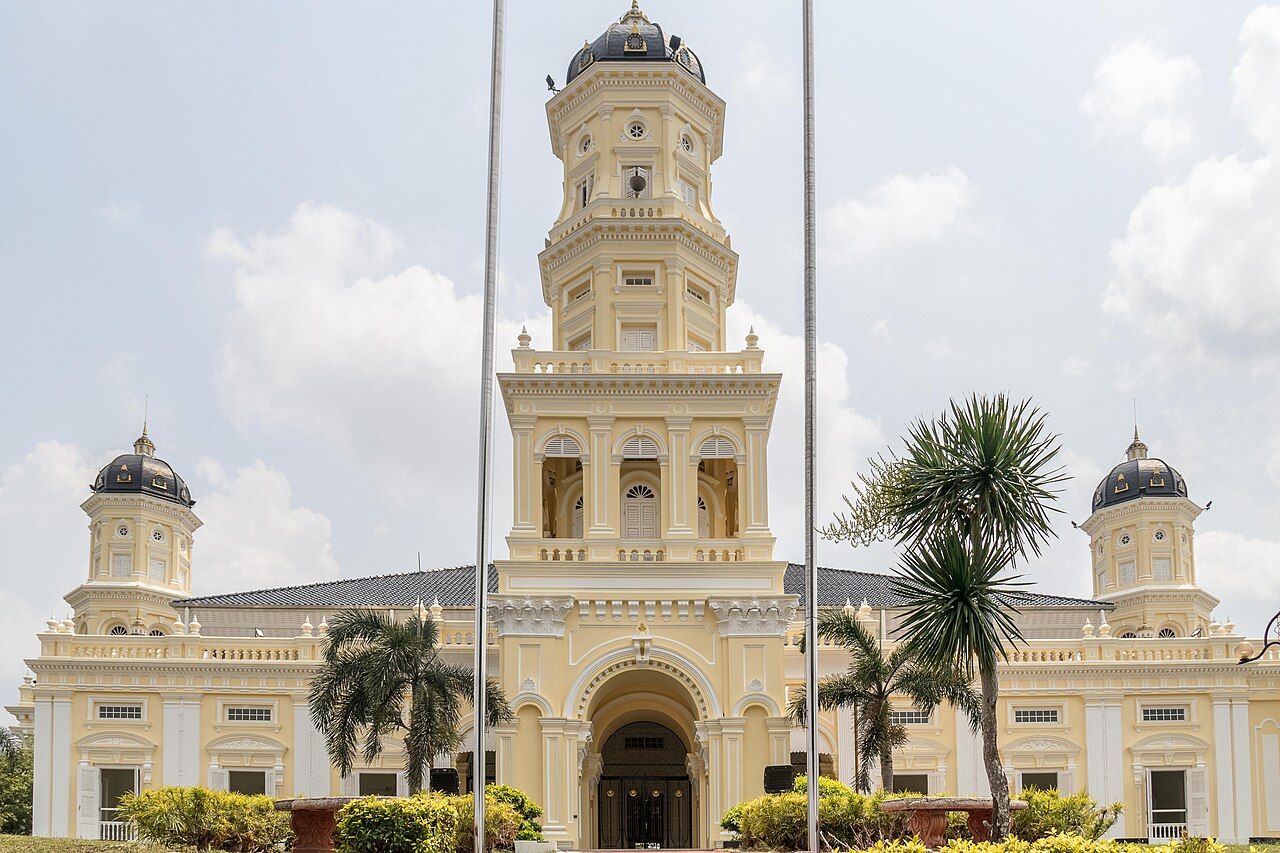
1892–1900
The mosque is built in the Moorish style along Jalan Skudai, a deliberately imported design rather than the vernacular mosque forms common in the region.
The Sultan Abu Bakar State Mosque is the state mosque of Johor, standing along Jalan Skudai in Johor Bahru. Construction ran from 1892 to 1900 under the direction of Sultan Abu Bakar, whose patronage gave the mosque its status as the sultanate's principal religious building rather than an ordinary neighbourhood mosque. It was raised in a Moorish architectural style, an imported design distinct from vernacular Malay mosque forms found elsewhere in the region. It remains in use today as the state mosque of Johor.
Photo: Graystravels (CC BY-SA 4.0)
Istana Besar
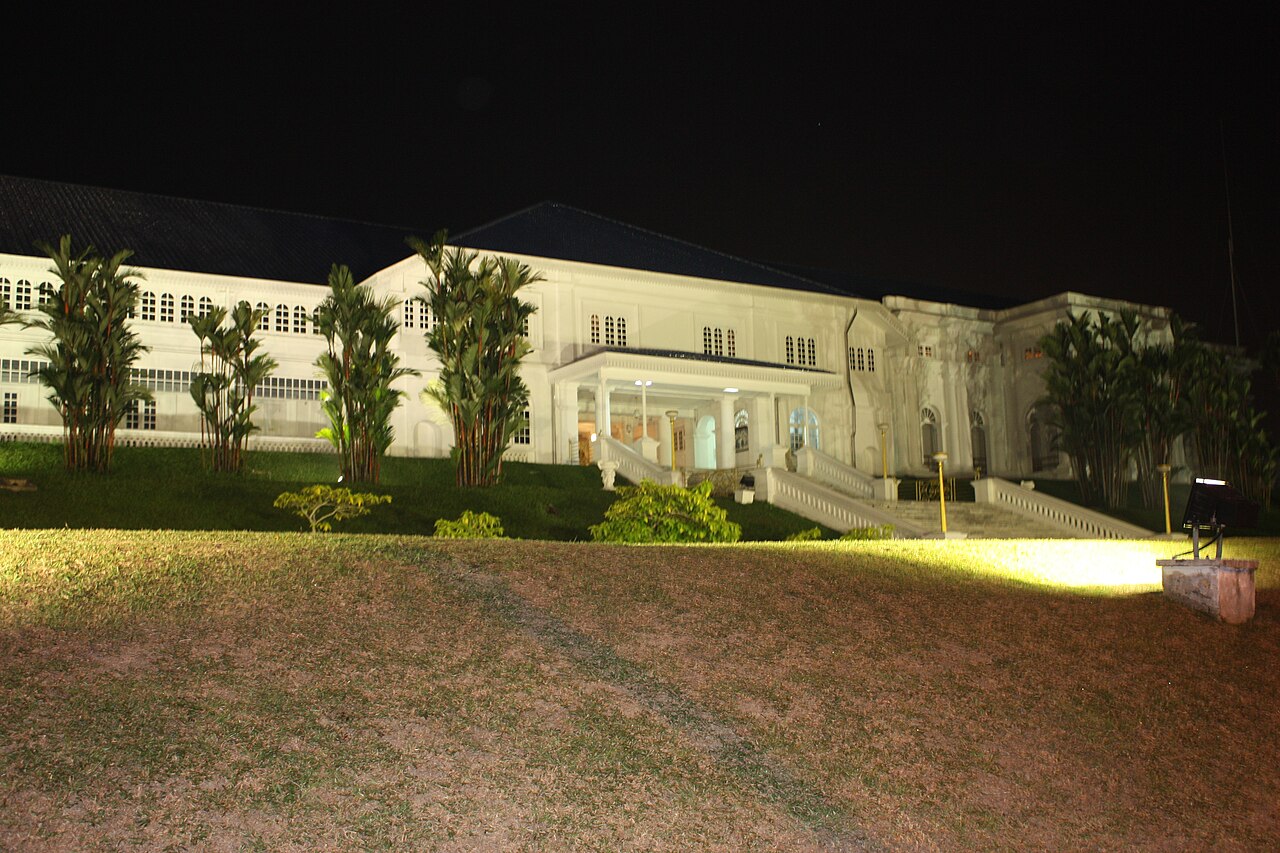
1866
Known locally as the Grand Palace, the Istana Besar has served since 1866 as the residence of the Sultan of Johor, making it one of the oldest surviving buildings in the city.
The Istana Besar, or Grand Palace, is the royal palace of the Sultan of Johor in Johor Bahru. Completed in 1866, it is among the city's oldest surviving structures and predates the modernisation that reshaped the settlement two decades later, when Sultan Abu Bakar's administration turned a fishing village into an administrative centre with new offices, schools and railway links. The palace remains associated with the ruling house of Johor and stands as a marker of the city's pre-colonial civic history.
Photo: Irwan Shah Bin Abdullah (CC BY-SA 4.0)
Sultan Ibrahim Building
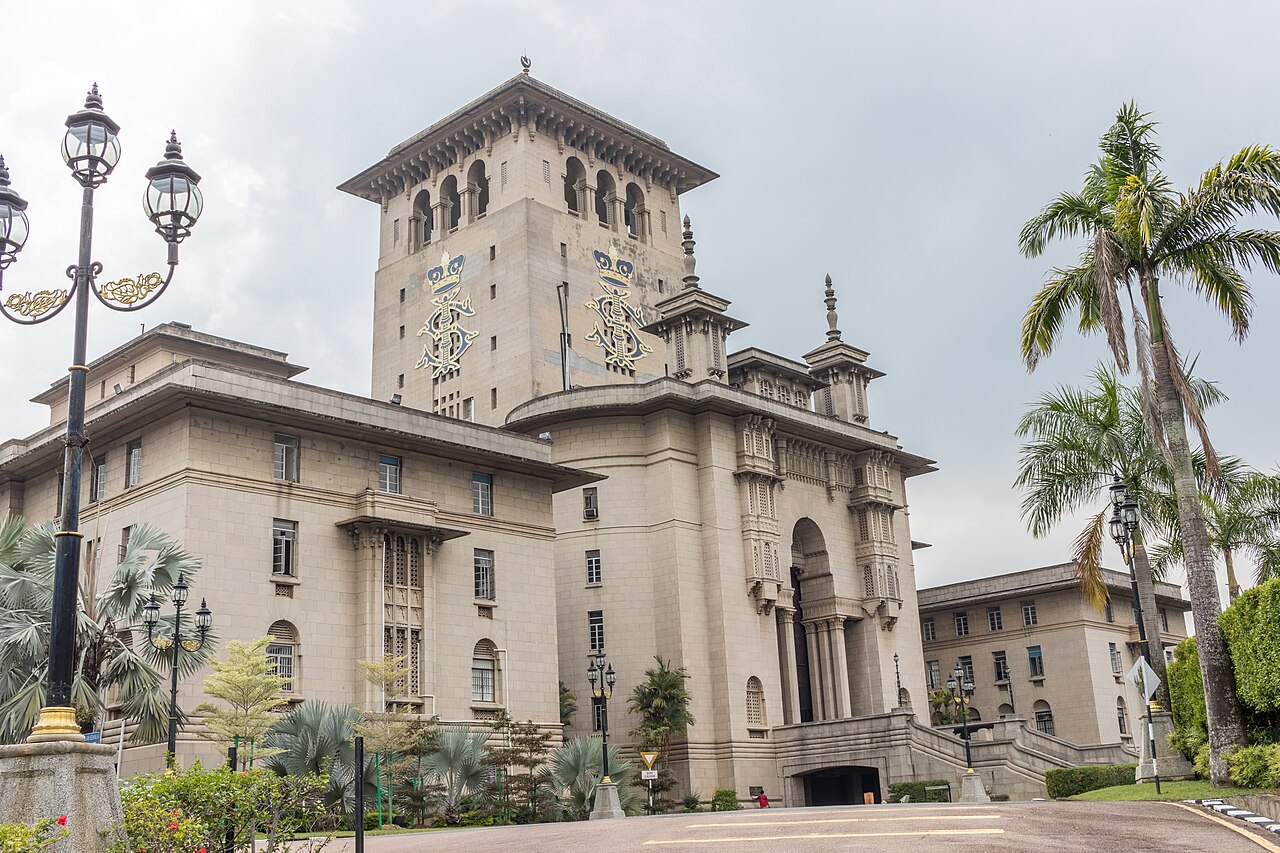
1936–1940
The Sultan Ibrahim Building stands on Bukit Timbalan in a British colonial style; it was the tallest building in Johor Bahru, and briefly in Malaya as a whole, until the Merlin Tower was completed in the 1970s.
The Sultan Ibrahim Building is a former state secretariat building of Johor at Bukit Timbalan in Johor Bahru. Built between 1936 and 1939 in a British colonial style and completed in 1940, it was opened by Sultan Ibrahim of Johor as the state government sought to streamline its administration. It was the tallest building in Malaya before independence, and remained the tallest in Johor Bahru until the Merlin Tower was completed in the 1970s. The state secretariat has since relocated to Kota Iskandar, and there are plans to convert the building into a museum.
- It was the tallest building in Malaya during the pre-independence era.
- It remained the tallest building in Johor Bahru until the Merlin Tower was completed in the 1970s.
- There are plans to convert it into a museum.
Photo: Graystravels (CC BY-SA 4.0)
Mahmoodiah Royal Mausoleum
The royal burial ground of the Johor sultanate, where Sultan Abu Bakar, the first sultan interred here, was buried in 1895. UMNO founder Dato' Onn Jaafar, who died in 1962, lies beside his father Dato' Jaafar bin Muhammad, who died in 1919.
Arulmigu Sri Rajakaliamman Glass Temple
A Hindu temple in Johor Bahru and one of the state's tourist attractions. It was listed in the Malaysian Book of Records on 12 May 2010 as the country's first and only glass temple.
Old Chinese Temple
One of the oldest structures in Johor Bahru, on Jalan Trus and flanked by modern skyscrapers. It serves as a symbol of unity among the city's seven Chinese dialect groups and was featured in a 2007 documentary episode, 'Grand March with the Deities.'
Istana Pasir Pelangi
A royal palace of the Tunku Mahkota of Johor, located in the royal town of Pasir Pelangi.
Church of the Immaculate Conception
The oldest church in Johor Bahru, built in 1927 to replace an earlier chapel. That first church, dedicated to Our Lady of Lourdes, was built in 1883 by Casimir-Jean Saleilles.
Independence Park
A green park in Johor Bahru, also known as Taman Merdeka or Merdeka Park.
City Square
The main square of Johor Bahru, completed on 1 January 1994, the day the city was declared. It features a 51-metre clock tower, a 31-metre flagpole and two giant LED screens imported from Japan.
Chinese Heritage Museum
A museum in Johor Bahru devoted to the history of the local Chinese community.
Tan Sri Dato' Haji Hassan Yunos Stadium
A multi-purpose stadium in Larkin, also known as Larkin Stadium, opened in 1964 with a capacity of 30,000. Named after former Johor Menteri Besar Tan Sri Hassan Yunus, it is used mostly for football and sits near Larkin Sentral.
Pasir Pelangi Royal Mosque
Johor's royal mosque, constructed in the 1920s in Pasir Pelangi. It bears an architectural design similar to that of the Sultan Abu Bakar State Mosque.
The Astaka
A twin-tower residential complex opened in 2018, its 278.9-metre Tower A the tallest building in Malaysia outside Kuala Lumpur and the tallest residential skyscraper in Southeast Asia. The complex holds 438 apartments, with the penthouses in both towers exclusively owned by the Sultan of Johor.
History
The Istana Besar was built in 1866 as the royal palace of the Sultan of Johor, predating the city's major growth. Modernisation followed under Sultan Abu Bakar's reign between 1886 and 1895, when Johor Bahru grew from a fishing village into an administrative centre with new offices, schools and railways. The Sultan Abu Bakar State Mosque, constructed between 1892 and 1900 under his direction, belongs to this same push, its Moorish design signalling the sultanate's new civic ambitions. Decades later, as the state administration expanded, the Sultan Ibrahim Building rose on Bukit Timbalan between 1936 and 1940 as the state secretariat, becoming the tallest building in Malaya before independence and holding that record locally until the Merlin Tower was completed in the 1970s. Johor Bahru was later occupied by Japanese forces during the Pacific War.