Landmarks in Penang
George Town's shophouse lanes hold ornate clan halls beside one indigo-blue mansion.
Penang's landmarks cluster in George Town, the state capital on Penang Island, where the Chinese trading community that grew around the free port left the densest architectural record. In the old town's narrow lanes, Hokkien clan wealth produced richly carved and gilded association halls such as Khoo Kongsi, grouped with theatres and rowhouses around granite-paved squares. A short distance away on Leith Street, a merchant's indigo-walled mansion mixes Chinese Imperial-period building with European fittings. Further out, at the hill settlement of Ayer Itam, a Buddhist temple complex grew for four decades into Malaysia's largest, its pagoda and colossal bronze Guanyin visible above the surrounding streets. Together the landmarks read as a record of nineteenth- and early twentieth-century immigrant fortunes rather than of any single ruling power.
Kek Lok Si
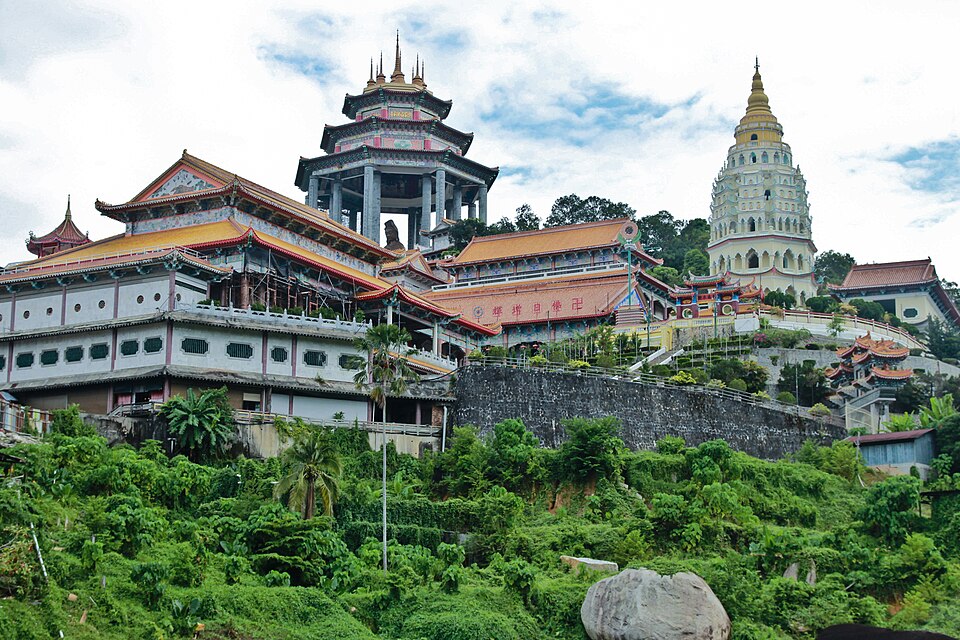
1890–1930
A seven-storey pagoda holding ten thousand alabaster and bronze Buddha statues rises in tiers above hillside terraces of shrines, beside a bronze statue of the Goddess of Mercy that stands nearly 37 metres tall.
This hillside complex is the largest Buddhist temple in Malaysia and a pilgrimage site for Buddhists travelling from Hong Kong, the Philippines, Singapore and elsewhere in Southeast Asia. Built up over four decades from 1890 under the abbot Beow Lean, it combines Mahayana and Theravada Buddhist traditions with Chinese ritual practice in both its architecture and its daily worship. Its centrepiece, a seven-storey pagoda holding ten thousand Buddha statues, was commissioned by the Thai king Rama VI and stands beside a colossal bronze statue of the Goddess of Mercy.
- The pagoda's ten thousand Buddha statues follow Chinese Mahayana tradition even though it was commissioned by Rama VI, a Theravada Buddhist king of Thailand.
- The bronze Goddess of Mercy statue beside the pagoda rises to 36.57 metres, about 120 feet.
Photo: Arne Müseler (CC BY-SA 3.0 de)
Khoo Kongsi
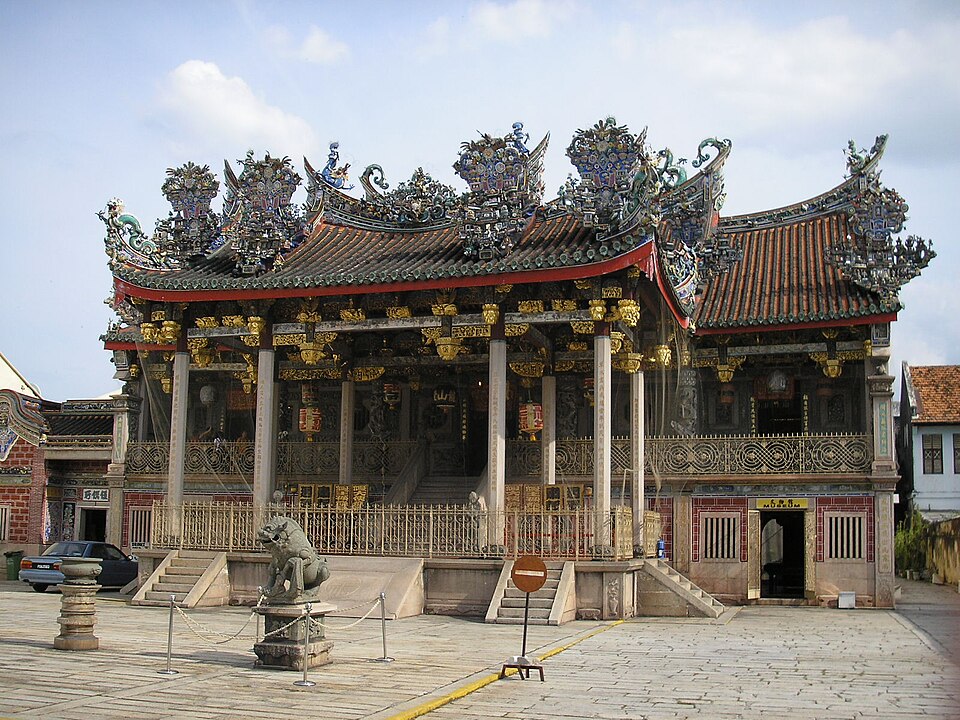
1906
Elaborate, densely ornamented architecture marks the clan hall's facade, which overlooks a granite-paved square enclosed by a traditional theatre and rows of clan housing, set amid the narrow, winding lanes of pre-war shophouses.
This is the largest Hokkien clan association hall in Malaysia and, by reputation, the grandest clan temple in the country, a mark of how dominant the Chinese community became in Penang. Built in 1906, it served as ancestral hall and communal seat for the Khoo clan. The complex keeps its historic setting intact: an association building, a traditional theatre, and late-nineteenth-century rowhouses for clan members, grouped around a granite-paved square amid the old town's narrow lanes. It is listed as a national historic building of Malaysia.
Photo: Gryffindor (Public domain)
Cheong Fatt Tze Mansion
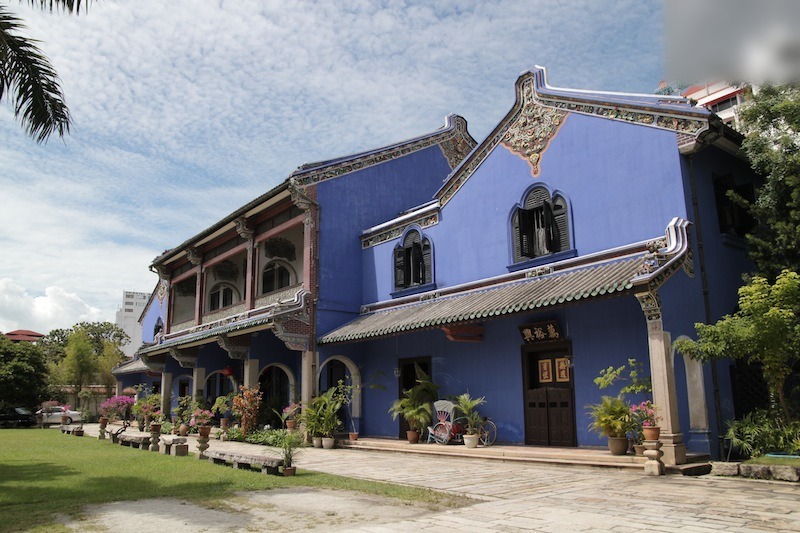
late 19th century
Indigo-blue outer walls wrap the mansion's 38 rooms and five granite-paved courtyards; louvred Gothic-style windows, cast-iron balustrades and Art Nouveau stained glass punctuate the eclectic Chinese-and-European facade.
Known as the Blue Mansion for its indigo-blue outer walls, this residence was built by the merchant Cheong Fatt Tze as both a private home and the seat of his business, finished at the end of the nineteenth century. It holds 38 rooms, five granite-paved courtyards, seven staircases and 220 timber louvre windows. The eclectic design mixes Chinese architecture of the Imperial period with European touches, including Gothic louvred windows, Stoke-on-Trent floor tiles and cast-iron work by Glasgow's MacFarlane & Co. Its layout follows Feng Shui principles, channelling rainwater from roof to courtyard.
- Its rainwater is channelled from the roof eaves down through the ceiling and walls to collect in a central courtyard, part of the mansion's Feng Shui design.
- A domestic annexe was built in front of the mansion specifically to prevent a road from forming a T-junction at its entrance, again for Feng Shui reasons.
- Its cast-iron work came from MacFarlane & Co. of Glasgow and its floor tiles from Stoke-on-Trent, both shipped from Britain to Penang.
Photo: Mahen Bala (CC BY-SA 3.0)
Balathandayuthapani Temple
A Hindu temple dedicated to Lord Murugan, topped by a seven-storey, 21.6-metre gopuram and touted as the largest Murugan temple outside India. Devotees climb 513 steps to reach it, and it serves as the focal point of Penang's Thaipusam pilgrimage from Lorong Kulit.
Wat Chayamangkalaram
A Theravada Buddhist temple opposite the Dhammikarama Burmese Temple on Lorong Burma, the oldest Siamese temple in the state. It becomes a focal point for the annual Songkran, Loy Krathong, and Vesak Day festivities in the city.
St. George's Church
A 19th-century Anglican church, the oldest purpose-built Anglican church in Southeast Asia. It was elevated to pro-cathedral status in 2023 and falls under the Upper North Archdeaconry of the Anglican Diocese of West Malaysia.
Dhammikarama Burmese Temple
A Theravada Buddhist temple opposite Wat Chayamangkalaram on Lorong Burma, the only Burmese temple in the state. It is the focal point for the annual Water, Thingyan, and Mid-Autumn festivals as well as Buddhist Lent.
Church of the Assumption
A Roman Catholic church established following the founding of George Town in 1786, the third oldest Catholic church in Malaysia. It also served as the seat of the Bishop of Penang from 1955 to 2003.
Suffolk House
Two successive residences on the same site, the earliest home to Francis Light, founder of Penang's first British settlement. After Light's death in 1794, and with Penang becoming India's fourth presidency in 1805, a newer Suffolk House replaced it, later neglected and then restored.
High Court
Founded in 1808 as the birthplace of Malaysia's judiciary, housed in a Palladian-style building on Light Street rebuilt in the 1900s. It sits atop Penang's court hierarchy and, in the 1920s, admitted the first female judge to the Straits Settlements and Federated Malay States Bars.
Town Hall
A British-built administrative building completed in the 1880s, the city's oldest municipal building, once housing the Municipal Commission of George Town. Its administrative role passed to the adjacent City Hall in 1903, and it has been a gazetted historic monument since 1993.
Peranakan Mansion
A museum dedicated to Penang's Peranakan heritage, housed in a distinctive green-hued mansion on Church Street once owned by 19th-century Chinese tycoon Chung Keng Quee. It holds thousands of Peranakan artifacts and has appeared in television shows including The Little Nyonya and The Amazing Race.
Nagore Durgha Sheriff
A Sufi dargah complex combining a shrine and mausoleum, completed in the early 19th century at the junction of Chulia Street and King Street.
Floating Mosque
A mosque within the city of George Town, also known as the Tanjong Bungah Floating Mosque.
State Mosque
The state's Sunni mosque, located at Jalan Masjid Negeri, also known as Green Lane, in George Town.
Hill Railway
A funicular railway up Penang Hill, originally opened in 1923 as a two-section line and rebuilt as a single-track railway in 2010. It climbs from Ayer Itam through a tunnel once the steepest in the world, with journeys taking five to twenty minutes.
Eng Chuan Tong Tan Kongsi
A Hokkien clan house on Beach Street, founded in the early 19th century by a Tan family from Zhangzhou, China. Originally named Tan Seng Ong Kongsi and claimed as Penang's oldest clan house, it is devoted to worship of the deity Kai Zhang Sheng Wang.
Lebuh Aceh Mosque
A mosque built in 1808 by the Acehnese on land donated by Tengku Syed Hussain Al-Aidid, who had opened a Muslim settlement in the area in 1792. The settlement grew into a center of Islamic studies drawing traders from the Malay archipelago, Arabia, and India.
Thean Kong Thnuah Temple
A Taoist temple at Ayer Itam completed in 1869, the only temple in Malaysia built for the worship of the Jade Emperor. It is the focal point of the annual Jade Emperor's Birthday celebrations and was featured in an episode of The Amazing Race 16.
MV Pulau Pinang
A retired Pinang-class RORO ferry, the last double-decker passenger-vehicle vessel to serve the Penang ferry route. It is now permanently moored at Tanjong City Marina as a museum ship, housing the Penang Ferry Museum.
Old Protestant Cemetery
A disused Protestant cemetery established in 1786 along Northam Road, now a Class 1 Heritage Site maintained by the Penang Heritage Trust. It predates cemeteries such as Père Lachaise in Paris and Highgate in London, and is 35 years older than Macau's Old Protestant Cemetery.
Sun Yat-sen Museum
A museum dedicated to Sun Yat-sen, formerly known as the Sun Yat-sen Penang Base. It commemorates the Chinese nationalist who founded the Republic of China after the Xinhai Revolution.
Mahindarama Buddhist Temple
A Theravada Buddhist temple, the only Sri Lankan temple in the state and one of the few in Malaysia housing relics of the Buddha. It becomes the focal point of the city's annual Vesak Day festivities.
Loke Villa
A historical beach villa, also known as Loke Mansion, on Gurney Drive next to Gurney Paragon.
Wesley Methodist Church
A Methodist church built in 1912 at the junction of Burmah Road and Larut Road.
Statue of Francis Light
A memorial statue to Captain Francis Light (1740–1794), who founded the British colony of Penang in 1786. It stands in the grounds of Fort Cornwallis.
Fort Cornwallis chapel
A Christian chapel inside Fort Cornwallis.
History
Francis Light established the Port of Penang as a free port in 1786, founding George Town alongside it and drawing merchants and labourers from southern China among others. That immigrant community built the landmarks that still define the old town: clan associations raised ornate ancestral halls such as Khoo Kongsi, and successful traders built private residences like the Cheong Fatt Tze mansion, an eclectic showpiece of Chinese and European craftsmanship finished around the turn of the twentieth century. From 1890 the Kek Lok Si temple complex rose over four decades at Ayer Itam, funded as a pilgrimage centre rather than a private venture. Penang later became part of the Straits Settlements under British rule, was occupied by Japan during the Second World War, and returned to British administration in 1945 before joining the Federation of Malaya at independence in 1957.