Landmarks in Gibraltar
A fortified town packed onto a narrow ledge below a 426-metre limestone mountain.
Gibraltar's landmarks sit within an area of only 6.8 square kilometres, so almost nothing here is far from anything else. The Moorish Castle, built during Marinid rule and dating in part to 1333, occupies a position described as visible from most of the town below it, thanks to its height rather than any ornament. At Europa Point, on the southern tip of the territory, a nineteenth-century lighthouse and a mosque completed in 1997 stand within sight of one another; the mosque faces south across the strait toward Morocco, several kilometres away. Above and behind all of it rises the Rock itself, a 426-metre limestone mass riddled with man-made tunnels, with a densely populated town clustered at its foot.
Rock of Gibraltar
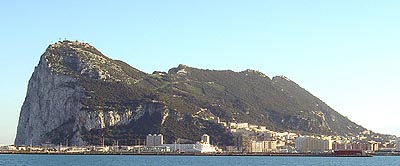
A single sheer mass of pale limestone over 400 metres high with a near-vertical face, visibly pocked with tunnel entrances, and home to around 300 Barbary macaques on its upper slopes.
This is a monolithic limestone mountain 426 metres high, standing at a narrow promontory where a sea meets an ocean. The Romans knew it as Mons Calpe and, according to ancient legend, it was one of two Pillars of Hercules said to mark the edge of the known world. Long used as a fortress, it holds a labyrinthine network of man-made tunnels. Most of its upper area is a nature reserve, home to roughly 300 Barbary macaques, and it remains a major tourist attraction.
- Ancient Greek and Phoenician legend held it to be one of two Pillars of Hercules marking the western limit of the known world.
- The Romans named it Mons Calpe.
Photo: Gibnews.net (Public domain)
Moorish Castle
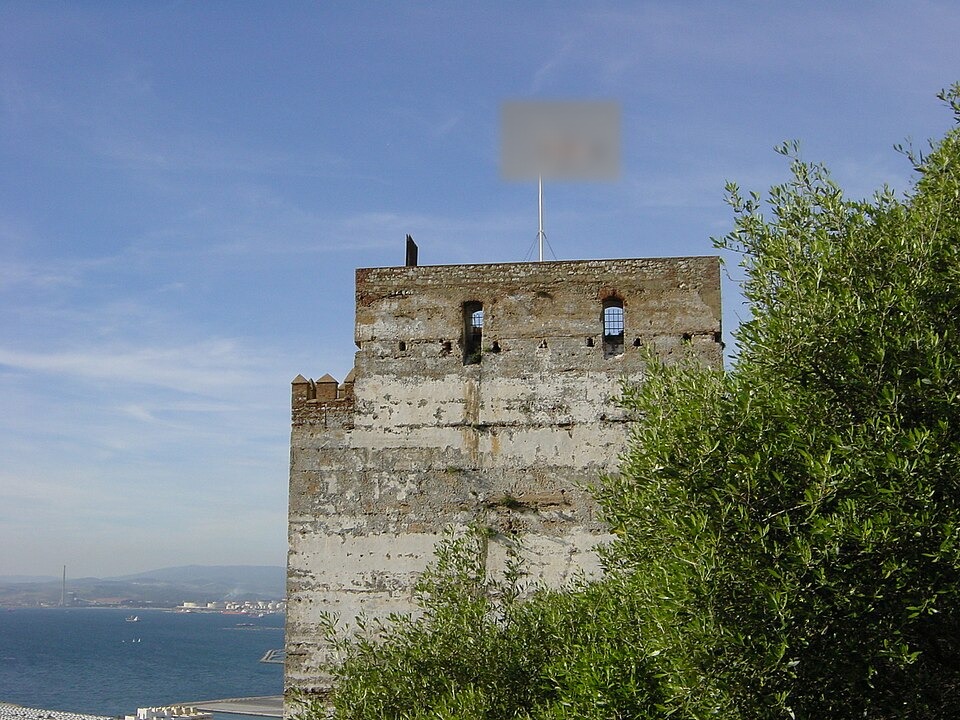
1333
A rectangular, crenellated tower of homage standing above a gatehouse and a run of defensive walls that follow the slope of the hill beneath it, imposing chiefly through height and position rather than ornament.
Dating in part to 1333, this medieval fortification comprises several buildings, gates and fortified walls, its most prominent features being the Tower of Homage and the Gate House. It was built under Marinid rule, which makes it unusual among castles of the Iberian Peninsula. Part of the complex was used as the territory's prison until as late as 2010. Its height and strategic position have long made the tower visible to anyone approaching by sea.
- It was built by the Marinid dynasty, making it unique among castles of the Iberian Peninsula.
- Part of the castle served as a prison until 2010.
Photo: Allie_Caulfield from Germany (CC BY 2.0)
Europa Point Lighthouse
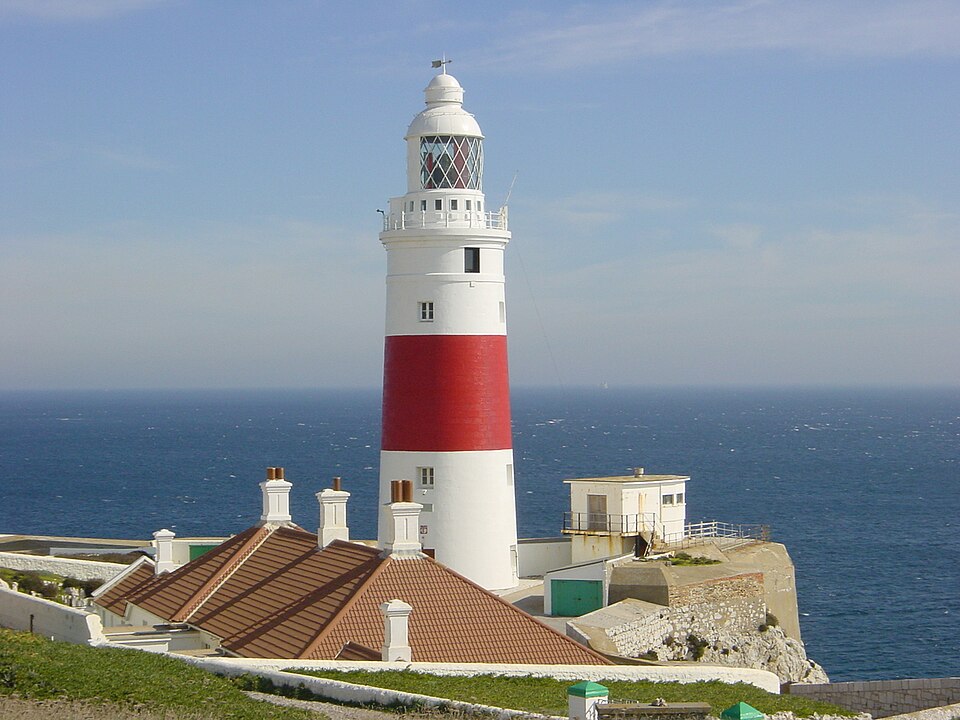
1838
A round, white-painted tower crossed by a broad red band around its middle; only about 20 metres tall itself, but standing on a point high enough to put its light some 49 metres above the sea.
First lit on 1 August 1841 in a ceremony watched by about 10,000 people, this lighthouse marks a headland at the entrance to the Mediterranean Sea. Its original single-wick lamp was replaced by a Chance Brothers four-wick burner in 1864, with further changes in 1875 and 1894, and a three-mantle burner added in 1905. It was fully automated in 1994 and converted to LED operation in 2016. It is operated by Trinity House.
- Its opening in 1841 was watched by around 10,000 people.
- It is also known locally as La Farola.
Photo: Allie Caulfield (CC BY 2.0)
Ibrahim-al-Ibrahim Mosque
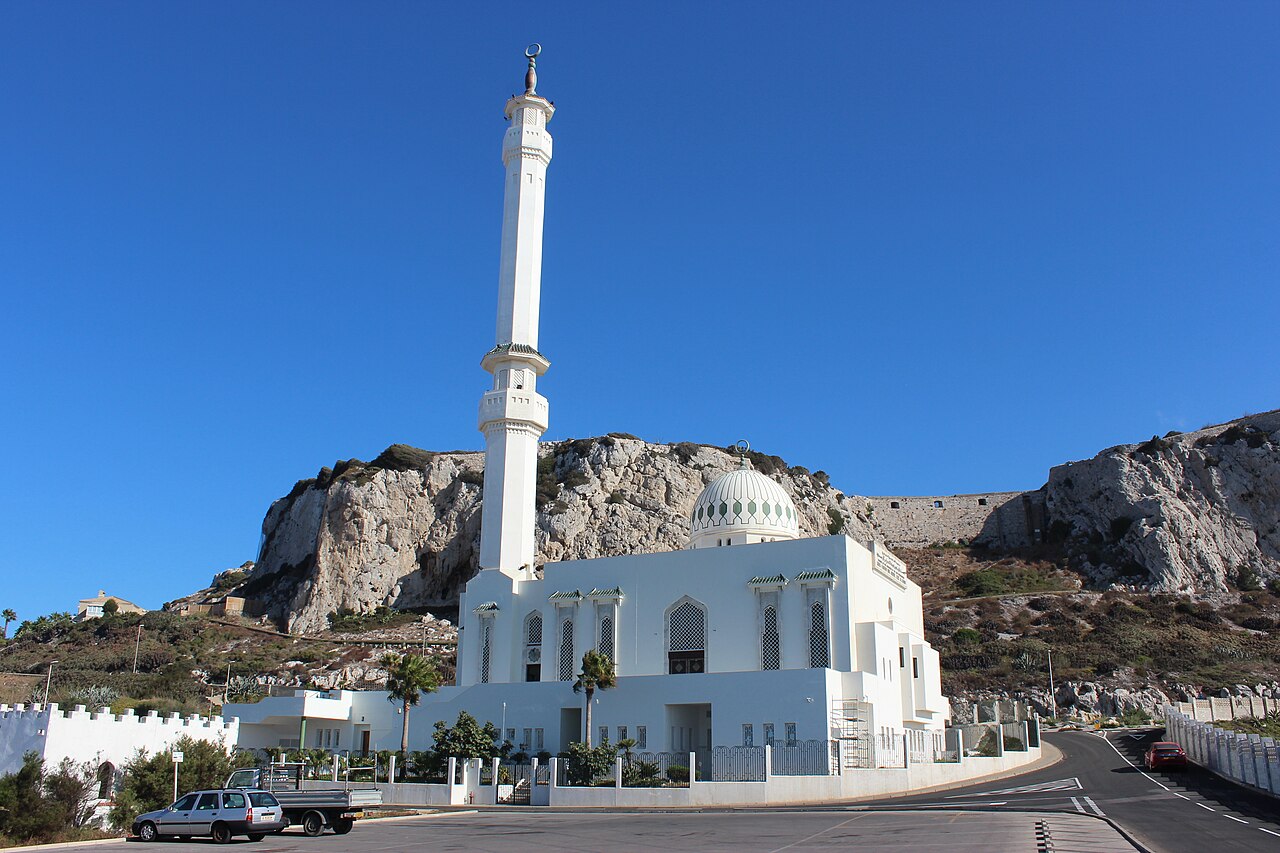
1997
A mosque in Islamic architectural style standing on an open, exposed headland beside a lighthouse, its form and ornament unlike anything else built along this stretch of coast.
Completed in 1997 in a recognisably Islamic architectural style, this mosque stands at Europa Point on Gibraltar's coast, facing south across open water toward the Strait of Gibraltar and Morocco, several kilometres away. It is also known by two longer names, the King Fahd bin Abdulaziz Al Saud Mosque and the Mosque of the Custodian of the Two Holy Mosques, in addition to its usual name.
- It is also known as the King Fahd bin Abdulaziz Al Saud Mosque, or the Mosque of the Custodian of the Two Holy Mosques.
- It faces south across the strait toward Morocco, only a few kilometres away.
Photo: Atiemann at English Wikipedia (Public domain)
St. Michael's Cave
A network of limestone caves in the Upper Rock Nature Reserve, more than 300 meters above sea level. The most visited of over 150 caves found inside the Rock of Gibraltar, it draws almost 1,000,000 visitors a year.
Great Siege Tunnels
A series of tunnels inside the northern end of the Rock of Gibraltar, also known as the Upper Galleries. British forces dug them from solid limestone during the Great Siege of Gibraltar in the late 18th century.
Grand Casemates Square
The larger of Gibraltar's two main squares, named after the Grand Casemates barracks completed at its northern end in 1817. Lined with pubs, bars and restaurants at the north end of Main Street, it serves as the gateway into the city centre for most tourists.
Gibraltar Cable Car
An aerial tramway with its base station near the southern end of Main Street, next to Alameda Gardens. As of November 2025 it was closed for a major reconstruction expected to last two years.
Gibraltar National Museum
A museum of Gibraltar's history, culture and natural history in the city centre, founded in 1930 by Governor Sir Alexander Godley. It incorporates the remains of a 14th-century Moorish bathhouse and has been directed since 1991 by Prof. Clive Finlayson.
Cathedral of the Holy Trinity
The Anglican cathedral for the Church of England's Diocese of Europe, in Cathedral Square, sometimes called simply Gibraltar Cathedral. It is known for its Moorish revival architecture, particularly its horseshoe arches, reflecting the period of Moorish control in Gibraltar.
King's Bastion
A coastal bastion on Gibraltar's western fortifications, overlooking the Bay of Gibraltar between Line Wall Road and Queensway. It defended the Rock during the Great Siege of Gibraltar, later became an electricity generating station, and today serves as the territory's leisure centre.
John Mackintosh Square
Gibraltar's main square, colloquially known as The Piazza and the centre of city life since the 14th century. Named after local philanthropist John Mackintosh, it is home to the Parliament Building and the City Hall.
The Convent
The official residence of the Governor of Gibraltar since 1728, built in 1531 as a Franciscan convent and heavily rebuilt during the 18th and 19th centuries. Its dining room holds the most extensive display of heraldry in the Commonwealth of Nations.
The Rock Hotel
A historic hotel built in 1932 by John Crichton-Stuart, 4th Marquess of Bute, set in a 3.6-hectare landscaped garden with 104 rooms. Housed in a white Art Deco building on Europa Road, it overlooks the Gibraltar Botanic Gardens.
Shrine of Our Lady of Europe
A Roman Catholic parish church and national shrine at Europa Point, dedicated to Our Lady of Europe, the Catholic patroness of Gibraltar. It belongs to the European Marian Network, which links twenty Marian sanctuaries across the continent.
Europa Point
The southernmost point of Gibraltar, marking the boundary between the Strait of Gibraltar and the Mediterranean's Alboran Sea. On clear days it offers views across to North Africa, including Ceuta and Morocco's Rif Mountains, as well as the Bay of Gibraltar.
Gibraltar Botanic Gardens
A botanical garden also known as La Alameda Gardens, covering around 6 hectares. The Rock Hotel stands above the park.
Trafalgar Cemetery
A cemetery on a former defensive ditch just south of Gibraltar's city walls, once called the Southport Ditch Cemetery. Though named for the 1805 Battle of Trafalgar, only two of its burials are from that battle, and it was restored in the 1980s.
Main Guard
An 18th-century guardhouse of unknown exact construction date, the oldest building on John Mackintosh Square. Having served over the centuries as a fire station, bath house and government offices, it now houses the Gibraltar Heritage Trust and the tourist information office.
Great Synagogue
An Orthodox Jewish synagogue completed in the 1720s, the oldest in continuous use in Gibraltar and its principal synagogue. It was the first synagogue on the Iberian Peninsula to operate after the Jewish expulsions from Spain and Portugal in 1492 and 1497.
Gibraltar Parliament
The legislature of the British overseas territory of Gibraltar. It was known as the Gibraltar House of Assembly between 1969 and 2006.
History
The town began as a watchtower raised by the Almohads in 1160 and was fought over by Nasrid, Castilian and Marinid rulers for the next two centuries; the Moorish Castle's tower dates from this period and was built under Marinid rule, unusual for a fortification on the Iberian Peninsula. Castile regained control in 1462, then lost it for good in 1704, when Anglo-Dutch forces seized the town during the War of the Spanish Succession; the Treaty of Utrecht ceded it to Britain in perpetuity in 1713. Its role as a Royal Navy base guarding the strait, especially during the Napoleonic Wars and the Second World War, left a legacy of maritime infrastructure, from the lighthouse raised at Europa Point in the 1840s to the mosque completed there in 1997.