Landmarks in Lisbon
Riverside limestone monuments trace Lisbon's rebuild after the 1755 earthquake.
Lisbon's oldest monuments mark different phases of the city's growth rather than sitting together. Its cathedral, the oldest church in the city, has stood near the centre since 1147 and now mixes Romanesque, Gothic, Baroque and Mannerist stonework from centuries of earthquake repairs. A few kilometres downstream, in the riverside parish of Belém, a fortified tower and a former monastery were built in the early sixteenth century from local limestone in the ornate Manueline style, paid for partly by the era's maritime trade. Between the two, the Baixa district was rebuilt in stone after the 1755 earthquake, and its triumphal arch was not finished until 1875. A modern double-decked suspension bridge, opened in 1966, carries road and rail traffic across the Tagus to the far bank.
Belém Tower
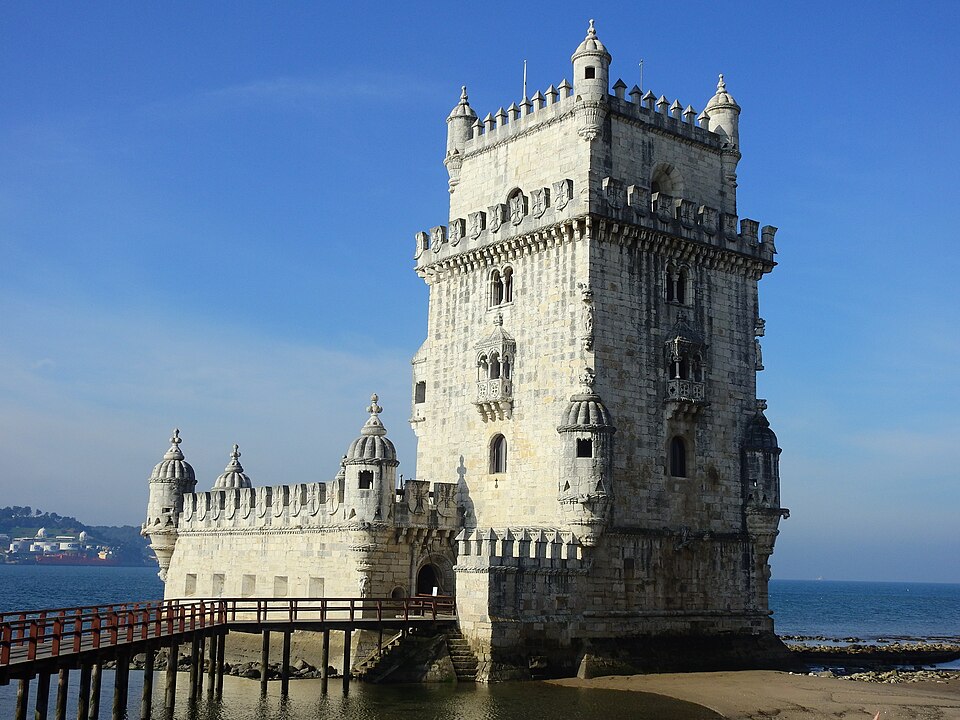
1519 · Francisco de Arruda
Its outline combines castle-style battlements with small domed corner turrets styled after minarets, all carved from pale local limestone; the four-storey tower and its projecting bastion rise directly from shallow water at the river's edge, a little apart from the main shore.
Built as a fortification on a small island near the mouth of the Tagus, the tower served both as a defensive point guarding the harbour and as a ceremonial gateway for explorers setting out and returning. Carved from pale local limestone, it combines a four-storey tower with a projecting bastion, its corner turrets showing Moorish influence. It is often said to have stood mid-river, left onshore only when the 1755 earthquake diverted the water — in fact it was built close to the shore from the start. It has been a UNESCO World Heritage Site since 1983.
- Its official name is the Tower of Saint Vincent, though it is universally known by the name of the parish where it stands.
- A long-repeated claim that the 1755 earthquake left the tower onshore by diverting the river is false; it was built beside the shore from the start.
Photo: Rehman Abubakr (CC BY-SA 4.0)
Jerónimos Monastery
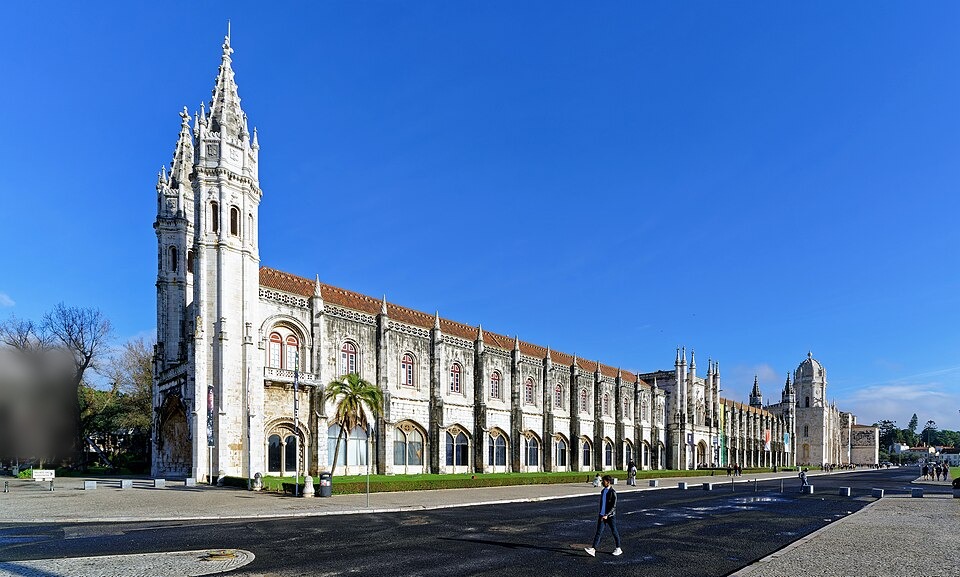
1502 · Diogo de Boitaca
The long church and adjoining cloister are covered in the intricate carved stonework of the Manueline style; inside, the carved tombs of Vasco da Gama and the poet Luís de Camões stand in the nave, close to those of two Portuguese kings, near the Tagus riverbank.
Formerly a monastery of the Order of Saint Jerome, the building became the necropolis of the Aviz royal dynasty before being secularised in 1833 and handed to the charity Real Casa Pia de Lisboa. Erected in the early 1500s near the point from which Vasco da Gama set out on his first voyage, construction was paid for by a tax on the profits of the annual India Armadas. Diego de Torralva and the sculptor Nicolau Chanterene both worked on later phases. In 1880, da Gama's remains and those of the poet Luís de Camões were moved into carved tombs in the nave.
- Construction was paid for by a tax on the profits of Portugal's annual India trading fleets.
- The remains of Vasco da Gama and the poet Luís de Camões were not moved into the nave's tombs until 1880, centuries after the building went up.
Photo: Holger Uwe Schmitt (CC BY-SA 4.0)
Rua Augusta Arch
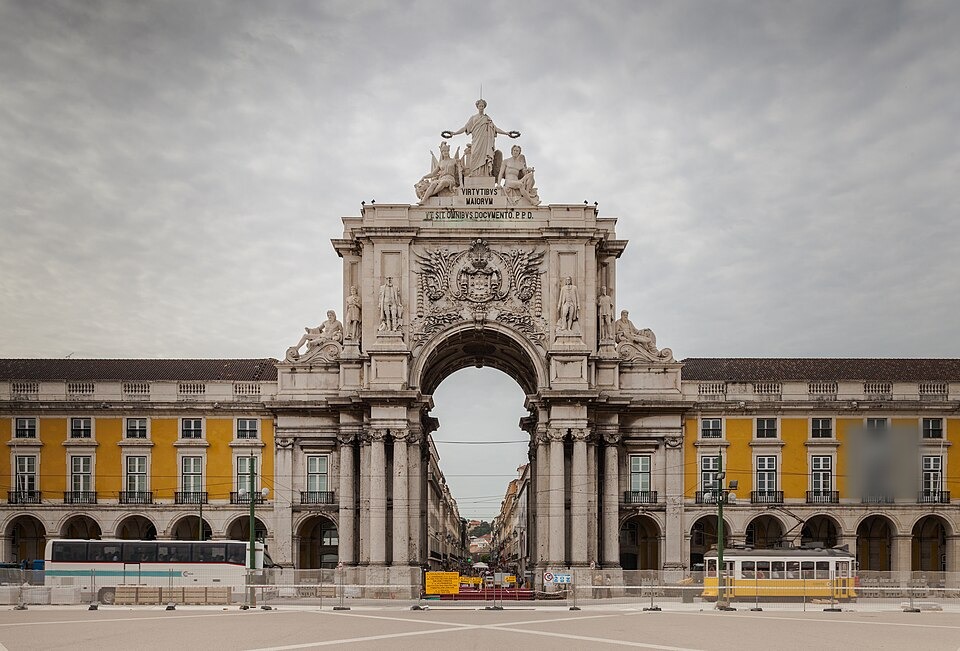
1875
Six columns, some 11 metres tall, support an arch whose unusually tall crown above the cornice gives it a heavy, monumental look; the entablature carries the coat of arms of Portugal, and sculpted figures representing Glory crowning Valour and Genius stand at the very top.
This stone arch on the Praça do Comércio commemorates Lisbon's rebuilding after the 1755 earthquake. It has six columns, some 11 metres high, and a notably tall section between the arch's crown and its cornice, which gives the structure a heavy appearance. The space beneath the top is filled with the coat of arms of Portugal, and the allegorical group above it — figures representing Glory crowning Valour and Genius — was made by the French sculptor Célestin Anatole Calmels. It was originally planned as a bell tower and only became an arch after more than a century.
- It was originally designed as a bell tower and only became an arch more than a hundred years later.
- The sculpture group at the top was made by a French sculptor, Célestin Anatole Calmels, not a Portuguese one.
Photo: Diego Delso (CC BY-SA 3.0)
Lisbon Cathedral
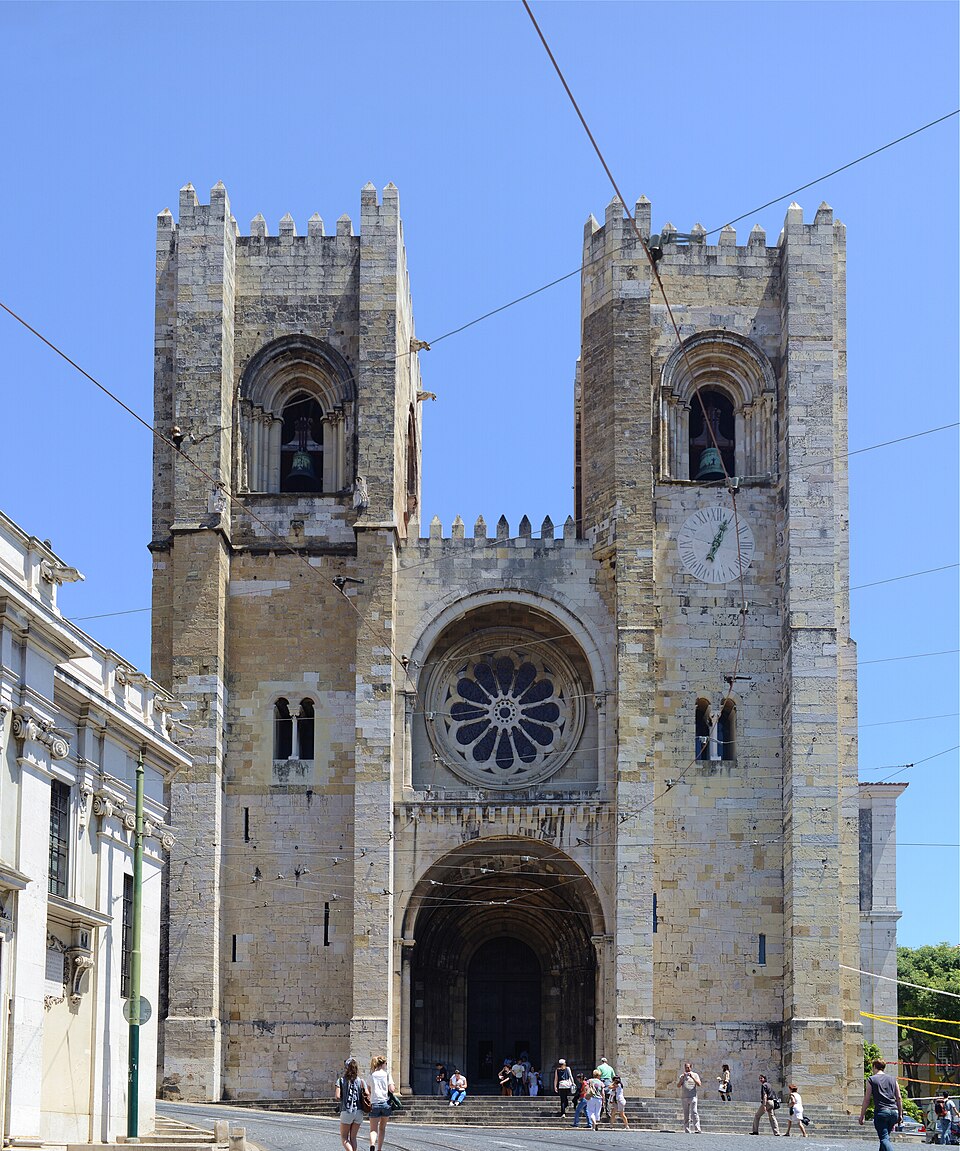
1147
The fabric visibly combines Romanesque, Gothic, Baroque and Mannerist stonework accumulated through repeated repairs after the city's earthquakes, giving the building a patched, mixed-period appearance rather than one unified style.
Built in 1147, this is the oldest church in Lisbon. It has survived numerous earthquakes over the centuries and been modified, renovated and restored so many times that its fabric now mixes Romanesque, Gothic, Baroque and Mannerist work. Officially the Cathedral of Saint Mary Major, it is generally known simply as the Sé. It serves as the seat of the Patriarchate of Lisbon and was classified as a National Monument in 1910.
- Despite its formal name, the Cathedral of Saint Mary Major, it is almost always called simply the Sé.
- It was not classified as a National Monument until 1910, centuries after it was built.
Photo: Alvesgaspar (CC BY-SA 3.0)
25 de Abril Bridge
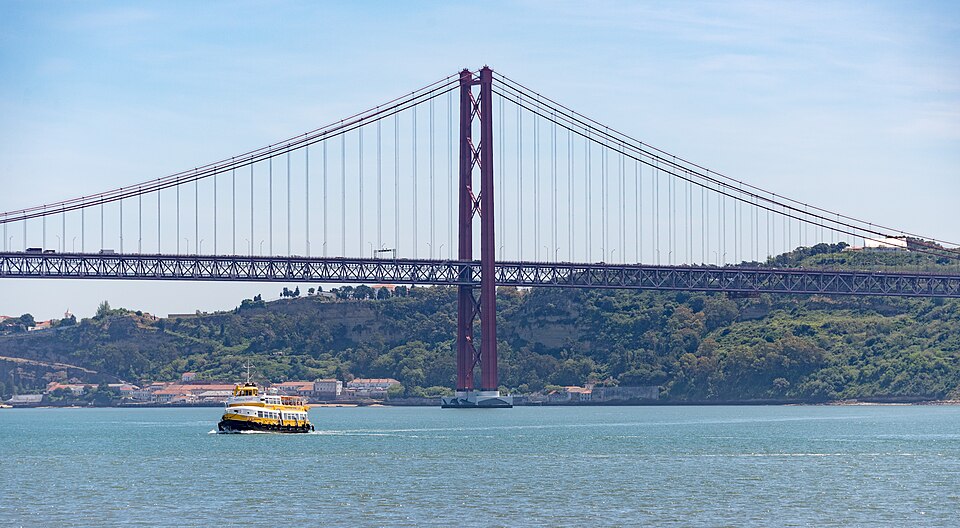
1966
The crossing's two-tier structure is its clearest identifying feature: six lanes of road traffic run on the upper deck while a double-track electrified railway occupies a distinct lower deck, the whole suspended across a main span of just over a kilometre.
This suspension bridge crosses the Tagus to link Lisbon with Almada on the river's south bank. Its main span of 1,013 metres made it the 48th longest suspension bridge in the world. At its 1966 opening it was named Salazar Bridge, after the dictator who ordered its construction; it was renamed after the 1974 Carnation Revolution for the date of that uprising. A fifth road lane was added in the 1990s, and in 1999 a long-planned lower deck carrying a double-track railway was finally completed.
- It opened as Salazar Bridge, named for the dictator behind its construction, and was renamed only after the 1974 Carnation Revolution.
- Although planned from the beginning, the lower railway deck was not actually built until 1999, more than three decades after the bridge opened.
Photo: xiquinhosilva from Cacau (CC BY 2.0)
Palace of Queluz
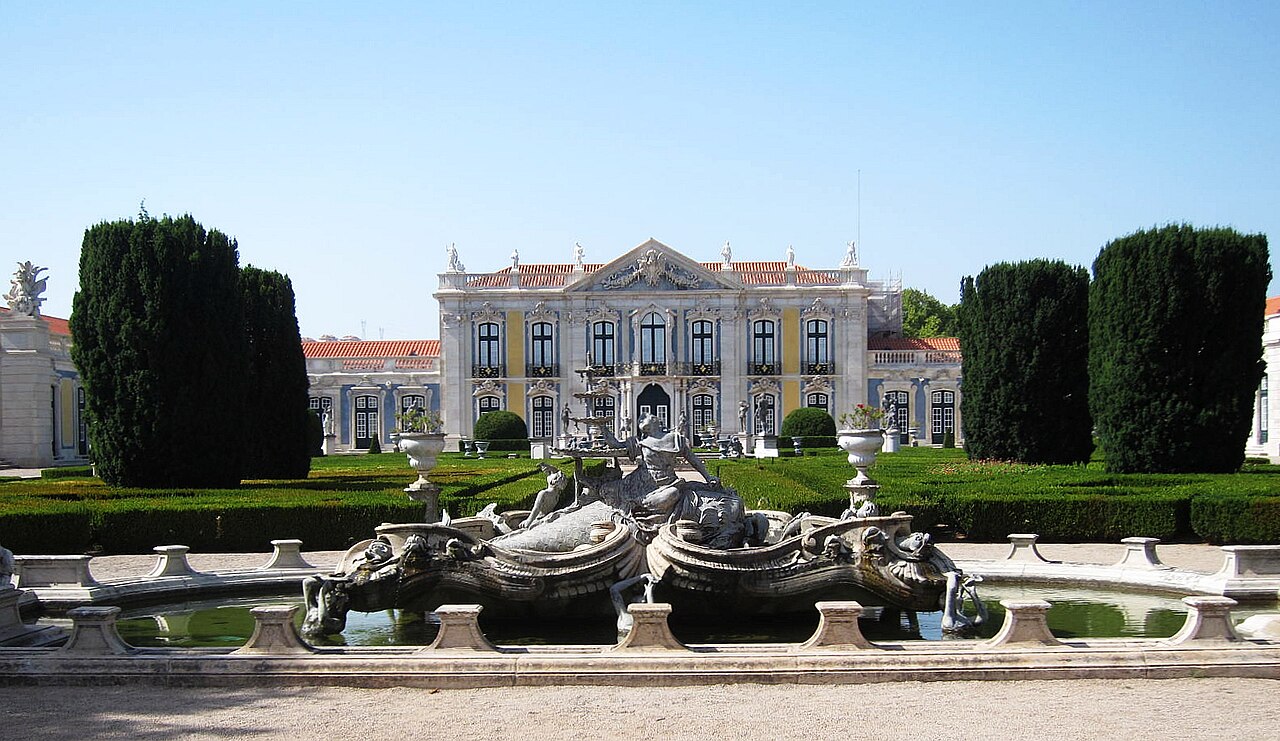
1747 · Mateus Vicente de Oliveira
Two low, symmetrical quadrant wings sweep forward from a small central block to form a semicircular forecourt; pale rendering and carved cartouches decorate the windows, an onion-domed chapel closes one end of the crescent, and a raised terrace called the Hanging Garden fills a courtyard on the building's western side.
Commissioned in 1747 as a country retreat for a Portuguese prince, the palace was designed by Mateus Vicente de Oliveira in the Rococo style, with gardens and interiors added later by Jean-Baptiste Robillon. Work paused after the 1755 earthquake, and the resulting redesign favoured long, low wings over a single tall block. The building briefly served as the Portuguese royal family's official residence after fire destroyed the Palace of Ajuda in 1794. It became state property in 1908, was heavily damaged by a 1934 fire, and reopened after restoration as a museum.
- Despite comparisons to Versailles, the palace has been described as looking more like "a very expensive birthday cake" than a monument to royal power.
- Its design was altered after the 1755 earthquake interrupted construction, favouring low, long wings that proved more earthquake-resistant than a single tall block.
- One wing housed Queen Maria I during the severe mental illness that struck her after her husband's death in 1786, serving as her discreet place of confinement.
Photo: Bosc d'Anjou from Portugal (CC BY 2.0)
Santa Justa Lift
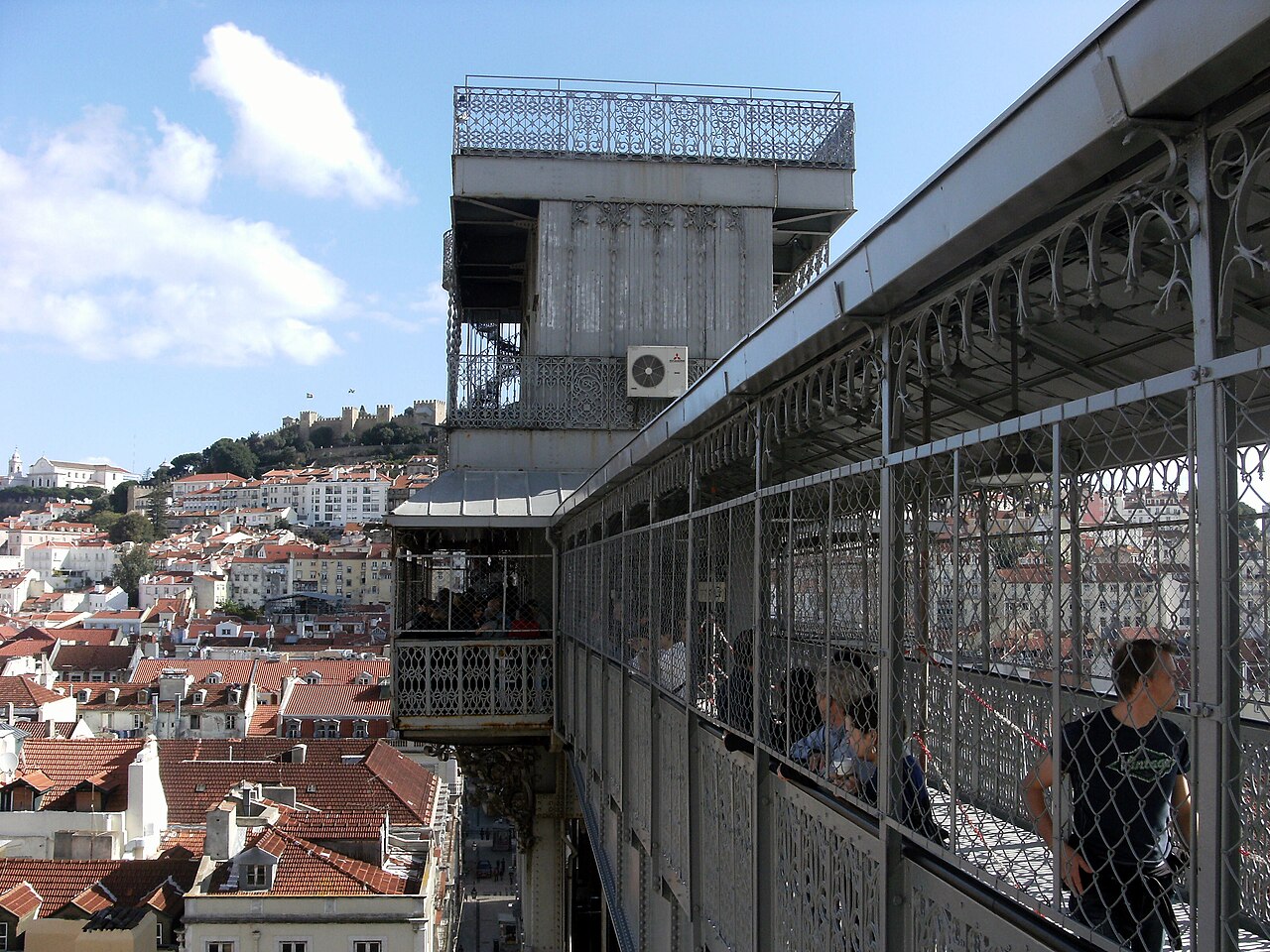
1901
A slender openwork iron tower rises about 45 metres beside a narrow street, topped by a small lookout platform; twin wood-panelled cabins trimmed with mirrors and windows travel inside the lattice-braced shaft, and an elevated walkway links the upper exit to a square on the hillside above.
Engineer Raoul Mesnier du Ponsard secured the concession to build this elevator in 1899 after two decades of competing proposals for linking Lisbon's lower Baixa streets with the hillside square above. Opened in 1901 and originally steam-powered, it was converted to electric operation in 1907. Its two wood-panelled cabins each carried up to 24 passengers, later increased to 29. Ownership passed through several companies before the lift joined the city's tram network in 1973; it was classified a National Monument in 2002 and reopened to the public after renovation in 2006.
- It is also called the Carmo Lift, after the company originally formed to build it, the Empresa do Elevador do Carmo.
- Originally powered by steam, it was converted to electrical operation in 1907, six years after opening.
- It celebrated its centenary in 2002, the same year it and Lisbon's three surviving funicular lifts were all classified as National Monuments.
Photo: Mark Ahsmann (CC BY-SA 3.0)
Ascensor da Bica
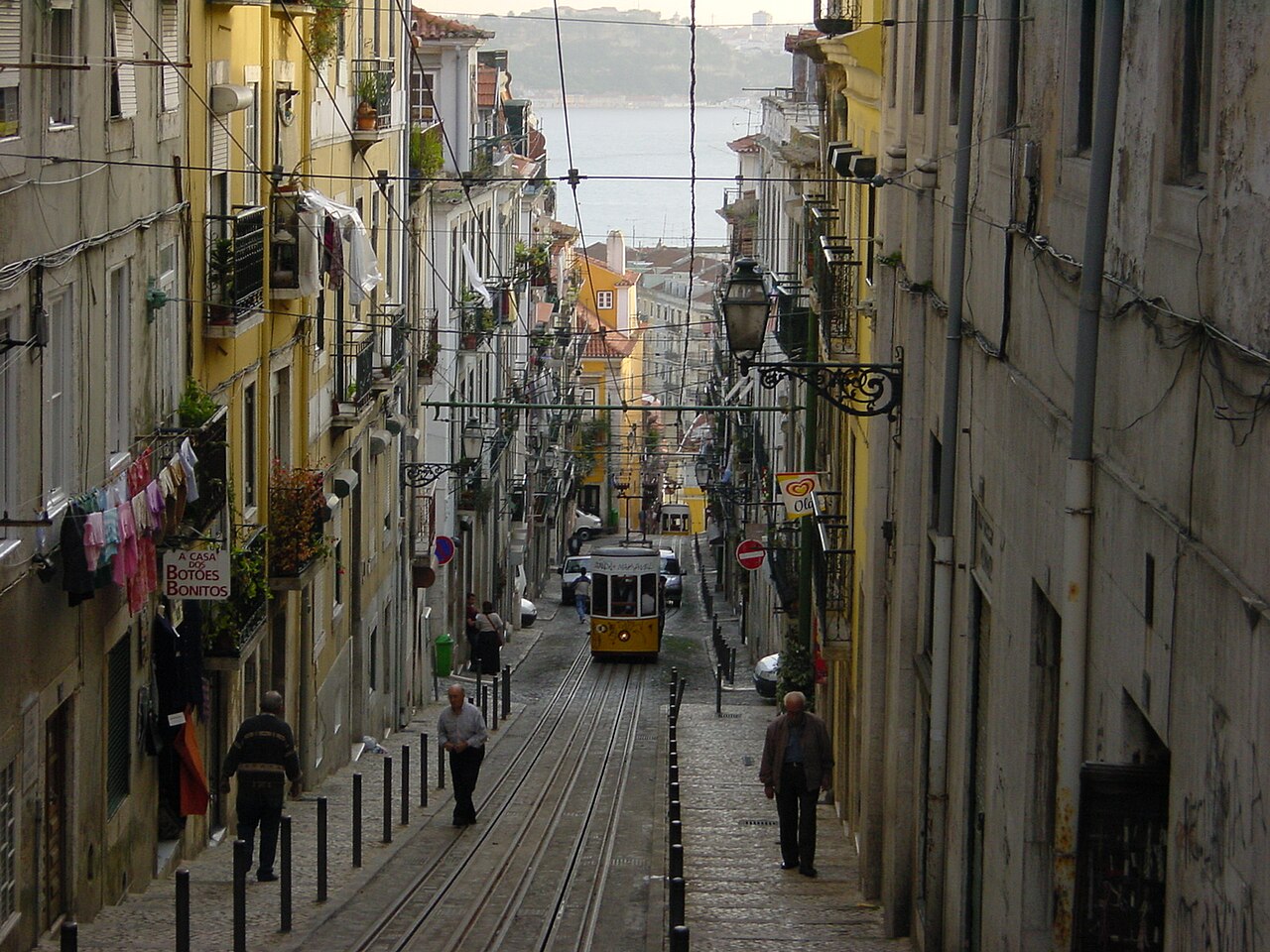
1892 · Raoul Mesnier du Ponsard
Two wood-panelled tramcars with several arched doorways along each side and transverse wooden seating travel a short, steep track between older rental buildings on a narrow street; the lower entrance sits behind a plain stone facade with a wrought-iron gate and small arched portico.
Carris operates this funicular line linking a steep street with a square above, its two wooden cars joined by a cable looped over a pulley at the summit so that each descending car counterbalances the one climbing. Engineer Raoul Mesnier du Ponsard conceived the project in 1888; track work finished in 1890 and the line opened in 1892, initially steam-powered. Automation tests in the mid-1910s ended when one car ran uncontrolled into its lower station, destroying it and halting service for years; new cars and electric power returned the funicular to operation in 1927. It has run almost continuously since.
- The 1912 contract that funded the line's electrification also covered every other funicular the same company operated in the city, part of a wider modernisation rather than a project for this line alone.
- Formal heritage protection took until 2011: a 2005 proposal needed ministerial approval in 2009 and a further two years before the protection order was ratified.
- The track climbs an 11.8 percent grade over a run of just 245 metres, one of the steeper short inclines of its kind in the city.
Photo: Allie_Caulfield (CC BY 2.0)
Monument of the Discoveries
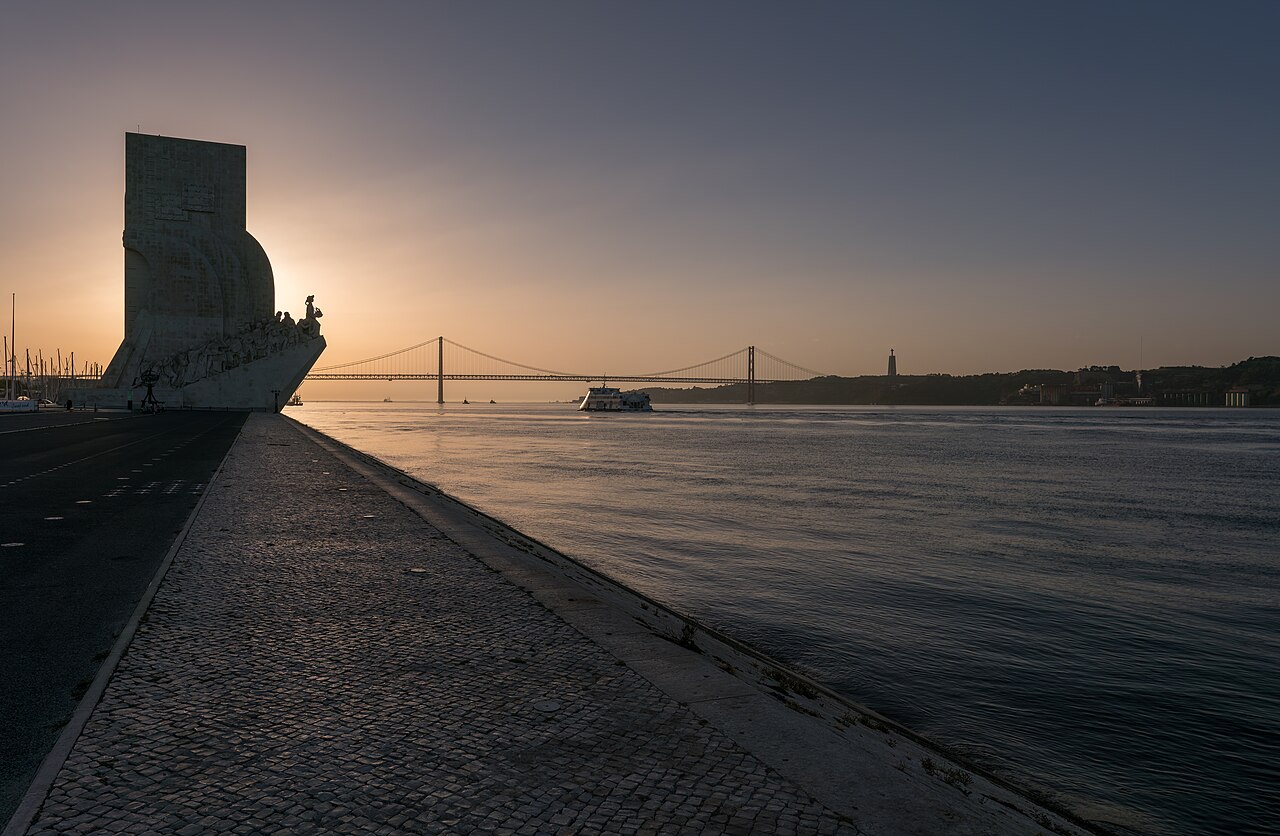
1958–1960 · António Pardal Monteiro
A tall vertical slab shaped like the bow of a caravel rises beside two ramps that meet at the waterline, with 33 limestone figures carved along the ramps and a larger figure at the very prow holding a model ship; the paved square in front holds a large compass-rose mosaic worked in different coloured stones.
This monument stands on the north bank of a river estuary near where ships once departed for India and the Orient, marking the Portuguese Age of Discovery of the 15th and 16th centuries. Architect José Ângelo Cottinelli Telmo designed an earlier version, a temporary structure built for a 1940 exhibition and demolished by 1943. The permanent monument, credited primarily to António Pardal Monteiro after Telmo's death, was built between 1958 and 1960 to mark the fifth centenary of Henry the Navigator's death; sculptor Leopoldo de Almeida modelled its 33 limestone figures. A cultural centre opened inside it in 1985.
- The 1940 original was a temporary structure of plaster and tow built for a national exhibition and torn down three years later; nothing of it survives in the monument seen today.
- South Africa's government paid for the paved square in front of the monument, including a 50-metre compass-rose mosaic and a 14-metre map showing historic sailing routes.
- The monument's interior sat empty for 25 years after its 1960 completion; a cultural centre with an auditorium and exhibition halls was not fitted out inside it until 1985.
Photo: Jules Verne Times Two (CC BY-SA 4.0)
São Jorge Castle
A castle on a hill occupied since the 8th century BC, held by Phoenicians, Carthaginians, Romans and Moors before Portugal's 1147 conquest of Lisbon. Since the 12th century it has served as royal palace and military barracks, now standing as a national monument and museum.
Belém Palace
The official residence of the President of Portugal, officially the National Palace of Belém, its main façade facing Afonso de Albuquerque Square and the Tagus River. A former royal residence, the complex includes buildings, wings, courtyards and gardens built between the 18th and 21st centuries.
Estádio da Luz
A multi-purpose stadium, home ground of Sport Lisboa e Benfica, opened on 25 October 2003 to replace the original Estádio da Luz. Designed by HOK Sport Venue Event at a cost of €160 million, it seats 68,100 and hosted matches during UEFA Euro 2004.
Calouste Gulbenkian Museum
A museum housing one of the world's leading private art collections, spanning Ancient Egypt to the early 20th century across the Islamic World, China, Japan and French decorative arts. Founded by oil magnate Calouste Gulbenkian, it closed for renovation and reopened on 18 July 2026.
Ascensor da Glória
A hybrid funicular-tram line connecting Restauradores Square with the Bairro Alto, one of three such funiculars in Lisbon. It opened in 1885, went electric in 1915, was declared a National Monument in 2002, and was suspended after a 2025 derailment killed 16 people.
Águas Livres Aqueduct
A historic aqueduct commissioned by King John V in the early 18th century, among the most remarkable examples of Portuguese engineering. Its main line runs about 14.2 kilometres, part of a network reaching nearly 58 kilometres, and it survived the 1755 earthquake unscathed.
Carmo Convent
A former Catholic convent ruined during the 1755 Lisbon earthquake, its destroyed Gothic church, the Igreja do Carmo, standing on the convent's southern facade. It remains the main trace of the great earthquake still visible in the old city.
Casa dos Bicos
A historical house built in the early 16th century in the Alfama neighbourhood, its façade covered in diamond-pointed stones influenced by Italian Renaissance palaces and Portuguese Manueline styles. It survived the 1755 earthquake and, after a 20th-century renovation, became headquarters of the José Saramago Foundation.
São Bento Palace
The seat of Portugal's Assembly of the Republic since 1834, in the Estrela district, originally a Benedictine monastery begun in 1598, nearly complete when the 1755 earthquake struck. Monasteries were dissolved in 1834, and the building became parliament's meeting place under the new constitutional monarchy.
Estrela Basilica
A minor basilica and former Carmelite convent, ordered built by Queen Maria I of Portugal to fulfil a vow and considered the most important architectural undertaking of her reign. It was the first church in the world dedicated to the Sacred Heart of Jesus.
Tejo Power Station
A thermoelectric power plant in the Belém district that supplied the city and wider Lisbon region from 1909 to 1972, though it operated only as a reserve station after 1951. It now houses the Museu da Electricidade.
Igreja de São Roque
A Catholic church that was the earliest Jesuit church in the Portuguese world, built in the 16th century as the first 'auditorium-church' designed for preaching. One of the few Lisbon buildings to survive the 1755 earthquake unscathed, it passed to the Holy House of Mercy.
Church of Nossa Senhora da Conceição Velha
A church in the Madalena parish, formerly known as Conceição dos Freires or Conceição Velha and also called the Church of the Misericórdia. Left partially ruined and excluded from Lisbon's post-earthquake rebuilding plans, it was rebuilt from 1770 by Pombaline architect Francisco António Ferreira.
National Coach Museum
First established in 1905 as the Royal Coaches Museum, it houses about 9,000 objects including coaches and carriages from the 16th to 19th centuries. The collection spans two buildings: the 1787 Royal Riding School of the Belém Palace and a modern 2015 building nearby.
National Museum of Ancient Art
Founded in 1884 to display collections of the Portuguese royal family and the National Academy of Fine Arts, in the Palácio Alvor-Pombal, once home to the Marquis of Pombal. Its 40,000-item collection spans a millennium of art, including works by Bosch, Raphael and Dürer.
Synagogue
A Jewish congregation and synagogue on Rua Alexandre Herculano, formally named Synagogue Shaaré Tikvah, meaning 'Gates of Hope'. Completed in 1904, it blends the Romanesque Revival and Byzantine Revival styles.
Avenida da Liberdade
A boulevard in central Lisbon, built between 1879 and 1886 and designed by engineer Frederico Ressano Garcia after Paris's Champs-Élysées. It replaced the Passeio Público, an 18th-century park reserved for nobility until King John VI opened it to all classes in 1821.
Camões Monument
A monument in Luís de Camões Square in the Chiado neighbourhood, its bronze statue of the national poet surrounded by eight smaller statues of Portuguese cultural figures. Sculpted by Victor Bastos, it was unveiled in 1867 before King Luís I and his father, Ferdinand II.
Teatro Nacional de São Carlos
An opera house in the historical centre of Lisbon's Chiado district, opened on 30 June 1793 by Queen Maria I to replace the Tejo Opera House, destroyed in the 1755 earthquake. It seats 844 people.
History
Long before it was Portugal's capital, the site was settled by pre-Celtic tribes and, by tradition, founded by Phoenician traders. Julius Caesar made it a Roman municipium, adding the name Felicitas Julia to the older Olisipo. Germanic tribes, chiefly the Visigoths, held the city after Rome's fall, until Moorish forces took it in the eighth century. Afonso Henriques conquered it in 1147 — the same year its cathedral went up — and in 1255 it replaced Coimbra as capital. Maritime trade profits later helped pay for the Jerónimos Monastery at Belém, built in the early 1500s partly through a tax on the annual India Armadas; the tower raised nearby in 1519 became another symbol of the same ventures. The 1755 earthquake then destroyed much of the centre; the triumphal arch, finished in 1875, and a bridge added in 1966 both belong to what followed.