Landmarks in Madrid
A fortress outpost grew into a court capital of baroque palaces and neoclassical gates.
Madrid's landmarks cluster in a short stretch of the old centre near the Manzanares River, which marks the city's western edge. The Royal Palace and the Almudena Cathedral face each other across a shared square, both raised in pale stone for the court and the church rather than for trade or defence. A few streets east, the Puerta de Alcalá marks where the old city walls once stood, and the Prado sits in the boulevard laid out soon after for the royal art collection. Styles run in sequence more than they mix: baroque grandeur from the Bourbon court, neoclassical restraint from the 1770s and 1800s, then heavier, eclectic civic architecture from the early twentieth century, visible in the white-fronted former post office that now serves as city hall.
Royal Palace of Madrid
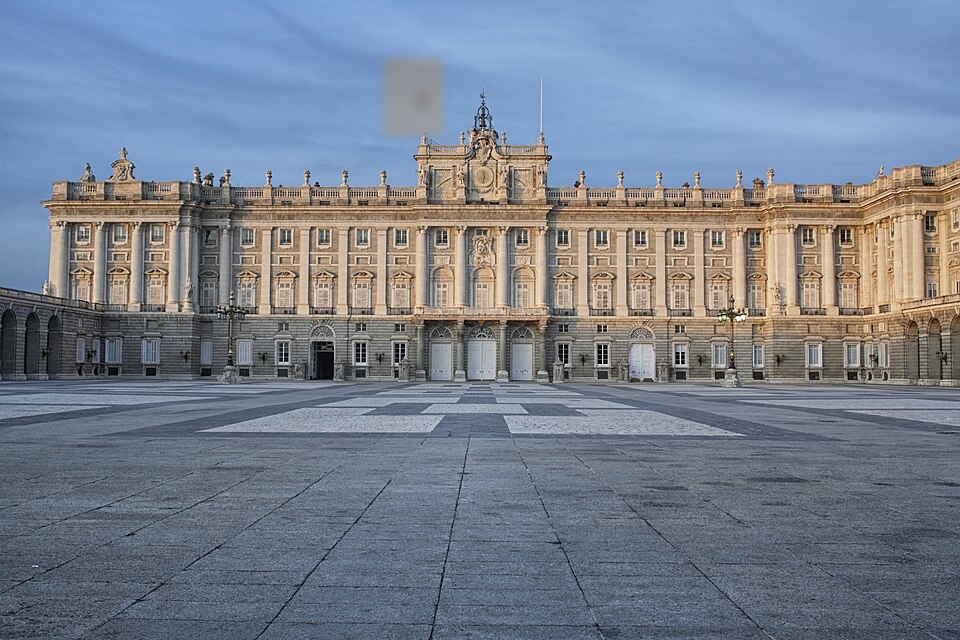
1738–1755 · Filippo Juvarra
A vast rectangular block of pale grey and white stone with a long, uniform facade and a roofline lined with statues, standing over its own paved square rather than crowded by neighbouring streets.
It replaced a medieval fortress that had guarded the site since the 9th century and served as a royal residence before burning down on Christmas Eve of 1734. A new, much larger palace was built from scratch between 1738 and 1755, its design credited to Filippo Juvarra, with Juan Bautista Sachetti and Francesco Sabatini also credited on the building after Juvarra's death in 1736. It now serves mainly for state ceremonies, though it remains the official residence of the Spanish royal family.
- With 3,418 rooms it is counted as the largest palace in Western Europe.
- During the Second Spanish Republic it was known instead as the Palacio Nacional.
Photo: Javier Perez Montes (CC BY-SA 4.0)
Puerta de Alcalá
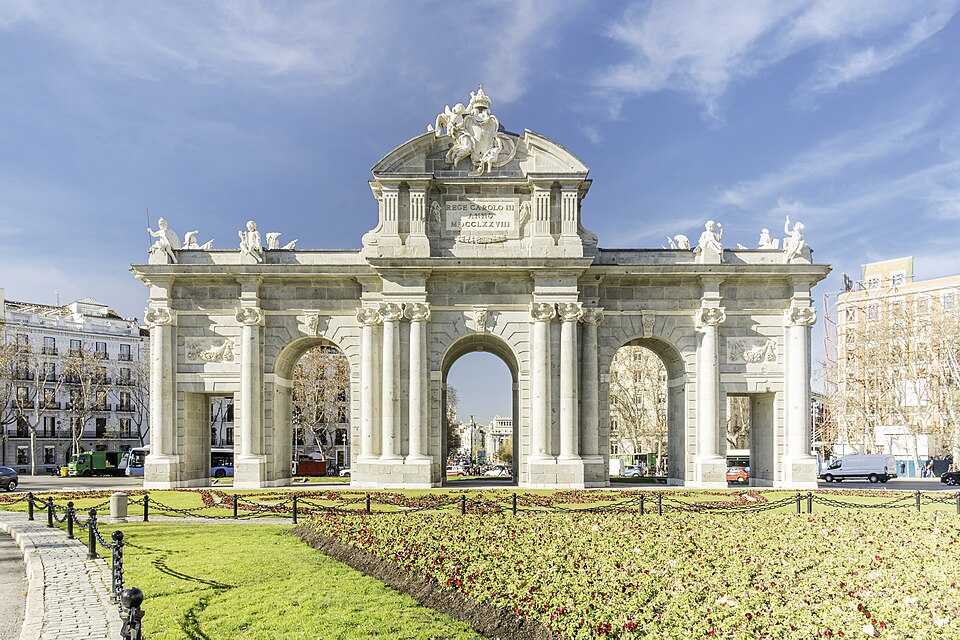
1778 · Francesco Sabatini
A five-opening stone arch — one tall central passage flanked by two smaller openings on either side — carved in pale stone on a granite base, standing alone at the centre of a roundabout with no wall left attached to it.
It replaced a smaller, older gate in the same stretch of city wall, commissioned around 1774 by King Charles III to carry an expanded road toward a nearby town, and inaugurated in 1778. Its ornamental sculpture was carved by Francisco Gutiérrez and Roberto Michel in white stone from Colmenar, set on an armature of granite from Segovia. Since the wall it once pierced was later demolished, it now stands alone at the centre of a roundabout.
- Its central plaque still gives the date in Roman numerals, MDCCLXXVIII.
Photo: Fernando Pascullo (CC BY-SA 4.0)
Cybele Palace
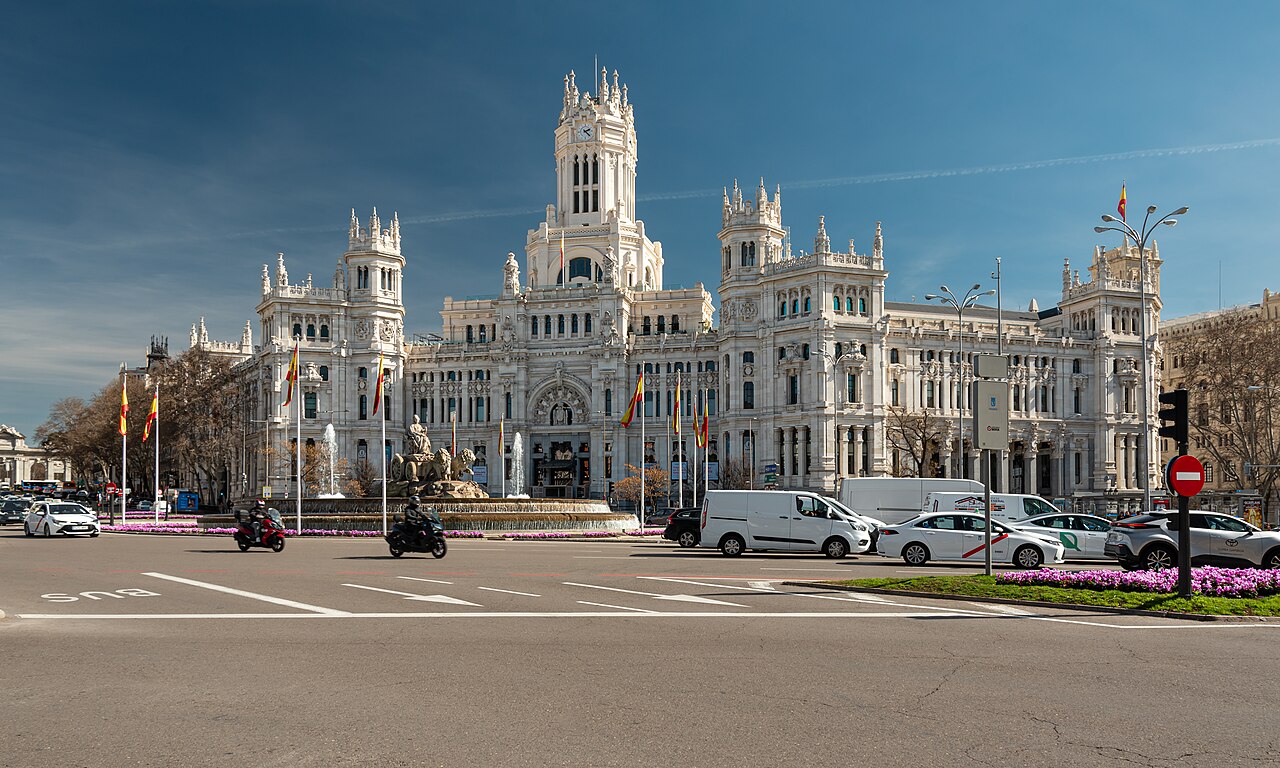
1919 · Antonio Palacios Ramilo
Two adjoining blocks with white stone facades, built in a deliberate mix of period styles rather than one, standing together as a single complex where they once housed the city's post and telegraph offices.
It served for decades as Madrid's main post office and telegraph and telephone headquarters, under the name Palacio de Comunicaciones. The design mixed architectural styles rather than settling on one, credited to Antonio Palacios Ramilo working with a second architect. Renamed Palacio de Cibeles only in 2011, it is now occupied by the City Council of Madrid as its city hall, alongside the public cultural centre CentroCentro.
- It carried the name Palacio de Comunicaciones until as recently as 2011.
Photo: Carlos Delgado (CC BY-SA 3.0)
Almudena Cathedral
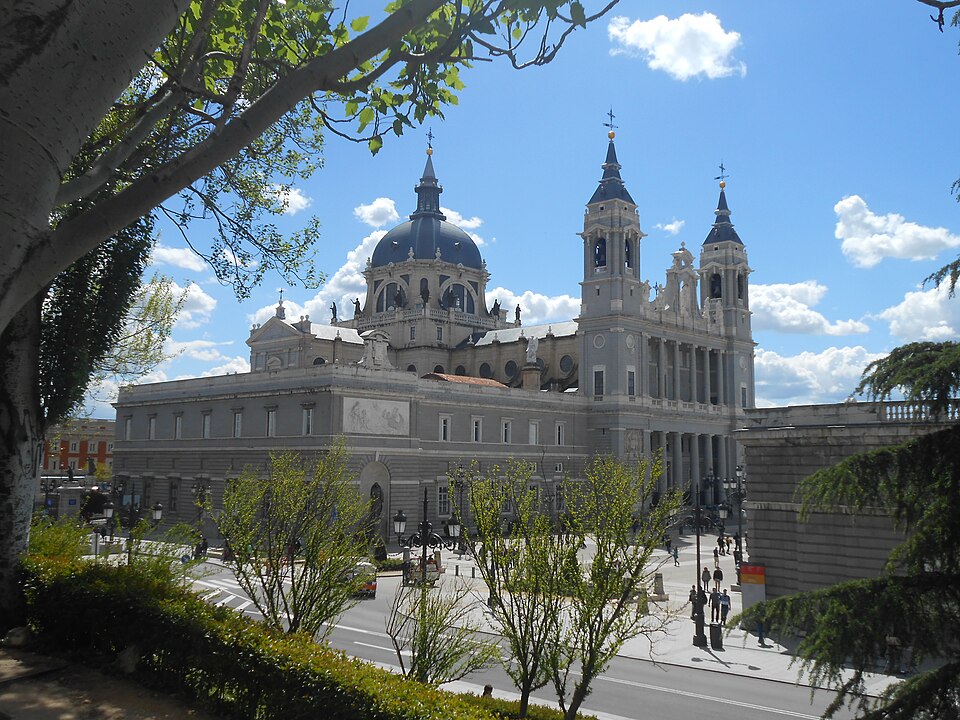
1883–1993 · Francisco de Cubas
A cathedral mixing Gothic Revival, Romanesque Revival and Neoclassical elements rather than one historical style, its facade designed to face and answer a much older palace across the square.
Construction began in 1883 to a design credited to Francisco de Cubas and took over a century to finish, with Pope John Paul II consecrating the building only in 1993. Its architects mixed Gothic Revival, Romanesque Revival and Neoclassical elements rather than settling on a single historical style, and its final exterior was shaped with the Royal Palace across the square in mind. It now serves as the seat of the Archdiocese of Madrid.
- The city had been a royal capital for more than four hundred years before its cathedral was finally consecrated, in 1993.
Photo: Combrian (CC0)
Prado Museum
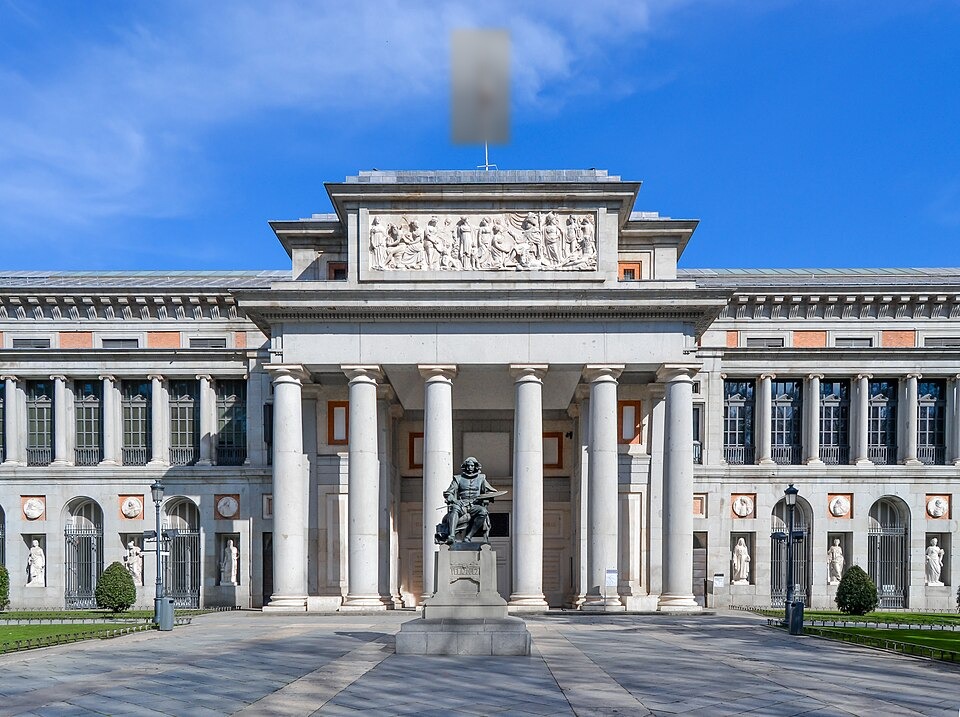
1819 · Juan de Villanueva
Identified less by its exterior than by its holdings: the single largest collection anywhere of one Spanish master's paintings, alongside one of the largest gatherings of Italian old masters outside Italy itself.
Founded in 1819 as a museum of paintings and sculpture, it was designed by Juan de Villanueva and built to display the former Spanish royal art collection. It now holds around 7,600 paintings, 8,200 drawings and 1,000 sculptures, including the largest collection anywhere of Francisco Goya and one of the largest collections of Italian masters outside Italy, much of it assembled through Diego Velázquez's own eye for painting. It ranked among the world's most visited museums as recently as 2020.
- As of 2012, only about 1,300 of its works were on display at any time, with some 3,100 on loan elsewhere and the rest in storage.
- Diego Velázquez, its most celebrated painter, was also the one who helped bring much of its Italian collection to Spain in the first place.
Photo: Emilio J. Rodríguez Posada (CC BY-SA 2.0)
Teatro Real
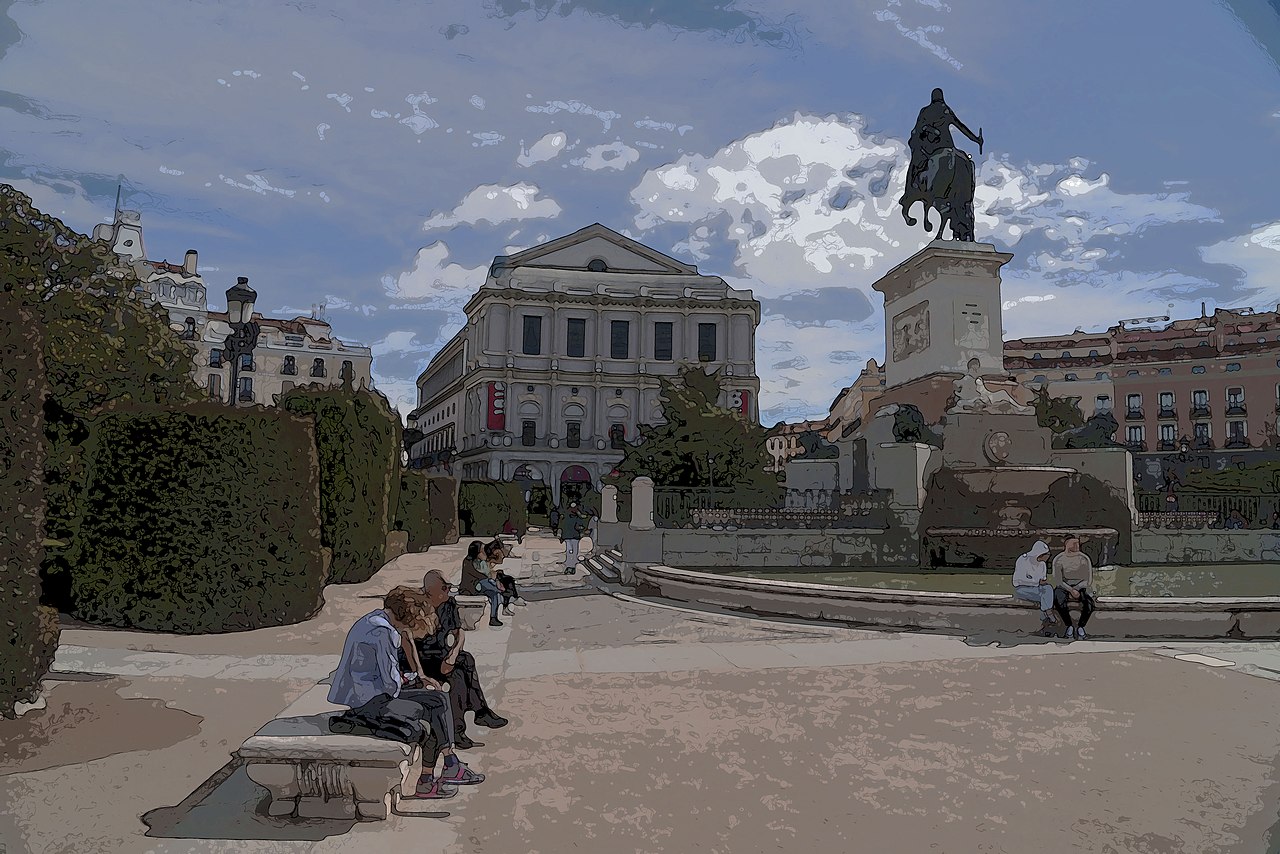
1818–1850 · Antonio López Aguado
A large theatre building standing alone on its own square, facing a former royal residence directly across the open space, with an interior floor area of over 78,000 square metres and seating for close to two thousand.
Its groundbreaking took place in 1818 under King Ferdinand VII, with construction credited to Antonio López Aguado and Custodio Teodoro Moreno; his daughter Queen Isabella II formally opened the building in 1850. Damage caused by construction of the Madrid Metro forced its closure in 1925, and it did not reopen until 1966, then only as a concert hall for the Spanish National Orchestra. A renovation begun in 1991 finally restored it as an opera house, reopening in 1997. It is now managed by a public foundation and hosts an annual season of opera, dance and concerts.
- It hosted the 14th Eurovision Song Contest in 1969 and the 25th Goya Awards in 2011.
- A considerable share of the seats added in its 1990s remodel have limited or no view of the stage, so performances are projected onto the hall's upper walls for those seats.
- Verdi's Rigoletto has been staged there more than any other opera, with 409 performances.
Photo: Nemo (CC BY-SA 4.0)
Parque del Buen Retiro
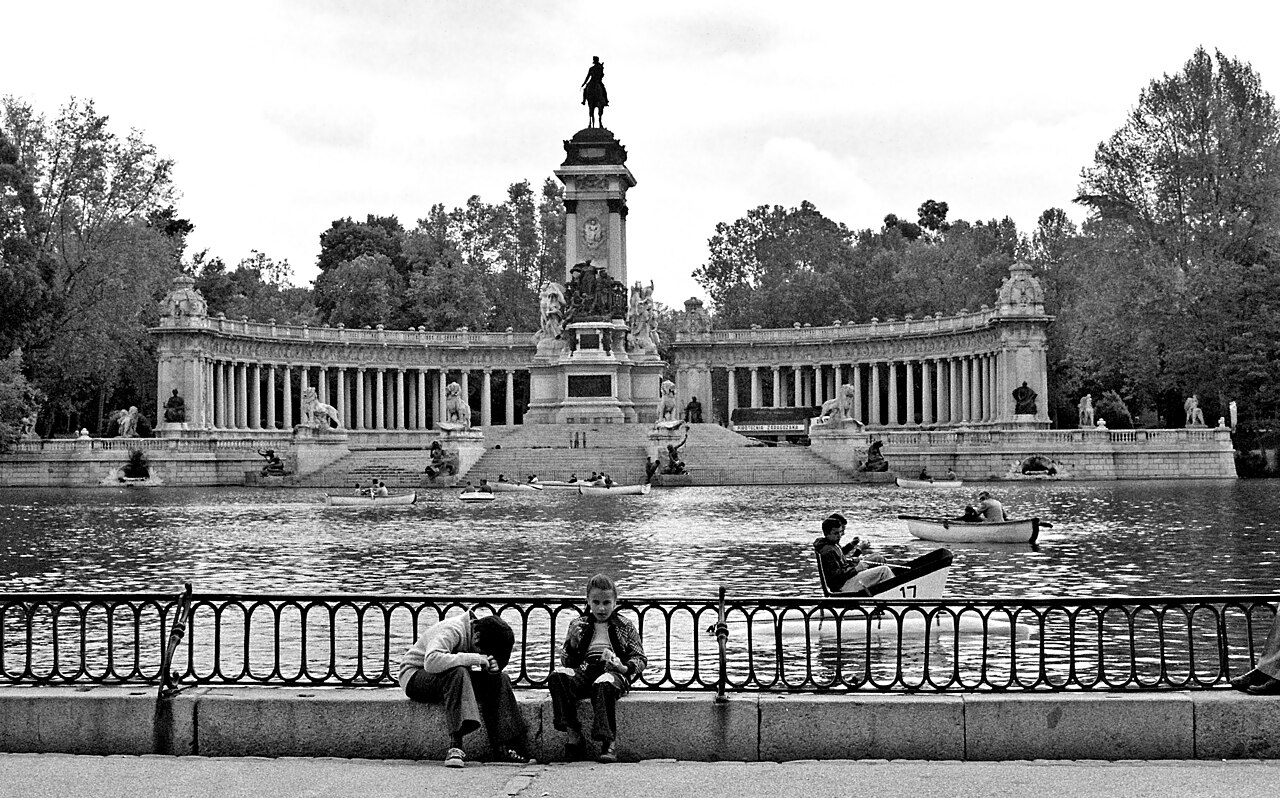
1630s · Cosimo Lotti
A large artificial lake bordered on one side by a curved, colonnaded monument topped with an equestrian statue, and, elsewhere in the grounds, an all-glass exhibition pavilion modelled on London's Crystal Palace, standing beside its own smaller pond.
Its site was developed from 1561 under King Philip II, then significantly enlarged in the 1630s when the Count-Duke of Olivares commissioned formal gardens laid out by the landscaper Cosimo Lotti around a royal palace, most of which was later destroyed during the Peninsular War. The grounds remained crown property until the 1868 revolution that overthrew Queen Isabella II, after which they opened to the public. Later additions include an 1887 glass exhibition pavilion and a rose garden planted in the 1930s and 1940s. Since 2021 it has formed part of a UNESCO World Heritage Site with the nearby boulevard.
- Its Fountain of the Fallen Angel, erected in 1922, is claimed to be the only known public monument anywhere dedicated to Satan.
- In 1887, part of the park hosted fairgrounds for the Philippine Islands Exposition, which included a human zoo.
- A memorial grove commemorates the 191 people killed in the 2004 Madrid train bombings.
Photo: LBM1948 (CC BY-SA 4.0)
Puerta del Sol
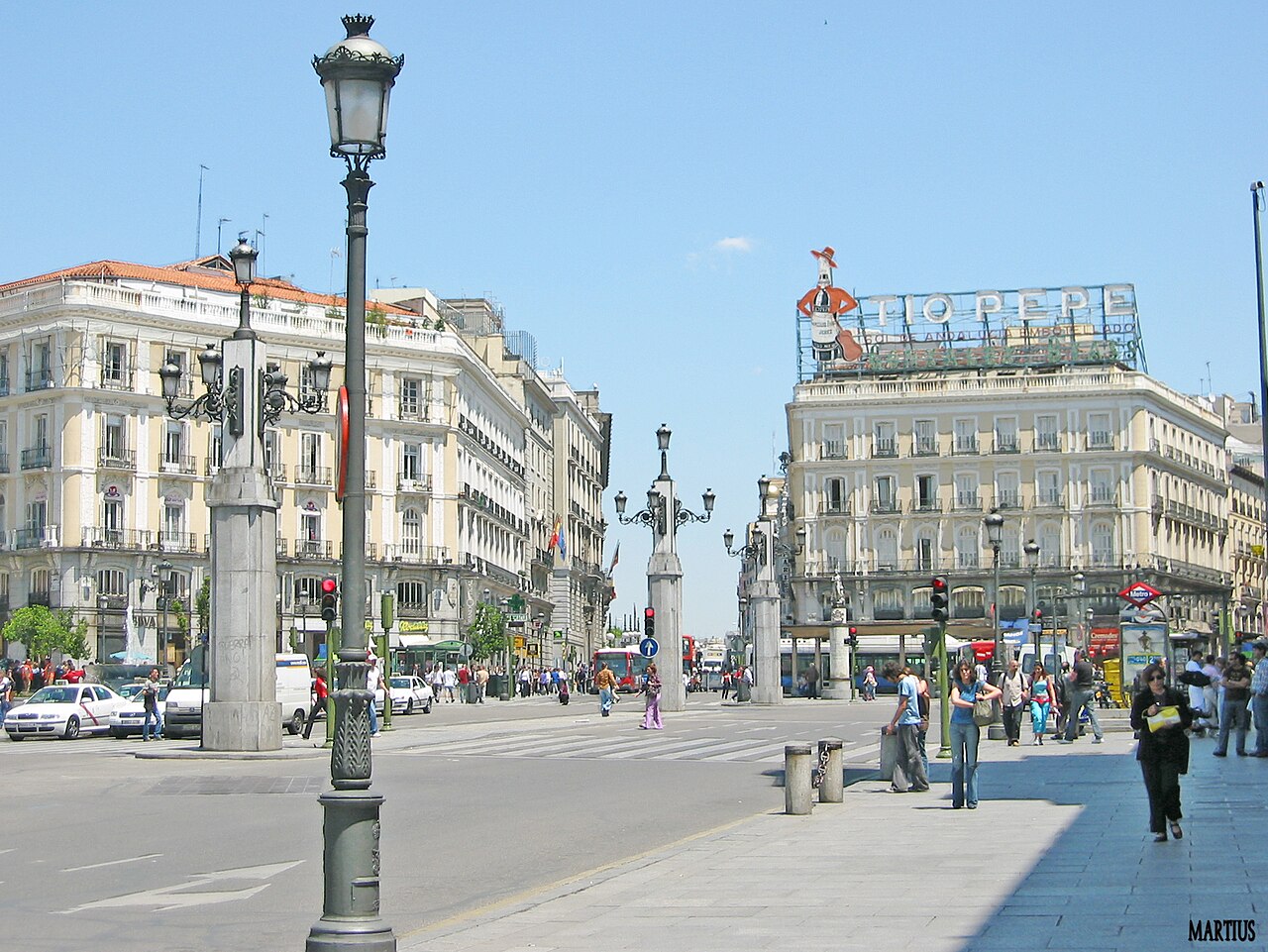
An open square with a bronze equestrian statue of King Charles III on one side, and a separate statue of a bear rearing up against a strawberry tree, a heraldic symbol, on the other, alongside a small plaque set into the pavement marking the exact point from which the country's road distances are measured. A raised clock on the square is watched every New Year's Eve as it chimes the arrival of midnight.
The square began as one of the gates through Madrid's fifteenth-century city wall, taking its name from a rising sun carved above the entrance; the wall and gate are both long gone. From the seventeenth to the nineteenth century it was a meeting point for news from abroad. Since 1857 a pavement plaque here has marked the reference point for the country's radial road network. Formerly the crossing point of six major roads, the square was closed to most traffic and pedestrianised in 2020. It has also been a site of political protests, including the 2011 anti-austerity 15-M movement.
- During New Year's Eve 2018–2019, the clock delayed its midnight chimes by an hour so as to also ring in the new year on Canary Islands time.
- The basement of the old Post Office building, now the seat of the regional government, was infamous under the Franco dictatorship as a place where political dissidents were tortured.
- In 2011 the square became the centre of a national protest movement whose demonstrators camped there for weeks under a free-standing dome built from wooden pallets.
Photo: Manuel M. Vicente from Spain (CC BY 2.0)
Plaza de España
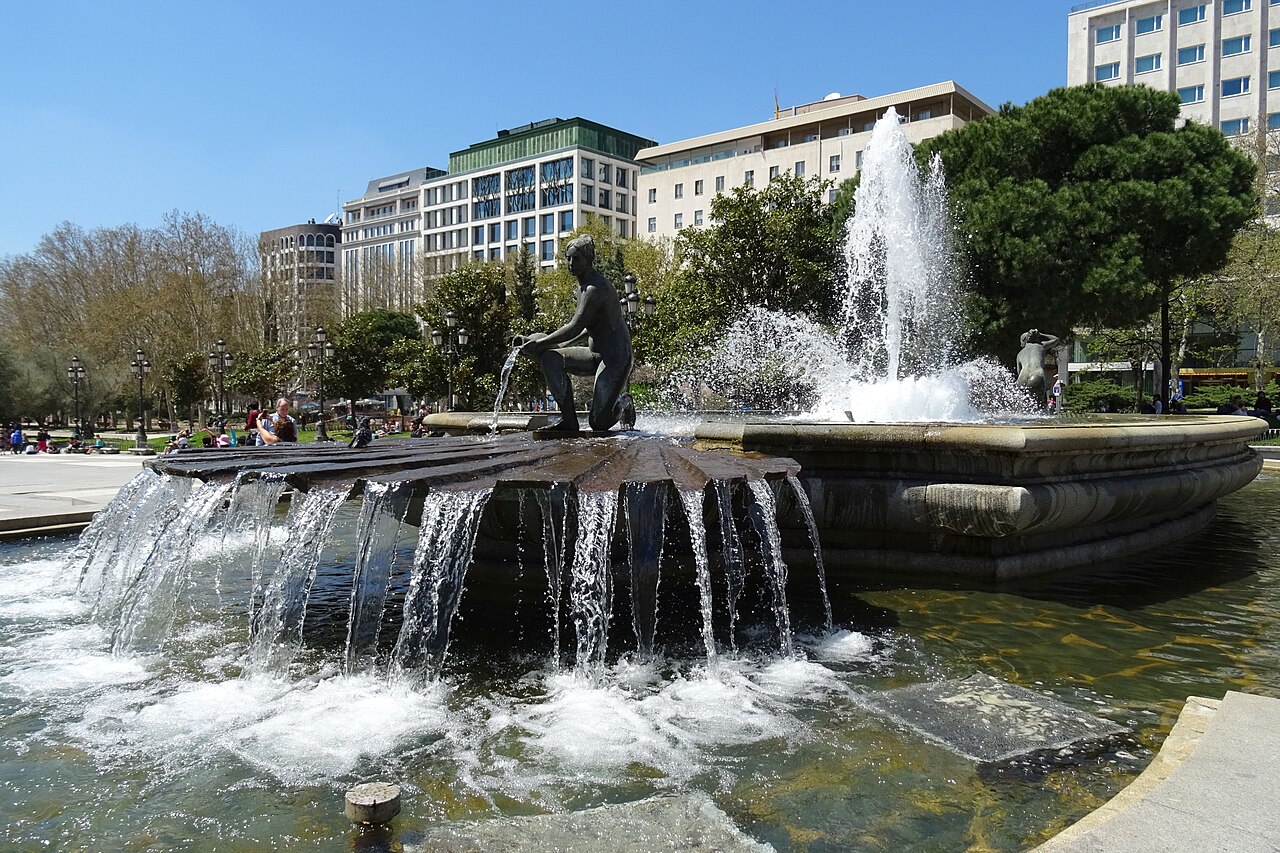
1911
A rectangular ornamental pool centred on a monument whose granite base carries bronze figures of a knight and his squire beneath a red-stone seated figure of their author, flanked along the square's sides by two of the area's tallest towers.
The square took its present form in 1911 at the western end of Gran Vía, centred on a rectangular pool and a monument to the writer Miguel de Cervantes unveiled in stages for the 1915 tercentenary of Don Quixote's second part and the 1916 centenary of the writer's death, designed by Rafael Martínez Zapatero with Pedro Muguruza Otaño and sculpted by Lorenzo Coullaut Valera. In 1808 the hill it stands on was used by occupying French troops as an execution ground. It reopened to pedestrians in 2021 after two and a half years of renovation.
- The monument's statues of Don Quixote and Sancho Panza originally stood roughly where the pool's centre now is, before the pool itself was built around them.
- Its sculptural program includes figures representing all five inhabited continents, each shown reading Cervantes's novel.
- The adjoining Casa Gallardo, an Art Nouveau apartment building, dates from the same year as the square, 1911.
Photo: Sjaak Kempe from Groningen, The Netherlands (CC BY 2.0)
Plaza Mayor
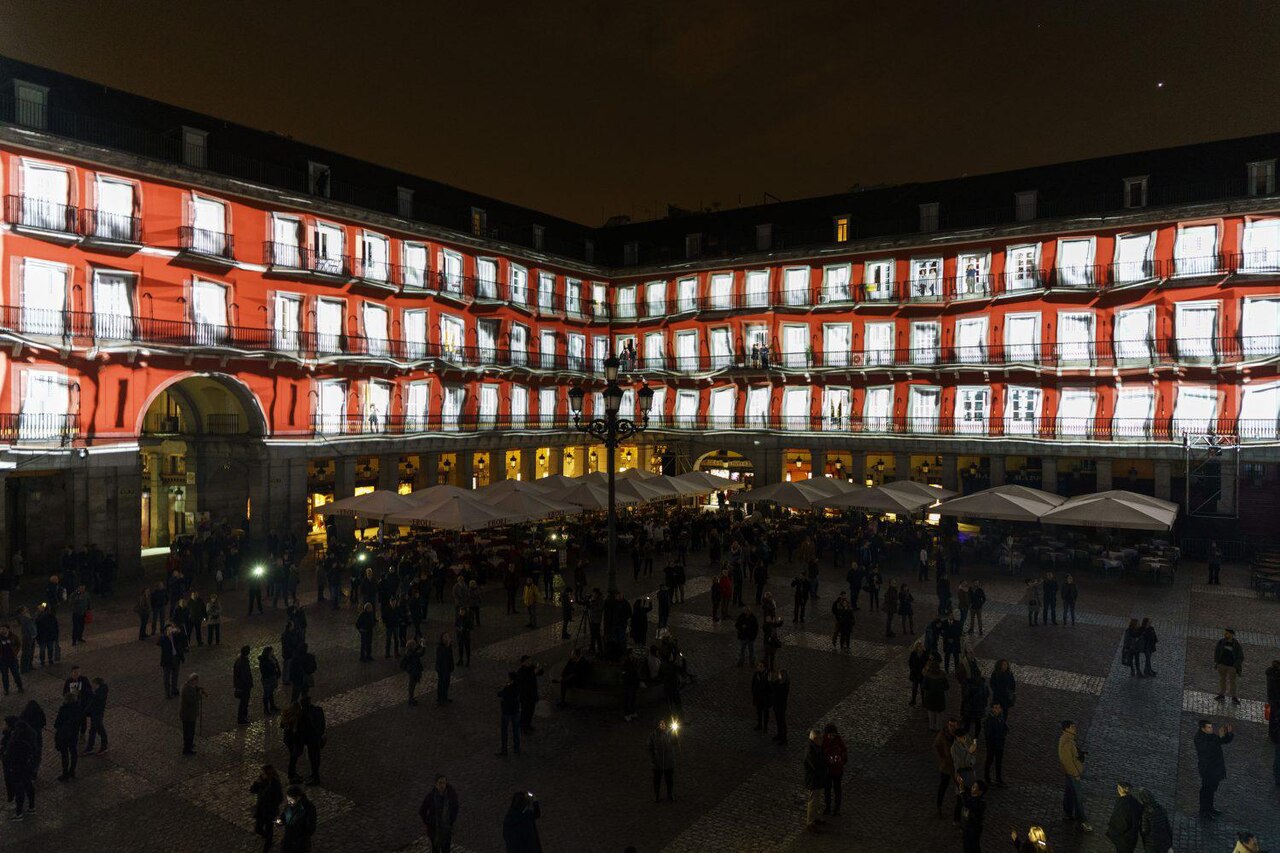
1619–1854 · Juan de Villanueva
A rectangular square roughly 129 by 94 metres, enclosed on all sides by uniform three-storey buildings pierced by ten arched entrances and lined with 237 overlooking balconies, with a bronze equestrian statue at its centre and, along one side, a two-towered building painted with mythological murals.
Its site began as a 15th-century marketplace, redesigned in Classical style under a royal commission to Juan de Herrera, though construction did not begin until 1617 under Juan Gómez de Mora and finished in 1619. Fires in 1631, 1670 and 1790 forced repeated rebuilding; the last and most severe was repaired under Juan de Villanueva, who lowered the surrounding buildings to three storeys and added the entrance archways that define the square today, with the work finished in 1854 by Antonio López Aguado and Custodio Moreno after Villanueva's death. It measures 129 by 94 metres, ringed by 237 balconies.
- In 1680 the square hosted a mass auto-da-fé in which the Spanish Inquisition sentenced 117 people, condemning 21 to be burned alive, most of them Christians of Jewish descent accused of secretly practising Judaism.
- The bronze equestrian statue at its centre, cast in 1616 by Giambologna and Pietro Tacca, was a gift from the Grand Duke of Tuscany and stood elsewhere in Madrid for two centuries before being moved to the square in 1848.
- Early in the Franco dictatorship the statue was pulled from its pedestal and damaged, and was not restored to its place until the 1950s.
Photo: Diario de Madrid (CC BY 4.0)
Temple of Debod
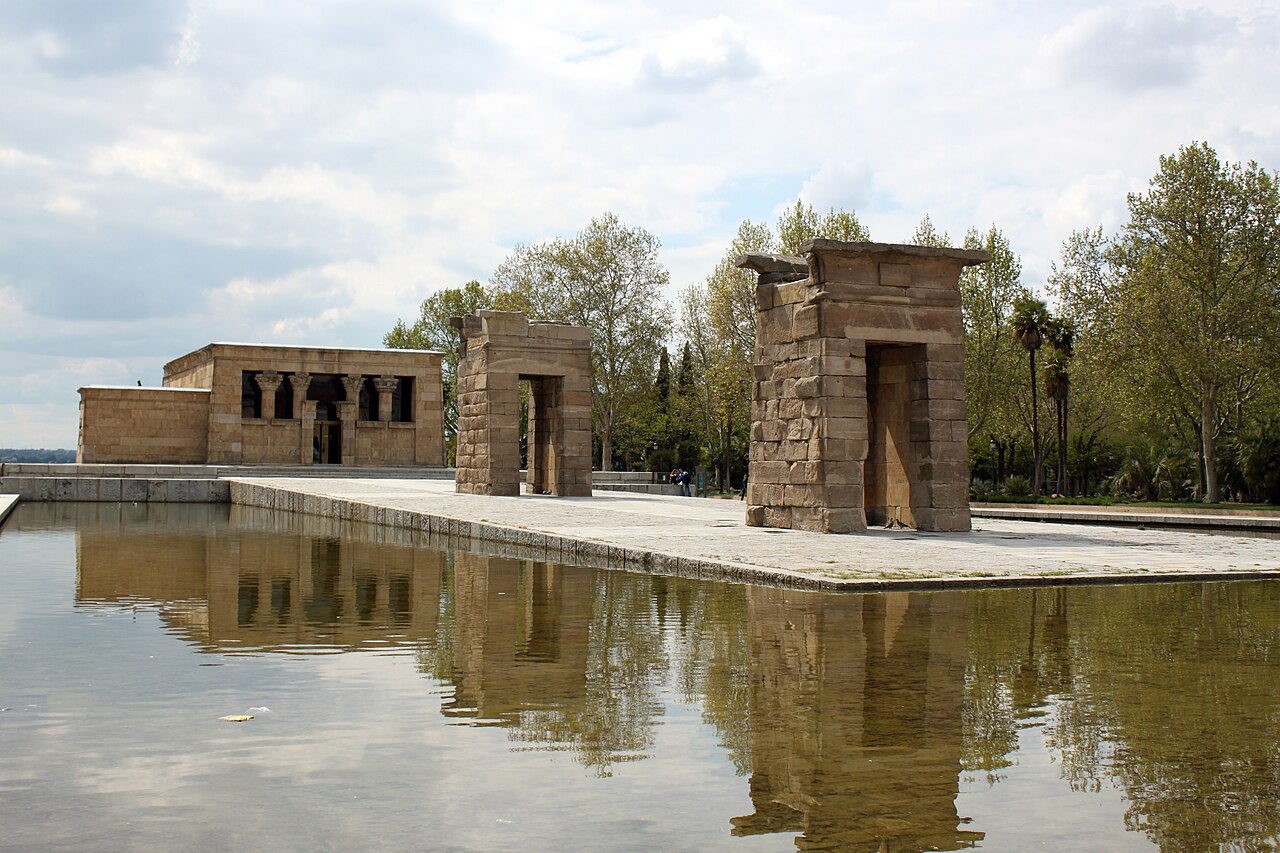
2nd century BC (rebuilt 1970–1972)
A short row of stone pylon gateways along a raised processional path leading to a small single-room sandstone temple, its blocks reassembled in a different order than they originally stood, its carved reliefs weathered by exposure to open air rather than sheltered.
Construction began in the early 2nd century BC, when the Nubian king Adikhalamani raised a single chapel to the god Amun; Ptolemaic and Roman rulers enlarged it into a small temple dedicated to Isis. Threatened by the rising waters behind the Aswan High Dam, it was one of several monuments Egypt gave away in 1968 in gratitude for Spain's help saving the Abu Simbel temples. Dismantled, shipped and reassembled on a Madrid hillside park between 1970 and 1972, its gateways set in a different order than they originally stood, and it remains exposed to open air rather than sheltered.
- Its stone pronaos, with four composite columns, collapsed in 1868 and no longer exists.
- It is one of only four ancient Egyptian temples Egypt gave away for relocation abroad, alongside others now in New York, Leiden and Turin.
- In 2020 the city council voted to build a permanent cover for the temple after Egyptologists criticised its continued exposure to the weather.
Photo: Anagoria (CC BY 3.0)
Edificio España
A skyscraper and hotel on Plaza de España, opened in 1953 as a mixed-use complex of hotel, offices, apartments and shops. It was Spain's tallest building until overtaken by the nearby Torre de Madrid, and reopened as a hotel in 2019 after renovation.
Thyssen-Bornemisza Museum
An art museum near the Prado, part of Madrid's Golden Triangle of Art alongside the Prado and the Reina Sofía. Built around the collection of Baron Heinrich Thyssen-Bornemisza, it holds over 1,600 paintings, once the world's second-largest private collection after the British Royal Collection.
Museo Nacional Centro de Arte Reina Sofía
Spain's national museum of 20th-century art, inaugurated on 10 September 1992 near the Atocha train and metro stations. It holds major collections of Picasso and Dalí, including Picasso's 1937 painting Guernica, its most famous work.
Hotel Ritz
A five-star Belle Époque hotel in the Retiro district, next to the Prado Museum, opened in 1910. Its façade is a listed national monument, and the hotel is owned and managed by the Mandarin Oriental Hotel Group.
Royal Botanical Garden
An 8-hectare botanical garden in central Madrid. Its public entrance sits on Plaza de Murillo, next to the Museo del Prado.
Palacio de las Cortes
The building housing the Congress of Deputies, one of the two chambers of Spain's Cortes Generales. Built in neoclassical style, it stands on Plaza de las Cortes, a short walk from Paseo del Prado, and ranks among the emblematic buildings of 19th-century Madrid.
Liria Palace
A neoclassical palace in Madrid. It serves as the Madrid residence of the Dukes of Alba.
Convent of Las Descalzas Reales
A royal monastery in central Madrid, known as the Convent of Las Descalzas Reales. It is administered today by the Patrimonio Nacional, Spain's national heritage body.
Royal Basilica of Saint Francis the Great
A Roman Catholic basilica in central Madrid, in the neighborhood of Palacio. It carries the name Saint Francis the Great, honoring the Franciscan order.
Church of Saint Jerome the Royal
A Roman Catholic church dating to the early 16th century, remodeled and restored many times since. It is the surviving structure of the Hieronymite monastery beside the former royal palace of Buen Retiro, and for centuries hosted the investiture of the Prince of Asturias.
Paseo del Prado
One of Madrid's main boulevards, running north-south between Plaza de Cibeles and Plaza del Emperador Carlos V, past the Fuente de Neptuno. It is protected as Bien de Interés Cultural and forms part of a UNESCO World Heritage Site with Buen Retiro Park.
Círculo de Bellas Artes
A private, non-profit cultural organization founded in 1880, housed in a building designed by architect Antonio Palacios and constructed in 1926. Declared a Bien de Interés Cultural in 1981, it hosts exhibitions, a cinema, a theatre and concert halls.
Market of San Miguel
A covered iron market hall originally built in 1916. Purchased by private investors in 2003, who renovated the structure and reopened it in 2009.
Telefónica Building
A skyscraper on Gran Vía, registered office of the telecommunications company of the same name. At completion it was the tallest skyscraper in Europe, at 89 metres of roof height, until overtaken by Genoa's Torre Martini in 1940.
Muslim Walls of Madrid
Surviving fragments of the city's walls, built in the 9th century during Muslim rule of the Iberian Peninsula on a promontory beside the Manzanares river. Probably the oldest construction still standing in Madrid, they were declared an Artistic-Historic Monument in 1954.
Beti Jai fronton
A Neo-Mudéjar sports venue built in 1893 and opened in 1894 for Basque pelota. The last game was played there in 1919; declared a Bien de Interés Cultural in 2011, it was fully renovated in 2019 as the last surviving 19th-century fronton in Madrid.
Matadero Madrid
The site of a former slaughterhouse and municipal cattle market, in the Arganzuela district. Today it operates as a contemporary arts centre.
Sobrino de Botín
A restaurant listed by Guinness World Records as the oldest in the world, according to a tradition dating its founding to 1725. In fact the restaurant, then called Pastelería de Cándido Remis, Sobrino de Botín, opened in 1865, and it closed during the COVID-19 pandemic.
Escuelas Pías de San Fernando
A building that was formerly a church, burned down during the Spanish Civil War. Its ruins were converted into a UNED university library, and it was declared a Bien de Interés Cultural in 1996.
History
Madrid began as a walled outpost above the Manzanares, raised in the late ninth century under the Emirate of Córdoba and taken by Christian forces in 1083 or 1085. It grew slowly through the Middle Ages as a town of the Crown of Castile, then changed scale after 1561 as the permanent seat of the Hispanic Monarchy's court. The old Alcázar burned down on Christmas Eve of 1734 and was rebuilt on a far larger scale between 1738 and 1755. Bourbon kings then opened the city outward: a monumental gate replaced an older one in 1778, and a museum for the royal art collection opened in 1819. The white-fronted post office beside the Cibeles fountain, built in the century's first two decades, and the cathedral facing the palace, begun in 1883 but not consecrated until 1993, closed the skyline in heavier eclectic and historicist stone.