Landmarks in Tunis
A medina of reused Roman stone opens through one gate onto French-era boulevards.
Tunis's oldest buildings sit inside the Medina, the walled old town at the city's centre and a World Heritage Site. Its earliest mosque was rebuilt in the ninth century using antique columns brought from Carthage, giving its prayer hall a patched-together character rather than a single design. The medina's boundary is marked by a nineteenth-century gate, an archway under a crenellated parapet, past which Avenue Habib Bourguiba carries the city into its colonial-era Ville Nouvelle of broad boulevards. Further out, a national art museum installed inside a former palace shows how public institutions took over older buildings rather than commissioning new ones. Coastal suburbs add later, different layers again.
Al-Zaytuna Mosque
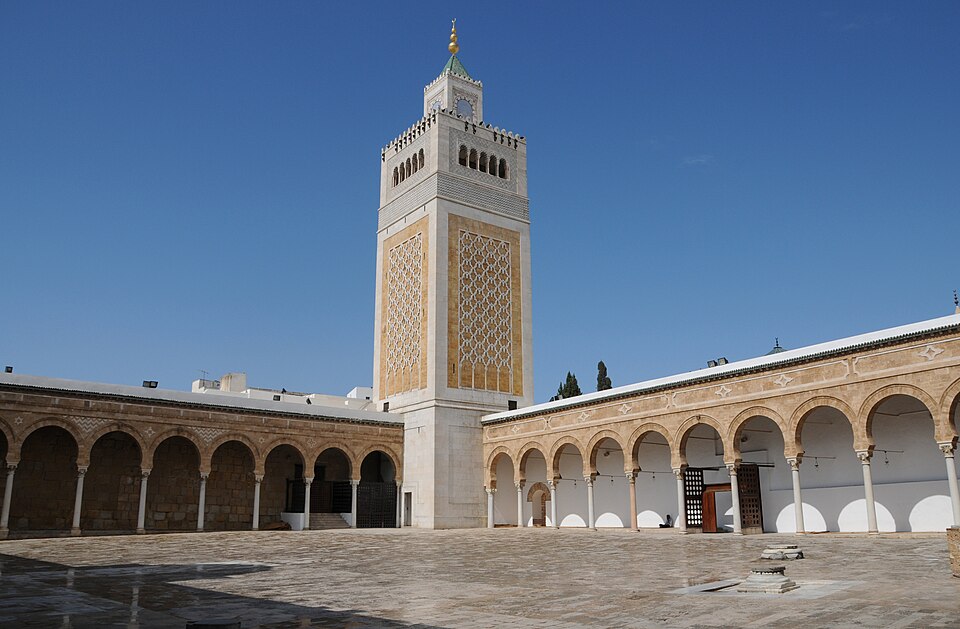
731–9th century
Its prayer hall stands on rows of mismatched antique columns, reused whole from an older Roman-era city rather than carved to a single plan, the mark of a ninth-century rebuilding over an earlier structure.
The oldest mosque in Tunis, founded at the end of the seventh century or start of the eighth, though the building seen today dates from a ninth-century reconstruction that reused antique columns brought from Carthage. It later grew into the University of Ez-Zitouna, Tunisia's foremost centre of higher education from around the thirteenth century onward. Its teachers included the Maliki scholar Ibn 'Arafa, the jurist al-Maziri, and the poet Aboul-Qacem Echebbi. It is a listed monument, restored repeatedly over the centuries.
- The university that grew from it, Ez-Zitouna, remained Tunisia's foremost seat of learning from around the thirteenth century onward.
- One of its teachers, Aboul-Qacem Echebbi, went on to become a celebrated Tunisian poet.
Photo: Citizen59 (CC BY-SA 3.0)
Bab el Bhar
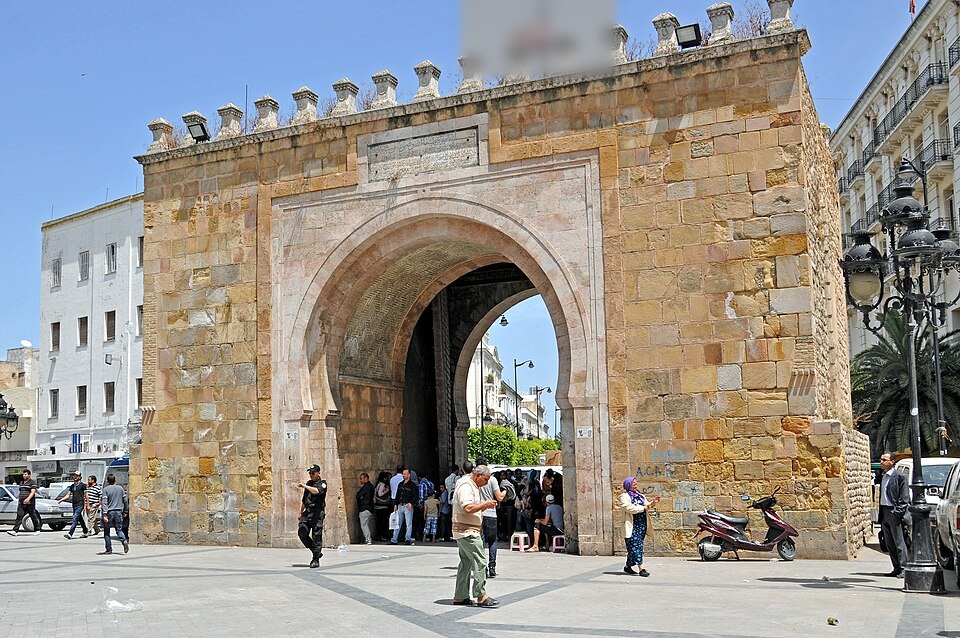
1848
An archway topped by a crenellated parapet, standing at the exact seam where dense old lanes end and wide, straight boulevards begin.
Bab el Bhar, also called Porte de France, is a gate on the eastern edge of the medina of Tunis, marking the point where the old walled town meets the newer city built up beyond it. Its current form, an archway topped by a crenellated parapet, dates from 1848, following many earlier alterations. It is a listed monument and forms part of the medina's UNESCO World Heritage listing.
Photo: Dennis G. Jarvis (CC BY-SA 2.0)
Bardo National Museum
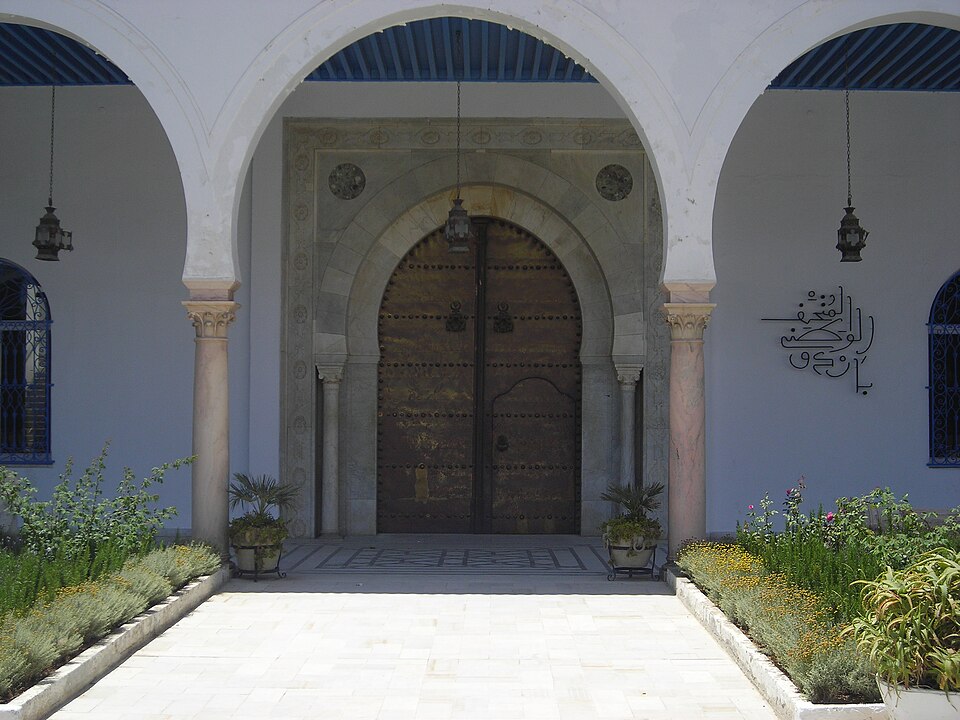
1888
What identifies the building from outside is the old palace itself: no purpose-built museum front was added when it opened to the public in 1888 as the Alaoui Museum, a name it kept until being renamed after independence.
The Bardo National Museum occupies an old beylical palace in Le Bardo, on the edge of Tunis, tracing Tunisia's history across several millennia through archaeological finds. First proposed in the 1860s by Muhammad Khaznadar, son of the country's prime minister, it has occupied the palace since 1888, when it opened as the Alaoui Museum, named for the reigning bey, later renamed after independence. It ranks among the most important museums in the Mediterranean and the second-largest in Africa after Cairo's Egyptian Museum, with one of the world's largest collections of Roman mosaics, gathered from sites including Carthage, Dougga and Utica.
- It was first proposed in the 1860s by Muhammad Khaznadar, son of Tunisia's prime minister.
- It is the second-largest museum in Africa, after the Egyptian Museum in Cairo.
- Its Roman mosaic collection includes the Virgil Mosaic, a major source on daily life in Roman Africa.
Photo: Yamen (CC BY-SA 3.0)
Kasbah Mosque
A mosque in the Kasbah district of Tunis's historic medina, built between 1230 and 1233 on the orders of Abu Zakariya Yahya, the first Hafsid ruler. It served as the main Friday mosque of the Kasbah.
Belvedere Park
The largest park in Tunis, built at the end of the 19th century in the northern part of the city.
Grand Synagogue of Tunis
A synagogue on Avenue de la Liberté in Tunis, also known as the Temple of Osiris.
Tourbet el Bey
A royal mausoleum in the southwest of the Tunis medina, built during the reign of Ali II ibn Hussein between 1759 and 1782. The largest funerary monument in Tunis, it holds the tombs of most Husainid dynasty rulers, opposite the earlier tomb of Al-Husayn I ibn Ali.
Ksar Saïd Palace
A former palace of the Tunisian Beys in the Bardo suburb, close to the other major Husainid residence, the Bardo Palace. Since 2019 it has been officially known as the Palace of Letters and Arts and is open to the public.
Youssef Dey Mosque
A 17th-century mosque in the Medina, the first Ottoman mosque built in Tunis. It began as a public speaking venue before becoming a mosque under Youssef Dey in 1631, and a 1926 decree made it an annex of the University of Ez-Zitouna.
El Menzah Stadium
A multi-purpose stadium in El Menzah, built in 1967 for that year's Mediterranean Games on the site of the former Vélodrome Stadium. It holds 39,858 spectators.
Cathedral of Saint Vincent de Paul
A Roman Catholic cathedral on Place de l'Indépendance, designed by L. Bonnet-Labranche in a mix of Moorish, Gothic and Neo-Byzantine styles. Construction began in 1893 and the church opened at Christmas 1897, initially without its bell towers for lack of funds.
National Monument of the Kasbah
A memorial monument in the center of Kasbah Square, facing the Town Hall, designed by the Tunisian sculptor Abdelfattah Boussetta in 1989. It commemorates several significant events in Tunisian history and appears as a background image on national ID cards.
Sidi Mahrez Mosque
A mosque in Tunis, also known as the Mohamed Bey El Mouradi Mosque, designated an official historical monument.
Dar Othman
A palace in the medina of Tunis, located in its southern quarter on El Mebazaâ Street.
Hammouda Pacha Mosque
A mosque in Tunis, also known as Hamouda Bay al Mouradi, designated an official historical monument.
Carthage Palace
The presidential palace of Tunisia, its official residence and seat of government, standing on the Mediterranean coast in the commune of Carthage near the ancient city's archaeological site. A house designed by Le Corbusier sits within the same grounds.
Saheb Ettabaâ Mosque
A mosque in the Halfaouine area of Tunis, also known as Youssef Saheb Al Tabaa Mosque. It was the last great mosque built in the city before the establishment of the French protectorate in 1881.
Hôtel du Lac
A Brutalist hotel in Tunis, designed by the Italian architect Raffaele Contigiani and built between 1970 and 1973 for the government of Habib Bourguiba.
Dar Lasram
A palace in the medina of Tunis, located at 24 Tribunal Street.
Russian Orthodox Church
An Eastern Orthodox church on Avenue Mohammed V, built by Tunis's Russian community in a distinctive Russian architectural style. Its foundation stone was laid in 1953 by the architect Michel Kozmin, and the church was inaugurated in 1956.
National Theatre of Tunisia
Tunisia's national theatre, a government-owned but financially autonomous cultural institution created by law in 1983. It has been directed by Mohamed Driss since 1988.
Jellaz Cemetery
A hillside Muslim cemetery established in the thirteenth century, the largest in Tunis, with the Ottoman-era Borj Ali Rais fortress visible from much of its grounds. In 1911 it was the site of the Jellaz Affair protests against French land policy, which turned deadly and left 39 people dead.
History
The oldest fabric sits inside the Medina, founded around the turn of the eighth century when its first mosque, the Zaytuna, was raised; a ninth-century rebuild reused antique columns brought from Carthage, and the mosque grew into the seat of what became the University of Ez-Zitouna, Tunisia's foremost centre of higher learning from around the thirteenth century onward. Successive rebuildings reshaped the old town's walls, and its sea-facing gate reached its present archway-and-parapet form only in 1848. The nineteenth century added a layer beyond those walls too: a former palace was converted into a national museum in 1888, while colonial administration laid out the Ville Nouvelle, a grid of boulevards built up around Avenue Habib Bourguiba, its buildings sitting in deliberate contrast to the smaller, older structures behind the sea gate.