Landmarks in Algiers
A mosque built in 1612 turned cathedral, then mosque again, faces a 1982 war memorial.
Algiers' landmarks span roughly three centuries and three ruling orders. The Ketchaoua Mosque, raised in 1611–1612 at the foot of the Casbah's steep stairways under Ottoman rule, was seized after the French conquest and rebuilt as a cathedral between 1845 and 1860 before reverting to a mosque at independence in 1962; its façade still mixes Moorish and Byzantine details. Notre-Dame d'Afrique, a Byzantine Revival basilica completed in 1872 under French colonial administration, held a canonically crowned Marian image within a few years of finishing. The Martyrs' Memorial, a concrete monument of three standing palm leaves opened in 1982, marks two decades of independence and the war that won it, giving the skyline its newest and most political structure.
Martyrs' Memorial
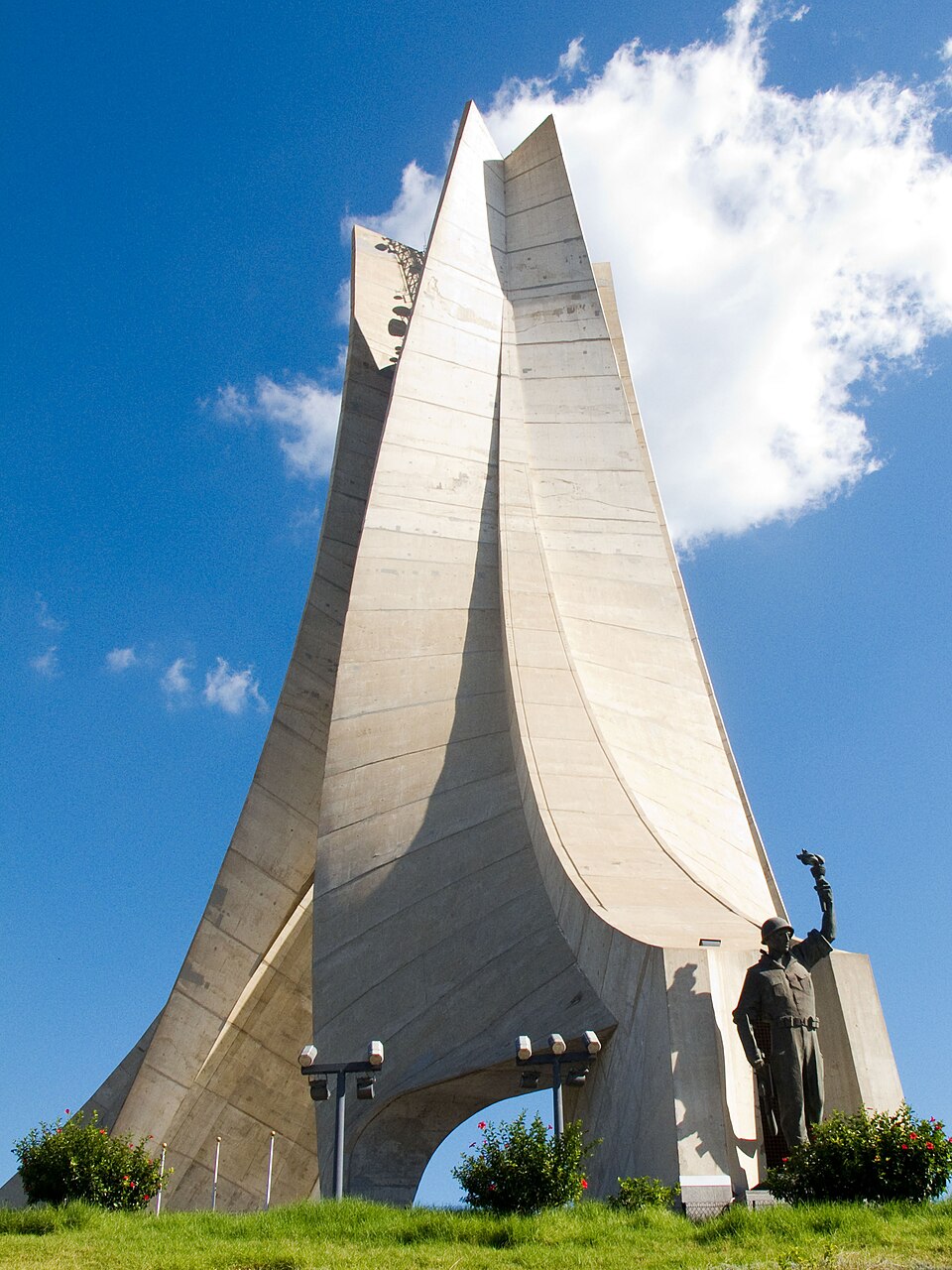
1982 · Bachir Yellès
Three towering concrete forms shaped like standing palm leaves lean together over an eternal flame, with a bronze soldier statue guarding the base of each leaf.
The Martyrs' Memorial is a concrete monument commemorating the Algerian War. It opened on 5 July 1982, exactly twenty years after Algeria's independence was declared. The design takes the form of three standing palm leaves that lean together to shelter an "Eternal Flame" beneath them. At the edge of each leaf stands a statue of a soldier, each representing a different stage of the independence struggle. Bachir Yellès designed the monument.
- It opened on 5 July 1982, exactly twenty years to the day after Algeria's independence was declared in 1962.
Photo: Poudou99 (CC BY 3.0)
Ketchaoua Mosque
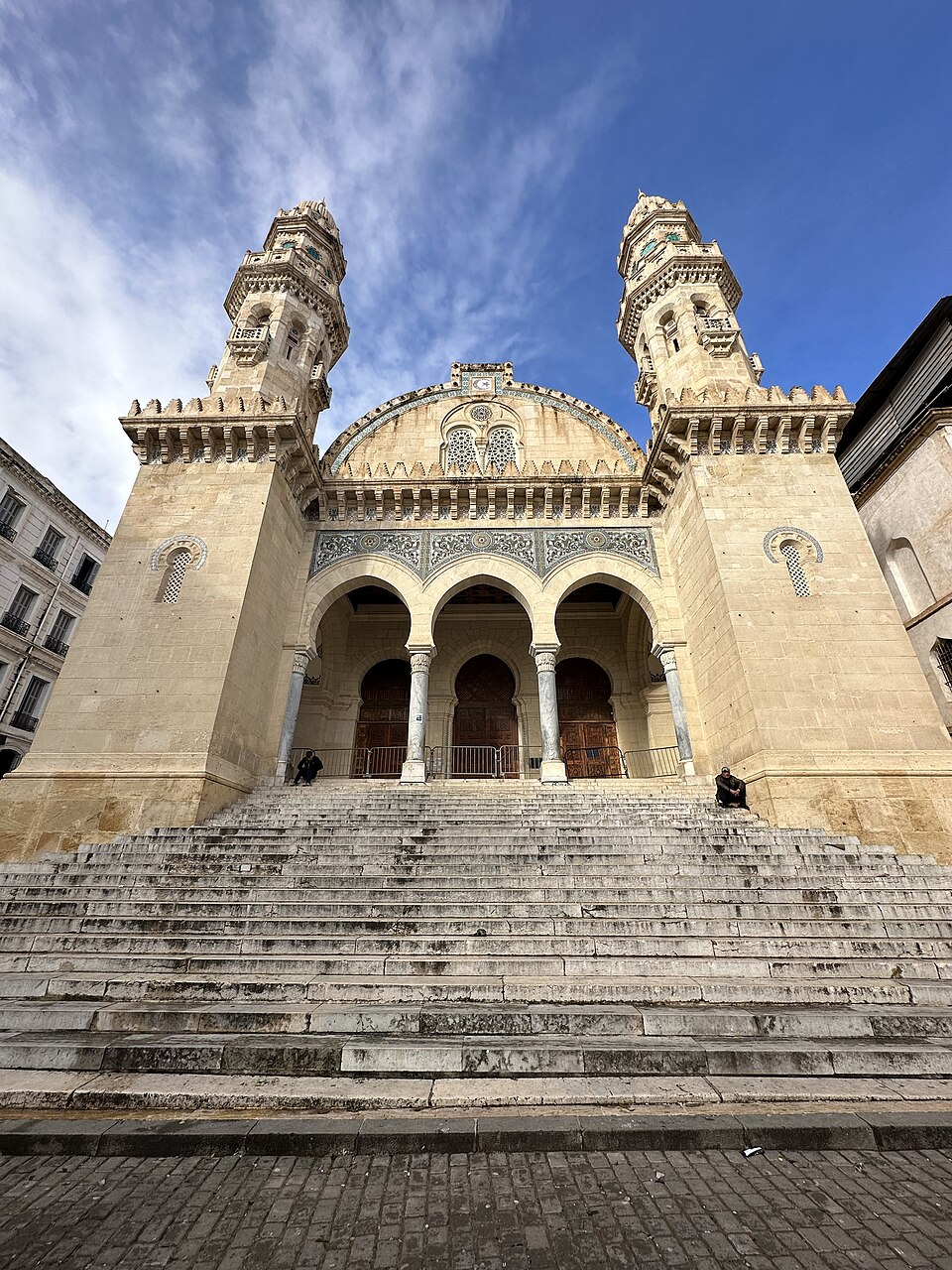
1612
Its façade blends Moorish and Byzantine details, standing right where the first of many steep stone stairways climbs into the old walled quarter above it.
Completed in 1611/1612 during Ottoman rule, this mosque stands at the foot of the Casbah, a UNESCO World Heritage Site, on the first of its many steep stairways. Its architecture fuses Moorish and Byzantine elements. In 1831 Muslims were evicted under French rule, and by 1832 it had been converted into the Cathedral of St Philippe; the structure was demolished and rebuilt entirely between 1845 and 1860, remaining a cathedral until 1962, when independence returned it to use as a mosque.
- The building was not merely reconsecrated but demolished and rebuilt from scratch as a cathedral between 1845 and 1860.
- It served as the Cathedral of St Philippe for 130 years before becoming a mosque again in 1962.
Photo: Rachid Hamatou (CC BY-SA 4.0)
Notre-Dame d'Afrique
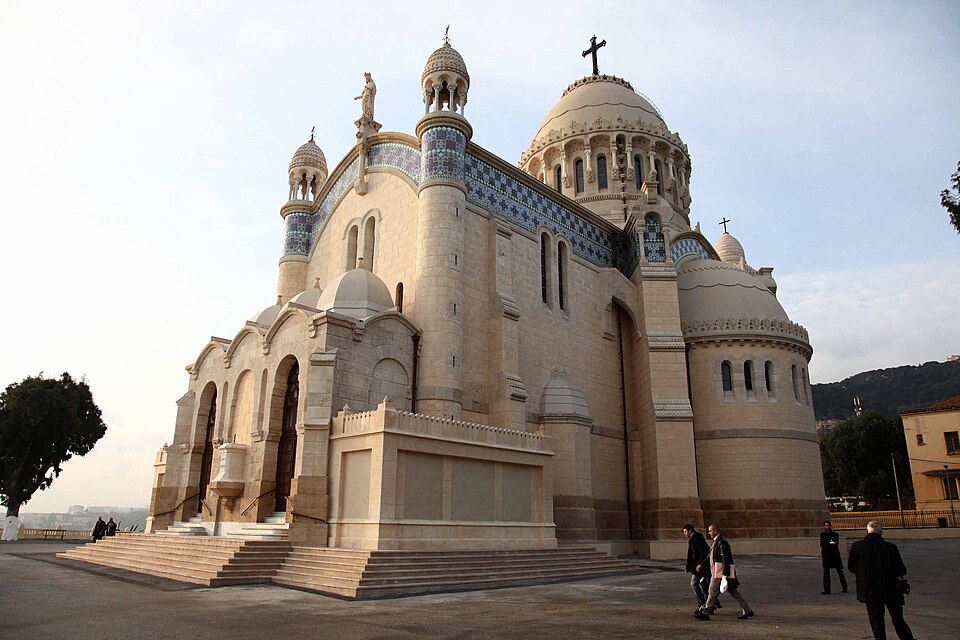
1872 · Jean-Eugène Fromageau
Built in the Byzantine Revival style, the basilica shelters a canonically crowned image of the Virgin that gave rise to the devotion known as Our Lady of Africa.
This Catholic basilica, designed by Jean-Eugène Fromageau in the Byzantine Revival style, was completed in 1872. Four years later, on 15 April 1876, Pope Pius IX issued two decrees concerning it: one authorised the canonical coronation of the venerated Marian image enshrined inside, carried out by the Archbishop of Carthage on 30 April 1876; the other raised the sanctuary to the rank of basilica on the grounds of "immemorial custom." It became the origin of the modern Catholic devotion to Our Lady of Africa.
- Its 1876 promotion to basilica rested on a claim of "immemorial custom" rather than a papal decree alone — a route Pope Benedict XV closed off for other churches in 1918.
- The coronation of the image inside was carried out by the Archbishop of Carthage, not a local cleric.
Photo: Magharebia (CC BY 2.0)
Djamaa el Djazaïr
A mosque completed in 2019 whose 265-metre minaret is the tallest in the world. Its dome spans 50 metres and the prayer hall inside holds up to 120,000 worshippers, making it the third-largest mosque anywhere.
Djamaa el Kebir
A mosque built in 1097, one of the few surviving examples of Almoravid architecture. It is the oldest mosque in Algiers, standing today inside the Casbah, a UNESCO World Heritage Site.
Palais des Rais
A compound of three palaces and six houses in the lower Casbah, also known as Bastion 23, whose oldest structure dates to 1576. Classified as a historical monument in 1909, it now forms part of the Casbah's UNESCO World Heritage listing.
Cathédrale du Sacré-Cœur
A Roman Catholic church completed in 1956 and elevated to cathedral in 1962, replacing the former Cathedral of Saint Philip after it reverted to the Ketchaoua Mosque. Designed by Paul Herbé and Jean Le Couteur, it is noted for its central tower and 52-metre nave.
Government Palace
A government office building inaugurated in 1933 as the Gouvernement général, seat of Algeria's prime minister. At 33,000 square metres, it was then the largest administrative building in the entire French state.
People's National Assembly Building
A public building designed in 1934 and inaugurated in 1951 as the new city hall for Greater Algiers. After independence in 1962 it was repurposed as the seat of Algeria's People's National Assembly.
National Museum of Fine Arts
One of the largest art museums in Africa, opened in the Hamma district in 1930. Its 8,000-work collection includes paintings by Monet, Matisse and Renoir alongside sculptures by Rodin and Bourdelle.
Bardo National Museum
A former Moorish villa built in the late 18th century for the Algerian admiral Raïs Hamidou. It opened as the Bardo National Museum of Prehistory and Ethnography in 1927.
National Museum of Antiquities and Islamic Art
An art museum in Algiers dedicated to antiquities and Islamic art.
Railway Station
A train station in the Kasbah municipality of Algiers, near the historic Kasbah and the port. Trains to destinations across Algeria depart from here, and it is considered the country's central station.
Hotel El-Djazaïr
A historic hotel formerly known as the Hôtel Saint-George. From November 1942 to December 1943 it served as the headquarters of the Allied Forces under Dwight D. Eisenhower.
Botanical Garden Hamma
A 32-hectare botanical garden in the Mohamed Belouizdad district, established in 1832. It combines landscaped gardens with an arboretum, known locally as the Jardin d'Essai du Hamma.
Stade du 5 Juillet
A football and athletics stadium inaugurated in 1972 and named for Algeria's 1962 independence day. It has hosted the 1975 Mediterranean Games and the 1990 Africa Cup of Nations final, which drew a record crowd of over 105,000.
El Mouradia Palace
The office and residence of the president of Algeria, on the hills of the El Mouradia neighborhood overlooking the city. Its name is used as shorthand for the presidency itself.
Villa des Oliviers
A Moorish Revival building in the El Biar district overlooking Algiers. It has served as the residence of the French ambassador to Algeria since 1963.
Villa Montfeld
A mid-19th-century residence in El Biar, rebuilt in Moorish Revival style by the English architect Benjamin Bucknall between 1878 and 1895. Purchased by the United States in 1947, it hosted the 1981 negotiations that produced the Algiers Accords ending the Iran hostage crisis.
Dar Aziza
A 16th-century Moorish palace in the Casbah, part of the former Janina Palace compound that predates the arrival of Turkish corsairs. Considered the most iconic surviving building of its era, it now houses Algeria's National Agency of Archaeology.
Dar Mustapha Pacha
A Moorish palace in the Casbah, built between 1798 and 1799 by the future Dey Mustapha Pacha. It now houses the National Museum of Miniatures, Illumination and Calligraphy.
Zawiya Thaalibia
A zawiya in the Casbah of Algiers, named for the saint Sidi Abd al-Rahman al-Tha'alibi.
Djamaâ Sidi Ramdane
A Sunni mosque and mausoleum completed in the 11th century, making it one of the oldest in Algiers. It stands within the Casbah, a UNESCO World Heritage Site.
Ali Bitchin Mosque
A Sunni mosque built in 1622 on the order of the corsair Ali Bitchin, for whom it is named. It stands within the Casbah, a UNESCO World Heritage Site, at the edge of Bab El Oued.
Museum of Modern Art
An art museum in Algiers, inaugurated in 2007.
National Library of Algeria
The main state library of Algeria, in the Hamma district. Established in 1835 under French colonial rule, it became the national library when Algeria gained independence in 1962.
El Alia Cemetery
A cemetery in the Oued Smar suburb of Algiers, established in 1928. Its 78-hectare plot was donated by its owner, Hamza El-Alia, before he left for Mecca.
Burdeau Bridge-Building
A structure combining an apartment building with a road and pedestrian bridge, built in 1952 in the Télemly district. Designed by the French architect Lucien Pierre-Marie, it has seven floors and 82 apartments.
History
Algiers began as a Phoenician trading settlement between roughly 1200 and 250 BC, then passed through Numidian, Roman and Islamic rule before Buluggin ibn Ziri formally founded the city in 972. It became capital of the Ottoman Regency in 1516, and under Ottoman rule the Ketchaoua Mosque rose at the foot of the Casbah in 1611–1612. French forces took the city in 1830; Muslims were evicted from the mosque the following year, and by 1832 it had become the Cathedral of St Philippe, entirely rebuilt between 1845 and 1860. Colonial Algiers also built outward, adding the Byzantine Revival basilica of Notre-Dame d'Afrique in 1872. Independence in 1962 returned the cathedral to a mosque, and twenty years later the Martyrs' Memorial rose to commemorate the war that had won it.