Landmarks in Sofia
A fourth-century basilica, an Ottoman mosque and two Orthodox cathedrals share the centre.
Sofia's most prominent religious buildings sit close together in the historic centre, each dating from a different regime that once ruled the city. The Church of Saint Sophia, raised as a basilica in the fourth century, was converted into a mosque under later rule and restored as a church; the surrounding town was renamed after it in 1329. Banya Bashi Mosque, attributed to Mimar Sinan and completed in 1566, belongs to the two and a half centuries when the city governed Rumelia for the Ottoman Empire. After Bulgarian independence in 1878 and Sofia's selection as capital the following year, a wave of Orthodox construction followed: the Russian Church in 1914 and the Alexander Nevsky Cathedral, begun in 1882 and largely finished by 1912.
Alexander Nevsky Cathedral
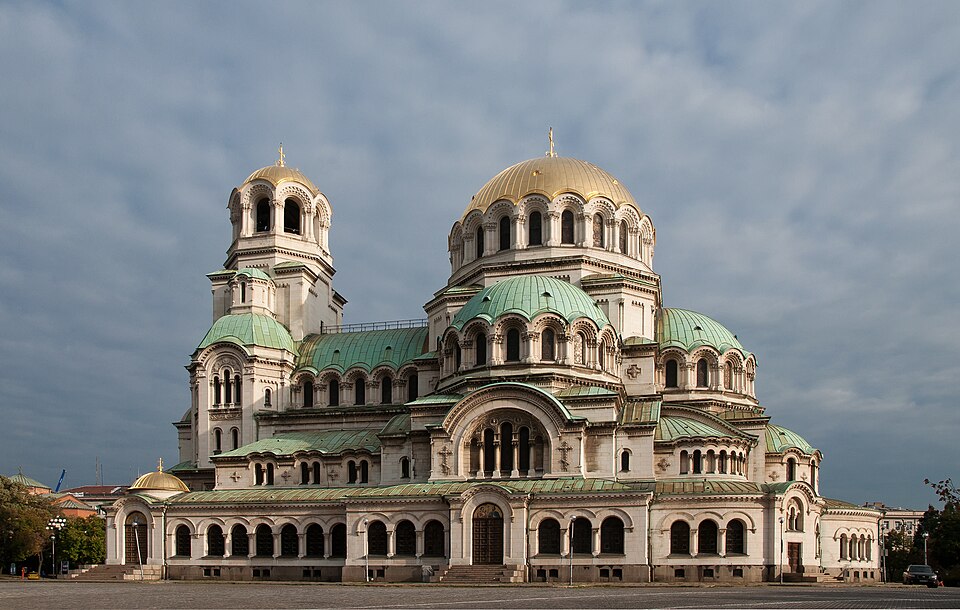
1882–1912 · Alexander Pomerantsev
The Alexander Nevsky Cathedral occupies more than 3,100 square metres in central Sofia and holds up to 5,000 worshippers, making it one of the ten largest Eastern Orthodox church buildings anywhere and, until the year 2000, believed to be the largest completed Orthodox cathedral in the world. Part of the building also serves as a museum.
The Alexander Nevsky Cathedral is a Bulgarian Orthodox cathedral in Sofia, built in the Neo-Byzantine style to a design by Alexander Pomerantsev, who died in 1918. Foundations were laid in 1882 and construction was largely complete by 1912; it serves as the cathedral church of the Patriarch of Bulgaria. Occupying more than 3,100 square metres and able to hold 5,000 worshippers, it ranks among the ten largest Eastern Orthodox church buildings in the world, and until 2000 was believed to be the largest completed Orthodox cathedral anywhere. Part of the complex also functions as a museum.
- Until the year 2000 it was believed to be the largest completed Orthodox cathedral in the world.
- Part of the building doubles as a museum alongside its role as a working cathedral.
Photo: Plamen Agov (user:MrPanyGoff) (CC BY-SA 4.0)
Church of Saint Sophia
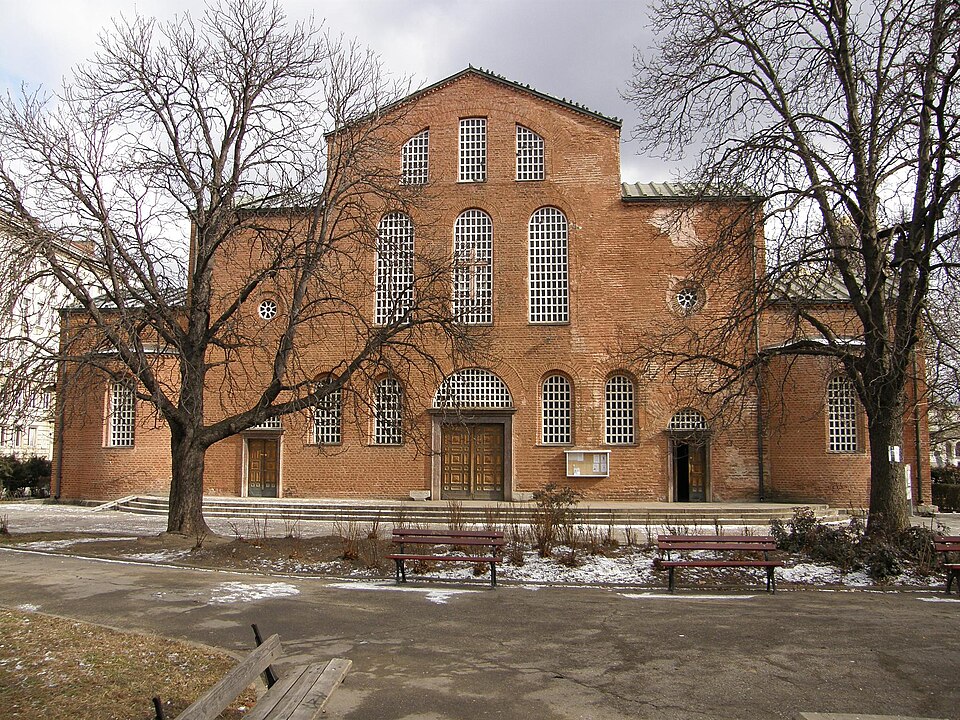
4th century
This fourth-century basilica is the building that gave Sofia its name: the surrounding settlement, then called Serdica, was renamed after the church in 1329, making it one of the oldest structures still standing in the city.
The Saint Sofia Church, dedicated to Holy Wisdom, was built as a Christian church in the fourth century CE, during the city's Roman and early Byzantine period. The surrounding town of Serdica took the name Sofia from the church in 1329. In the sixteenth century the building was converted into a mosque, and it was restored as a Christian basilica during the nineteenth and twentieth centuries. It is counted among the oldest churches in the city and follows an Early Christian and Byzantine architectural style.
- The city of Sofia takes its name from this church, renamed after it in 1329.
Photo: Klearchos Kapoutsis from Paleo Faliro, Greece (CC BY 2.0)
Banya Bashi Mosque
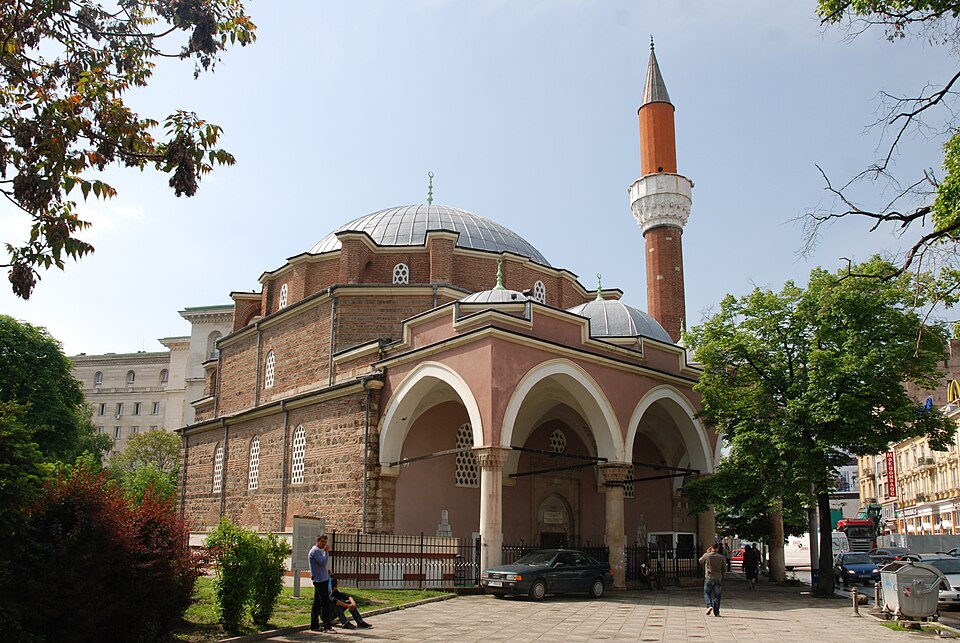
1566 · Mimar Sinan
Attributed to the architect Mimar Sinan, the Banya Bashi Mosque was raised in 1566 in the Ottoman architectural style. It dates from the two and a half centuries when Sofia served as regional capital of Rumelia, the Ottoman Empire's largest province.
Banya Bashi Mosque is a Sunni Islamic mosque in Sofia, built in 1566 and attributed to the architect Mimar Sinan, who died in 1588. It follows the Ottoman architectural style and dates from the two and a half centuries when the city served as regional capital of Rumelia, the Ottoman Empire's largest and most important province. It was raised to serve the city's Muslim community under Ottoman administration, and stands today as one of central Sofia's clearest markers of that period.
Photo: xiquinhosilva from Cacau (CC BY 2.0)
Russian Church
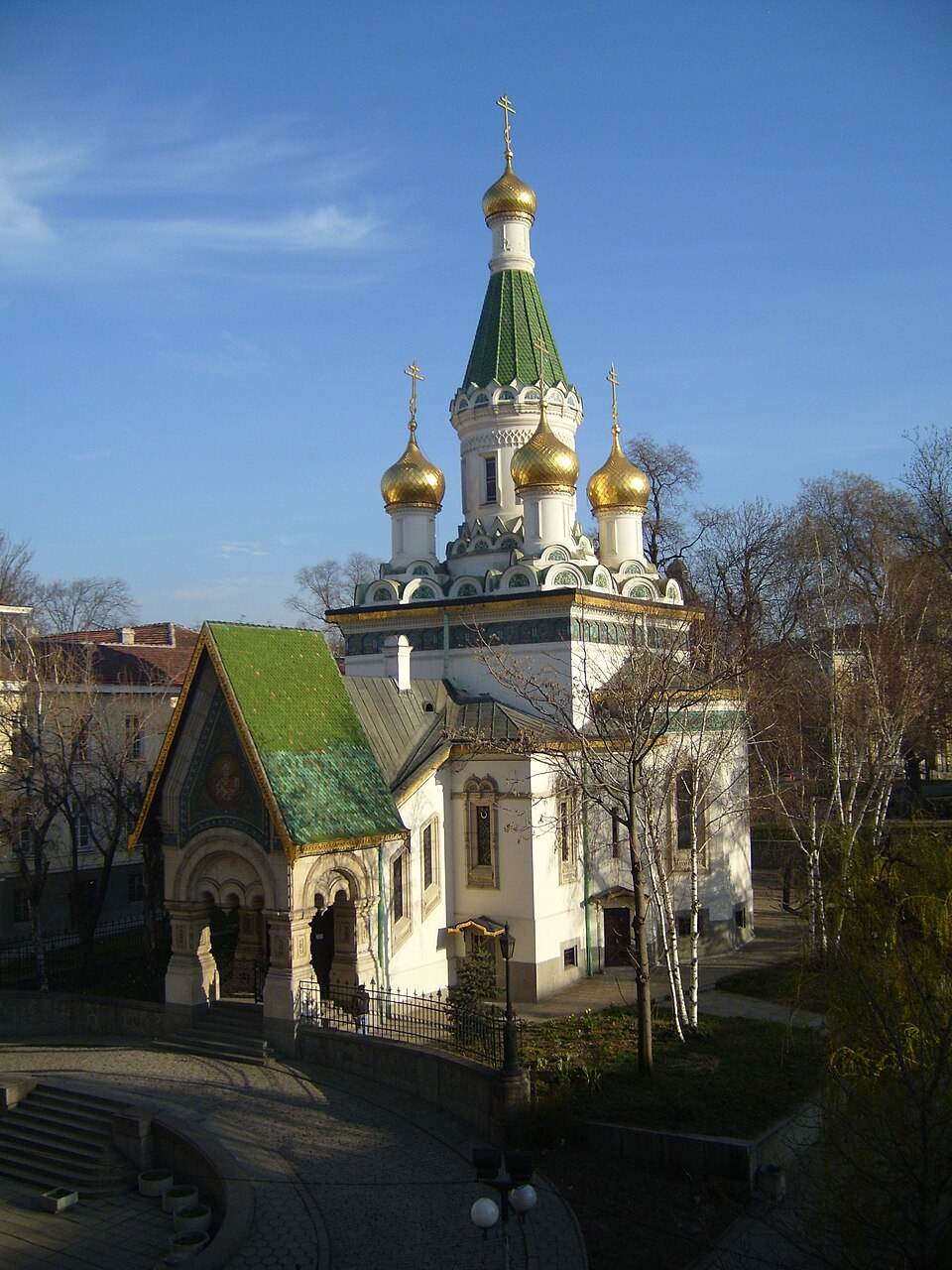
1914 · Mikhail Preobrazhensky
Formally the Church of St Nicholas the Miracle-Maker, the Russian Church stands on Tsar Osvoboditel Boulevard in central Sofia. Its Russian Revival design, by the architect Mikhail Preobrazhensky, sets it apart from the Byzantine-influenced style used in the city's other Orthodox churches.
The Russian Church, formally the Church of St Nicholas the Miracle-Maker, is a Russian Orthodox church on Tsar Osvoboditel Boulevard in central Sofia. It was built in 1914 to a design by the architect Mikhail Preobrazhensky, who died in 1930, in the Russian Revival architectural style. The church belongs to the wave of construction that followed Sofia's establishment as capital of the Third Bulgarian State in 1879, and its style marks a departure from the Byzantine-influenced architecture found in the city's older Orthodox churches.
- Its official name honours St Nicholas the Miracle-Maker, though it is generally known simply as the Russian Church.
Photo: SiefkinDR (Public domain)
Boyana Church
A medieval Bulgarian Orthodox church on the outskirts of the city, added to the UNESCO World Heritage List in 1979. Built in stages from the late 10th century to the mid-19th, its walls carry 89 fresco scenes with 240 human figures.
Largo
An architectural ensemble of three Socialist Classicism buildings around Independence Square, designed and built in the 1950s as the city's representative centre. It comprises the Council of Ministers and TSUM department store, the National Assembly with its spired former Party House, and the Presidential Administration.
Church of Saint George
A late-antique red-brick rotunda built in the early 4th century as Roman baths, later a church in Serdica and considered the oldest building in modern Sofia. Its central dome carries three layers of frescoes, later painted over when the building became a mosque.
Saint Nedelya Cathedral
An Eastern Orthodox cathedral whose temple dates from the 10th century, serving as the city's cathedral since the 18th century and rebuilt repeatedly after destruction. The present building, designed by the architectural team Vasilyov-Tsolov, holds the relics of the Serbian king Stefan Uroš II Milutin.
Ivan Vazov National Theatre
Bulgaria's national theatre, the oldest in the country, facing the City Garden in the city centre with a 750-seat main stage plus two smaller stages. Its façade appears on the obverse of the Bulgarian 50 levs banknote issued in 1999 and 2006.
National Palace of Culture
A multifunctional conference and cultural centre opened on 31 March 1981 to mark the 1300th anniversary of the Bulgarian state. Initiated at the suggestion of Lyudmila Zhivkova, its interior uses geometric motifs, dark colours, murals, mosaics, sculpture, and metalwork.
Royal Palace
A landmark on Battenberg Square, built after Bulgaria became a semi-independent principality in 1878 as the residence of its first knyaz, Alexander I Battenberg. Having witnessed the country's shift from monarchy through socialist republic to today's democracy, it now forms part of the National Gallery.
Sofia Synagogue
A Romaniote Orthodox Jewish synagogue completed in 1909, the largest in Southeastern Europe and the third-largest in Europe. It remains one of only two active synagogues in Bulgaria, though services now draw just 50 to 60 worshippers.
National Archaeological Museum
An archaeological museum occupying the largest and oldest former Ottoman mosque in the city, begun in 1451 under grand vizier Veli Mahmud Pasha and completed in 1494. Established as the National Museum in 1893, it opened officially in 1905.
Central Mineral Baths
A landmark in the city center, built in the early 20th century near the site of a destroyed Turkish bathhouse. It served as the city's public baths until 1986.
Statue of Sofia
A monumental sculpture unveiled by the capital's mayor on 28 December 2000, erected in just two days on a spot once occupied by a statue of Lenin. It was originally meant to be called Saint Sophia, but the Orthodox Church judged the name too pagan.
Monument to the Tsar Liberator
An equestrian monument in the city centre honoring Russian Emperor Alexander II, who freed the Russian serfs and won the Russo-Turkish War of 1877-78. Designed by Italian sculptor Arnoldo Zocchi, who won the commission over 31 other entrants, it was completed in 1903.
Amphitheatre of Serdica
The ruins of a Roman amphitheatre discovered in 2004, built in the 3rd-4th century AD atop an earlier theatre destroyed by the Goths. Among the largest in the eastern Roman Empire, it hosted gladiator and beast fights but was abandoned by the 5th century.
Borisova gradina
The oldest and best-known park in the city, its layout begun in 1884 and named for Bulgarian Tsar Boris III. Its design passed through three periods under three successive gardeners, each building on the original scheme rather than replacing it.
Vasil Levski National Stadium
The country's second-largest stadium, with 43,230 seats, named after national hero Vasil Levski and located within the Borisova gradina park. It hosts the Bulgaria national football team's home matches and Bulgarian Cup finals, as well as athletics competitions and Sofia derbies.
Eagles' Bridge
A bridge over the Perlovska River in downtown Sofia, named for the four eagle statues that stand on it as symbolic guardians. It lies near the Vasil Levski National Stadium, the Monument to the Soviet Army, and Borisova gradina.
Lions' Bridge
A bridge over the Vladaya River built between 1889 and 1891 by Czech architect Václav Prošek with his brother and cousins. It gives its name to the busy junction of Marie Louise and Slivnitsa boulevards, connecting the Central Railway Station to the city centre.
City Garden
The city's oldest and most central public garden, in existence since 1872. Rearranged under city architect Antonín Kolář after the 1878 liberation of Bulgaria, it was originally named the Alexander II Garden for the Russian tsar.
National Opera and Ballet
Bulgaria's national institution for opera and ballet, housed in an imposing building in the city. Its roots trace to the Bulgarian Opera Society, founded in 1908, which staged the country's first full opera, Pagliacci, in 1909.
Seven Saints Church
A Bulgarian Orthodox church established in 1547 as an Ottoman mosque, the Black Mosque, before its conversion and inauguration as a church on 27 July 1903. It is dedicated to Cyril and Methodius and their five disciples, together known as the Sedmochislenitsi.
Church of St Petka of the Saddlers
A medieval Bulgarian Orthodox church, partly below ground level, set inside a semi-submerged shopping mall. It can be reached via the Serdika metro station.
Old Parliament House
The National Assembly Building, still used for parliamentary debates, designed in Neo-Renaissance style by Serbian-Bulgarian architect Konstantin Jovanović and built between 1884 and 1886. Its façade appears on the reverse of the Bulgarian 20 leva banknote, issued in 1999 and 2007.
Central Market Hall
A covered market on Marie Louise Boulevard, opened in 1911. It remains an important trade centre in the city today.
SS. Cyril and Methodius National Library
Bulgaria's national library, founded on 4 April 1878, gaining national-library status three years later and absorbing the Bulgarian National Revival Archive in 1924. Its present building, designed by the architectural team Vasilyov-Tsolov and completed between 1940 and 1953, is counted among the city's landmarks.
Monument to the Soviet Army
A partially dismantled monument on Tsar Osvoboditel Boulevard, built in 1954 to mark the tenth anniversary of the Soviet liberation. It depicts a Soviet soldier as a freedom fighter flanked by a Bulgarian woman and man, and was partially removed in December 2023.
History
The area has been inhabited since at least 7000 BC and was taken from the Celtic Serdi by the Roman Republic in 29 BC, becoming Serdica. Its Church of Saint Sophia was raised as a basilica in the fourth century, in that Roman and early Byzantine period. Khan Krum brought the city into the First Bulgarian Empire in 809, and it changed hands between Byzantine and Bulgarian rule until the Ottoman conquest of 1382. From 1530 to 1836 it served as regional capital of Rumelia, the empire's largest province, a status that produced the 1566 Banya Bashi Mosque. Bulgarian rule returned in 1878, and Sofia became capital of the Third Bulgarian State in 1879, driving the growth that funded the Russian Church of 1914 and the Alexander Nevsky Cathedral, under construction from 1882 and largely complete by 1912.