Landmarks in Skopje
Ottoman stone survives in a valley whose skyline was almost entirely rebuilt after 1963.
Skopje's oldest landmarks sit close together on either bank of the Vardar River, in and around the Old Bazaar and the fortress hill above it: a fortified height overlooking the water, a stone bridge crossing to the market quarter, a mosque built into the bazaar itself, and an Orthodox church on the rising ground behind the fortress. All but the fortress date from the fifteenth and sixteenth centuries, when five hundred years of Ottoman rule reshaped the city's religious and commercial life. Little else from before the twentieth century remains: a 1963 earthquake destroyed much of Skopje, and the modern city around these older structures was rebuilt afterward with international assistance, in largely different materials and styles.
Stone Bridge
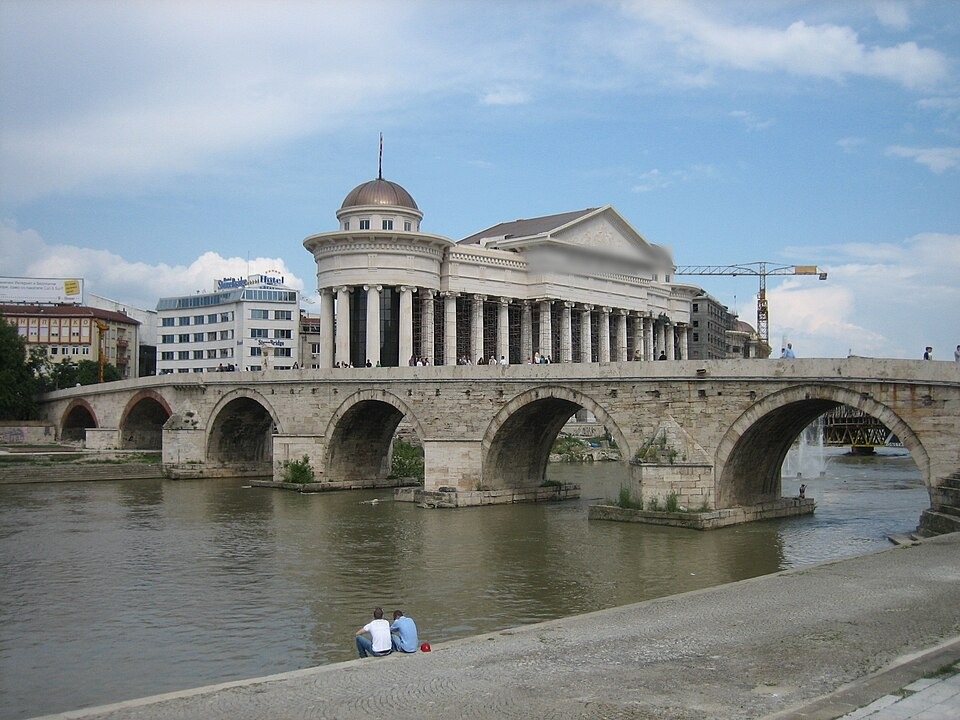
1451
A low stone bridge of repeated round arches, its outline reproduced on the city's coat of arms and flag, crossing the river between the main square and the old bazaar.
The Stone Bridge crosses the Vardar River in Centar Municipality, connecting the main square to the Old Bazaar on the opposite bank. It was built for Sultan Mehmed the Conqueror and is registered as a heritage site in North Macedonia. Long treated as a symbol of the city, its arched form appears on the municipal coat of arms and, through that, on the city flag. The crossing still functions as a footbridge, joining the same two quarters — square and market — that it was raised to connect.
- It carries three names in daily use — Kamen most in Macedonian, Ura e gurit in Albanian, and Taşköprü in Turkish — all of which simply mean 'stone bridge.'
Photo: Prince Roy (CC BY 2.0)
Skopje Fortress
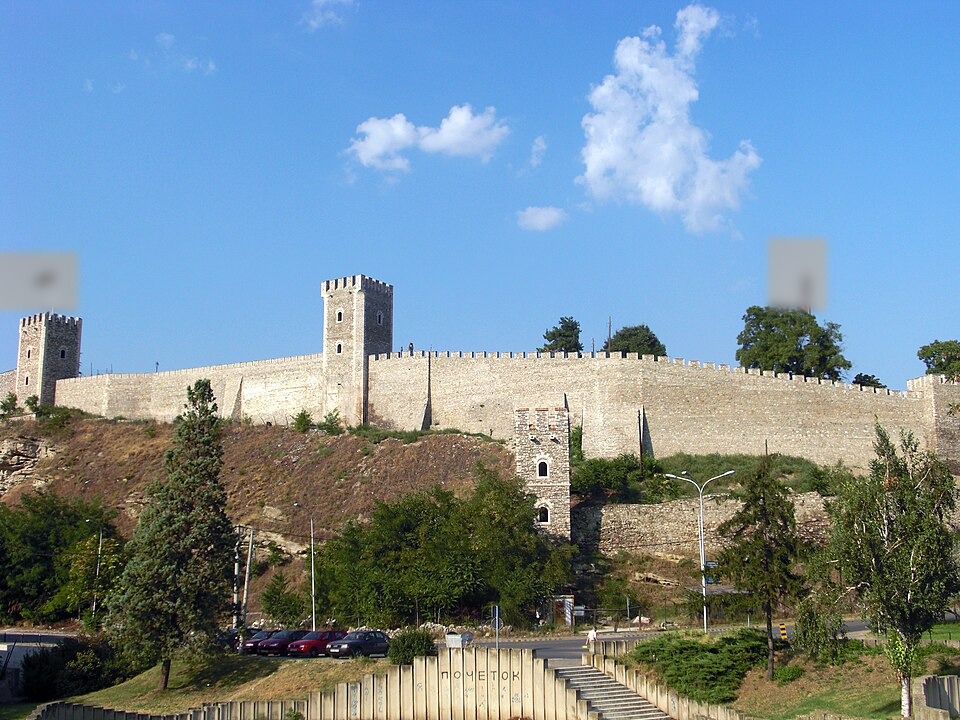
6th century
Stone ramparts trace the crown of a hill above the river; what lies inside reads as an excavated archaeological ground rather than a furnished castle interior, and its outline, like the nearby bridge's, appears on the city's coat of arms.
Skopje Fortress, generally known by the Turkish word for fortress, Kale, occupies the highest point in the old town, above the Vardar River. It is catalogued as an archaeological site as well as a fortification, meaning what survives today is largely excavated wall remains rather than an intact interior. Its outline, like that of the nearby bridge, is depicted on the city's coat of arms and, through that, its flag. The site is registered as a heritage site in North Macedonia.
- Its common name, Kale, is simply the Turkish word for 'fortress'; the Macedonian and Albanian names for the site translate the same way.
Photo: Yemc (Public domain)
Mustafa Pasha Mosque
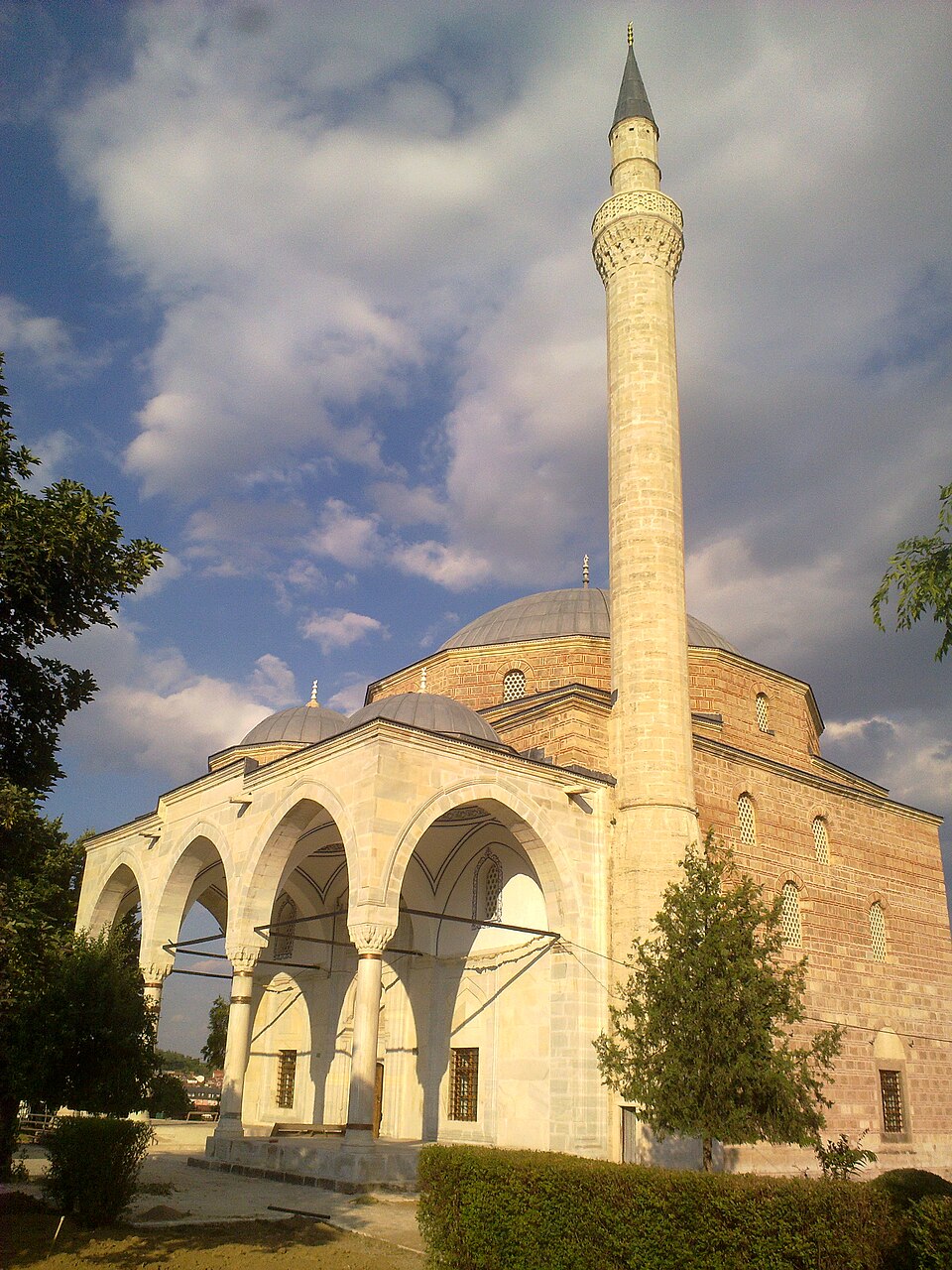
1492
An Ottoman-era mosque standing among the stalls of the Old Bazaar, one of the district's oldest religious buildings rather than a later addition to the market around it.
Mustafa Pasha Mosque is an Ottoman-era mosque built in 1492 in the Old Bazaar of Skopje. It belongs to the same fifteenth-century wave of Ottoman construction that gave the surrounding market quarter its lasting form, standing among stalls and workshops rather than as an isolated monument. Its architecture follows the Ottoman style typical of religious buildings from the period. The mosque is registered today as a heritage site in North Macedonia.
Photo: Antti T. Nissinen from Finland (CC BY 2.0)
Church of the Ascension of Jesus
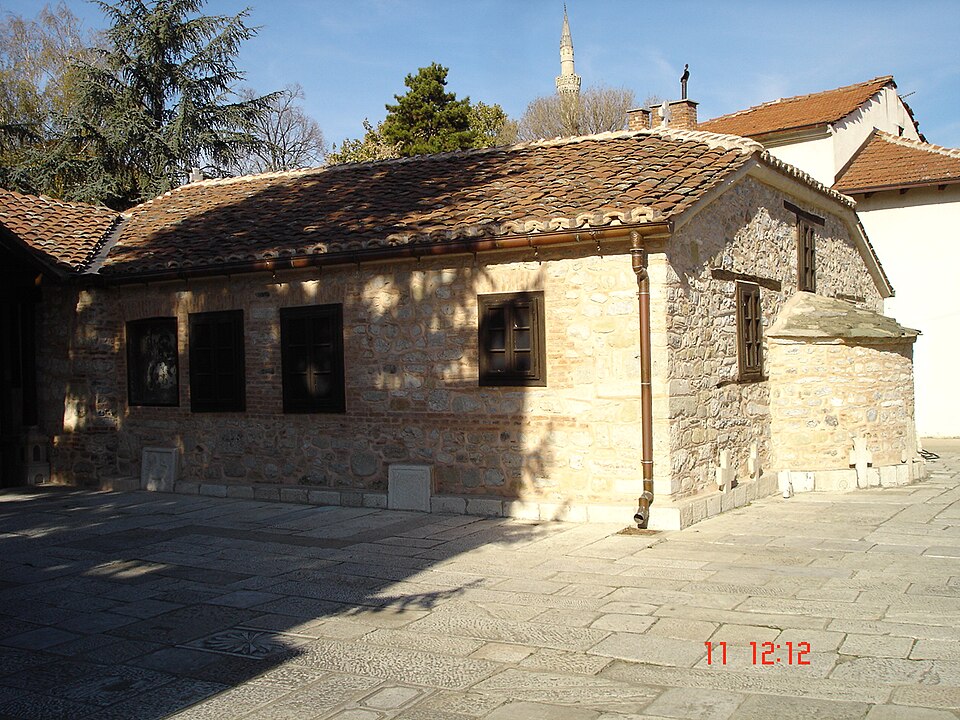
1544
A three-nave stone church, its central nave arched and its flatter side bays covered with small domes, entered through a heavy oak door into a courtyard that holds a white marble sarcophagus.
The Church of the Ascension of Jesus stands east of Kale Fortress and was built in the mid-sixteenth century as a three-nave Eastern Orthodox church, with an arched central nave, domed side bays, and a women's gallery to the west. Its iconostasis was completed in 1824 and fitted with throne icons in 1867, both made by cooperatives and traders from Skopje. In 1901 it became the seat of the Skopje Metropolitan, Firmilijan, and his successors. A heavy oak door leads into its courtyard, where a white marble sarcophagus holds the remains of the revolutionary Gotse Delchev.
- A wall painting uncovered during repairs in 1963–64 was found to date from the sixteenth or seventeenth century.
- In 1874 the congregation voted, by 91 percent, to join the Bulgarian Exarchate, a decision reversed by 1890 when Greek priests regained the church.
Photo: Македонец (CC BY 3.0)
Old Bazaar
A bazaar on the Vardar's eastern bank, running from the Stone Bridge to Bit-Pazar and from Skopje Fortress to the Serava river. One of the oldest and largest marketplaces in the Balkans, it has been the city's trading center since at least the 12th century.
Skopje Aqueduct
An aqueduct and archaeological site in the Vizbegovo neighborhood, 2 kilometers northwest of central Skopje. It is the only aqueduct in North Macedonia and one of the three largest and best preserved in the former Yugoslavia, alongside examples near Split and in Montenegro.
Millennium Cross
A 66-meter cross on top of Vodno Mountain above Skopje, built in 2002 as one of the tallest crosses in the world. It commemorates 2,000 years of Christianity in Macedonia and Saint Paul's evangelizing in the region, and has become a symbol of the city.
Scupi
An archaeological site between Zajčev Rid and the Vardar River near Skopje, where a Roman camp was founded in the 2nd century BC over an older Dardanian settlement. It became the chief center for Romanizing Dardania before its abandonment in AD 518 after an earthquake.
Museum of the City of Skopje
A museum tracing Skopje's development from its earliest settlements around 3000 BC to the present, established in 1949 and opened in 1951. Since 1970 it has occupied a renovated section of the old railway station, badly damaged in the 1963 Skopje earthquake.
National and University Library "St. Kliment of Ohrid"
North Macedonia's national library, founded on 23 November 1944 by decision of the Anti-Fascist Assembly of the National Liberation of Macedonia. Its patron, Saint Clement of Ohrid, established the region's first monastic library, and the collection continues a tradition of medieval Macedonian monastic libraries.
Memorial House of Mother Teresa
A museum in Skopje dedicated to Mother Teresa, built on the site of the former Sacred Heart of Jesus church, where she was baptized. Opened in January 2009 in her hometown, where she lived from 1910 to 1928, it drew 12,000 visitors in three weeks.
Museum of Contemporary Art
The country's biggest and most modern museum, founded in 1963 after the earthquake that struck Skopje that year. Donated by the Polish government and designed by the Polish group Tigers, winners of a 1966 competition among over 80 entries, it symbolizes post-earthquake solidarity.
Church of St. Clement of Ohrid
A cathedral church of the Macedonian Orthodox Church in Skopje, often called simply the Soborna Crkva. It is the largest cathedral belonging to the Macedonian Orthodox Church.
Church of St. Panteleimon, Gorno Nerezi
A small 12th-century Byzantine church in a monastery complex at Gorno Nerezi, built in 1164 and dedicated to St. Panteleimon, patron of physicians. Damaged by a 16th-century earthquake, it preserves Komnenian-era frescoes, once painted over and restored in 1923, later shown on a banknote.
Sobranie Palace
The seat of the Assembly of North Macedonia, built in 1938 under the Kingdom of Yugoslavia to house the Vardar Banovina administration. It became the Socialist Republic of Macedonia's seat in 1944, and since 1991 has served as parliament and, until 2009, the president's office.
Sultan Murad Mosque
An Ottoman-era mosque built in the 15th century on the site of the Monastery of Saint George. The monastery had been destroyed when Ottoman commander Pasha Yiğit Bey captured Skopje from Vuk Branković in 1392.
Suli An
A han in the Old Bazaar of Skopje, built in the mid-15th century by Isa-Beg Isaković. It now houses the Museum of the City of Skopje's permanent exhibition on the history of the Old Bazaar.
Murat Pasha Mosque
A mosque in Skopje, North Macedonia.
Skanderbeg Square
A square in Skopje running from the Macedonian Philharmonic and Opera to the Old Bazaar, covering 28,000 square meters. An equestrian statue of Albanian ruler Skanderbeg was installed in 2006, and the square was rebuilt between 2014 and 2018 for about 10 million euros.
Kral Kızı Mausoleum
A türbe dedicated to the Bosnian princess Catherine, near the Faculty of Natural Sciences and Mathematics of Ss. Cyril and Methodius University. Destroyed in the 1963 earthquake, it was rebuilt in 2014 by North Macedonia's Ministry of Culture with funding from Bosnia and Herzegovina.
Macedonia Square
Skopje's main square and the largest in North Macedonia, covering 18,500 square meters and crossing the Vardar River in the city center. It hosts Christmas festivals and other events, and it was here that Kiro Gligorov, the country's first president, declared independence from Yugoslavia.
Porta Macedonia
A memorial arch on Pella Square, 21 meters tall, built between 2011 and January 2012 at a cost of 4.4 million euros. Designed by sculptor Valentina Stevanovska for 20 years of Macedonian independence, it carries 193 square meters of marble reliefs of Macedonian history.
Church of Sts. Constantine and Helena
A Macedonian Orthodox church on Street Macedonia in Skopje. It was built as part of the Skopje 2014 project.
Church of the Nativity of the Theotokos
An Eastern Orthodox church in Skopje, North Macedonia.
Museum of the Republic of North Macedonia
A national institution in the Old Bazaar near Skopje Fortress, formed by merging the archaeological, historical and ethnological museums of Macedonia. Its oldest component, the archaeological museum, opened in 1924, the date now used as the institution's founding year.
Holocaust Memorial Center for the Jews of Macedonia
A memorial in Skopje to the 7,148 Jews of North Macedonia killed in the Holocaust, and to the wider history of Jews in the Balkans.
Archaeological Museum of the Republic of North Macedonia
An archaeological museum in Skopje, North Macedonia.
History
The area has been inhabited since the Chalcolithic period, but the city itself began as Scupi, founded in the late first century under the Roman emperor Domitian. An earthquake destroyed it in 518; Justinian I had it rebuilt. The settlement grew significant under the First Bulgarian Empire and, briefly, as a capital of the Serbian Empire, before five centuries of Ottoman rule left the bridge, the mosque and much of the Old Bazaar that still stand. Serbia annexed the city in 1912; it later became part of Yugoslavia and, after the Second World War, capital of the Socialist Republic of Macedonia. A 1963 earthquake devastated Skopje again, and the city was rebuilt with international help before becoming capital of independent North Macedonia in 1991.