Landmarks in Tirana
Ottoman mosque, clock tower and stone bridge stand beside a 1941 rationalist palace.
Tirana's landmarks cluster close to where the Ottoman nobleman Sylejman Pasha founded the city in 1614. The Et'hem Bey Mosque and the Clock Tower stand together as a single complex, built in stone in the late Ottoman style that shaped the settlement for three centuries. A short distance away, the Tanners' Bridge is a plain stone arch that once carried livestock and produce along the road to the eastern highlands, before the stream beneath it was diverted in the 1930s. The one break from this Ottoman fabric is the Palace of Brigades, a large rationalist building commissioned in the years before the Second World War, built at a scale and in a style unlike anything raised in the city before it.
Et'hem Bey Mosque
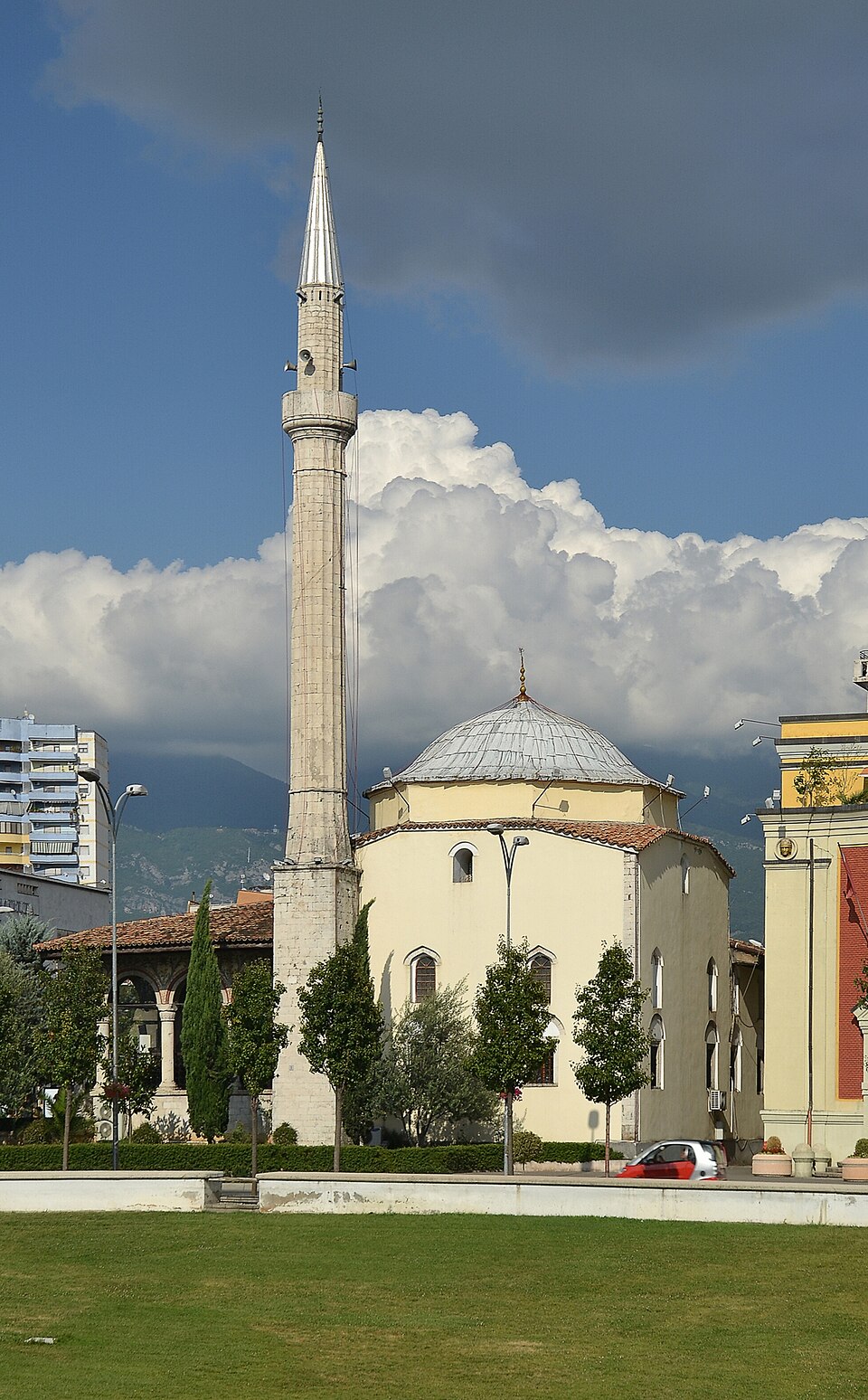
1789–1821
Painted frescoes of trees, waterfalls and small bridges cover the walls of its portico, both outside and in — an unusual decorative scheme for a mosque, and the detail most visitors remember.
The Et'hem Bey Mosque is a Sunni mosque that forms an architectural complex with the neighbouring clock tower. Its portico is painted, inside and out, with frescoes of trees, waterfalls and bridges, an unusual decorative scheme for a mosque in the region. Closed under Communist rule, it reopened as a place of worship in 1991 and now offers daily tours, except during prayer service; visitors remove their shoes before entering the inner room.
- When the mosque reopened in 1991, some 10,000 people attended without official permission, and police did not intervene.
Photo: Pudelek (CC BY-SA 4.0)
Clock Tower of Tirana
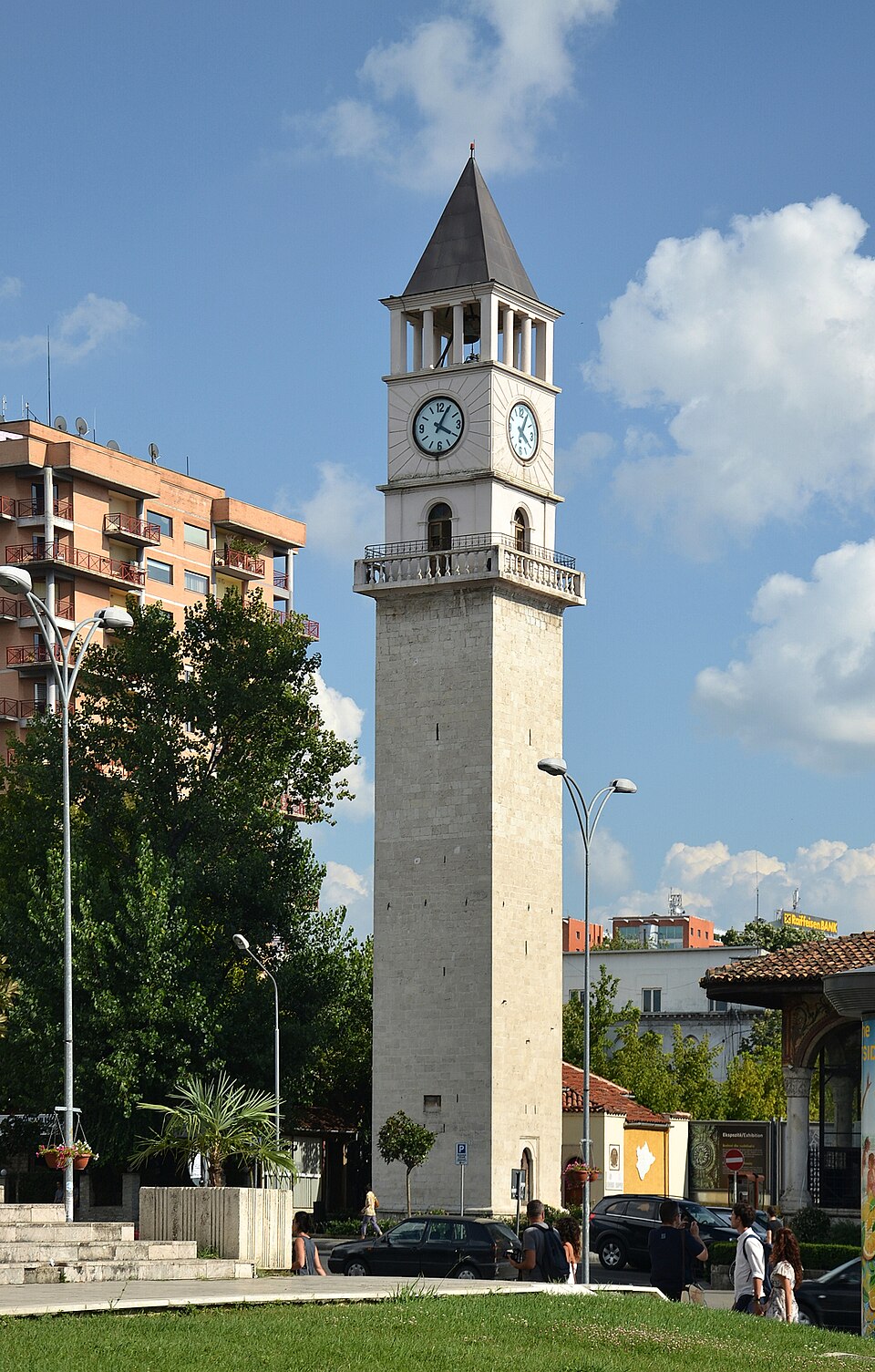
1822
A tower topped with a clock face, standing immediately beside a frescoed mosque with which it forms a single architectural complex.
The Clock Tower of Tirana is an Ottoman-era monument that forms a single architectural complex with the frescoed mosque standing beside it. It gained formal heritage protection in 1948 from the Institute of Sciences, and was redesignated twice more, by the State University of Tirana in 1963 and by the Ministry of Education and Culture in 1973, confirming its status as a protected cultural monument rather than changing the structure itself.
- It was granted heritage protection three times by three different institutions across twenty-five years: 1948, 1963 and 1973.
Photo: Pudelek (CC BY-SA 4.0)
Tanners' Bridge
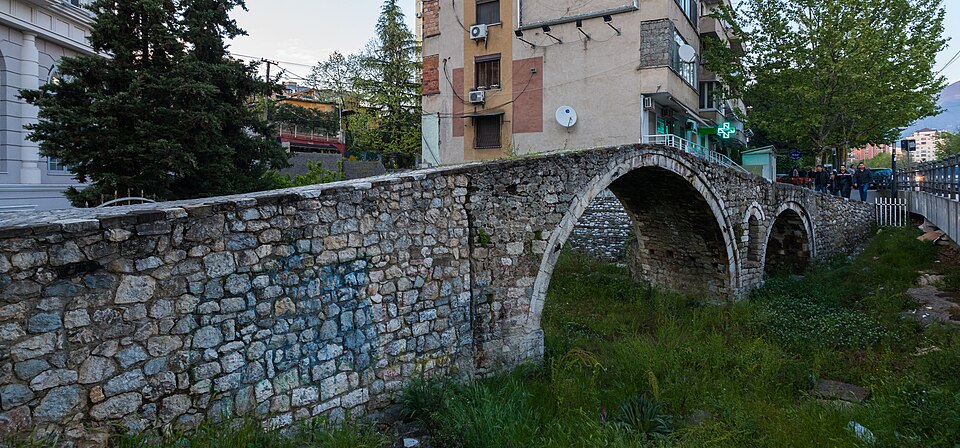
1700
A single low stone arch, just wide enough for foot traffic, crossing a streambed that has carried no river beneath it since the waterway was diverted decades ago.
The Tanners' Bridge is a stone footbridge over the Lanë stream, built near the Tanners' Mosque where butchers and leather workers once worked. It carried the Saint George Road, the route by which livestock and produce reached the town from the eastern highlands. Disused after the stream was diverted in the 1930s, the crossing fell into disrepair until it was restored for pedestrians in the 1990s.
Photo: Diego Delso (CC BY-SA 3.0)
Palace of Brigades
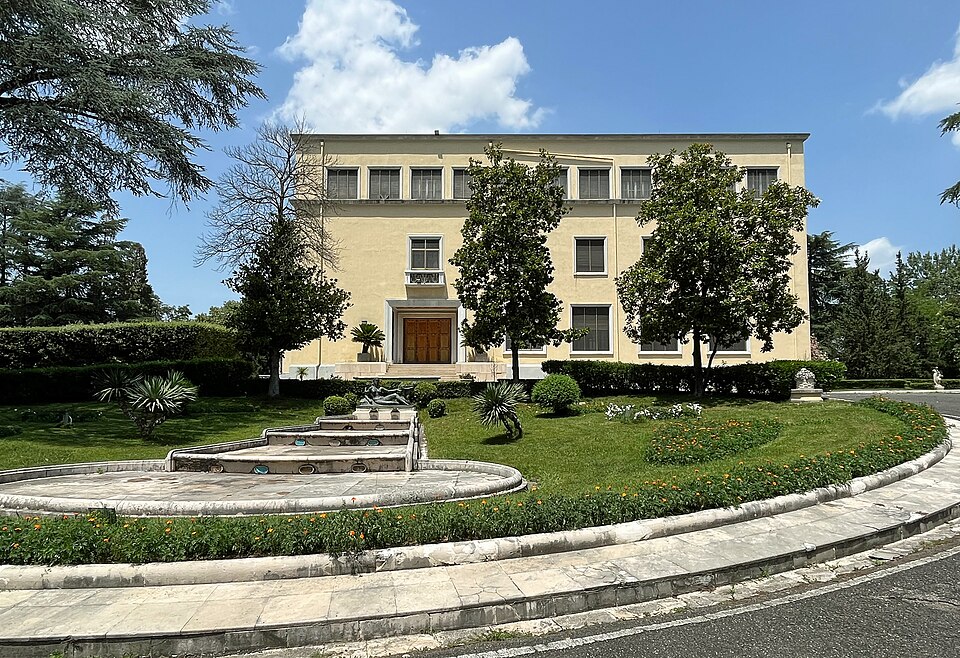
1941 · Gherardo Bosio
A stark, geometric rationalist building with bas-relief sculpture across its façade — reliefs that were hidden behind drapes for years rather than removed.
The Palace of Brigades, now the Presidential Palace, was commissioned by King Zog I as his official residence and designed by the Italian architect Gherardo Bosio in the rationalist style. It lost its royal function in 1945, when the monarchy was replaced by a Communist government, after which the state used it for ceremonies and receptions. Its bas-relief façades were covered with drapes during the 1970s cultural revolution but survived intact, and since 2013 part of its grounds has again served as a head of state's residence.
- The building was still unfinished when a photograph of it appeared in Life magazine on 22 May 1939.
- Its architect, Gherardo Bosio, died in 1941, the year the palace was completed.
Photo: Albinfo (CC BY-SA 4.0)
Pyramid of Tirana
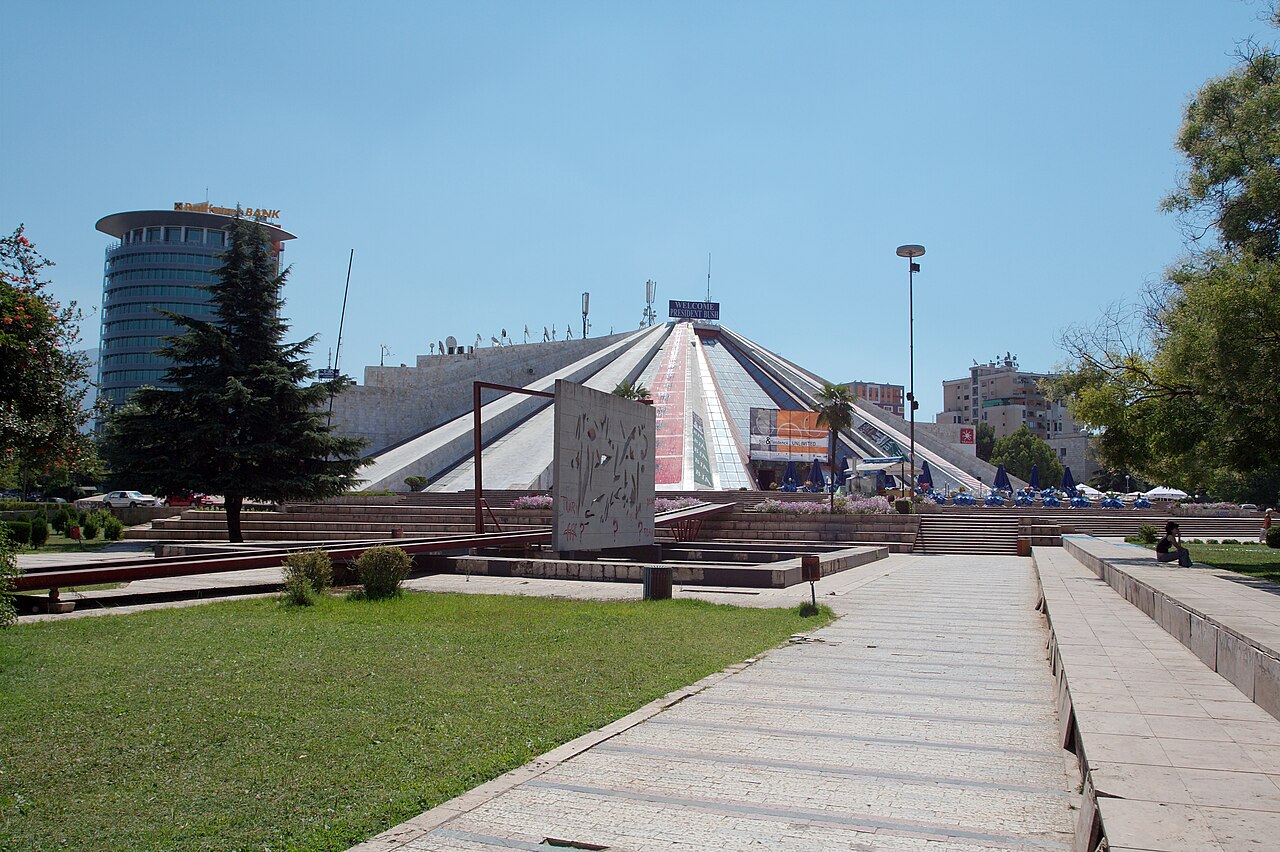
1988–2023 · MVRDV
A concrete building shaped like a stepped pyramid, its sloping sides converted into a staircase that can be climbed, with new glass skylights and colourful elements added during a recent renovation.
The Pyramid of Tirana opened in 1988 as a museum dedicated to Communist leader Enver Hoxha, designed by his daughter Pranvera Hoxha with Klement Kolaneci, Pirro Vaso and Vladimir Bregu. After 1991 it became a conference and exhibition venue, and in 1999 served briefly as a NATO base during the Kosovo War. Left to decline for two decades — part used as a broadcasting centre for local television and radio, the rest as a parking lot — it was renovated by MVRDV into a youth technology centre, preserving the original concrete structure and reopening in 2023.
- When built, it was reportedly the most expensive individual structure ever constructed in Albania.
- It has been sardonically nicknamed the "Enver Hoxha Mausoleum," though that was never an official name.
- Part of a 2019 remake of the 1995 horror film Castle Freak was filmed inside the building before its renovation.
Photo: Dori (CC BY 2.5)
Resurrection Cathedral
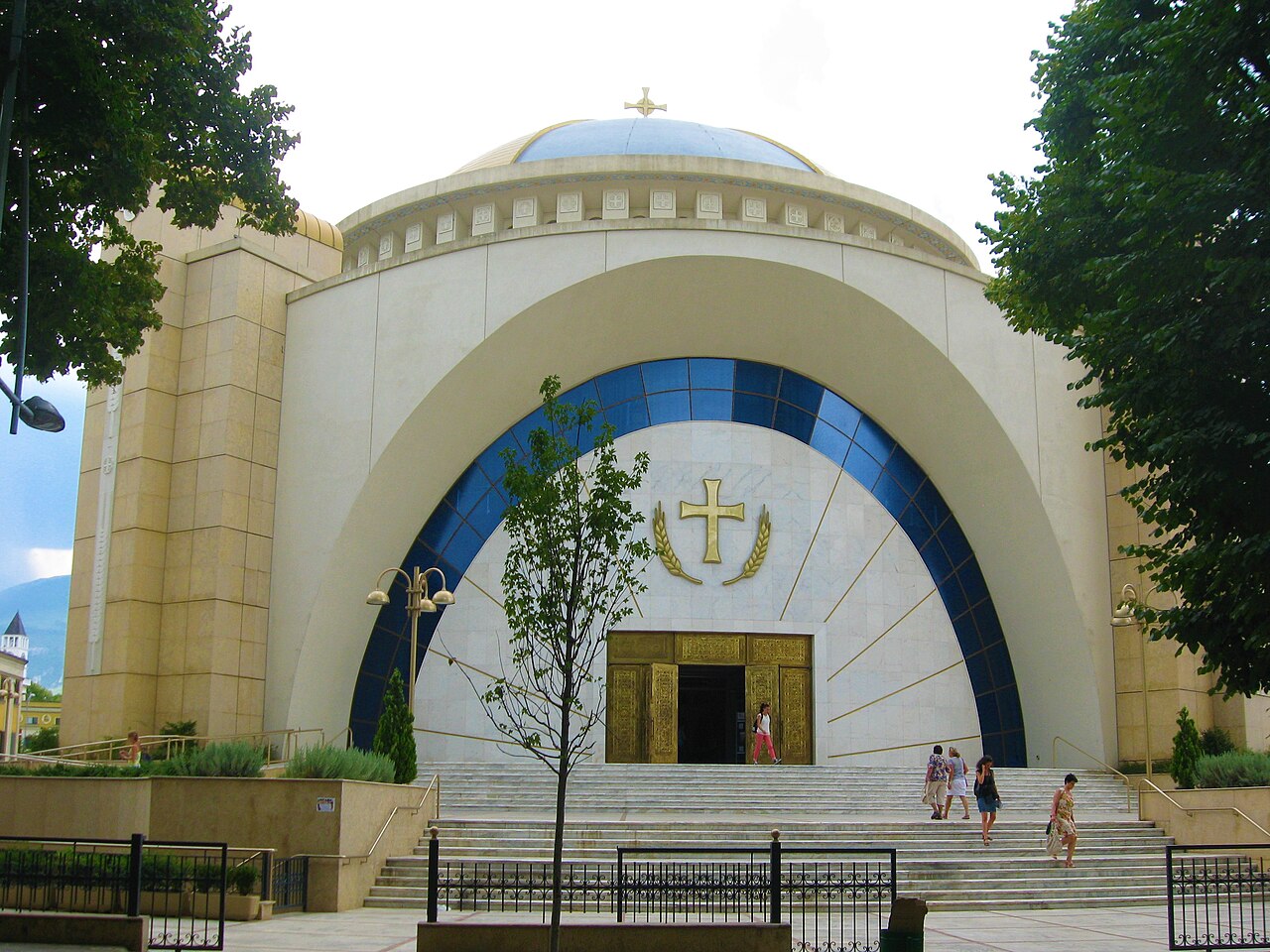
2005–2012 · Steven P. Papadatos
A cross-shaped Byzantine-style cathedral with a tall bell tower built as four fluted candles joined around a central spiral stair, topped by a four-faced clock and an open belfry; the dome behind it rises about 32 metres, the tower some 46.
The Resurrection of Christ Cathedral is an Albanian Orthodox cathedral designed by the New York-based architect Steven P. Papadatos with Lizardos Engineering Associates, among the largest Eastern Orthodox church buildings in the Balkans. Its complex includes a chapel, a bell tower, clergy housing, a cultural centre, a library and a small museum, with two underground levels built as a conference and concert venue seating up to 850. Opened in June 2012 to mark the twentieth anniversary of the Albanian Orthodox Church's revival, it received its full liturgical consecration two years later, attended by patriarchs of several Orthodox churches.
- Its bell tower is shaped as four giant Paschal candles symbolising the four Evangelists, designed and sculpted by Archbishop Anastasios himself.
- The cathedral's two underground levels house an amphitheatre seating 500 to 850 people, which can also be used as a theatre.
Photo: Inga Tomane (CC BY-SA 4.0)
Namazgah Mosque
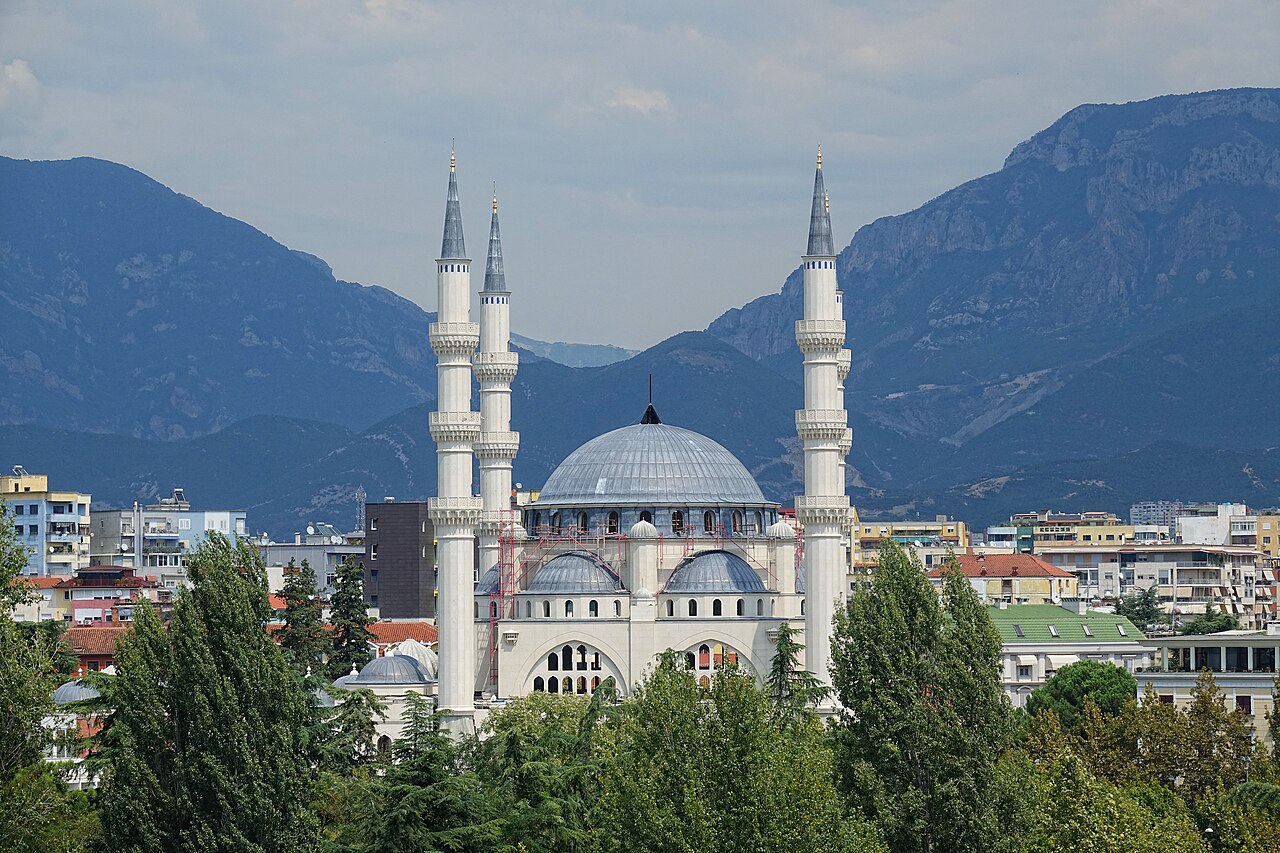
2015–2024
A large Ottoman-style mosque with four slender minarets about 50 metres tall flanking a central dome roughly 30 metres high, set within a paved courtyard large enough for thousands to pray outdoors.
The Namazgah Mosque, also known as the Great Mosque of Tirana, is a Sunni mosque with capacity for 10,000 worshippers, built in a style drawing on Classical Ottoman architecture. President Sali Berisha laid a symbolic first stone in 1992 near the parliament building, but construction stalled amid political objections. The decision to proceed was taken in 2010, after the number of mosques in the city fell from 28 in 1967 to eight. Building began in 2015 with partial financing from Turkey's Diyanet, and the mosque opened on 10 October 2024, replacing an Ottoman-era mosque as the city's principal one.
- President Sali Berisha laid a symbolic first stone near the site in 1992, more than two decades before actual construction began.
- Turkish president Recep Tayyip Erdoğan attended ceremonies both when construction launched in 2015 and when the mosque officially opened in 2024.
- It replaced the Et'hem Bey Mosque, previously the city's principal mosque, whose capacity of only 60 people had made outdoor prayer common in Skanderbeg Square during holidays.
Photo: Bjørn Christian Tørrissen (CC BY-SA 4.0)
Skanderbeg Square
The main plaza of Tirana, covering about 40,000 square metres and dominated by the Skanderbeg Monument. Its surrounding city plan, begun by Armando Brasini in 1925 and continued by Florestano Di Fausto, frames landmarks including the National Opera, National Library, and Ethem Bey Mosque.
World Headquarters of the Bektashi
The international headquarters of the Bektashi Order, a Sufi order, on the eastern edge of Tirana. It includes a museum, library, and archive, and has been proposed as the territory of a small sovereign Bektashi state modeled on Vatican City.
Grand Park of Tirana
A 289-hectare public park in southern Tirana, built around an artificial lake and popularly known as the Park on the Artificial Lake. It includes the St Procopius Church, the Presidential Palace, a zoo, and a botanical garden with nearly 120 tree species.
Rinia Park
The central public park of Tirana, known as Youth Park. Built in 1950 during the communist era, it covers 2.98 hectares.
Petrelë Castle
A hilltop castle whose history dates to the 6th century under Byzantine emperor Justinian I, though the present triangular structure with two towers dates from the 15th century. Part of Krujë Castle's signal-fire defense network, it was once commanded by Skanderbeg's sister, Mamica Kastrioti.
Museum of Secret Surveillance
A historical museum, also known as the House of Leaves, opened in 2017 in the building that served as the headquarters of the communist-era secret police, the Sigurimi. It is dedicated to those who were spied on, arrested, and prosecuted under the regime.
National Theatre of Opera and Ballet
The largest theatre in Albania, hosting music and dance performances year-round. It is home to the National Theatre of Opera and Ballet of Albania.
National Martyrs' Cemetery
The largest cemetery in Albania, on a hill overlooking Tirana. It holds the 12-metre Mother Albania statue and was once the resting place of former leader Enver Hoxha, whose remains were later moved to a more modest grave.
Mother Albania
A 12-metre concrete statue at the National Martyrs' Cemetery, dedicated in 1972 by sculptors Kristaq Rama, Muntaz Dhrami, and Shaban Hadëri. It stands over roughly 28,000 graves of Albanian partisans killed in the Second World War, holding a wreath and a star.
Fortress of Justinian
A Byzantine-era castle in central Tirana, also known as Tirana Castle, dating from before 1300 at the crossing of the city's main roads. Little remains above ground beyond a 6-metre Ottoman-era wall, though its uncovered foundations have been built into the pedestrianised Murat Toptani Street.
Madrasa of Tirana
An Islamic educational institution founded on 1 March 1924, also known as the Hadji Mahmud Dashi Madrasa. Its curriculum combines religious education with general academic studies.
Dajti Castle
A 1.12-hectare archaeological site on Mount Dajti, containing the ruins of a Roman fortification possibly built over earlier Illyrian foundations. Discovered in 1963 and listed among Albania's Cultural Monuments, it underwent a three-year restoration project starting in 2008.
National Museum of Fine Arts
The national art museum of Albania, featuring works by Albanian artists such as Kole Idromeno and Sadik Kaceli. It closed in October 2021 for a revamp of its building and construction of a new one alongside it.
Postbllok Memorial
An installation-art memorial by writer Fatos Lubonja and artist Ardian Isufi, commemorating the atrocities of communist-era Albania. It opened on 26 March 2013 on Dëshmorët e Kombit Boulevard.
Selman Stërmasi Stadium
A multi-purpose stadium seating 7,308, home ground of KF Tirana and named for one of the club's greatest players, Selman Stërmasi. It was also used by Dinamo City and Partizani until 2010, when fee disputes ended the arrangement.
Kokonozi Mosque
An Ottoman-era mosque built in 1750, one of the few in Tirana to survive the communist dictatorship. Closed in 1966 and used as a food and later tobacco store, it reopened as a mosque on 18 February 1991.
Open Theatre of Tirana
An open-air theatre within the Grand Park of Tirana, known locally as an amphitheatre. Its near semi-circular form recalls the shape of classical Roman theatres, though it is not one.
Sheh Dyrri Tekke
A tekke in Tirana associated with the Qadiriyya Sufi order. It was designated a Cultural Monument of Albania in 1963.
Mausoleum of the Albanian Royal Family
The mausoleum of Albania's royal family, originally designed by Qemal Butka and inaugurated in 1935, then destroyed by communist forces in 1944. Rebuilt as a replica and reopened in 2012, it holds the remains of King Zog I and other members of the House of Zogu.
Kapllan Pasha Tomb
A Muslim türbe built in 1817 in central Tirana, with eight carved stone columns on an octagonal base. It once held the remains of an Ottoman ruler of Tirana, later repatriated to Istanbul, and was restored by the municipality in 1985.
History
Tirana was a minor Ottoman town for three centuries before it had any civic importance: founded in 1614 around the Old Mosque and a türbe, its surviving religious and craft-guild architecture — the Et'hem Bey Mosque, the Clock Tower beside it, and the Tanners' Bridge on the old road to the eastern highlands — all date from this period, built for a town of merchants and herders rather than a capital. That changed only in 1912, when the Congress of Lushnjë declared Tirana the capital of a newly independent Albania. The clearest result is the Palace of Brigades, commissioned by King Zog I and designed by the Italian architect Gherardo Bosio in a rationalist style unlike anything built in the city before, and kept in official use through the monarchy, the Communist government and the republic that followed.