Landmarks in Belgrade
A river-confluence fortress and a wave of Byzantine Revival domes define its skyline.
Belgrade's oldest built layer sits on the bluff where the Sava meets the Danube: a fortified citadel, expanded and rebuilt across centuries, still forms the historic core of the city. Away from the river, the skyline is shaped by two large Eastern Orthodox churches raised in the Byzantine Revival style during the twentieth century, one finished only in 2004 after decades of interrupted work, the other completed in 1940 and modelled closely on a medieval monastery. Government sits downtown in the seat of the National Assembly, near one of those churches. Together the landmarks read as two eras: an old river stronghold and a younger city rebuilding its national identity in brick and dome.
Belgrade Fortress
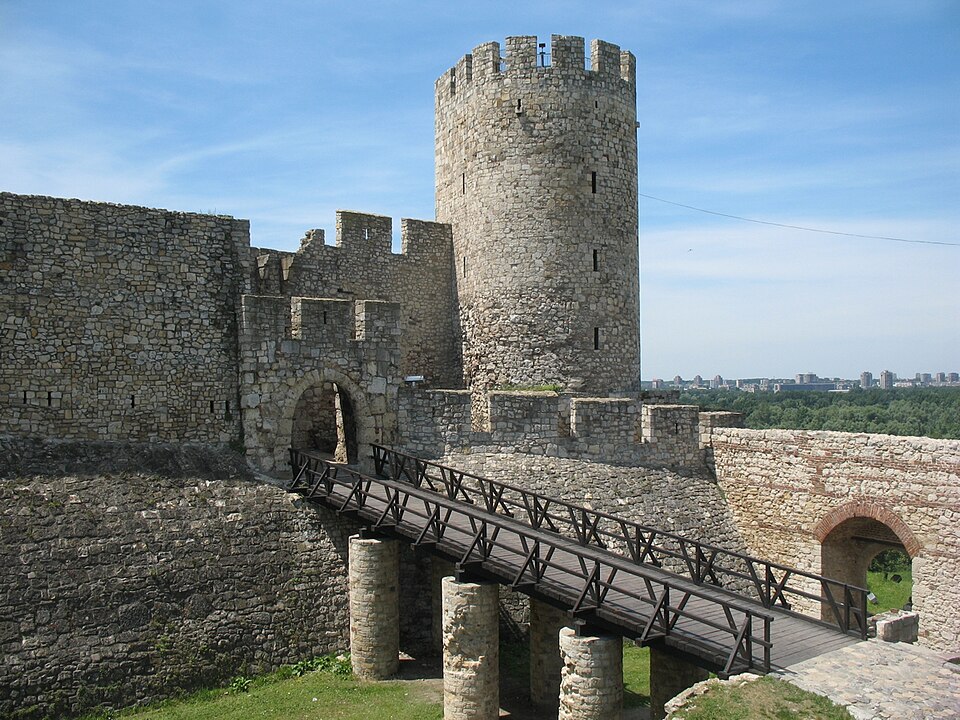
The old citadel's stone ramparts and bastions occupy a wooded bluff directly over the confluence, split into an Upper and a Lower Town and ringed today by the green expanse of a large riverside park.
This fortified citadel forms Belgrade's historic core, standing where the Sava and Danube rivers meet. It combines an old citadel, divided into Upper and Lower Town, with the surrounding parkland of Kalemegdan. Declared a protected monument soon after the Second World War, among the first such designations in Serbia, it was formally listed as a Monument of Culture of Exceptional Importance in 1979. It remains the most visited attraction in the city, drawing more than two million visitors a year.
- It draws more than two million visitors a year, more than any other sight in the city.
- It was among the first structures in Serbia to be officially declared a cultural monument, a status granted right after the Second World War.
Photo: CrniBombarder!!! (CC BY-SA 3.0)
Church of Saint Sava
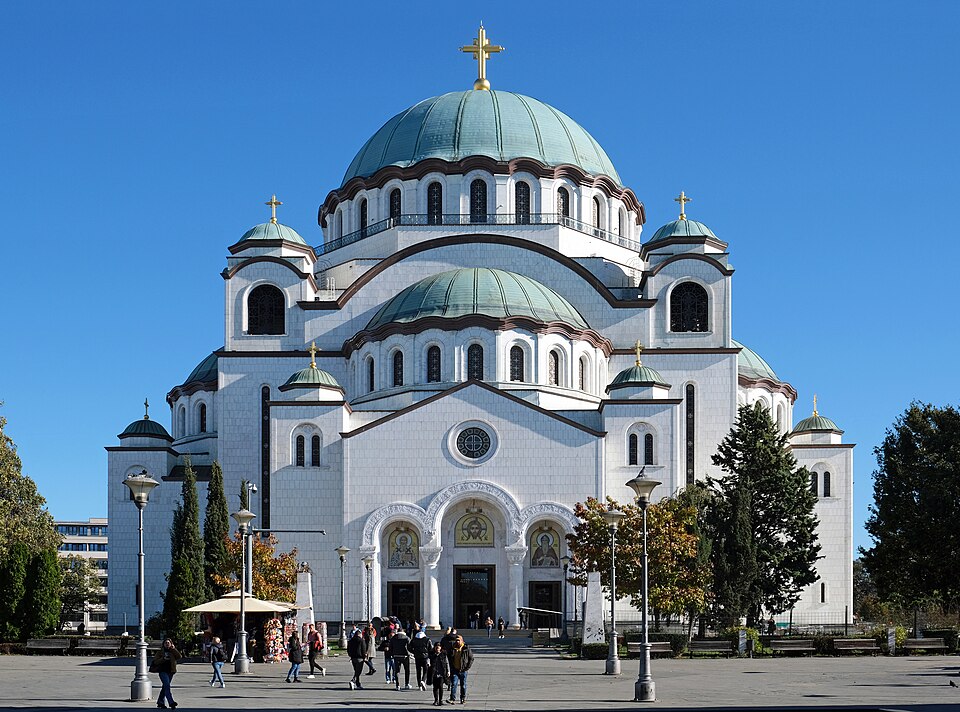
1935–2020 · Aleksandar Deroko
A vast Eastern Orthodox church crowned by a large central dome, built in the Byzantine Revival style and modelled in part on the Hagia Sophia; its sheer scale, among the largest Orthodox churches anywhere by volume, sets it apart from anything nearby.
The church is dedicated to Saint Sava, the first Serbian archbishop and the country's patron saint, and stands on the site where his relics are believed to have been burned by the Ottomans in 1594 after a Serb uprising. Construction began in 1935 and was repeatedly interrupted by war and political turmoil; the exterior was finished only in 2004, with interior work completed in 2020. Modelled in part on the Hagia Sophia, it ranks as the fourth largest Eastern Orthodox church in the world and one of the largest by volume.
- Building continued on and off for 85 years: started in 1935, its exterior finished in 2004, and its interior only in 2020.
- It stands on the spot where Ottoman forces are said to have burned the relics of Serbia's patron saint in 1594.
- Its design draws on the Hagia Sophia, and by volume it ranks among the largest Eastern Orthodox churches anywhere.
Photo: kallerna (CC BY-SA 4.0)
National Assembly of Serbia
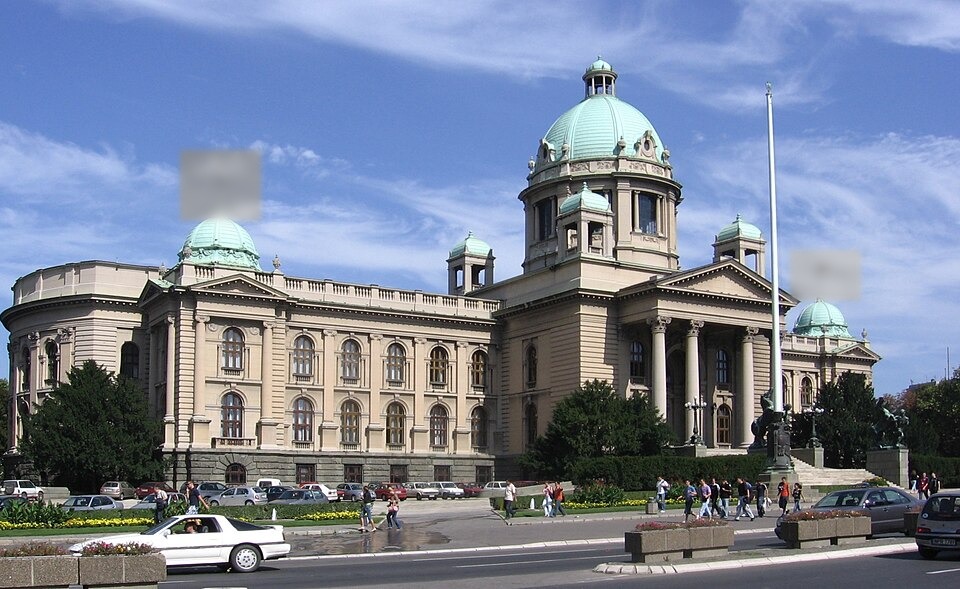
No description of its exterior is available here; what identifies it is its role as the country's single legislative chamber, where two hundred and fifty deputies sit for sessions presided over by a speaker and at least one deputy speaker.
This building is the seat of Serbia's National Assembly, the unicameral legislature of 250 deputies elected to four-year terms by direct, secret ballot. Sessions are presided over by a speaker, assisted by at least one deputy speaker. The assembly holds supreme legislative power: it adopts and amends the constitution, passes laws, elects the government, and appoints senior officials, including the state prosecutor, the ombudsman, the central bank governor and the head of the state audit institution.
- Changing the constitution needs a two-thirds majority of all 250 deputies, while ordinary laws pass with a simple majority of those present.
Photo: Impi (CC BY-SA 3.0)
St. Mark's Church
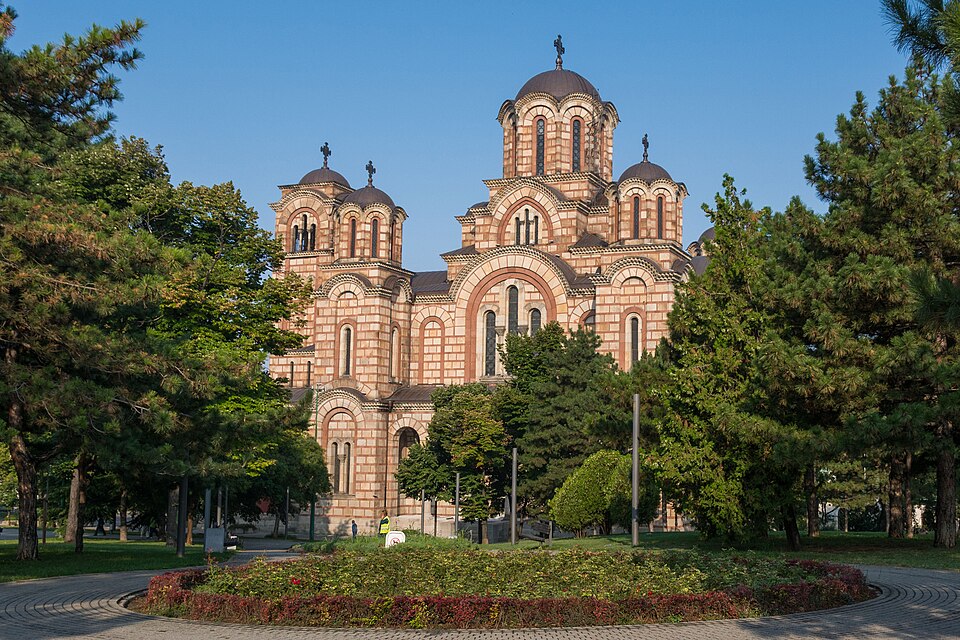
1940 · Petar and Branko Krstić
Built in the Serbo-Byzantine style, its exterior closely echoes the medieval Gračanica Monastery, on which it was directly modelled; it ranks as the second largest church in the country, after the domed cathedral it stands near.
Dedicated to Mark the Evangelist, this Eastern Orthodox church stands in Tašmajdan park in downtown Belgrade, near the National Assembly building. Its exterior, in the Serbo-Byzantine style, was modelled closely on the medieval Gračanica Monastery. Completed in 1940, it is considered one of the finest examples of that style and ranks as the second largest church in Serbia, after the Church of Saint Sava. A smaller Russian Orthodox church stands immediately next to it.
- It was modelled closely on the medieval Gračanica Monastery.
- A smaller Russian Orthodox church, dedicated to the Holy Trinity, stands right next to it.
Photo: Nikolai Karaneschev (CC BY 3.0)
Pobednik
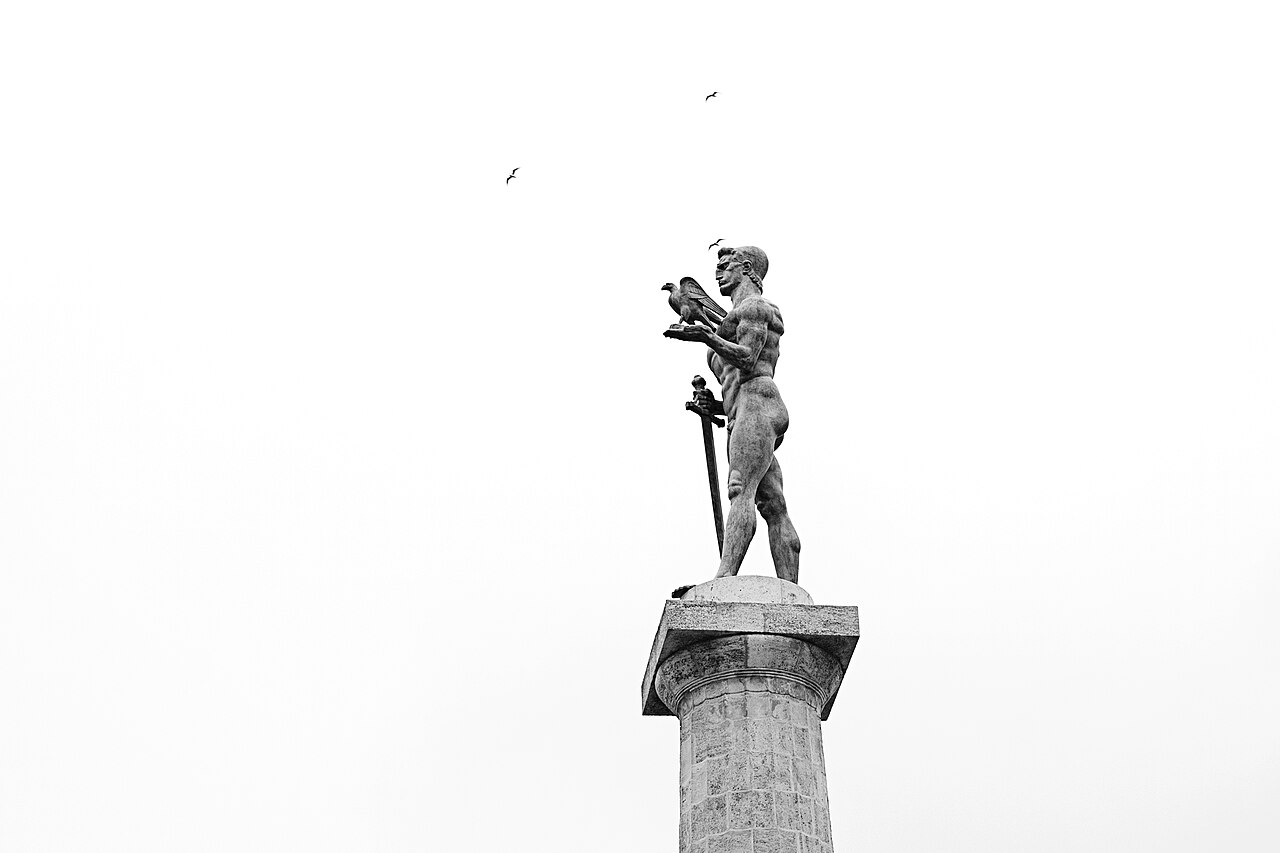
1913–1928 · Ivan Meštrović
A tall standing bronze male nude on a Doric-style column atop a tall cubic base, holding a falcon in one hand and a sword in the other, facing out across a river confluence toward distant hills.
Cast in 1913 to mark Serbia's victories over the Ottoman and Austro-Hungarian empires in the Balkan Wars and the First World War, this bronze nude by sculptor Ivan Meštrović stands 14 metres tall on a Doric-column pedestal designed by architect Petar Bajalović. The First World War and funding shortages delayed its return to Belgrade until 1923, and a 1927 public campaign over the figure's nudity further postponed its erection until 1928. It was removed for restoration in October 2019 and returned to its pedestal in February 2020.
- A 1927 campaign against the statue argued it insulted the modesty of the city's women and lacked distinctly Serbian symbols such as the šajkača hat.
- It was originally conceived as the centrepiece of a much larger monumental fountain, of which only the figure and lion-head masks were ever cast.
Photo: Ivana Todorović (CC BY-SA 4.0)
Prince Mihailo Monument
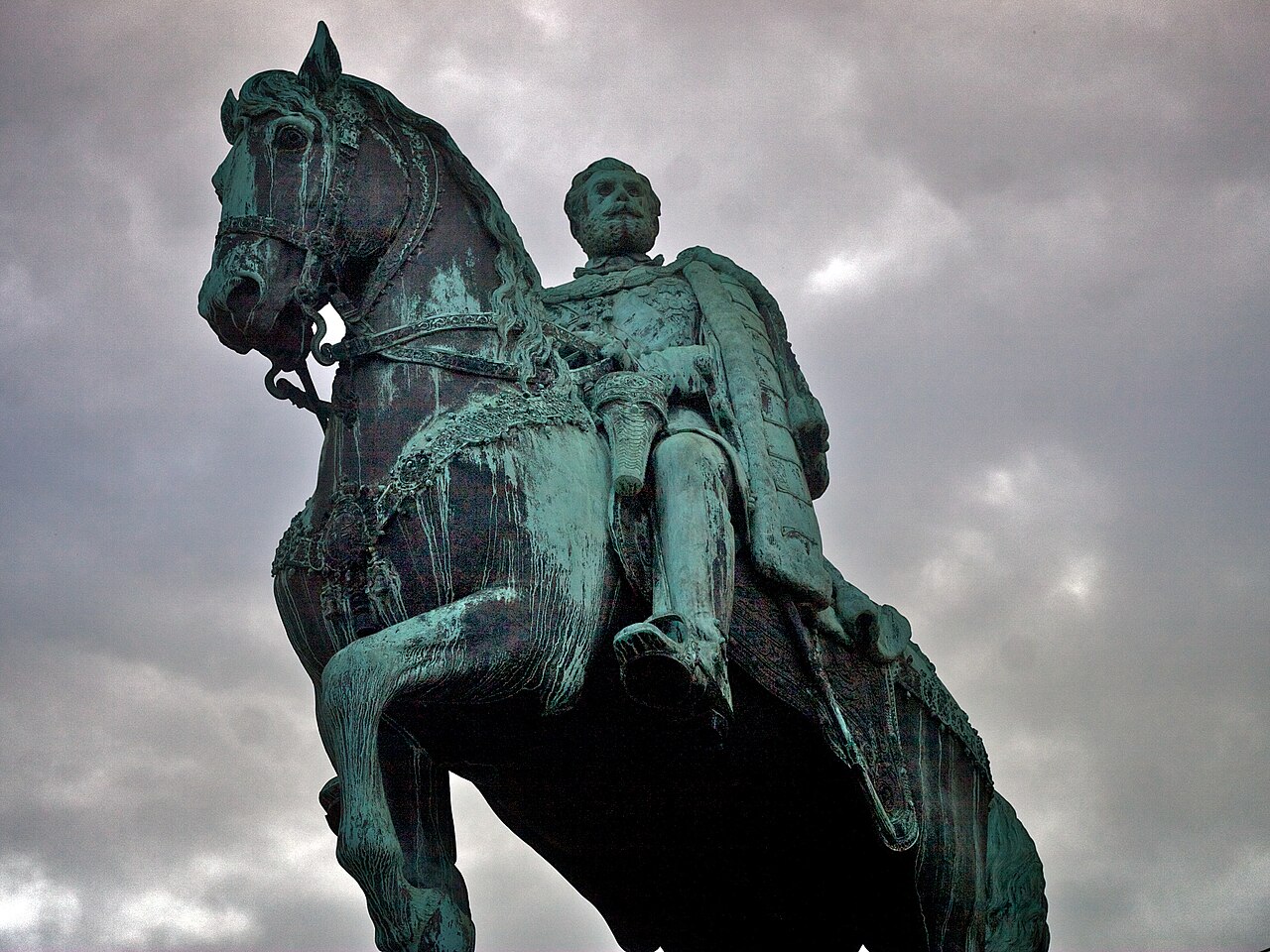
1872–1882 · Enrico Pazzi
A bronze equestrian statue on a stone pedestal in a central square, the mounted rider shown bare-headed rather than helmeted, with narrative reliefs set into the sides of the base.
This bronze equestrian statue depicts Prince Mihailo Obrenović, assassinated in 1868, and was Serbia's first public monument to portray a mounted ruler. An 1873 international competition, its second attempt after an earlier scheme by Mikhail Mikeshin was dropped, awarded the commission to Florentine sculptor Enrico Pazzi over rival designs; work on the statue ran from 1872 to 1879, and its reliefs were made after drawings by architect Konstantin Jovanović. Unveiled in December 1882, it was declared a Monument of Culture of Great Importance in 1979.
- At its 1882 unveiling, a rider shown without a hat was considered unusual enough to draw public notice.
- An earlier scheme for the monument, drafted by Russian sculptor Mikhail Mikeshin after a state delegation's 1867 visit to Moscow, was abandoned in 1871.
Photo: Tony Bowden from Tallinn, Estonia (CC BY-SA 2.0)
Cathedral of Saint Archangel Michael
An Eastern Orthodox cathedral serving as seat of the Archdiocese of Belgrade and Karlovci, one of the few buildings surviving from the early 19th century. Protected as a heritage site of exceptional importance, it stands directly across the street from the Palace of the Patriarchate.
Hotel Moskva
A four-star hotel on Terazije, one of the oldest still operating in Serbia and under government protection since 1968. It began in 1908 as a 36-room inn within the Palace Rossiya, a major Russian Empire investment, before expanding to fill the entire building.
National Theatre
A theatre founded in the latter half of the 19th century and built in 1868 on Republic Square, at the corner of Vasina and Francuska Street. It houses three artistic ensembles, opera, ballet and drama, and was declared a Monument of Culture of Great Importance.
Stari dvor
The city hall of Belgrade, housing the office of the mayor, and formerly a royal residence of the Obrenović and Karađorđević families from 1884 to 1922. It stands on the corner of Kralja Milana and Dragoslava Jovanovića streets, opposite Novi Dvor.
Novi Dvor
The seat of the president of Serbia, standing on Andrićev Venac opposite Stari Dvor, the Belgrade City Hall. It served as a royal residence of the Karađorđević dynasty of the Kingdom of Yugoslavia from 1922 to 1934.
Ada Bridge
A cable-stayed bridge over the Sava River, crossing the tip of Ada Ciganlija island to connect Čukarica and New Belgrade. Construction began in 2008 and the bridge opened on 1 January 2012, with its access roads finished in 2013.
Western City Gate
A 36-story brutalist skyscraper also known as the Genex Tower, designed in 1977 by Mihajlo Mitrović as two towers joined by a two-story bridge with a revolving restaurant on top. At 117 metres, it was the tallest building in Serbia for 42 years until 2021.
General Staff Building
A complex of government buildings in Savski Venac, formerly Yugoslavia's Federal Secretariat of People's Defence and Army General Staff. Heavily damaged in the 1999 NATO bombing and left derelict, a 2025 deal to demolish it for a Trump Tower hotel later fell through.
National Museum of Serbia
The largest and oldest museum in Belgrade, established in 1844 on a plot facing Republic Square. It moved into its present building in 1950, opened to the public in 1952, and now holds a collection of over 400,000 objects.
National Library of Serbia
The national library of Serbia, and the country's largest library and its oldest institution overall. It has been destroyed multiple times over the past two centuries.
Ružica Church
A Serbian Orthodox church inside Belgrade Fortress, originally built in the early 15th century, remodelled in 1869 and fully reconstructed in 1925. Located near the Saint Petka spring, it draws constant crowds of visitors, especially on Saint Petka's feast day.
Bajrakli Mosque
A mosque built around 1575 in Belgrade, now the only one still standing in the city out of the 273 that existed under Ottoman rule of Serbia.
Nebojša Tower
The only surviving medieval tower of Belgrade Fortress, built in the 15th century as its major defensive structure. It later served as a dungeon before being adapted into a museum in 2010, and stands near the confluence of the Sava and Danube.
Belgrade Synagogue
An Orthodox Jewish synagogue in downtown Belgrade, officially named the Sukkat Shalom Synagogue. It is the only functioning synagogue in Serbia and was declared a national heritage site in 2013.
Palace Albanija
A high-rise on Terazije, built in 1939 as the Palace of the Mortgage Bank of the Merchant's Fund and, on completion, the first skyscraper in Southeast Europe. It was Belgrade's tallest building for three years and was declared a cultural monument in 1984.
Beograđanka
A modern high-rise in downtown Belgrade, officially named Belgrade Palace, standing 101 metres tall. It is considered a symbol of the city and of the 1965–1974 mayoral term of Branko Pešić, seen as a golden age of Belgrade's development.
Ušće Towers
Two 25-story mixed-use skyscrapers on Mihajlo Pupin Boulevard in New Belgrade. The first, built in 1964 as headquarters of the Central Committee of the League of Communists of Yugoslavia, was Serbia's tallest building for 15 years; its twin was completed in June 2020.
Monument of Gratitude to France
A monument in Kalemegdan Park unveiled on 11 November 1930, the anniversary of World War I's end, before King Alexander, Queen Maria and a French delegation. Declared a cultural monument in 1965 and one of great significance in 1983, it portrays another nation positively.
Branko's Bridge
The second-largest bridge in Belgrade after Gazela, crossing the Sava River to connect the city center with New Belgrade. Built in 1956 on the foundations of the 1934 King Alexander Bridge, destroyed in World War II, it took its present name from adjoining Brankova Street.
Old Railway Bridge
The first railway bridge built in Belgrade, spanning the Sava River. It is one of two railway crossings there today, though it has not been operational since the summer of 2018.
Mehmed Paša Sokolović Fountain
An Ottoman-era fountain by the Defterdar's Gate on Belgrade Fortress's Upper Town wall, erected in 1576/77 according to traveler Evliya Çelebi. It is Grand Vizier Mehmed Paša Sokolović's only surviving endowment in Belgrade, and its exact position went unrecorded until the 17th century.
Cvijeta Zuzorić Art Pavilion
An Art Deco exhibition building in Kalemegdan's Little Kalemegdan section, next to the fortress's south-eastern front, built between 1927 and 1928 to a design by architect Branislav Kojić. It was the first venue in Serbia built specifically as an exhibition space or art gallery.
New Cemetery
A cemetery complex in Zvezdara municipality, built in 1886 as Belgrade's third Christian cemetery and the first in Serbia to be architecturally and urbanistically planned. It includes military graves from several wars and an Alley of the Greats honoring notable Serbian figures.
History
Belgrade grew from a Celtic settlement named Singidūn, taken by Rome under Augustus and granted city rights in the mid-second century. Slavs settled the area in the 520s, and control passed repeatedly between Byzantine, Frankish, Bulgarian and Hungarian rule before the Serbian king Stefan Dragutin made it his seat in 1284, after which it served as capital of the Serbian Despotate. Its fortress, at the point where the Sava meets the Danube, remained the city's defensive core and was formally protected as a cultural monument soon after the Second World War. The twentieth century added a different layer: a Byzantine Revival cathedral begun in 1935 on the site where Ottoman forces are said to have burned the relics of Serbia's patron saint, and a sister church in the same style finished in 1940 nearby.