Landmarks in Budapest
Castle Hill's Baroque terraces and Pest's neo-Gothic towers, both rebuilt after war.
Budapest's landmarks sit along the Danube, where the old town of Buda faces Pest across the water. On Castle Hill, Buda Castle's Baroque palace and the Neo-Romanesque terraces of Fisherman's Bastion stand in pale stone above the river, both rebuilt more than once after war. Below them, the Széchenyi Chain Bridge's cast-iron chains formed the first permanent crossing, linking the two halves of the city. Across on the Pest bank, the neo-Gothic Hungarian Parliament Building and the Neoclassical St. Stephen's Basilica rise within a few years of each other around the turn of the twentieth century, when the city built at a scale to match its new standing as a capital.
Hungarian Parliament Building
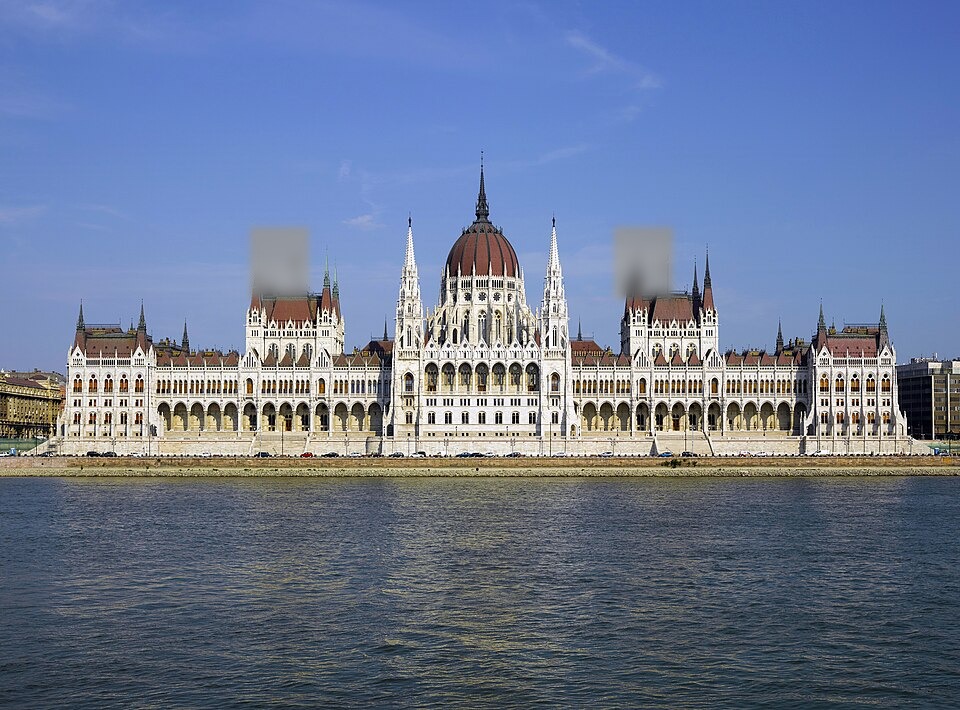
1902 · Imre Steindl
Its long riverfront facade is dominated by a central dome flanked by two virtually identical wings, dozens of turrets and Gothic Revival spires lining the roofline in pale stone.
The Hungarian Parliament Building is the seat of the National Assembly, standing on Kossuth Square on the eastern bank of the river in Pest. Imre Steindl designed it in neo-Gothic style, drawing on Vienna's city hall for its silhouette and a Viennese church for the Renaissance-influenced cupola over its central dome. It opened in 1902 and has remained the largest building in the country ever since. Steindl died in 1902, the same year his building was completed.
- Imre Steindl died in 1902, the same year the building he designed was completed.
- Its neo-Gothic design drew on Vienna's city hall for its overall form and a Viennese church for the Renaissance-style cupola.
Photo: Source: User:Godot13 Derivative: User:MathKnight (CC BY-SA 4.0)
Buda Castle
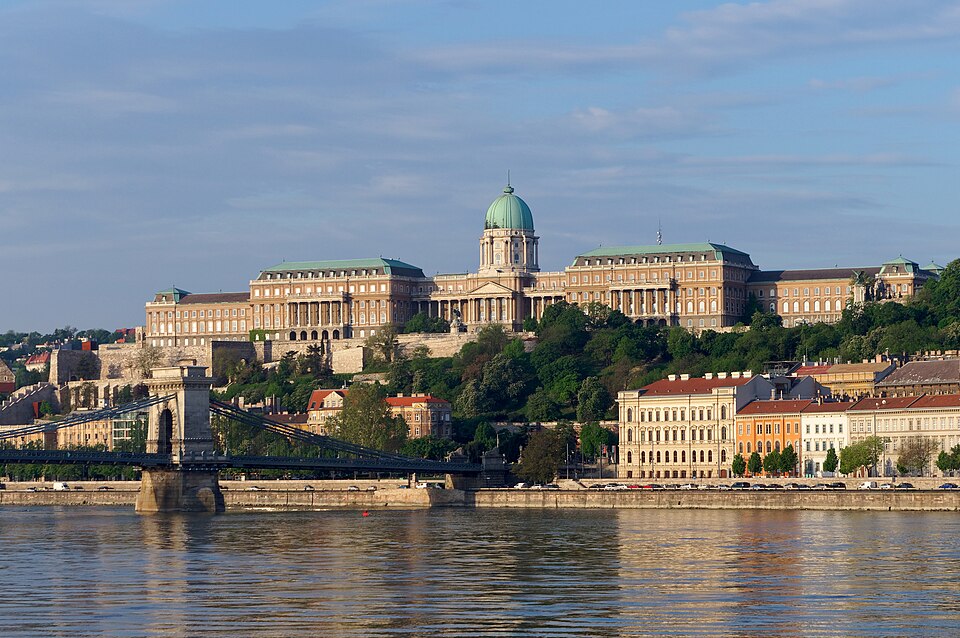
1265–1769 · Jean-Nicolas Jadot de Ville-Issey
The palace occupies the southern tip of Castle Hill above the Danube, a long pale Baroque range topped by a dome, enclosed by walls that continue north around the whole medieval Castle Quarter.
Buda Castle is the historical castle and palace complex of the Hungarian kings, first completed in 1265 on a fortified hill above the river. The Baroque palace seen today, largely the work of Jean-Nicolas Jadot de Ville-Issey, was built between 1749 and 1769; Miklós Ybl and Alajos Hauszmann enlarged it further in the nineteenth century. Severely damaged in the Siege of Budapest during the Second World War, it was rebuilt in simplified Baroque form under the state communist era. It now houses the national gallery, a history museum and the national library.
- Its defensive walls extend north to enclose an entire district of medieval, Baroque and neoclassical houses collectively known as 'the Castle.'
- A funicular linking it to the square below also connects to the base of the Chain Bridge.
Photo: Jakub Hałun (CC BY-SA 4.0)
Fisherman's Bastion
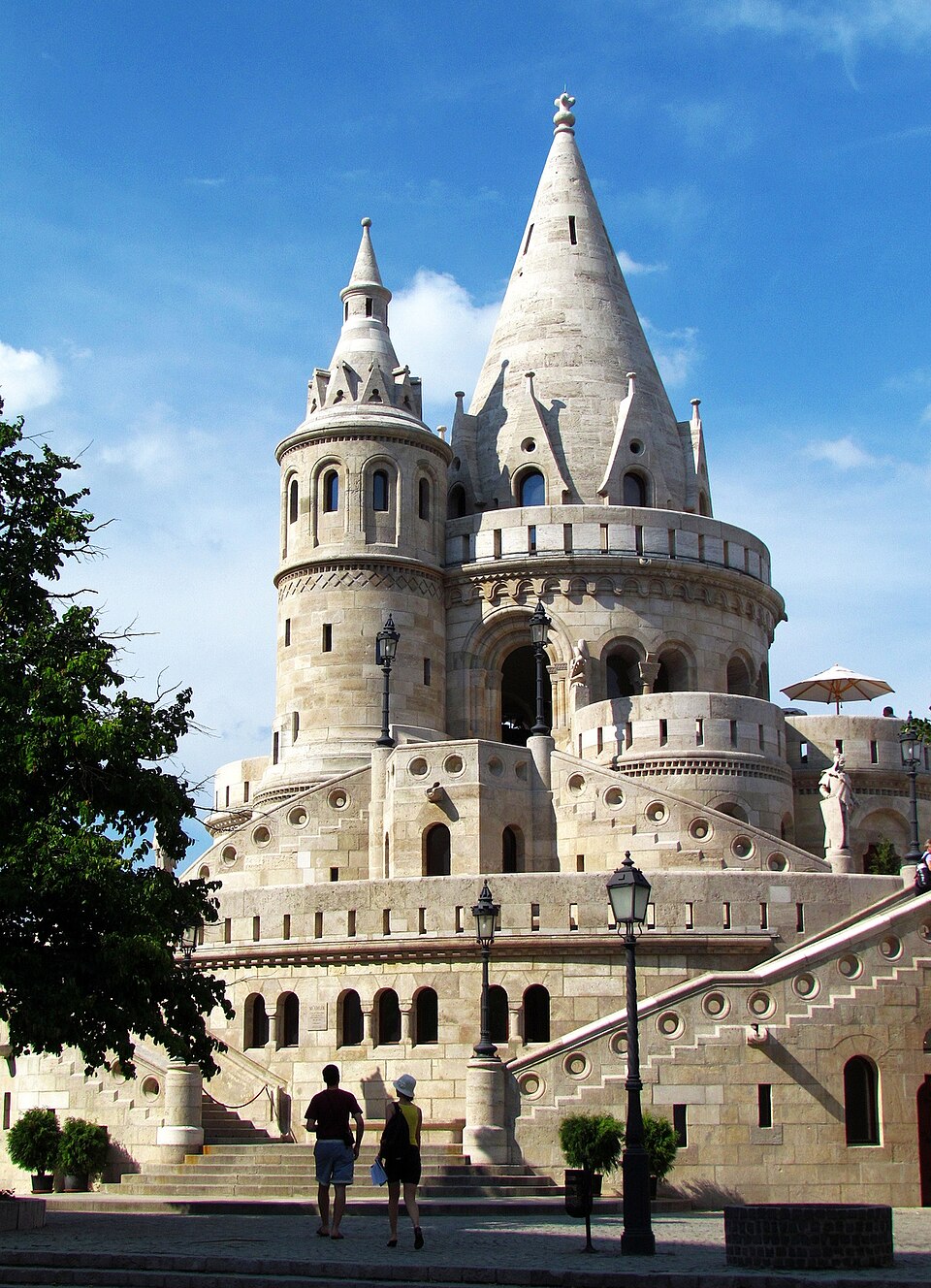
1895–1902 · Frigyes Schulek
Its Neo-Romanesque terraces run about 140 metres along the hilltop facing the river, punctuated by seven high, conical stone towers and a decorative central parapet, all in pale white stone.
Fisherman's Bastion stands beside Buda Castle on the same fortified hill, its terraces offering a panorama over the city below. Its original walls date to the 1700s, when a guild of fishermen was said to have defended this stretch of the castle fortifications from Fishtown below. The current Neo-Romanesque structure was built between 1895 and 1902 by architect Frigyes Schulek, who also restored the neighbouring walls; its seven towers symbolise the tribal chieftains who founded Hungary in 895. It has formed part of a UNESCO World Heritage Site since 1987.
- Its seven stone towers stand for the seven chieftains said to have founded the country in 895.
- A guild of fishermen who lived below the walls in the Middle Ages is thought to have given the bastion its name.
Photo: TUX (CC BY-SA 2.5 hu)
Széchenyi Chain Bridge
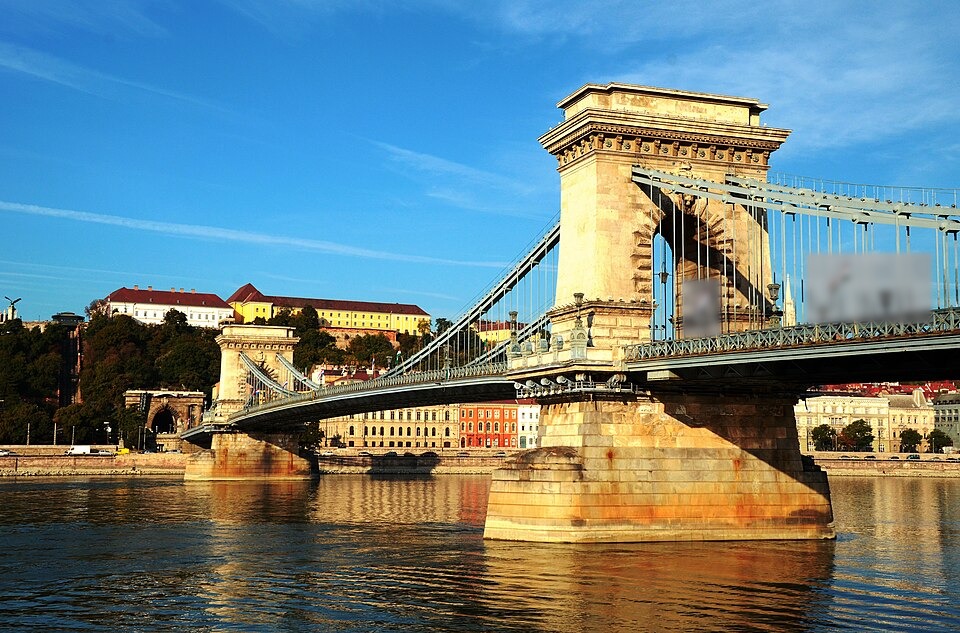
1849 · William Tierney Clark
The roadway hangs from heavy iron chains slung between two stone pylons on each bank, its cast-iron ornament original to its construction as the first fixed crossing linking the two halves of the city.
The Széchenyi Chain Bridge spans the Danube between Buda and Pest, opened in 1849 as the first permanent bridge across the river in Hungary. It was designed by the English engineer William Tierney Clark, and built by the Scottish engineer Adam Clark, an unrelated namesake. Considered a marvel of modern engineering at the time, it still carries cast-iron decoration from its original construction. It takes its name from István Széchenyi, a major backer of the project, though it is usually called simply the Chain Bridge.
- Its designer, William Tierney Clark, and its builder, Adam Clark, shared a surname despite being unrelated.
- At the time of its construction it was regarded as a marvel of modern engineering.
Photo: Alireza Javaheri (CC BY 3.0)
St. Stephen's Basilica
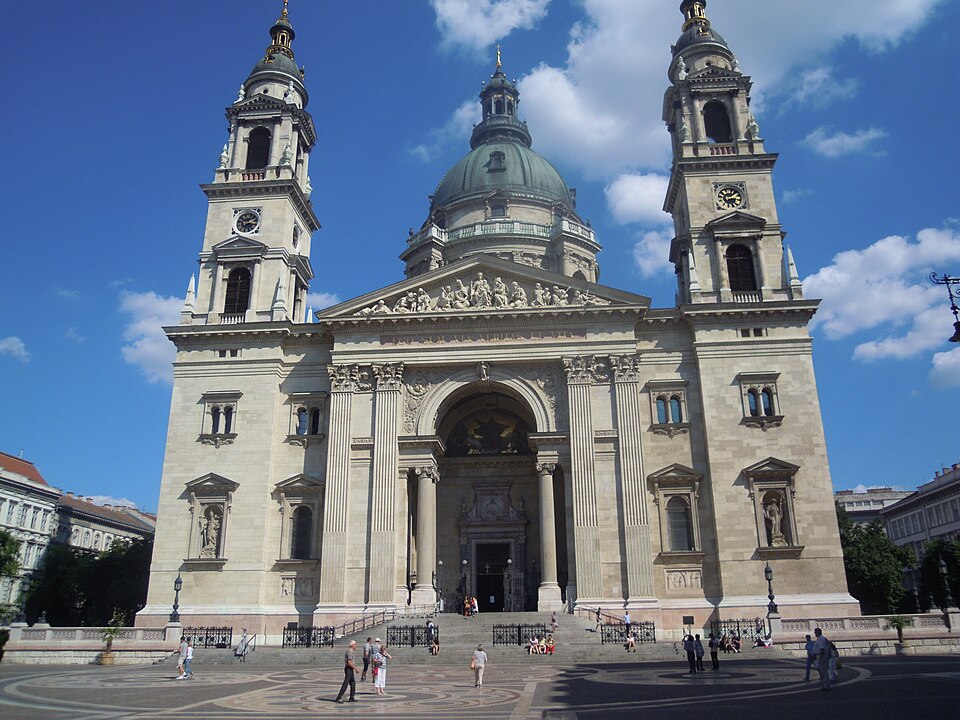
1905 · József Hild
As the largest church in the city and third largest in the country, it is built in a restrained Neoclassical style and stands within the buffer zone of the city's UNESCO World Heritage listing.
St. Stephen's Basilica is a Roman Catholic basilica named for Stephen, the first King of Hungary, whose preserved right hand is kept inside as a relic. Built in Neoclassical style, it was begun under József Hild and continued after his death by Miklós Ybl, with construction finishing in 1905 — after both architects had already died. It serves as co-cathedral of the Roman Catholic Archdiocese of Esztergom-Budapest, and is the largest church in the city and the third largest in the country, standing within the buffer zone of the city's UNESCO World Heritage Site.
- József Hild began its design and Miklós Ybl continued it, but both architects had died before the building was completed in 1905.
- Its reliquary holds the preserved right hand of the king it is named for.
Photo: Prolete (CC0)
Elisabeth Bridge
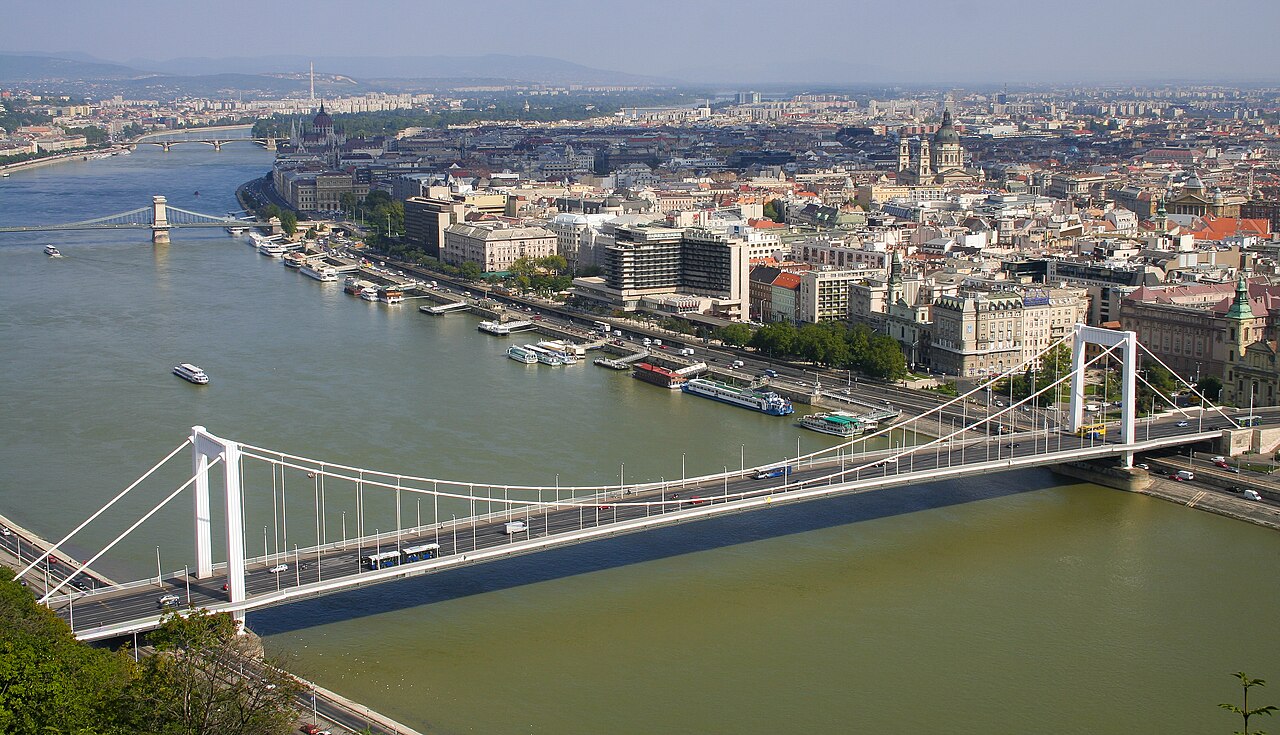
1961–1964 · Pál Sávoly
A slender, unornamented white suspension bridge in a stark modern style with no decorative ironwork, its main cables hexagonal rather than round in section; a bronze statue of the assassinated Austro-Hungarian empress the crossing is named for stands in a small garden near one of its approaches.
This bridge crosses the river at its narrowest point and takes its name from Elisabeth of Bavaria, empress of Austria-Hungary, assassinated in 1898. An earlier decorative chain suspension bridge opened here in 1903 after a corruption scandal over land needed for its approach roads; retreating German sappers destroyed it in the last days of the Second World War, the only bridge in the city that could not be rebuilt to its original design. The current slender, unornamented bridge, designed by Pál Sávoly after Cologne's Mülheim Bridge, opened in 1964; tram tracks were removed in 1973 after cracks appeared.
- Its main cables are hexagonal rather than circular in cross-section, an engineering shortcut adopted partly because computers of the day could not calculate a solution for a round cable made from several different wire gauges.
- Japan funded part of the bridge's distinctive lighting scheme, installed by designer Motoko Ishii to mark an anniversary of diplomatic relations between the two countries.
- A statue of the assassinated empress near the bridge took 32 years and five design competitions to complete, then was damaged when the bridge was destroyed in 1945, removed again in 1953, and not fully restored to its present spot until 1957.
Photo: mandoft from El Campello (Alicante), Spain (CC BY-SA 2.0)
Margaret Bridge
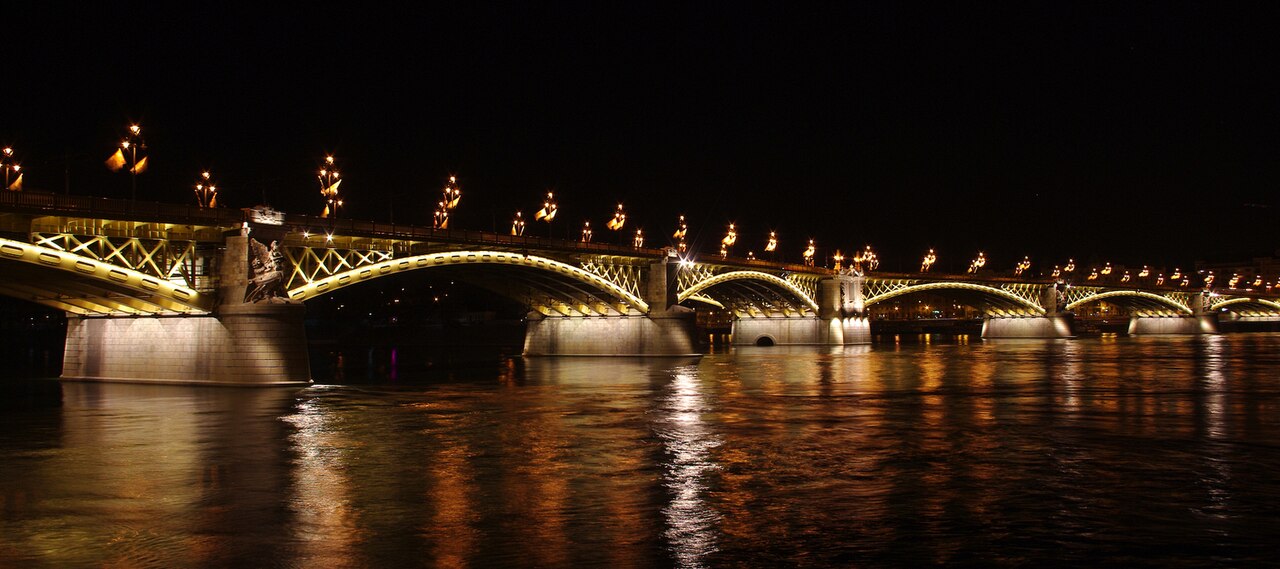
1872–1876 · Ernest Goüin
Two long straight spans meet a short middle section at a wide, distinctly non-perpendicular angle, the bend needed to reach an island whose connection was added to the design only after the main structure was already planned; steel latticework, barriers and floodlights added in a 2009–2011 renovation closely follow the crossing's nineteenth-century appearance.
Designed by French engineer Ernest Goüin and built by his own firm between 1872 and 1876, this was the city's second permanent bridge, after the Chain Bridge. Its two main spans meet a short branch to a nearby island at an unusual 165-degree angle, added to the plan after the main design was fixed. In November 1944 a spark from a passing tram accidentally detonated explosives German sappers were fitting to the bridge, destroying one span and killing at least a hundred people; workers later salvaged the original steel for the rebuild. A 2009–2011 renovation restored its original appearance.
- A poem about a wave of suicides from the bridge shortly after it opened, "Bridge Inauguration" by János Arany, was widely circulated as an illustrated leaflet.
- Among those killed by the 1944 explosion was Endre Kabos, an Olympic champion fencer, who was riding across the bridge in a truck with other Jewish forced labourers at the time.
- The 2009–2011 renovation uncovered human remains later identified as mostly Jewish victims of the fascist Arrow Cross regime, which briefly ruled the country in 1944–45.
Photo: Jotti63 (CC BY-SA 3.0)
Hungarian State Opera House
A historic opera house on Andrássy Avenue, designed by Miklós Ybl and opened in 1884 after construction began in 1875. Funded by the city of Budapest and Emperor Franz Joseph I, it is today the second-largest opera house in Hungary.
Dohány Street Synagogue
The largest synagogue in Europe, seating 3,000, built between 1854 and 1859 in the Moorish Revival and Romantic Historicist styles. Its Viennese architect, Ludwig Förster, drew the decoration from Islamic models in North Africa and the Alhambra in Spain.
Heroes' Square
A major square at the end of Andrássy Avenue, known for the Millennium Monument with statues of the Seven Chieftains of the Magyars and other national leaders. It holds the Museum of Fine Arts and the Palace of Art, and hosted Imre Nagy's 1989 reburial.
Gellért Baths
A thermal bath complex on the Buda side of the Danube. It forms part of the well-known Hotel Gellért, from which the baths take their name.
Hungarian National Museum
Hungary's national museum for history, art and archaeology, founded in 1802 and covering territory beyond the country's modern borders, including Transylvania. It occupies a Neoclassical building in Budapest's 8th district, purpose-built by architect Mihály Pollack between 1837 and 1847.
City Park
A public park near central Budapest containing 19th-century buildings such as the Széchenyi thermal bath, the Budapest Zoo and Botanical Garden, and the Capital Circus. It also houses museums and cultural institutes, including the Museum of Ethnography and the Hungarian House of Music.
Kossuth Square
A city square in the Lipótváros neighborhood on the bank of the Danube, dominated by the Hungarian Parliament Building. It has its own stop on the M2 metro line as well as a stop for the scenic Tram No. 2.
Museum of Fine Arts
A museum facing the Hall of Art on Heroes' Square, built between 1900 and 1906 in an eclectic-neoclassical style by architects Albert Schickedanz and Fülöp Herzog. Its collection of international art numbers more than 100,000 pieces across six departments, including Egyptian and old master paintings.
Franz Liszt Academy of Music
A music university and concert hall founded on 14 November 1875 by Franz Liszt himself, though it took his name only in 1925. It holds the Liszt Collection of books and manuscripts he donated, in a building at the heart of Budapest.
Keleti Station
Budapest's main international and inter-city railway terminal, standing where Rákóczi Avenue splits into Kerepesi and Thököly Avenues. Its name, meaning "eastern," dates from 1891 and reflects its original role serving lines from eastern Hungary, Transylvania and the Balkans.
Puskás Aréna
An all-seater football stadium for 67,215 spectators in Budapest's 14th district, built between 2017 and 2019 on the site of the demolished Ferenc Puskás Stadium. It serves as home ground for the Hungary national football team and is named after captain Ferenc Puskás.
Memento Park
An open-air museum of monumental statues and plaques from Hungary's Communist period between 1949 and 1989, including figures of Lenin, Marx and Engels. Designed by architect Ákos Eleőd after he won a 1991 competition, it is divided into sections including Statue Park.
Sándor Palace
A palace beside the Buda Castle complex in the historic Castle District. It has served as the official residence and workplace of the President of Hungary since 2003.
New York Palace
A five-star luxury hotel on the Grand Boulevard's Erzsébet körút stretch, in Budapest's 7th district. It operates today as part of the Anantara Hotels & Resorts brand under Minor Hotels.
Museum of Ethnography
A national museum in Budapest, Hungary, dedicated to ethnography.
Kazinczy Street Synagogue
An Orthodox Jewish synagogue complex on Kazinczy Street in Pest's 7th district, completed in 1913. Considered one of the most characteristic works of Hungarian synagogue architecture before World War I, it also includes a beit midrash, a rabbi's residence, a school, offices and a kitchen.
Rumbach Street Synagogue
A Neológ synagogue in Erzsébetváros, the historic old town of Pest. Since 2021 the building has also served as a concert hall and Jewish museum.
Tomb of Gül Baba
The northernmost Islamic pilgrimage site in the world, a mausoleum on Mecset Street in the Rózsadomb district, a short walk from Margaret Bridge. It holds the tomb of Gül Baba, a member of the Bektás Dervish Order who died in Ottoman Buda in 1541.
Budapest Zoo and Botanical Garden
Hungary's oldest zoo, opened on 9 August 1866 within City Park in the city center. It holds 1,072 animal species, including the Komodo dragon and, since December 2011, the wombat, alongside Art Nouveau buildings by Kornél Neuschloss and Károly Kós.
City Park Ice Rink
A public ice rink in City Park between Heroes' Square and Vajdahunyad Castle, opened in 1870 as the world's largest continuous artificial ice rink. In summer the area floods into a pond, and a 2009–2011 renovation expanded the skating area to 12,000 square meters.
Hungarian Postal Savings Bank
The head office of a major Hungarian savings institution established in 1886 as the Hungarian Royal Postal Savings Bank and wound up in 1948. Its striking Art Nouveau building in District V was designed by architect Ödön Lechner.
Fiume Road Graveyard
Budapest's most famous cemetery, officially the Fiume Road National Graveyard and also known as Kerepesi Cemetery. One of Hungary's oldest cemeteries, it has been almost completely preserved.
Aquincum
The ruins of an ancient Roman city on the northeastern edge of the province of Pannonia, found today in Budapest's Óbuda district. Marcus Aurelius is believed to have written part of his Meditations there.
History
Buda Castle traces to 1265, though almost everything visible today comes from a Baroque rebuild carried out between 1749 and 1769 under Habsburg rule. Its walls, and the Neo-Romanesque Fisherman's Bastion raised on their base between 1895 and 1902, were badly damaged in the Siege of Budapest during the Second World War and reconstructed afterward in simplified form. The Castle Quarter around them was declared a UNESCO World Heritage Site in 1987. The Chain Bridge opened in 1849 as the first permanent crossing of the Danube, built by an English designer and a Scottish engineer who happened to share a surname. Half a century later, civic ambition produced two of the country's largest buildings within a few years of each other: the neo-Gothic Hungarian Parliament, opened in 1902, and St. Stephen's Basilica, finished in 1905.