Landmarks in Rio de Janeiro
A granite peak, a colonial church and a Beaux-Arts theatre map four centuries of building.
Rio's landmarks sit at three different heights and belong to three different centuries. Down in the old commercial core, a colonial-era parish church shows how long building could stretch here: a Portuguese Baroque façade begun in 1775, carrying Neoclassical and Neo-Renaissance decoration added inside well into the following century. A few streets away, an opera house finished in 1909 belongs to the eclectic, European-modelled rebuilding of the same district, its exterior carved with the names of admired artists. Above both, reinforced concrete and soapstone define the twentieth century: a colossal Art Deco statue of Jesus, built between 1922 and 1931 on a 700-metre granite summit, is visible from most of the city spread below it. Colonial masonry, belle-époque stone and modern concrete sit within a few kilometres of one another.
Christ the Redeemer
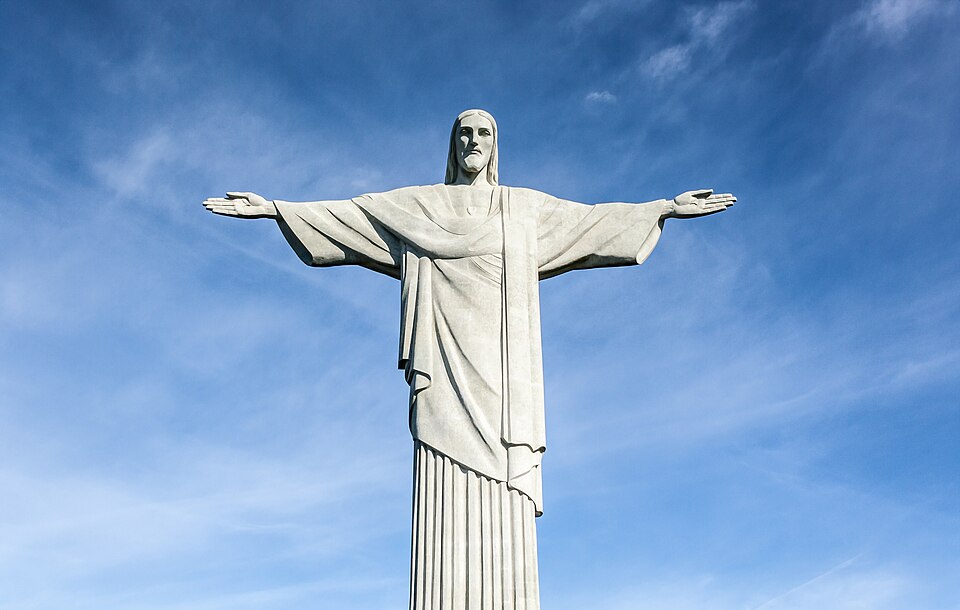
1922–1931 · Paul Landowski
The pale, soapstone-clad figure spreads its arms 28 metres wide, nearly as wide as its 30-metre height, and crowns a bare granite summit that rises straight out of the forest, visible from almost anywhere in the city below.
The statue was designed by French-Polish sculptor Paul Landowski and realised by Brazilian engineer Heitor da Silva Costa with French engineer Albert Caquot; Romanian sculptor Gheorghe Leonida modelled the face. The organisers' first plan showed Christ holding a globe in one hand and a cross in the other before it was changed to the current arms-spread design. Built of reinforced concrete faced in soapstone, it stands on the 700-metre summit of Corcovado inside Tijuca National Park and was later voted one of the New 7 Wonders of the World.
- The original design had Christ holding a globe in one hand and a cross in the other before organisers switched to the outstretched arms seen today.
- It weighs 635 metric tons and is the largest Art Deco sculpture in the world.
Photo: Arturdiasr (CC BY-SA 4.0)
Municipal Theatre of Rio de Janeiro
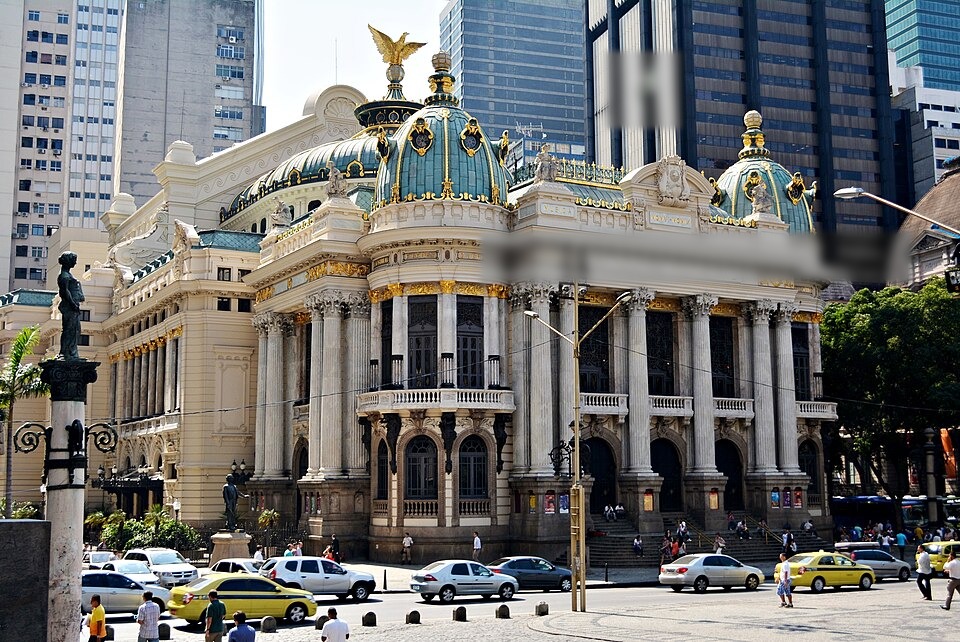
1909
Modelled closely on a famous Parisian opera house, its cream stone façade, mansard roofline and colonnaded front overlook an open square in the old centre, with the carved names of European and Brazilian artists running along the outer walls.
The theatre is an opera house in Rio's Centro district, near the National Library and the National Fine Arts Museum, overlooking the open Cinelândia square. Completed in 1909, it is built in an eclectic style inspired by Charles Garnier's Paris Opéra, and its outer walls carry the carved names of classic European and Brazilian artists. It holds heritage protection as an INEPAC Good Class monument and is counted among the country's most important theatres.
Photo: Elvis Boaventura (CC BY 3.0)
Candelaria Church
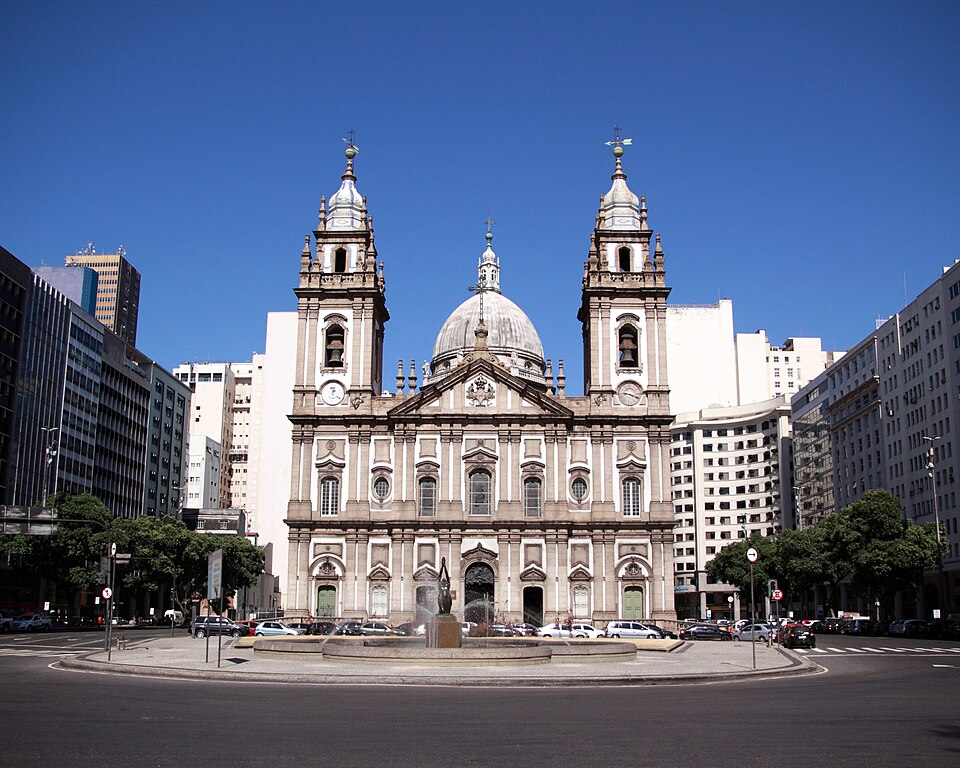
1775–late 19th century
A Portuguese colonial Baroque exterior, built as a single freestanding block in the old commercial centre, encloses an interior whose Neoclassical and Neo-Renaissance decoration was added generations after the façade itself.
Candelária is a Roman Catholic parish church in the old commercial centre of Rio de Janeiro. It was built and decorated over a long stretch of time, from 1775 into the late nineteenth century, which is why its Portuguese colonial Baroque exterior encloses later Neoclassical and Neo-Renaissance interior work rather than a single unified style. It is recognised for its Portuguese colonial influence and is listed as a heritage asset by IPHAN.
Photo: Halley Pacheco de Oliveira (CC BY-SA 3.0)
Maracanã Stadium
A football stadium opened in 1950 to host the FIFA World Cup, where Brazil lost 2-1 to Uruguay in the deciding match before a still-standing record crowd of 210,850. It was renovated again after the 2016 Summer Olympics and Paralympics.
Sambadrome Marquês de Sapucaí
A purpose-built parade venue in Cidade Nova, where samba schools compete each year during Rio Carnival. Designed by architect Oscar Niemeyer, it was his first major work after the end of Brazil's 1964-1985 military dictatorship.
Rio de Janeiro Cathedral
The seat of the Archdiocese of Rio de Janeiro, home to the cathedra of the city's archbishops. It is dedicated to Saint Sebastian, the patron saint of Rio de Janeiro.
São Bento Monastery
A Benedictine abbey on the Morro de São Bento, founded in 1590 by monks from Bahia and still operational today. Its Mannerist-style church is considered a primary example of Portuguese colonial architecture in Brazil.
Sugarloaf Cable Car
A cableway rising to the 396-metre summit of Sugarloaf Mountain, opened in 1912 as only the third such system built anywhere in the world. Its cars, enlarged in 1972, appeared in the 1979 James Bond film Moonraker.
Escadaria Selarón
A set of mosaic-tiled steps in the Lapa neighbourhood, known locally as the Lapa Steps. They are the work of Chilean-born artist Jorge Selarón, who described the project as his tribute to the Brazilian people.
Carioca Aqueduct
An aqueduct built in the mid-18th century to carry fresh water from the Carioca River into the city, also known as the Arcos da Lapa. Since the late 19th century it has served as a bridge for the Santa Teresa Tramway.
Copacabana Palace
A luxury hotel facing Copacabana beach, designed by French architect Joseph Gire and opened on 13 August 1923. With 243 rooms across its main and annex buildings, it has repeatedly been voted the best hotel in South America.
Rio–Niterói Bridge
A box girder bridge spanning Guanabara Bay to connect Rio de Janeiro and Niterói, completed in 1974 at 13.29 kilometres long. It was the world's second-longest bridge until 1985, and its 300-metre central span rises 72 metres to let ships pass beneath.
Museu Nacional de Belas Artes
A national art museum established in 1937 and inaugurated in 1938 by President Getúlio Vargas, housed in a 1908 eclectic-style building designed by Adolfo Morales de los Ríos. Its collection traces back to the Portuguese Royal Collection brought to Brazil by King John VI.
Paço de São Cristóvão
An imperial palace in the Quinta da Boa Vista park, home to the Portuguese and then Brazilian royal families until the 1889 republican coup. It housed most of the National Museum's collection, largely destroyed by fire in 2018, and reopened restored in 2025.
Gustavo Capanema Palace
A government office building in downtown Rio, also known as the Ministry of Education and Health Building. As the country's first modernist project, it is historically important to Brazilian architecture and sits on Brazil's UNESCO tentative list.
National Library of Brazil
The depository of Brazil's bibliographic and documentary heritage, standing on Cinelândia square in a city that was Brazil's capital from 1763 to 1960. UNESCO considers it the largest library in Latin America and the seventh largest in the world, with some 9 million items.
Catete Palace
An urban mansion in Flamengo, built between 1858 and 1867, that served as Brazil's presidential palace from 1897 to 1960 and was the site of Getúlio Vargas's suicide. It now houses the Museu da República and a theatre.
Museum of Modern Art
A modern art museum in northeastern Flamengo Park, on Guanabara Bay just west of Santos Dumont Airport. It sits within the Centro district of Rio de Janeiro.
Tiradentes Palace
An eclectic-style government building beside the Paço Imperial, inaugurated on 6 May 1926. It served as the seat of Brazil's Chamber of Deputies until 1960 and now houses the Legislative Assembly of Rio de Janeiro state.
Guanabara Palace
The official seat of the Rio de Janeiro state government, in the Laranjeiras neighbourhood, formerly known as Paço Isabel. It is distinct from the nearby Laranjeiras Palace, which serves as the governor's official residence.
Paço Imperial
A historic building on Praça XV de Novembro, built in the 18th century as a residence for the governors of colonial Brazil. From 1808 it served as a royal residence, and later as a workplace for emperors Pedro I and Pedro II until 1889.
Fort Copacabana
A military base at the southern end of Copacabana beach, open to the public. It contains a coastal defense fort along with the Museu Histórico do Exército, the Army's historical museum.
Old Cathedral of Rio de Janeiro
A Carmelite church that served as Rio de Janeiro's cathedral from around 1808 until 1976, on Praça XV square. During the 19th century it also functioned as the Royal and Imperial Chapel for the Portuguese and Brazilian royal families.
Cinelândia
The popular name for a major public square in central Rio de Janeiro. Its official name, Praça Floriano Peixoto, honours Floriano Peixoto, the second president of Brazil.
Rio de Janeiro Botanical Garden
A 54-hectare botanical garden founded in 1808 by King John VI of Portugal, originally to acclimatize spices such as nutmeg and cinnamon from the West Indies. Opened to the public in 1822, it now displays some 6,500 species of Brazilian and foreign flora.
Equestrian statue of Pedro I
An equestrian statue of Pedro I standing in Tiradentes Square, in central Rio. It has been listed as national heritage by IPHAN since 1999 and as state cultural heritage by INEPAC since 1978.
Valongo Wharf
A dock built in 1811 where, over two decades, between 500,000 and one million enslaved Africans were landed and traded before the practice was banned in 1831. Renovated in 1843 for the arrival of Princess Teresa Cristina, it was then renamed the Empress Wharf.
Cidade do Samba
A complex of buildings in the Gamboa neighbourhood, formally named Cidade do Samba Joãosinho Trinta. About fourteen of Rio's major samba schools maintain warehouses there to prepare for Carnival.
History
Founded in 1565 as a Portuguese captaincy, Rio de Janeiro became capital of the State of Brazil in 1763 and, after 1808, seat of the Portuguese royal court itself, transplanted there when Queen Maria I's government fled Europe — the only time in modern history a colonising power's capital moved into one of its own colonies. The city kept that rank through the 1822 War of Independence, through the Empire of Brazil, and through the early republic, losing the title only in 1960, when the capital moved to Brasília. Nearly two centuries as a seat of government and court left a compact historic core built up in overlapping fashions: Portuguese colonial churches decorated across generations, then the eclectic civic architecture of the early twentieth-century republic. A single mountain rising straight from that same city later carried the concrete Christ that became its best-known image.