Landmarks in Montevideo
A colonial cathedral, a domed parliament and a 1920s eclectic tower mark three eras.
Montevideo's oldest landmark, the Metropolitan Cathedral, stands in the colonial grid of Ciudad Vieja, the peninsula where the Spanish city took shape after 1724. Two later buildings mark the country's push into the twentieth century: the neoclassical Legislative Palace, raised in the Aguada district between 1904 and 1925 for the centenary of independence, and the eclectic Palacio Salvo, a reinforced-concrete skyscraper finished in 1928 at Plaza Independencia in Centro. The three sit a few kilometres apart, tracing growth from a defensive colonial port toward the modern capital that now hosts Mercosur's headquarters. Materials shift with the eras: colonial masonry gives way to the poured concrete that let Palacio Salvo briefly stand as the tallest reinforced-concrete structure anywhere.
Palacio Salvo
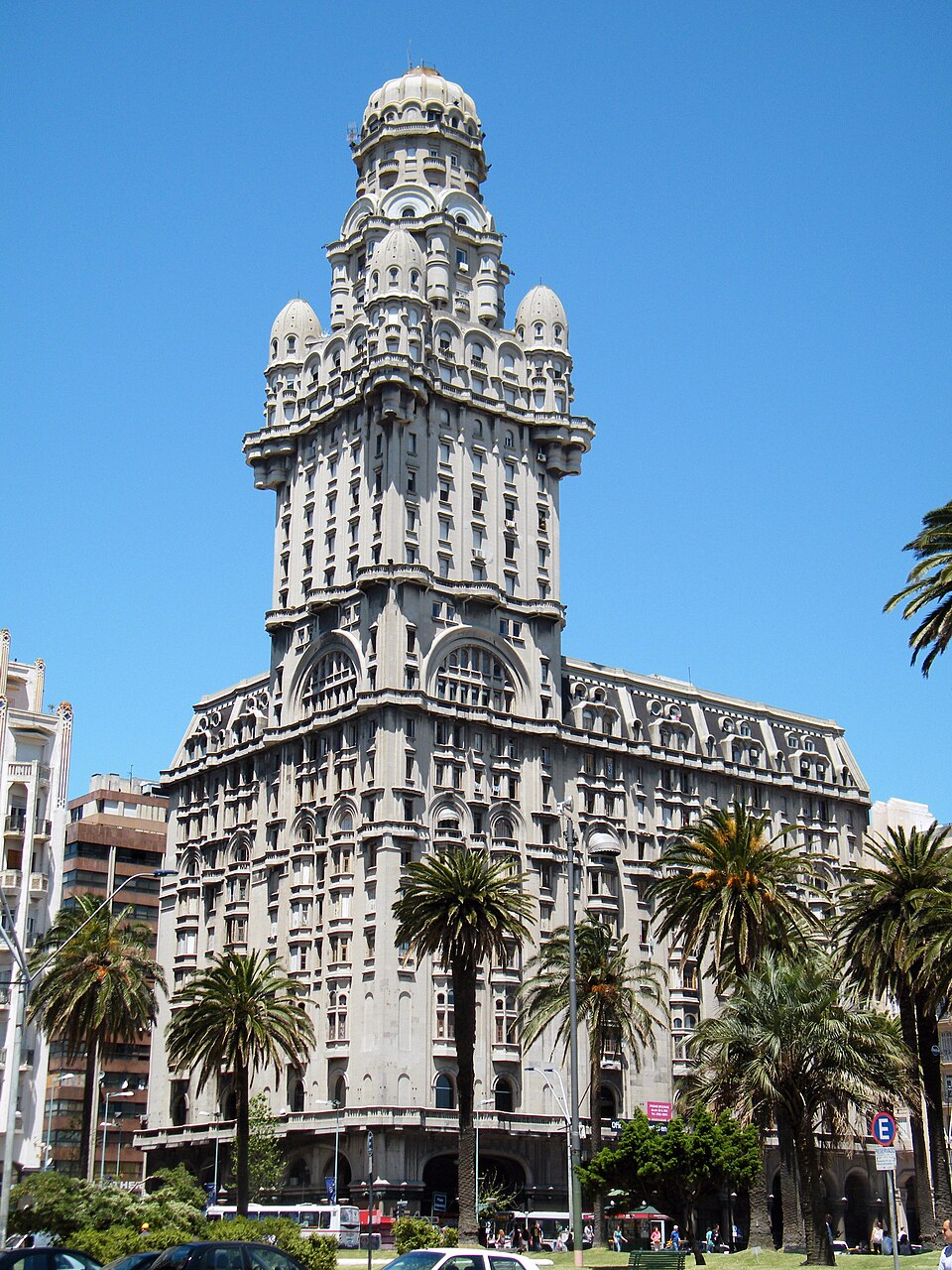
1928 · Mario Palanti
A slender, eclectic-style concrete tower of 27 floors and 105 metres, built to a design its architect reused for the very similar Palacio Barolo skyscraper in Buenos Aires.
Palacio Salvo is an eclectic 27-storey skyscraper at the junction of 18 de Julio Avenue and Plaza Independencia, in the Centro district. Built for the businessmen brothers Angel, Jose and Lorenzo Salvo, it was completed in 1928 to a design by the Italian-born architect Mario Palanti, who used the same plan for his Palacio Barolo in Buenos Aires. At 105 metres over 27 floors it was briefly the tallest building in Latin America and, on completion, the tallest reinforced-concrete structure in the world. It has been a National Historical Monument since 1996.
- On completion in 1928 it was, for a time, the tallest reinforced-concrete structure in the world.
- Its architect, Mario Palanti, built an almost identical skyscraper, Palacio Barolo, in Buenos Aires.
Photo: Coolcaesar (CC BY-SA 3.0)
Legislative Palace of Uruguay
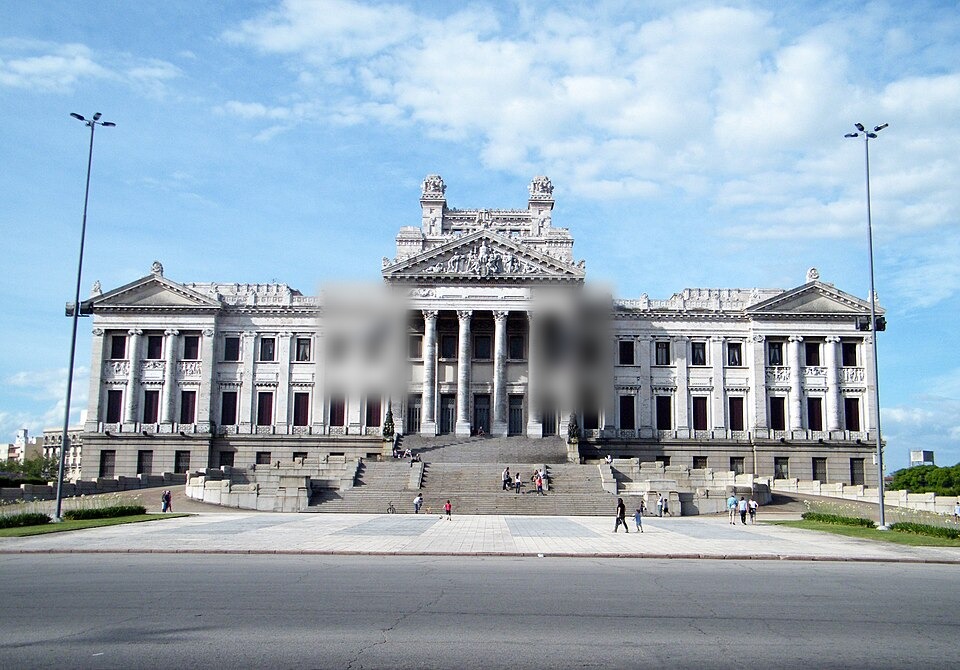
1904–1925 · Vittorio Meano
A single large neoclassical block in the Aguada district, monumental in scale, built as the seat of Uruguay's General Assembly and still in that use today.
The Legislative Palace is the seat of Uruguay's General Assembly, in the Aguada neighbourhood of Montevideo. Its neoclassical design is credited to Vittorio Meano, who died in 1904, the year ground was broken; Giannino Castiglioni is also credited among its architects. Construction ran two decades, and the building was inaugurated on 25 August 1925 to mark the centenary of the Declaration of Independence. It was declared a National Historic Monument in 1975, under the government of President Juan Maria Bordaberry.
- One of its two credited architects, Vittorio Meano, died in 1904, the very year construction began.
- It was declared a National Historic Monument in 1975, during Juan Maria Bordaberry's presidency.
Photo: Coolcaesar (CC BY-SA 3.0)
Montevideo Metropolitan Cathedral
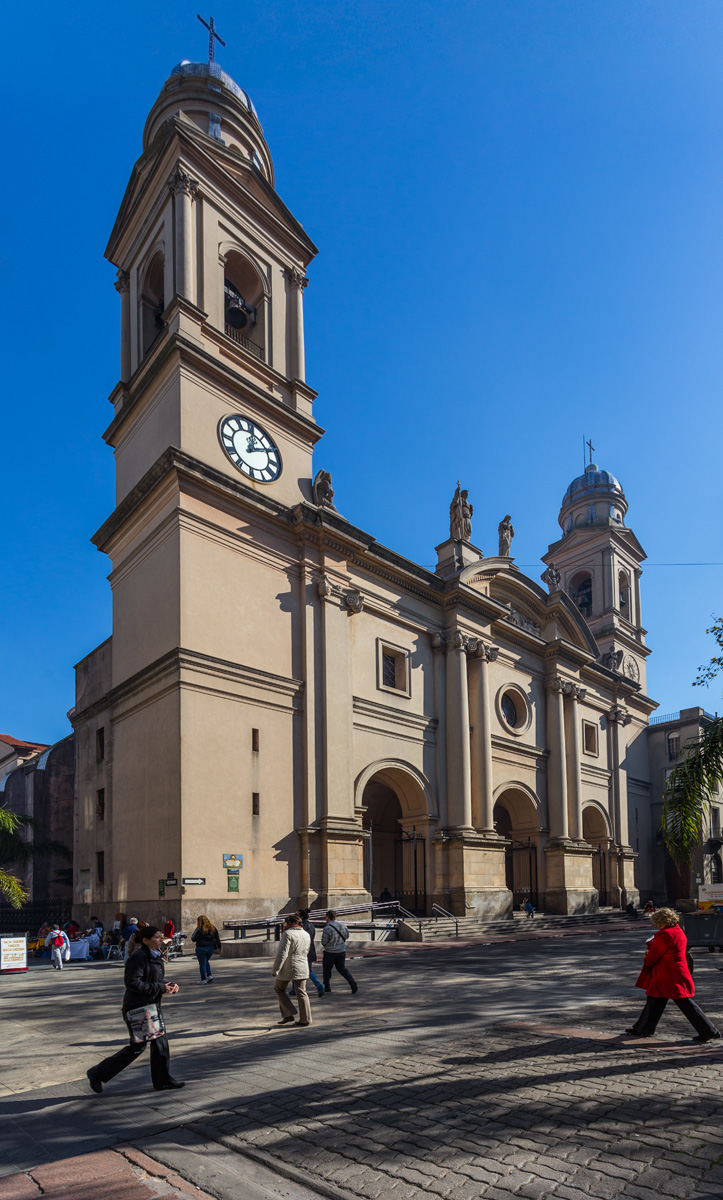
1804
A neoclassical facade fronting Constitution Square in Ciudad Vieja, standing directly opposite the colonial Cabildo building in the city's oldest quarter.
The Montevideo Metropolitan Cathedral is the main Roman Catholic church of the city and seat of its archdiocese. It stands in Ciudad Vieja, the colonial-era quarter, directly across Constitution Square from the Cabildo. Built in the neoclassical style, the standing cathedral was completed in 1804. It continues to serve as the city's principal cathedral and is listed as a Cultural Heritage Monument.
Photo: Nicolas Barriola (CC BY-SA 3.0)
Estadio Centenario
A football stadium in the Parque Batlle neighborhood, built between 1929 and 1930 to host the inaugural 1930 FIFA World Cup. In 1983 FIFA declared it the first Historical Monument of World Football, a distinction no other stadium holds.
Plaza Independencia
The main public square in Montevideo, laid out in the 19th century on the site of its former Citadel. It is framed by the Palacio Salvo, the Solís Theatre, the Estévez Palace, and the Executive Tower, and has long hosted political demonstrations and official ceremonies.
Solís Theatre
Uruguay's most important theater, designed by Italian architect Carlo Zucchi and opened in 1856 next to Plaza Independencia. It was closed for reconstruction from 1998 and reopened in 2004, and hosted the 1878 premiere of La Parisina, considered the first Uruguayan national opera.
Mercado del Puerto
A former covered marketplace in the Ciudad Vieja that now houses restaurants serving traditional Uruguayan cuisine, especially asado grilled over open-fire parrillas. Each New Year's Eve it hosts a midday street festival built around a traditional water and cider fight.
Estadio Gran Parque Central
The stadium of Club Nacional de Football, built in 1900, the oldest stadium still in use in the Americas. It hosted one of the opening matches of the 1930 FIFA World Cup, when the United States beat Belgium 3–0, later marked with a commemorative plaque.
Plaza de Cagancha
A public square on 18 de Julio Avenue that originated in 1836 as the central space of the newly laid-out 'Ciudad Nueva.' It is surrounded by notable buildings including the Palacio Piria, seat of the Supreme Court, and the Ateneo de Montevideo.
Estévez Palace
A neoclassical building on Plaza Independencia, completed in 1873 and the country's seat of government from 1880 to 1985. Designated a National Historic Monument in 1975, it now serves as the ceremonial executive headquarters and houses a museum on the Uruguayan presidency, established in 1999.
City Hall
The seat of the city government on 18 de Julio Avenue, designed by architect Mauricio Cravotto after a 1930s tender for a municipal building. Its esplanade is a busy meeting place where matches of the Uruguayan national football team are broadcast on a large screen.
Mercado Agrícola
A historic enclosed market in the Aguada neighborhood, built in the 1910s and reopened in 2013. It combines permanent shops selling fresh produce and butchered meats with several restaurants and cafés.
Parque Rodó
A park that lies mostly in the Punta Carretas area, though it shares its name with the surrounding Parque Rodó neighborhood. It is named for José Enrique Rodó, a prominent Uruguayan writer, whose monument stands on the park's southern side.
Sodre National Auditorium
A performing arts venue located in the old Urquiza Theater building, which caught fire on September 18, 1971. Named for Adela Reta, it is now home to the National Ballet of Uruguay and was declared a Historical Monument of Uruguay in 2019.
Palacio Piria
The headquarters of the Supreme Court of Uruguay, on the south side of the Plaza de Cagancha, declared a National Historical Monument in 1975. In front of its main entrance stands the Monument to Justice, a work by Rafael Lorente Mourelle.
Palacio Taranco
A palace built between 1907 and 1910 for the Taranco Ortiz family, designed by French architects Charles Louis Girault and Jules Chifflot León. It stands on the site of Montevideo's first theatre, built in 1793, and now houses the Museum of Decorative Arts.
Telecommunications Tower
A 157-meter, 35-story skyscraper beside the Bay of Montevideo, completed in 2002 and designed by architect Carlos Ott. It houses the headquarters of the state telecommunications company ANTEL and is the tallest building in Uruguay.
Antel Arena
A multipurpose indoor arena in the Villa Española neighborhood, holding up to 15,000 people for concerts and 10,000 for basketball games. It was built by the state telecommunications company ANTEL under a 30-year agreement with the city and is operated by ASM Global.
Uruguay Temple
A temple of the Church of Jesus Christ of Latter-day Saints, with groundbreaking in 1999 and dedication on March 18, 2001. Designed by architect Edvardo Signorelli with an asa branca granite exterior, it has a single spire topped by a statue of the angel Moroni.
Ateneo
A cultural institution founded in 1886 through the merger of the Sociedad Universitaria and the Ateneo del Uruguay. It is housed in an eclectic-historicist style building on the Plaza de Cagancha in Centro.
Teatro de Verano
An open-air amphitheatre in the Parque Rodó neighborhood, officially named Teatro de Verano Ramón Collazo, inaugurated in January 1944. With seating for about 5,000, it serves as the main stage for the Montevideo Carnival's artistic and theatrical performances.
Edificio London París
A building at the corner of 18 de Julio Avenue and Río Negro, built between 1905 and 1908 in an eclectic style. Also known as The Standard Life, it housed the London París department store from 1908 to 1966.
Headquarters of the Bank of the Oriental Republic of Uruguay
The headquarters building of the Banco de la República Oriental del Uruguay, in the Ciudad Vieja. Built in the neoclassical style, it was designed by Italian architect Giovanni Veltroni and completed in 1938.
Cilindro Municipal
An indoor arena that opened in 1956 for Uruguay's Industrial Exhibition of Production. It later served as the main venue of the 1967 FIBA World Cup, with a seating capacity of 18,000.
Edificio Lapido
A 14-story modernist building on 18 de Julio Avenue, designed by architect Juan Aubriot and completed in 1933. It housed the newspaper La Tribuna Popular until the 1960s and later printed clandestine opposition publications during the 1973–1985 dictatorship.
Museo Torres García
A museum in the Ciudad Vieja displaying cubist paintings and portraits by Joaquín Torres García, founded by his widow after his death in 1949. It draws more than 85,000 visitors a year and also functions as a library and, in its basement, a theatre.
History
A Portuguese garrison first held the site from November 1723, part of a wider Spanish-Portuguese dispute over the Rio de la Plata region; a Spanish force under Bruno Mauricio de Zabala expelled it in February 1724, and the city's founding is dated from Zabala's diary entry of 24 December 1726. Full separation from Buenos Aires as an independent city followed on 1 January 1730, and a brief British occupation in 1807 ended when Spanish criollo forces retook it during the British invasions of the River Plate. The Metropolitan Cathedral, completed in 1804, still fronts the old colonial square in Ciudad Vieja. A century later, independent Uruguay marked the Declaration of Independence's centenary with the Legislative Palace, built between 1904 and 1925, and the boom years that followed produced the Palacio Salvo, a 1928 concrete skyscraper that was for a time the tallest reinforced-concrete building anywhere.