Landmarks in Asunción
Asunción's landmarks are 19th-century neoclassical monuments built along the riverbank.
Asunción's landmark buildings sit within a few blocks of the historic downtown, close to the bay where the Paraguay River bends, rather than scattered across the wider city. Nearly all of them are neoclassical, raised in a single nineteenth-century push under the López governments that sought to give the young republic the trappings of a capital: a presidential palace, a cathedral, a chapel intended as a mausoleum. That push was interrupted by the War of the Triple Alliance, which damaged or halted construction across the city, and one landmark stood unfinished for decades afterward. What stands today is a mix of completed 1840s-1860s construction and later twentieth-century finishing work, all still reading as a single neoclassical old town.
Palacio de los López
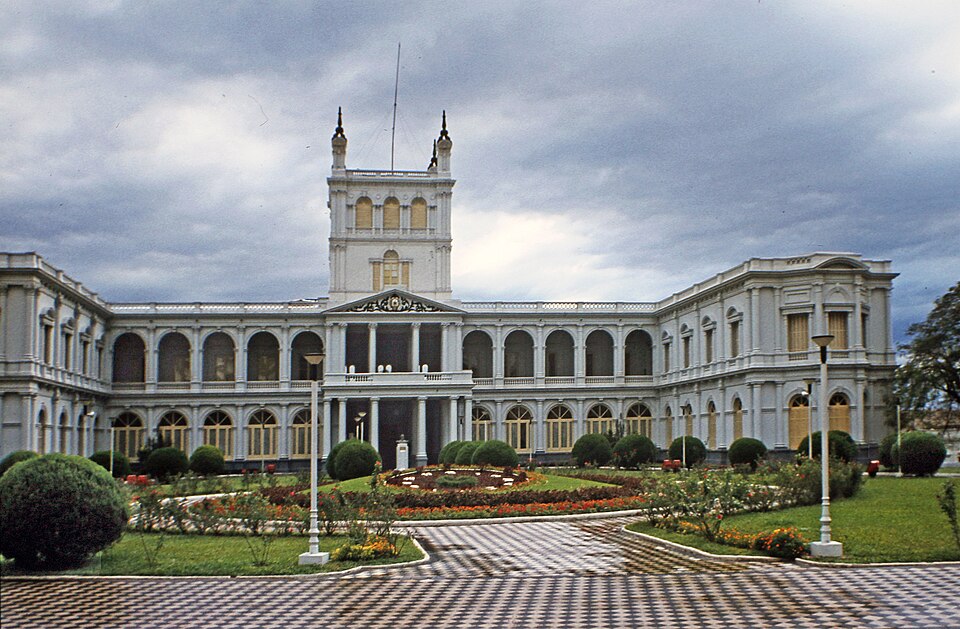
1857–1867 · Alonso Taylor
A low, symmetrical neoclassical palace built in restrained Palladian proportions, its main facade turned toward the water of a broad river bay rather than the streets behind it.
Commissioned by the country's first constitutional president under an 1844 constitution, construction began in 1857 under the English architect Alonso Taylor and was substantially finished by 1867. It was built to house the president's son and chosen successor, who in the end never moved in. During the War of the Triple Alliance, Brazilian and Argentine forces sacked the building in January 1869, looting its furniture and ornaments; occupying troops then used it as a barracks for seven years, leaving it derelict by 1876. It now serves as the seat of the national government.
- It was built to house a president's chosen successor, who never actually lived there.
- Brazilian and Argentine forces sacked and looted it in 1869, and occupying troops left it derelict within a decade.
Photo: W. Bulach (CC BY-SA 4.0)
National Pantheon of the Heroes
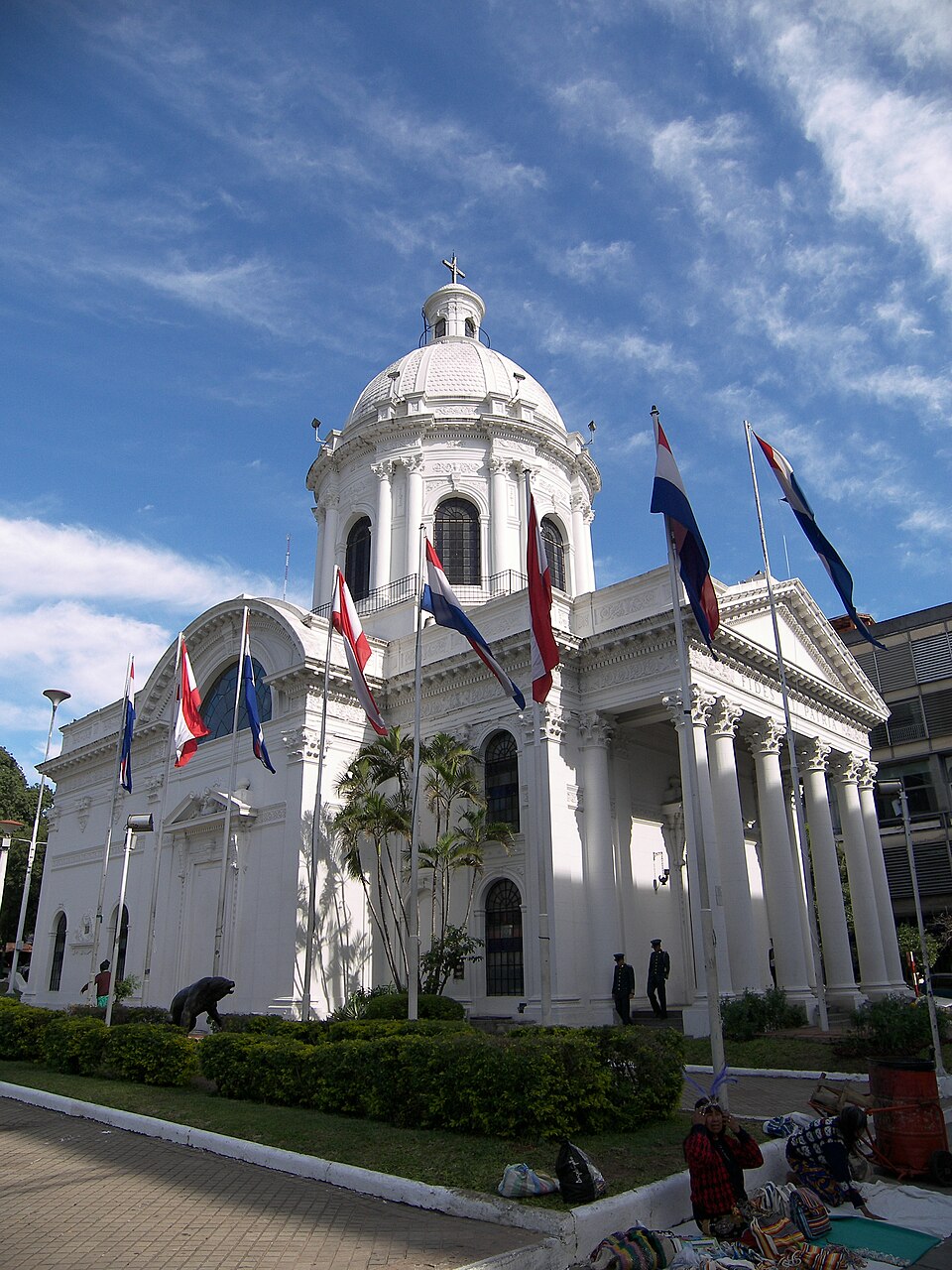
1863–1936 · Alejandro Ravizza
A neoclassical church that still carries the modest footprint of the chapel it began as, now serving as a state mausoleum for the country's historic dead behind its plain facade.
Construction began in October 1863 as a chapel dedicated to the Assumption of Mary, designed by the Italian architect Alejandro Ravizza with the builder Giacomo Colombino. The War of the Triple Alliance halted the work, and the unfinished chapel stood scaffolded for more than seventy years. It was finally completed after the Chaco War and inaugurated on 12 October 1936 as the National Pantheon of Heroes. The building now functions as a state mausoleum, holding the remains of two former presidents, a Chaco War general and his wife, child soldiers killed at the Battle of Acosta Ñu, and unknown soldiers.
- The chapel stood unfinished and scaffolded for more than seventy years before it was completed.
- It holds the remains of child soldiers killed in a nineteenth-century battle, buried alongside two former presidents.
Photo: Felipe Antonio (CC BY-SA 3.0)
Asunción Cathedral
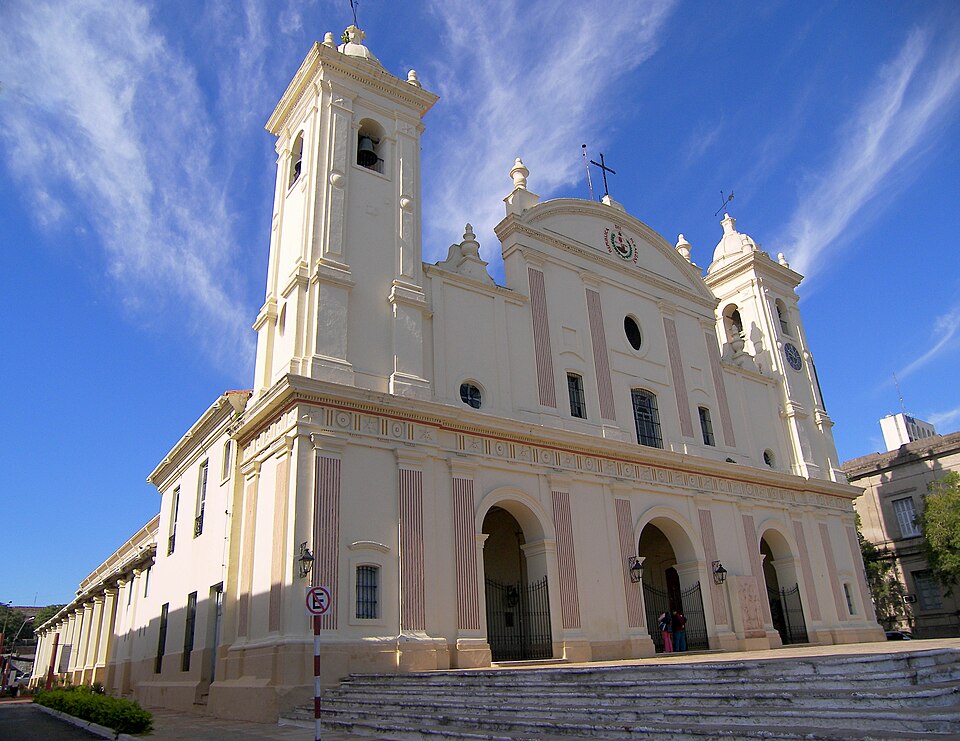
1845
A neoclassical cathedral with a plain exterior that gives no hint of the high altar faced entirely in silver inside, standing at the heart of the old colonial center.
The present building, the cathedral's latest version, was constructed under the government of Carlos Antonio López and inaugurated in 1845. It is dedicated to Our Lady of the Assumption, patroness of the capital, and its diocese was the first to be established in the wider Río de la Plata region. Located in the historic center, it has a high altar coated in silver and remains the seat of the metropolitan archdiocese, the principal Catholic church of the country.
- Its high altar is coated entirely in silver.
- It was the first diocese established anywhere in the Río de la Plata region.
Photo: FF MM (CC BY-SA 4.0)
Cultural Center of the Republic
The former Cabildo, or town council building, now houses the Cultural Center of the Republic. Its programs focus on national history, and the building itself is treated as a monument.
Casa de la Independencia Museum
A colonial-style house on the corner of Presidente Franco and 14 de Mayo streets, opened as a museum on May 14, 1965. On the evening of May 14, 1811, a group of Paraguayans emerged from it to declare the country's independence from Spain.
Botanical Garden and Zoo of Asunción
A botanical garden and zoo covering 110 hectares of natural forest on the city's north side. The zoo holds close to seventy species of birds, mammals and reptiles, mostly native to South America, alongside a garden of native trees.
Municipal Theatre Ignacio A. Pane
A municipal theatre in Paraguay's capital, named Ignacio A. Pane.
Recoleta Cemetery
A national cemetery on Avenue Mariscal López in the Recoleta district, covering about 14 hectares and open to the public. It holds the graves of important figures in Paraguay's history, including several former presidents.
Héroes del Chaco Bridge
A cable-stayed bridge across the Paraguay River, inaugurated on March 3, 2024, linking the capital with Nueva Asunción. It is Asunción's only large-span bridge, built to ease traffic on the Remanso Bridge eight kilometers upstream.
Museo Memoria de la Ciudad
A history museum in the Viola House, part of the Manzana de la Rivera complex, opened in 1996 as an idea of architect Carlos Colombino. Its collection, gathered from Paraguay and cities such as New York and Buenos Aires, traces the city's history.
Museo Nacional de Bellas Artes de Asunción
The National Museum of Fine Arts, founded in 1909 by the collector Silvano Godoi, Paraguay's first director-general of museums and archives. It displays over 650 paintings, sculptures, ceramics and other works, and shares its building with the National Archives.
Asunción Paraguay Temple
A Latter-day Saint temple dedicated in 2002 and rededicated in 2019 after renovation, the first LDS temple built in Paraguay. Its exterior walls are white-gray Brazilian granite, topped by a spire with a statue of the angel Moroni.
Congress of Paraguay
The seat of Paraguay's bicameral legislature, made up of a 45-member Senate and an 80-member Chamber of Deputies. Members are elected concurrently with the president under a system of proportional representation, deputies by department and senators nationwide.
History
Asunción's built landmarks trace back to the government of Carlos Antonio López, who in the 1840s and 1850s pursued a program of neoclassical construction meant to project the authority of Paraguay's new republic: a cathedral finished in 1845, and a palace begun in 1857 for the president's son and chosen successor. His government also ordered a chapel in 1863, the year before war engulfed the country. The War of the Triple Alliance devastated Asunción: occupying forces sacked the palace and looted its furnishings, while the unfinished chapel stood scaffolded for more than seventy years. Completion work continued long after the war and closed only in the twentieth century - the chapel was finally finished in 1936, after a second war, the Chaco War, had ended.