Landmarks in Buenos Aires
Beaux-Arts palaces and a lone concrete obelisk define a capital rebuilt after 1880.
Buenos Aires became a federal capital in 1880, split from its surrounding province and enlarged to absorb the towns of Belgrano and Flores. The landmarks left from that era share a European vocabulary brought by immigrant architects: Casa Rosada's pale pink Neoclassical and Italianate front took shape by 1898, and the Beaux-Arts Palace of the Argentine National Congress, raised between 1898 and 1906, sits where the barrios of Balvanera and Monserrat meet. Both were built to project a young capital's ambitions during decades of mass immigration. Four decades later, the reinforced-concrete Obelisk went up in a single year, 1936, at the crossing of two central avenues — a plainer, modern counterpoint marking four centuries since the city's founding rather than any governing function.
Obelisk of Buenos Aires
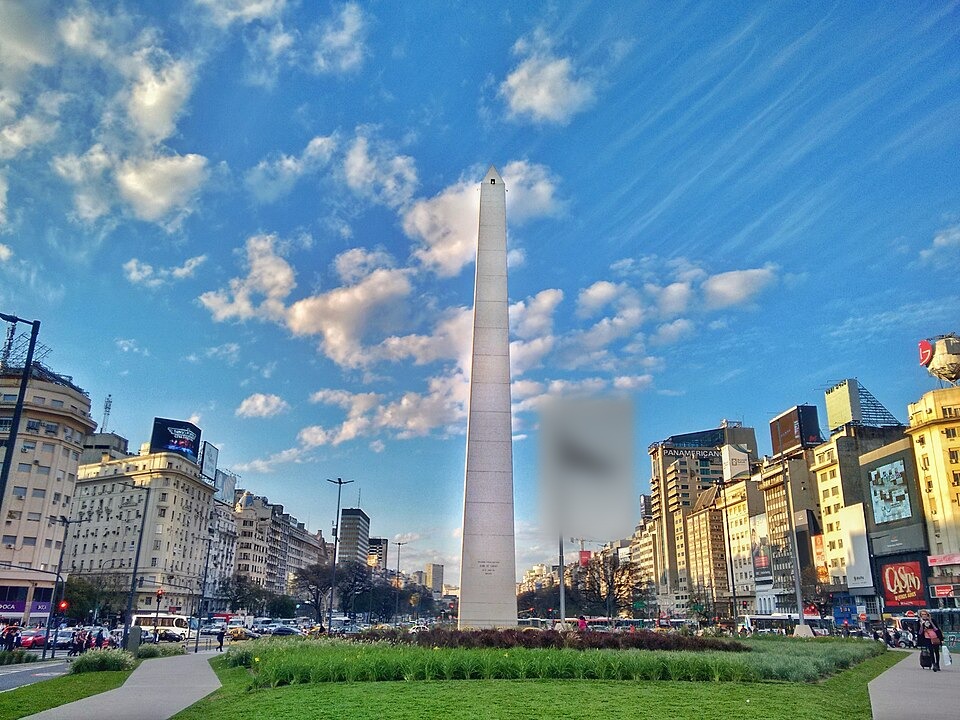
1936 · Alberto Prebisch
A tall, plain reinforced-concrete obelisk standing alone at the center of a broad avenue intersection, its bare shaft rising to a simple pointed cap with no other ornament.
The Obelisk is a national historic monument in reinforced concrete, erected in 1936 in the Plaza de la República, at the meeting of the avenues Corrientes and 9 de Julio. It was raised to mark the four-hundredth anniversary of the city's first founding. The design is credited to architect Alberto Prebisch, who died in 1970. It has no function beyond its role as monument and has become a fixture of the surrounding square, dominating the wide intersection around it.
Photo: Sebastianalmaraz (CC BY-SA 4.0)
Casa Rosada
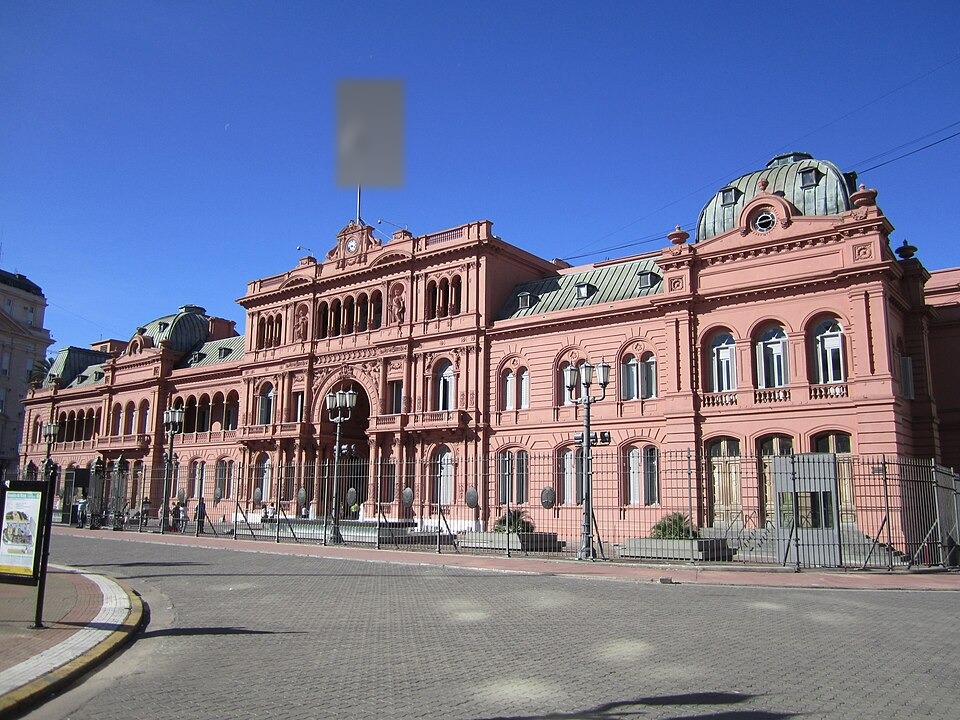
1898 · Carlos Kihlberg
The building is identified at a glance by its distinctive pale pink facade, an eclectic combination of Neoclassical, Italianate and Romanesque Revival detailing across a large palatial mass.
Casa Rosada is the official workplace of Argentina's president, formally called Casa de Gobierno. It took its present pink, eclectically revivalist form in 1898, a design credited to Carlos Kihlberg together with Enrique Aberg and Francesco Tamburini. The facade blends Neoclassical, Italianate and Romanesque Revival detailing, and the building has been declared a National Historic Monument. It also houses a museum devoted to former presidents of Argentina, alongside the president's active offices.
- The president does not actually live here — the official residence, Quinta de Olivos, is elsewhere in Greater Buenos Aires.
Photo: Dragan (CC BY 3.0)
Palace of the Argentine National Congress
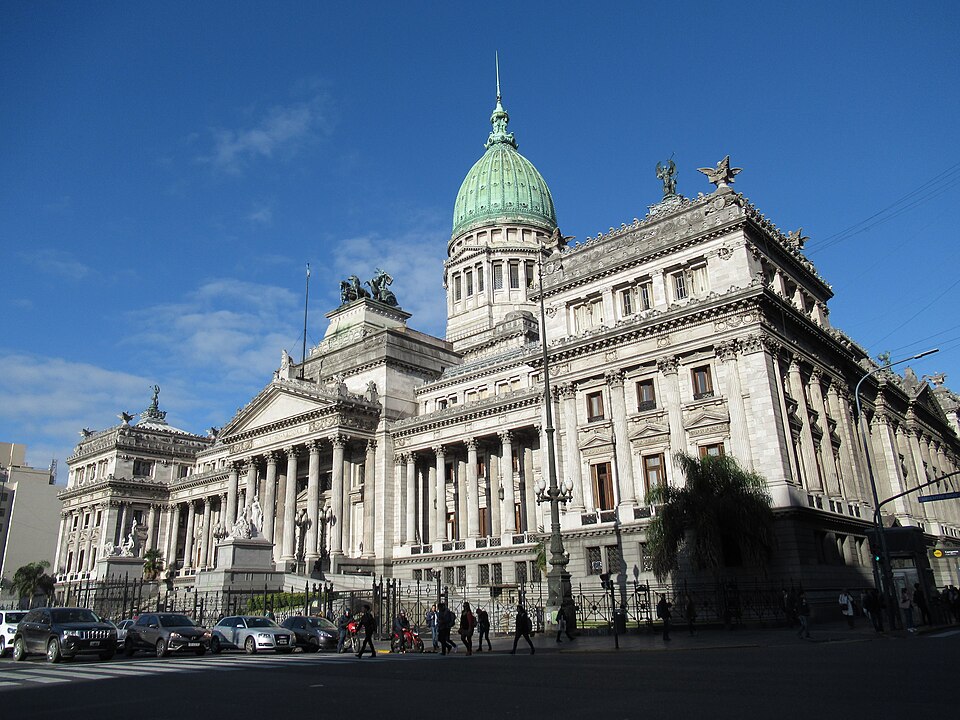
1898–1906 · Vittorio Meano
The palace is a monumental Beaux-Arts and Neoclassical building serving as the seat of the national legislature; a milestone in its adjoining Congressional Plaza marks kilometer zero for the country's national highway network.
The Palace of the Argentine National Congress is the seat of Argentina's national legislature, standing in the barrio of Balvanera at its border with Monserrat, an area informally called the Congreso neighborhood. Built between 1898 and 1906 to a design by Vittorio Meano in Beaux-Arts and Neoclassical style, it is listed as a National Historic Landmark. The adjoining Congressional Plaza holds the milestone marking kilometer zero for the country's national highways.
- Vittorio Meano, the architect who designed the palace, died in 1904 — two years before it was completed.
- A milestone beside the building marks kilometer zero for the country's entire national highway system.
Photo: Felipe Restrepo Acosta (CC BY-SA 4.0)
La Recoleta Cemetery
A cemetery in the Recoleta neighborhood holding the graves of notable Argentines, including Eva Perón, national presidents, and military commanders. The BBC named it one of the world's best cemeteries in 2011, and CNN ranked it among the ten most beautiful in 2013.
Cabildo
The public building that served as the colonial town council's seat and the government house of the Viceroyalty of the Río de la Plata. It also housed the Royal Audience court until 1812 and, longest of all, the city prison from 1608 to 1877.
Estadio Monumental
An association football stadium opened on 26 May 1938 and named for former club president Antonio Vespucio Liberti. Home to River Plate, it is the largest stadium in Argentina and South America, with capacity for 85,018, and hosted the 1978 World Cup final.
Avenida 9 de Julio
A major thoroughfare through the city centre, named for Argentina's Independence Day of 9 July 1816. Up to seven lanes wide in each direction with parallel service streets on either side, it measures 110 metres across, the widest avenue in the world.
Palacio Barolo
A landmark office building on Avenida de Mayo, the city's tallest for over a decade until the Kavanagh Building rose in 1936. Declared a national historic monument in 1997, it now houses travel agencies, a language school, and offices for architects and lawyers.
Palacio de Aguas Corrientes
A water pumping station completed and inaugurated in 1894, built in the 19th century to house the tanks of the former state waterworks company. One of the most notable eclectic-style buildings in Argentina, it was declared a National Historic Monument in 1989.
Legislature Palace
A Neoclassical palace of grey granite in the Montserrat district, housing the Legislature of the City of Buenos Aires. It contains the Esteban Echeverría Library, the Eva Perón Hall, and a carillon that was the largest in South America when installed in 1930.
Pirámide de Mayo
The oldest national monument, at the hub of Plaza de Mayo, ordered built in 1811 for the May Revolution's first anniversary. Renovated in 1856 and moved 63 metres east in 1912, it is crowned by an allegorical statue of Liberty, rising 18.76 metres in total.
Plaza del Congreso
A public park facing the Argentine Congress, part of a three-hectare open space made up of three adjoining plazas. A milestone in the plaza marks Kilometre Zero for all of Argentina's national highways.
National Museum of Decorative Arts
An art museum in the Recoleta neighborhood.
Alvear Palace Hotel
A luxury hotel on Avenida Alvear in Recoleta, commissioned by physician Rafael de Miero and opened on 3 September 1932. It became one of the city's grand hotels, hosting royalty, heads of state, and film stars, and reopened in 2021 after a 17-month restoration.
Santo Domingo Convent
A colonial-era convent and basilica dedicated to Our Lady of the Rosary, in the Monserrat neighborhood. It was the scene of fighting during the British invasions of the Río de la Plata and holds the tomb of national hero Manuel Belgrano.
King Fahd Islamic Cultural Center
A Sunni mosque and Islamic cultural center named after King Fahd of Saudi Arabia. Its full official name honors him as Custodian of the Two Holy Mosques.
Confitería del Molino
An Art Nouveau coffeehouse facing the Palace of the National Congress, opened on 9 July 1916 and closed in 1997, when it was declared a National Historic Monument. Left dilapidated, it was expropriated under a 2014 law mandating restoration, which began in 2016.
Teatro General San Martín
A public theatre on Corrientes Avenue, one of the major theatres in Argentina. It stages theatre and film alongside art exhibitions, adjacent to a cultural center of the same name.
Botanical Garden
A triangular botanical garden in the Palermo neighborhood, declared a national monument in 1996. Covering almost seven hectares, it holds about 5,500 plant species along with sculptures, monuments, and five greenhouses.
Museo Nacional de Bellas Artes
Argentina's national art museum, located in the Recoleta section of the city. It holds works by Goya, Rembrandt, Van Gogh, Rodin, Manet, and Chagall, and opened a branch in Neuquén in 2004.
El Ateneo Grand Splendid
A bookshop named the second most beautiful in the world by The Guardian in 2008. National Geographic went further in 2019, naming it the world's most beautiful bookstore.
Harrods
A department store that opened as a branch of London's Harrods in 1912, located on the corner of Córdoba Avenue and San Martín street. It closed in 1998, and despite several attempts, has not reopened since.
National Library of Argentina
The largest library in Argentina, located in the Recoleta neighborhood and named for Mariano Moreno, an ideologist of the May Revolution and its first director. It operates today as an agency under the Ministry of Culture of Argentina.
Pueyrredón Bridge
A bascule bridge crossing the Matanza River, popularly known as the Riachuelo, connecting Barracas with Avellaneda Partido. It carries vehicle, bicycle, and pedestrian traffic, and is named after painter and architect Prilidiano Pueyrredón, one of the country's first prominent artists.
Palacio Duhau - Park Hyatt
A five-star hotel in the Recoleta section, occupying a palace originally opened in 1934. Declared a national historic landmark in 2002, it has been operated by Hyatt since 2006.
Estadio Diego Armando Maradona
A football stadium in the Villa General Mitre district, home to club Argentinos Juniors, with capacity for 25,110 spectators. Renamed in 2004 for Diego Maradona, who made his professional debut there in 1976, the honor also marking the club's centenary.
ARA Uruguay
A corvette turned floating museum ship berthed at Puerto Madero, built in Birkenhead, England, and commissioned into the Argentine navy in 1874. Decommissioned in 1926 after service as a gunboat, school ship, and Antarctic rescue vessel, its steel hull is sheathed in teak.
Abasto
One of the city's largest shopping malls, built as the central wholesale fruit and vegetable market from 1893 to 1984, in an Art Deco structure completed in 1934. Abandoned after the market closed, it was bought in 1996 and reopened as a mall in 1998.
History
Buenos Aires was federalized in 1880, after the Argentine Civil War, separating the city from Buenos Aires Province and folding in the towns of Belgrano and Flores. The following decades brought heavy European immigration and a building program to match the new capital's status. Casa Rosada, seat of the national executive, took its present pink, eclectically revivalist form by 1898. Nearby, the Palace of the Argentine National Congress rose between 1898 and 1906 in Beaux-Arts and Neoclassical style, its plaza later marked as kilometer zero for the country's highways. A 1994 constitutional amendment gave the city formal autonomy. The Obelisk, a reinforced-concrete monument erected in 1936, added a modern, unornamented landmark marking the city's four-hundredth anniversary.