Landmarks in Luxembourg
A fortress capital of stone bridges over river gorges and acorn-topped surviving towers.
Luxembourg City's landmarks sit across a plateau cut by two river valleys, and much of what defines the skyline follows from that terrain. The Adolphe Bridge is a stone double-deck arch that carries traffic over the Pétrusse gorge between the old town and the Bourbon Plateau. Within the old town proper stand a Renaissance palace from the 1570s and a cathedral begun in 1613 that mixes late Gothic structure with Renaissance ornament. Across the valley in Kirchberg, three acorn-topped towers are what remain of an eighteenth-century fort, most of it dismantled after an 1867 treaty; only rebuilding in the 1990s returned the fort to something like its original form.
Grand Ducal Palace
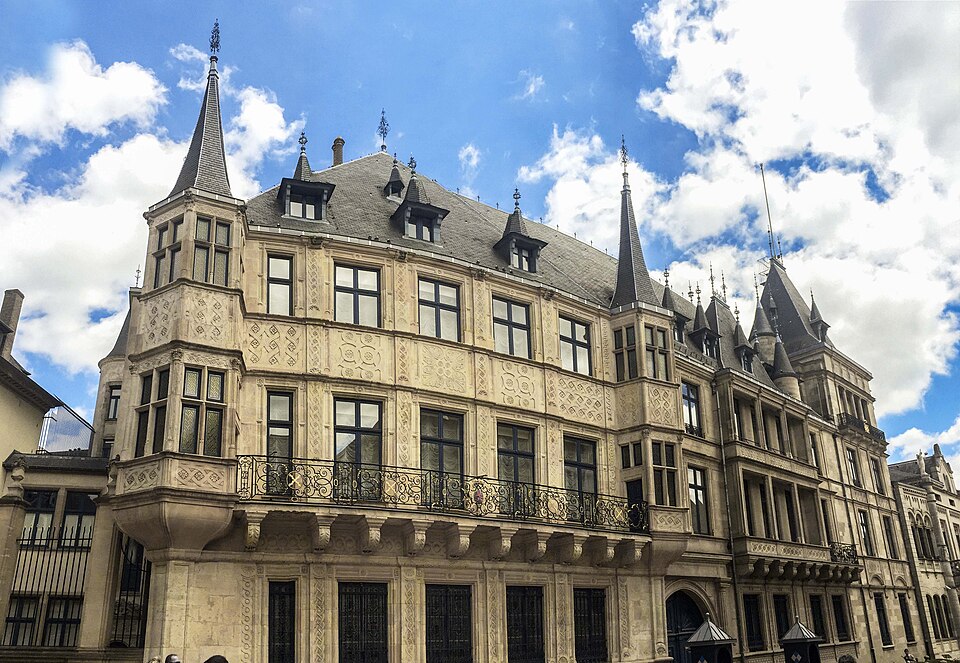
1572
A château-scaled Renaissance palace standing in the heart of the old town; it hosts ceremonial and administrative duties rather than serving as the head of state's actual home.
The Grand Ducal Palace, raised in the Renaissance style in the early 1570s, serves as the official residence of Luxembourg's grand duke and the setting for most of his duties as head of state. It does not function as his everyday home: that role belongs to Berg Castle, in Colmar-Berg, some distance away. Standing in the historic core of Luxembourg City, the palace combines ceremonial and administrative functions, hosting state business while remaining, in practice, a secondary residence for the ruling family.
Photo: EEJCC (CC BY-SA 4.0)
Notre-Dame Cathedral
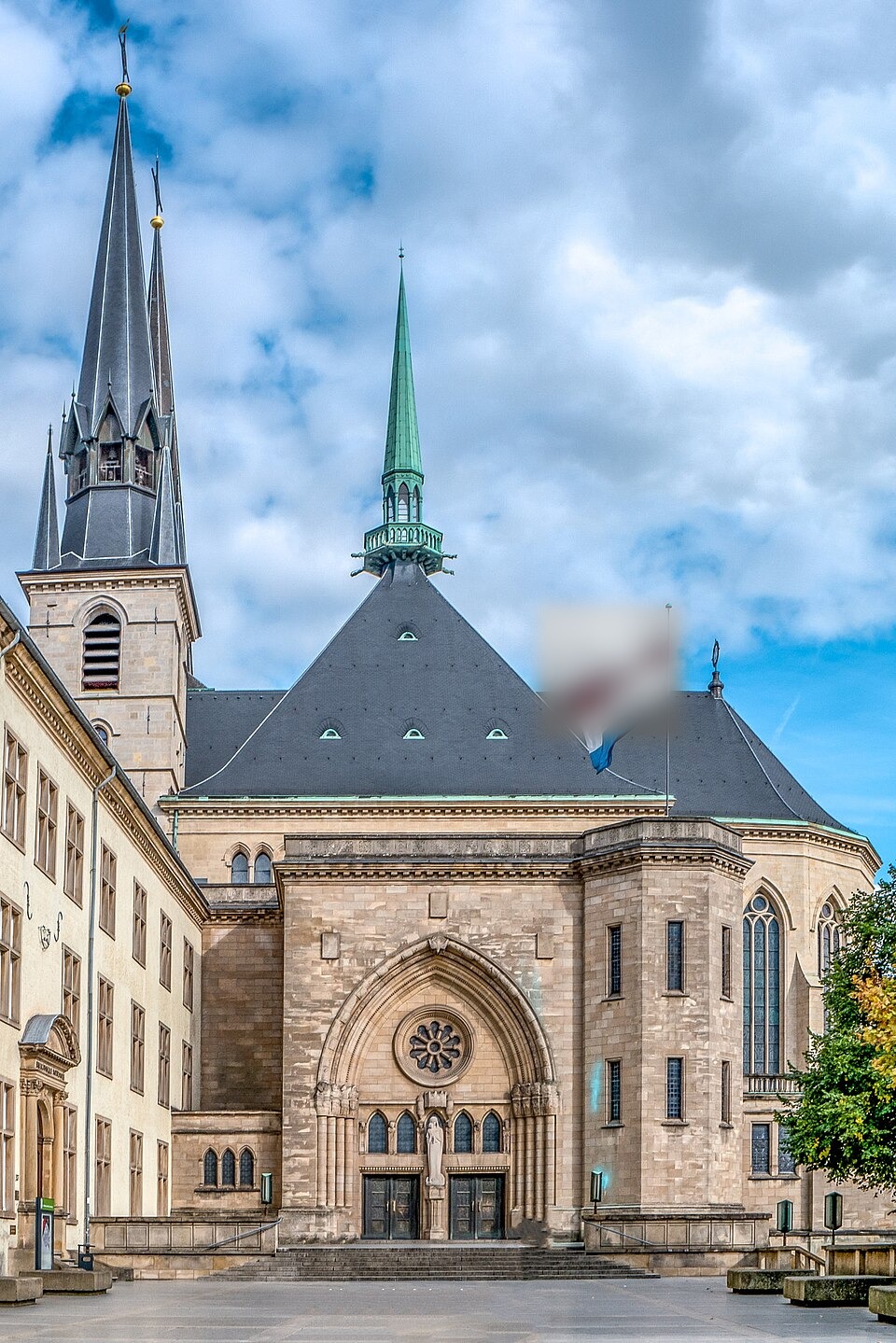
1613–1938 · Jean du Blocq
A late Gothic church whose stonework carries substantial Renaissance ornament from the same building campaign, rather than a single unified style; its cemetery holds a bronze memorial figure by a twentieth-century sculptor, part of a monument to resistance and deportation.
Notre-Dame Cathedral began as a Jesuit church, its cornerstone laid in 1613; late Gothic in structure, it carries substantial Renaissance ornament from the same building campaign. The building became Luxembourg's only cathedral in 1870, having earlier housed a Marian image granted a papal coronation decree in 1866. It was expanded between 1935 and 1938, giving the cathedral much of its present form. Its cemetery holds a national monument to resistance and deportation, centered on a bronze figure by the sculptor Lucien Wercollier.
- The rite that crowned the church's Marian image in 1866 was carried out by a cardinal brought in from Munich, rather than by local clergy.
Photo: Michał Jaroszczyk (CC BY 3.0)
Adolphe Bridge
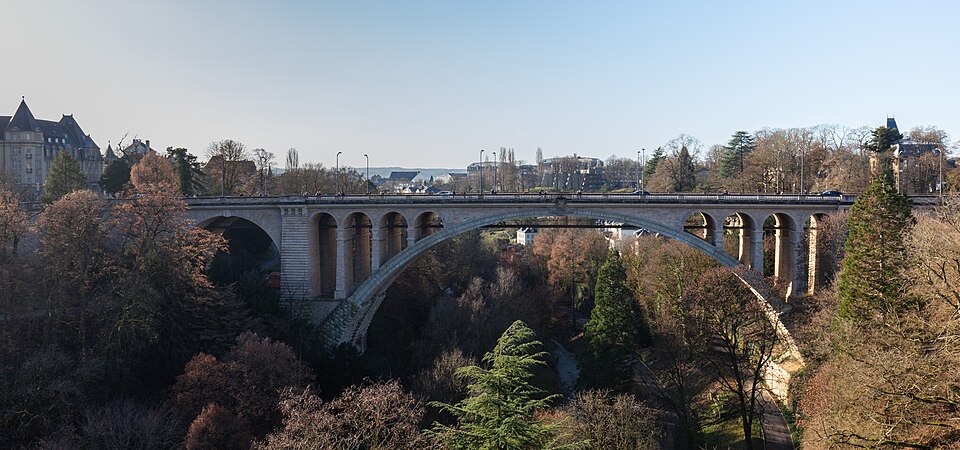
1900–1903 · Paul Séjourné
Two decks are visible at once: a stone arch carrying the roadway above, and a slender steel walkway suspended in open air beneath it, built later for cyclists and pedestrians.
The Adolphe Bridge carries traffic across the Pétrusse valley on two levels: an upper deck, 153 metres long, built for road and pedestrian use between 1900 and 1903, and a lower deck added in 2018 for bicycles, suspended beneath the upper one. Trams have used the upper deck since December 2020. Designed by the French engineer Paul Séjourné together with Albert Rodange, a Luxembourger, the bridge is named after Grand Duke Adolphe, who reigned from 1890 to 1905, and has since become an unofficial symbol of the country's independence.
- Its design was later copied for the Walnut Lane Bridge, built afterward in Philadelphia, in the United States.
Photo: Diego Delso (CC BY-SA 4.0)
Fort Thüngen
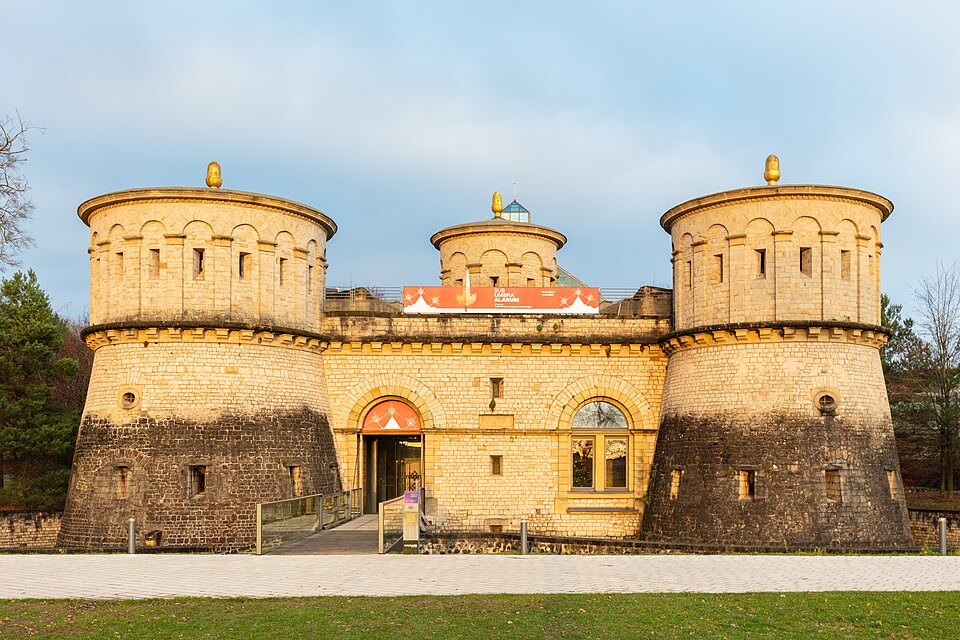
1732–1733
Three round towers, each roofed with a distinctive acorn-shaped stone finial — the feature that gave the fort its popular nickname — are what survived the fortress's demolition; they now stand rebuilt in full within a park in the Kirchberg district, beside the country's museum of modern art.
Fort Thüngen was built in 1732 and 1733 and named after the military commander Adam Sigmund von Thüngen. It was enlarged in 1836 and again from 1859 to 1860, but an 1867 treaty required the demolition of Luxembourg City's fortifications, and only the fort's three towers and their foundations survived. The site was rebuilt in full during the 1990s, alongside construction of the country's museum of modern art nearby, and reopened in 2012 as the Musée Dräi Eechelen, in Dräi Eechelen Park in the Kirchberg district.
Photo: Diego Delso (CC BY-SA 4.0)
Palais de la Cour de Justice
A building complex in Kirchberg housing the Court of Justice of the European Union, centered on the original 1973 building known as the Ancien Palais. Later additions include an encircling Anneau building and translation towers, the newest now the tallest building in Luxembourg.
MUDAM
A museum of modern art in Luxembourg City, standing on the site of the old Fort Thüngen at the southwestern edge of the Kirchberg plateau. It sits close to many of the European Union institutions based in the city.
ARBED building
The former headquarters of the ARBED steel company, later part of ArcelorMittal, completed in 1922 on the Avenue de la Liberté opposite the Rose Garden. It was designed by French architect René Théry, with construction overseen by Sosthène Weis.
National Library of Luxembourg
Luxembourg's national library, founded in its current form in 1899 out of institutions dating back to the 18th century, located in the Kirchberg district. It holds 1.8 million printed items, the largest collection of any library in the country.
Memorial to the victims of the Shoah
A memorial commemorating the persecution, deportation and murder of Luxembourg's Jews under the National Socialist dictatorship, inaugurated in the city on 17 June 2018. The date marked 75 years since the last deportation train left, near the site of the city's first synagogue.
Heisdorf Castle
A late-19th-century castle in Heisdorf, built by Baron Lippmann and designed by Belgian architect Charles Thirion within a large park. The Sisters of the Christian Doctrine took it over as a convalescent home in 1916 and it has housed the elderly since 1982.
Munsbach Castle
A castle west of Munsbach, built in 1775 as a Baroque manor before its conversion into a castle in the late 19th century with two added towers. Its public rose garden holds more than 600 varieties and hosts an annual Rose Fest each September.
Villa Pauly
A house built in 1923 on Boulevard de la Pétrusse for surgeon Dr. Norbert Pauly, designed by architect Mathias Martin. Its corner towers echo the castle architecture of the Late Middle Ages and Renaissance, and Pauly initially ran his practice from its basement.
La Fontaine Castle
A castle in Clausen begun in 1563 as the residence of Peter Ernst I von Mansfeld-Vorderort, governor of Luxembourg, who kept extending it until his death in 1604. Also known as the Palais Mansfeld, almost nothing of the building remains today.
Casino Luxembourg
A forum for contemporary art that opened in 1882 as the Casino Bourgeois, a center for gaming and for cultural and social events. It was adapted and renovated in 1995 to house temporary exhibitions of Luxembourg art.
Senningen Castle
A revival-style castle in the town of Senningen, within the commune of Niederanven in the Grand Duchy of Luxembourg. It is used today by the Luxembourg state for official meetings.
Pulvermuhl Viaduct
A two-track railway viaduct in the Pulvermuhl area of eastern Luxembourg City. It is known locally as the Biisser Bréck.
St. Peter and Paul Church
Luxembourg's first Russian Orthodox church. It falls under the jurisdiction of the Western European Diocese of the Russian Orthodox Church Outside Russia.
Palais du Mobilier Bonn Frères
An Art Deco building in Luxembourg City designed by architect Léon Bouvart and built in 1925–26 by contractor Achille Giorgetti for the Bonn family. Originally a furniture showroom, it is listed today as a cultural heritage monument.
Walferdange Castle
A castle in Walferdange dating from 1824, built as a stud farm by William I of the Netherlands, also Grand Duke of Luxembourg. It later served the University of Luxembourg and has been used since 2015 by the Ministry of National Education, Childhood and Youth.
Stade de Luxembourg
The national stadium of Luxembourg, in the Gasperich district, built between September 2017 and July 2021 and rated Category 4 by UEFA. It hosts the national football and rugby teams and the Coupe de Luxembourg final, replacing the older Josy Barthel stadium.
History
Luxembourg City grew as a fortified stronghold, and its landmarks trace that history from dynastic and religious building to military demolition and later civic rebuilding. The Grand Ducal Palace, raised in the Renaissance style in the early 1570s, predates the city's later fortress expansion. Notre-Dame Cathedral began as a Jesuit church in 1613, later enlarged between 1935 and 1938 into its present form. Fort Thüngen, built in 1732 and 1733 and named for a military commander, was one of many defensive works ringing the city until an 1867 treaty required their demolition; only its three towers survived, rebuilt in full only in the 1990s. The Adolphe Bridge, completed in 1903 to span the Pétrusse gorge, came later still and became an unofficial symbol of the country's independence.