Landmarks in Frankfurt
Bank towers rise a few streets from a medieval old town rebuilt after wartime bombing.
Frankfurt's oldest landmarks sit within a few streets of each other on the north bank of the Main, around the Altstadt: the Römer city hall, the Gothic cathedral where Holy Roman emperors were elected and crowned, and the Eschenheimer Turm, a surviving gate from the medieval wall. Most of this quarter was rebuilt after the Second World War, including a reconstruction of the old town finished only in 2018. Away from that medieval core, the nineteenth century added the neoclassical St. Paul's Church, seat of the country's first national parliament, and the Alte Oper, an opera house gutted by bombing in 1944 and reopened as a concert hall in 1981 inside its restored shell.
Römer
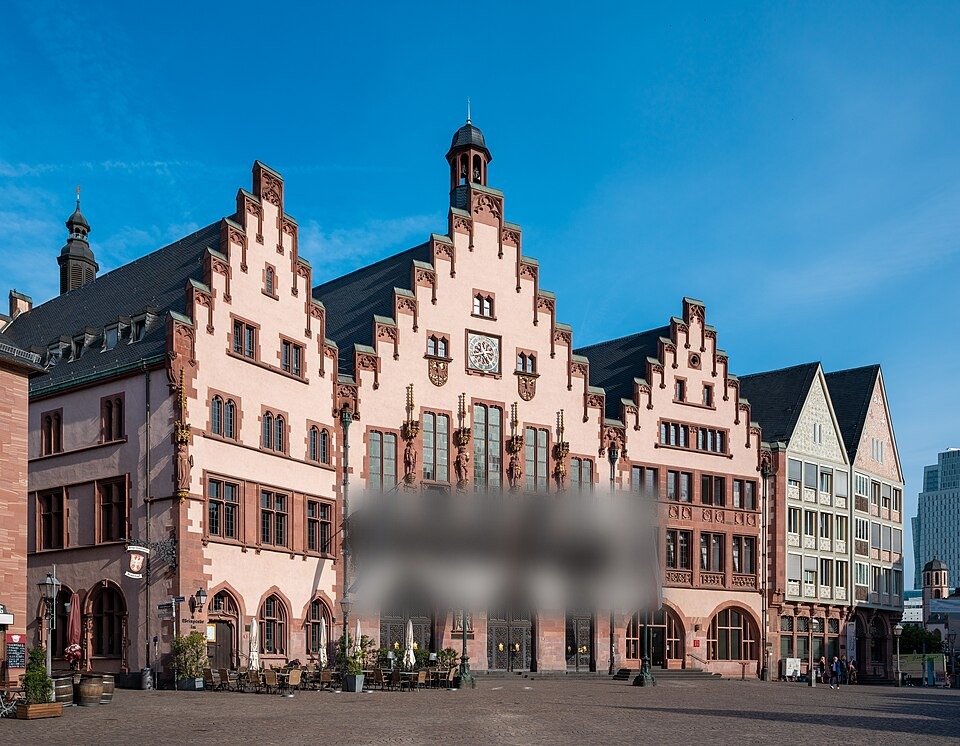
1405
It forms the central building of three joined houses on the Römerberg square, standing opposite the Old St. Nicholas Church, with the adjoining Haus Löwenstein housing the city's wedding rooms.
The Römer is a medieval building in Frankfurt's old town, formed from three adjoining houses that the city council bought from the Römer merchant family, together with a second building known as the Golden Swan, on 11 March 1405, converting them for use as the city hall. It has held that function for more than six hundred years and remains in use today, including as a civil registration office, even though it is not run as a museum. The neighbouring old town quarter has since been redeveloped, with several historical reconstructions, into the 2010s.
- The council bought it as part of a package deal that included a second building known as the Golden Swan.
- Weddings are still registered here today, in the adjoining Haus Löwenstein, even though the building is not run as a museum.
Photo: Thomas Wolf, www.foto-tw.de (CC BY-SA 3.0 de)
Frankfurt Cathedral
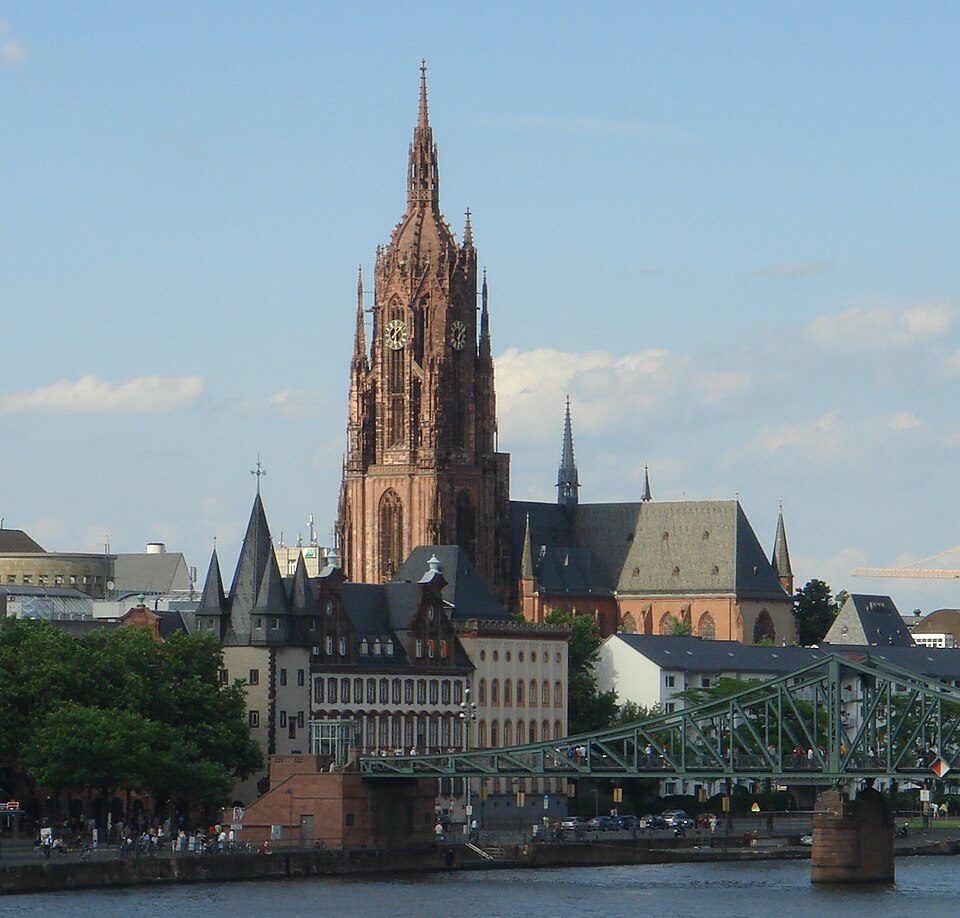
1239–1550 · Madern Gerthener
As the largest religious building in the city, its Gothic profile dominates the historic centre; despite being commonly called a cathedral, it has never held that official rank, having served instead as the empire's election and coronation church.
Frankfurt Cathedral is a Roman Catholic Gothic church dedicated to Saint Bartholomew, its construction spanning the thirteenth to the sixteenth century, with Madern Gerthener among the architects who worked on it. Although its English name suggests otherwise, it has never held the rank of a true cathedral with a bishop's seat; the term Dom instead marks it as the main church of the city. It served as the election and coronation church of the Holy Roman Empire, a role that made it a symbol of national unity in the nineteenth century.
- Although English speakers call it a cathedral, the building has never held that official rank, since it never had a bishop's seat.
Photo: rupp.de (CC BY-SA 3.0)
Alte Oper
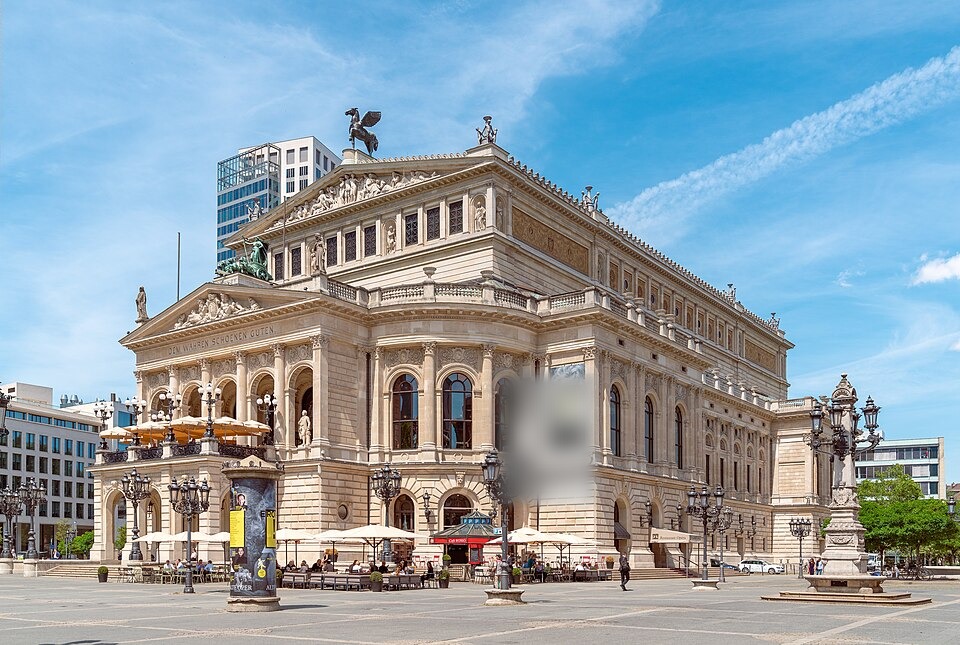
1880–1981 · Richard Lucae
It stands in the banking district behind a square still called Opernplatz, its nineteenth-century exterior preserved even though the interior was rebuilt from a wartime ruin into a concert hall that reopened in 1981.
The Alte Oper opened in 1880 as Frankfurt's opera house, designed by Richard Lucae, who died three years before its completion. Bombing destroyed the building in 1944, and it stood as a ruin for decades before being rebuilt in the 1970s as a concert hall with a large auditorium and several smaller venues, reopening in 1981. The square in front is still known as Opernplatz. Its stage saw the premieres of Schreker's Der ferne Klang and Orff's Carmina Burana in 1937, before Frankfurt's opera company moved elsewhere in 1951.
- Carl Orff's Carmina Burana had its first performance here, in 1937.
- The architect died three years before the building he designed was completed.
Photo: Thomas Wolf, www.foto-tw.de (CC BY-SA 3.0 de)
St. Paul's Church
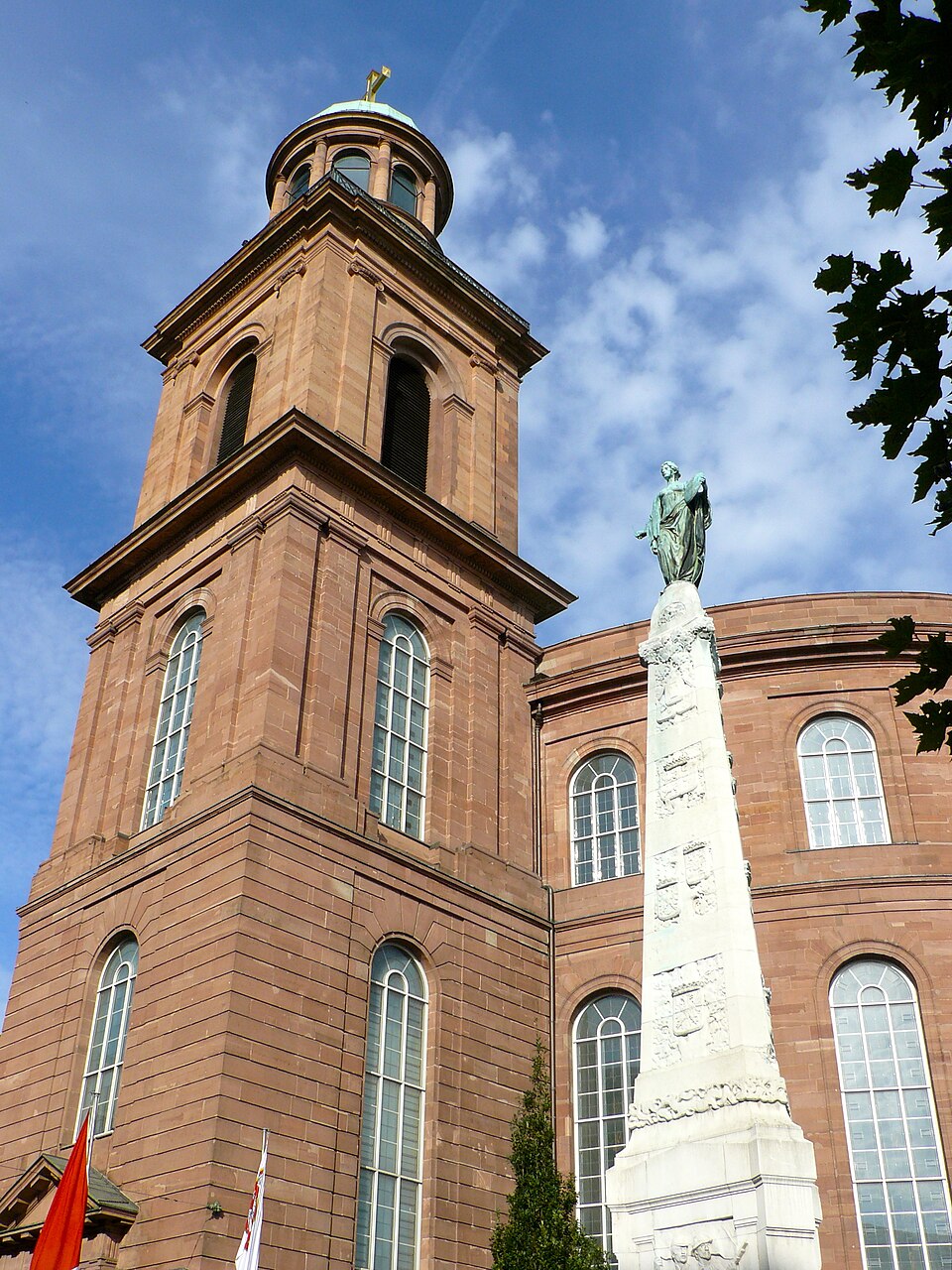
1789–1833 · Johann Friedrich Christian Hess
It is unusual among churches for its plan: a neoclassical circular building, now emptied of its historic interior and used instead as an exhibition, memorial and meeting space rather than for worship.
St Paul's Church was built between 1789 and 1833 to replace the medieval Barfüßerkirche, demolished in 1786, and served as Frankfurt's main Protestant church until 1944. Designed by Johann Friedrich Christian Hess in a neoclassical, circular plan, it became the meeting place of the Frankfurt National Assembly in 1848–49, the first all-German parliament, and alongside Hambach Castle a lasting symbol of the country's democratic movement. Almost nothing of the interior from that era survives; the building is now used for exhibitions, memorials and civic gatherings rather than worship.
- Almost nothing survives from the interior of its most historically significant era, the 1848–49 parliament.
- It replaced a medieval church that had already been demolished three years before construction began.
Photo: ArcCan (CC BY-SA 3.0)
Eschenheimer Turm
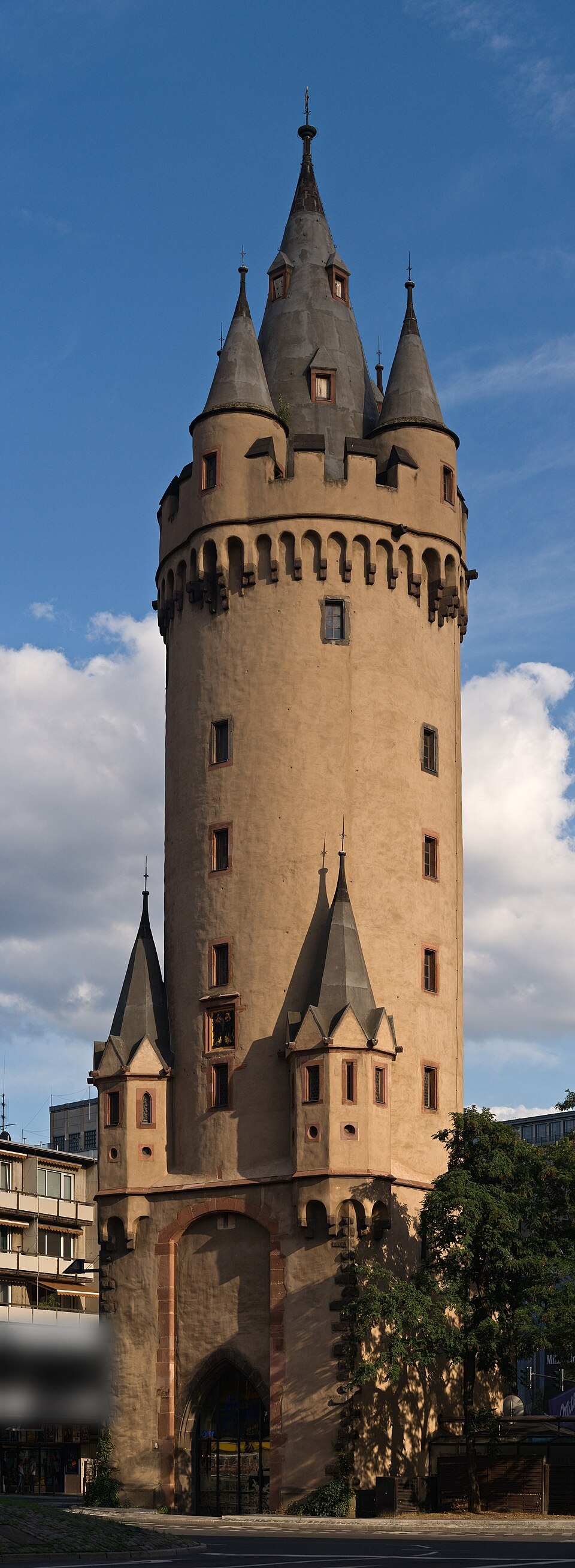
1428
As the oldest and least altered structure in an otherwise largely rebuilt district, it stands out as a distinctly medieval tower amid its modern surroundings, a surviving fragment of the city's former fortifications.
Eschenheimer Turm was a city gate and part of the late-medieval fortifications, erected at the beginning of the fifteenth century. It stands in what was then Frankfurt's Neustadt, or new town, an area rebuilt extensively over the centuries and now known as the Innenstadt, or city centre. Despite that wider reconstruction, the tower itself survives as the oldest and least altered building in the district, a rare intact fragment of the fortifications that once encircled the medieval city.
Photo: Jürgen Matern (CC BY-SA 3.0)
Goethe House
The birthplace and childhood home of Johann Wolfgang von Goethe, where he wrote Götz von Berlichingen and The Sorrows of Young Werther. Operated as a museum since 1863, the house was destroyed by RAF bombing in World War II and later reconstructed.
Hauptwache
A central plaza originally named Schillerplatz, a name superseded in the early 1900s. It lies west of Konstablerwache, with the two squares connected by the Zeil, the city's main shopping street.
Deutsche Bank Twin Towers
A twin-tower skyscraper complex in the Westend-Süd district, with both towers rising to 155 meters. It serves as the headquarters of Deutsche Bank, Germany's largest bank.
Commerzbank Tower
A 56-story skyscraper standing 259 meters tall, or 300.1 meters with its antenna spire, making it the tallest building in Germany. Designed by Foster & Partners and built between 1994 and 1997, it includes winter gardens for natural lighting and ventilation.
Main Tower
A 56-story, 200-meter skyscraper named after the nearby Main river, the only building in Frankfurt with a public viewing observatory. Its foyer displays a video installation by Bill Viola and a wall mosaic by Stephan Huber.
Messeturm
A 63-story, 257-meter skyscraper designed by Helmut Jahn in a postmodern style, completed in 1990. It was the tallest building in Europe until 1997, and despite its name is used as an office tower rather than for trade fairs.
Städel
An art museum on the Museumsufer with one of Germany's most important collections, holding 3,100 paintings, 660 sculptures and more than 100,000 drawings and prints. Named Museum of the Year by German art critics in 2012, it drew a record 447,395 visitors that year.
Haus zur goldenen Waage
A medieval half-timbered house in the old town, prized for its architectural and historic value, destroyed in the air raid of 22 March 1944. Its detailed Renaissance facade dated to 1619, but the surviving remains that could have allowed reconstruction were removed in 1950.
St. Catherine's Church
The largest Protestant church in Frankfurt, completed in 1681 in the Baroque style near the Hauptwache square. Heavily damaged in 1944 and rebuilt more simply in the 1950s, it saw detailed restorations between 1978 and 2005, with the steeple and roof restored in 2011.
Palmengarten
One of Frankfurt's two botanical gardens, covering 22 hectares in the Westend-Süd district. It is a major tourist attraction in the city.
Seat of the European Central Bank
The European Central Bank's headquarters, combining a twin-tower skyscraper with the city's former Wholesale Market Hall, connected by a low-rise building. Completed in 2014 and officially opened on 18 March 2015, it replaced the bank's earlier premises in the Eurotower, Eurotheum and Japan Center.
Großmarkthalle
The city's former wholesale market hall in the Ostend district, mainly for fruit and vegetables, closed on 4 June 2004. Considered a major example of expressionist architecture, the building now forms part of the Seat of the European Central Bank.
Westend Synagogue
The city's largest synagogue, built between 1908 and 1910 to serve as the spiritual center of the Jewish community. It is the only one of the four pre-war large synagogues here to survive the November 1938 pogroms and wartime bombing, though it suffered significant damage.
Waldstadion
A retractable-roof stadium, known commercially as Deutsche Bank Park, that opened in 1925 as the home ground of Eintracht Frankfurt. Redeveloped as a football-only venue for the 2006 World Cup, it seats 60,100 and hosted the 2011 Women's World Cup final.
Schirn Kunsthalle
An exhibition hall between the Römer and Frankfurt Cathedral, opened in 1986 on a site destroyed in the Second World War and left undeveloped until then. It has hosted retrospectives of artists including Wassily Kandinsky, Marc Chagall and Alberto Giacometti.
Museum für Moderne Kunst
A museum of modern art designed by the Viennese architect Hans Hollein, founded in 1981 and opened to the public on 6 June 1991. Its triangular shape has earned it the popular nickname Tortenstück, or 'piece of cake.'
Festhalle
A multi-purpose arena with a domed interior reaching 40 meters at its highest point, covering 5,646 square meters. Its variable grandstand system seats up to 8,500 people, or holds 13,500 for standing events.
Henninger Turm
A 120-meter, 33-story grain storage silo built for the Henninger Brewery between 1959 and 1961. Its rooftop pod held a viewing platform and revolving restaurant until closing to the public in 2002, and the site became a residential estate of 150 apartments in 2017.
Liebieghaus
A late 19th-century villa on the Sachsenhausen bank of the Main, housing the Liebieghaus sculpture collection. Its holdings comprise about 3,000 sculptures spanning more than 5,000 years of culture.
Museum Angewandte Kunst
A museum of applied arts on the Museumsufer, holding more than 30,000 objects spanning European handicrafts from the twelfth to twenty-first centuries, design, and Islamic and East Asian art. It has hosted exhibitions by designers including Stefan Sagmeister and Patricia Urquiola.
Jewish Museum
Germany's oldest independent Jewish museum, opened by Chancellor Helmut Kohl on 9 November 1988, the 50th anniversary of Kristallnacht. It presents Frankfurt's Jewish history across two venues, the Museum Judengasse and the Rothschildpalais, refurbished and expanded between 2015 and 2020.
Old Jewish Cemetery
The largest of Frankfurt's twelve Jewish cemeteries, opened alongside the Main Cemetery in 1828 and noted for its many monumental graves. It closed to new burials in 1928, after around 40,000 interments, when the New Jewish Cemetery opened in its place.
Fairy Tale Fountain
An Art Nouveau bronze fountain at Willy-Brandt-Platz, designed by Ernst Friedrich Jausmann in 1910. Its sculptures depict characters from well-known fairy tales, making it a popular gathering point and photography spot.
Noor Mosque
The first purpose-built mosque in Frankfurt and the third in Germany, completed in 1959 on Babenhäuser Landstraße in Sachsenhausen. The boxer Muhammad Ali once prayed here.
Saint Justin's Church
The oldest building in Frankfurt, a Carolingian basilica dating to around 830 with a late Gothic chancel added in 1441. One of the few nearly complete surviving early medieval churches, it has been in continuous use for around 1,200 years.
History
Frankfurt was first recorded in 794 and became a free imperial city in 1372, holding that status for nearly five centuries while serving as an election and coronation site for Holy Roman emperors. The Römer became the city hall in 1405, after the council bought it from the merchant family whose name it bears. St. Paul's Church, finished in 1833, hosted the Frankfurt National Assembly of 1848–49, the first all-German parliament, and is remembered as a symbol of the country's democratic movement. Prussia annexed the city in 1866, ending its independence. Allied bombing in the Second World War gutted the Alte Oper and left much of the old town in ruins; reconstruction of that quarter, including replicas of buildings lost in the war, continued until 2018.