Landmarks in Brussels
A Gothic civic core, a neoclassical park arch, and a lone steel giant from 1958.
Brussels' most recognisable buildings cluster in two places. Around the medieval market square stand the Gothic Town Hall, finished in the mid-15th century, and a cathedral rebuilt in the same style over the following centuries; a small bronze fountain figure stands a short walk away. East of the centre, a triple neoclassical arch of 1905 anchors a formal park where broad avenues converge, raised while the young Belgian state was investing in monumental civic architecture. To the north, on its own, rises a structure from a different era: nine steel spheres built for the 1958 world's fair, still without an equivalent nearby. Carved Gothic stone, dressed neoclassical stone, and bare steel sit within a few kilometres of each other, each marking a distinct century of building.
Atomium
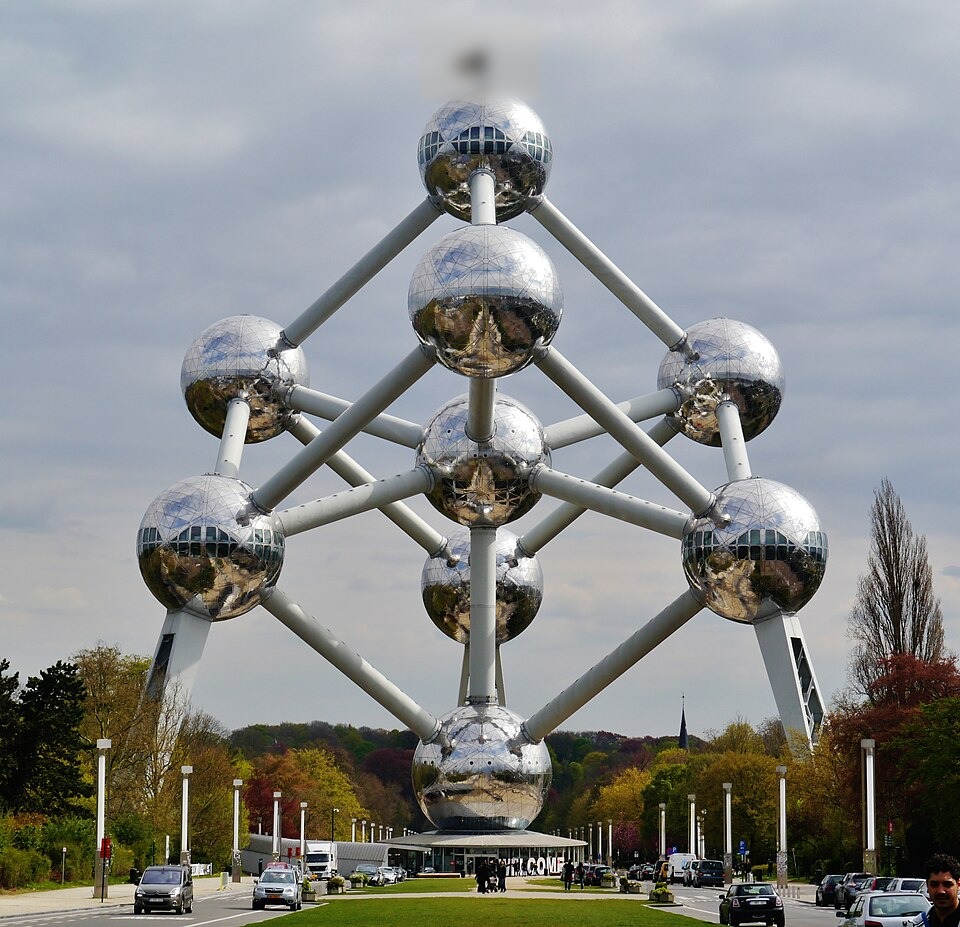
1958 · André and Jean Polak
Nine mirror-finished, stainless-steel spheres 18 metres across, joined by tubes carrying stairs, escalators and a lift, arranged in the pattern of a magnified iron crystal and rising 102 metres on angled support tubes.
Designed by the engineer André Waterkeyn together with architects André and Jean Polak, it was built as the centrepiece of a 1958 world's fair, conceived as a tribute to scientific progress and to Belgian engineering skill. Its nine spheres, linked by tubes carrying stairs, escalators and a lift, hold exhibition halls and a restaurant at the top with a panoramic view. It was completely renovated between 2004 and 2006 by the firms Jacques Delens and BESIX.
- Its nine spheres form the shape of an iron crystal's unit cell magnified 165 billion times.
- It underwent a complete renovation between 2004 and 2006.
Photo: Zairon (CC BY-SA 4.0)
Brussels Town Hall
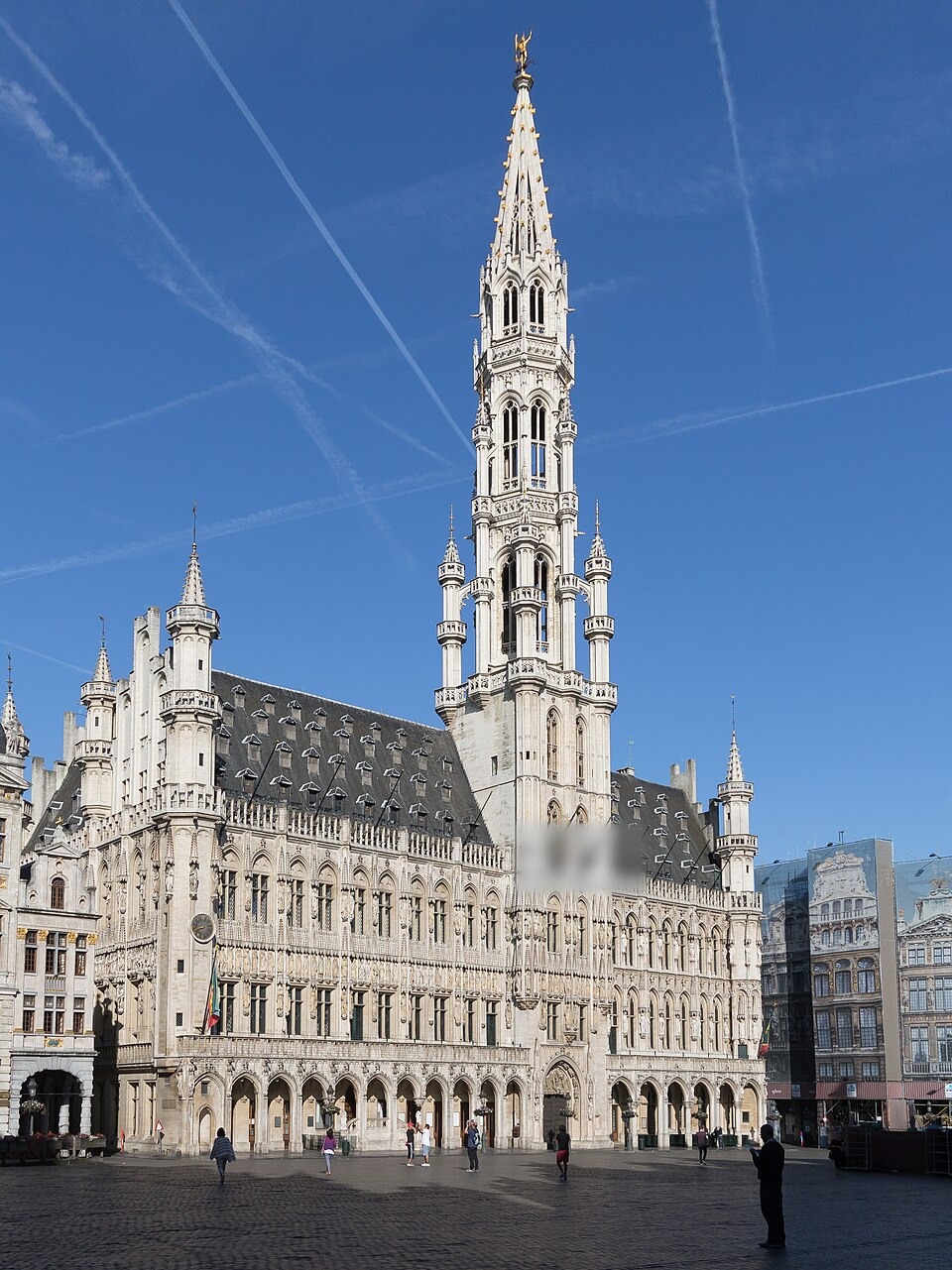
1401–1455 · Jan van Ruysbroeck
Its finely carved Gothic stone facade, with pointed windows and pinnacles in the Brabantine style, contrasts with the plainer classicist wings added at the rear three centuries later; it is the only medieval building left standing on its square, facing a neo-Gothic building across the way.
Erected between 1401 and 1455, it is the only medieval building remaining on its market square and is considered a masterpiece of civil Gothic, specifically Brabantine Gothic, architecture. Jacob van Thienen began the work, and Jan van Ruysbroeck is credited with later contributions to it. Three classicist wings were added at the rear in the 18th century, and Victor Jamaer and Eugène Viollet-le-Duc were both involved in restoration during the 19th century. Since 1998 it has formed part of a UNESCO World Heritage Site together with its square.
- It is the only medieval building still standing on its square.
- Its three rear wings, added in the 18th century, are built in a plainer classicist style than the Gothic front.
Photo: Michielverbeek (CC BY-SA 4.0)
Manneken Pis
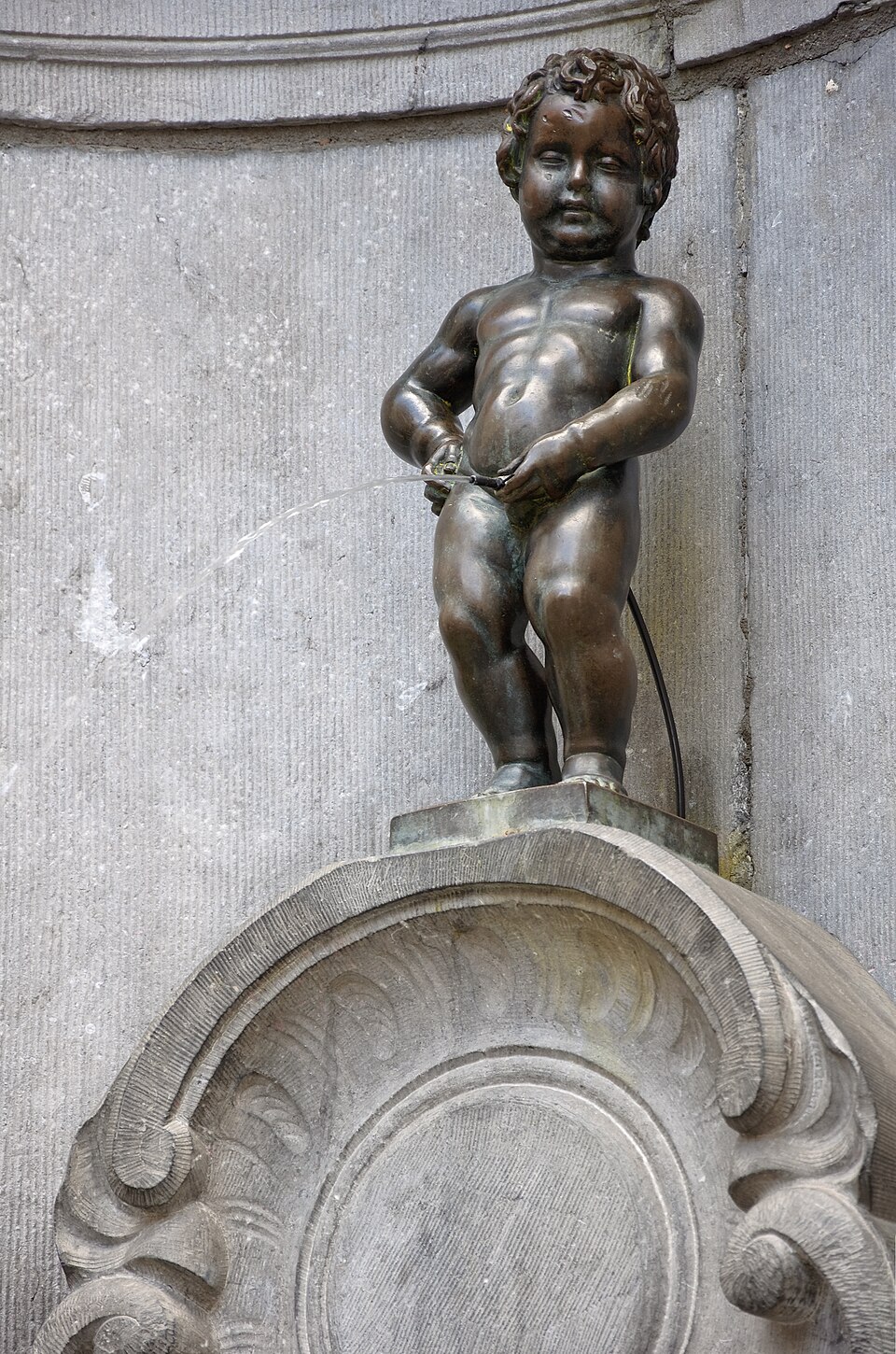
1619 · Jérôme Duquesnoy the Elder
Just 55.5 centimetres tall, it shows a naked boy standing over a fountain basin, continuously relieving himself into the water; the figure on site is a replica cast in 1965, the original kept in a museum, and it is regularly dressed in one of roughly a thousand different costumes.
Though a figure at this spot is attested as early as the mid-15th century, its present design was created by the Brabantine sculptor Jérôme Duquesnoy the Elder and installed in 1619; its blue-stone rocaille niche followed in 1770. The statue has been stolen or damaged repeatedly over its history, so since 1965 a replica has stood in its place while the original is kept in the Brussels City Museum. Its extensive wardrobe is now shown in a dedicated museum.
- Its wardrobe runs to around a thousand different costumes, now shown in a dedicated museum that opened in 2017.
- The statue on site since 1965 is a replica; the original is kept in a city museum.
Photo: Myrabella (CC BY-SA 3.0)
Cathedral of St. Michael and St. Gudula
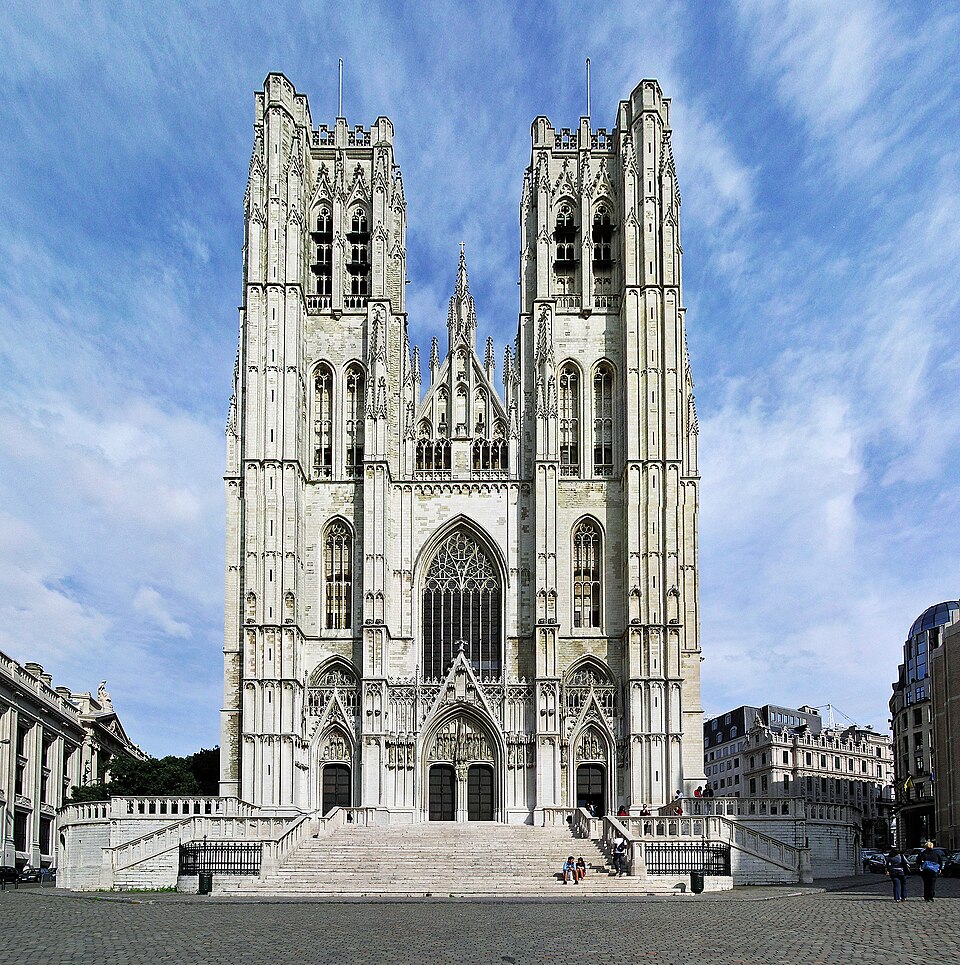
1226–1519
Built of pale stone in the Brabantine Gothic style, its interior mixes late-Gothic and Baroque chapels with neo-Gothic stained-glass windows added during a 19th-century restoration, and it is fitted with two pipe organs and large church bells.
The church began as a Romanesque building in the 11th century, replacing an earlier chapel, and was rebuilt in the Gothic style over the following centuries, reaching largely its present form by the 16th century. Its interior later gained late-Gothic and Baroque chapels, along with neo-Gothic stained-glass windows installed during a 19th-century restoration. Designated a historic monument in 1936, it was raised to cathedral status only in 1962, and now serves jointly with St. Rumbold's Cathedral in Mechelen.
- It only became a cathedral in 1962, centuries after the building itself was largely complete.
- It houses two pipe organs and large church bells.
Photo: Donaldytong (CC BY-SA 3.0)
Cinquantenaire Arcade
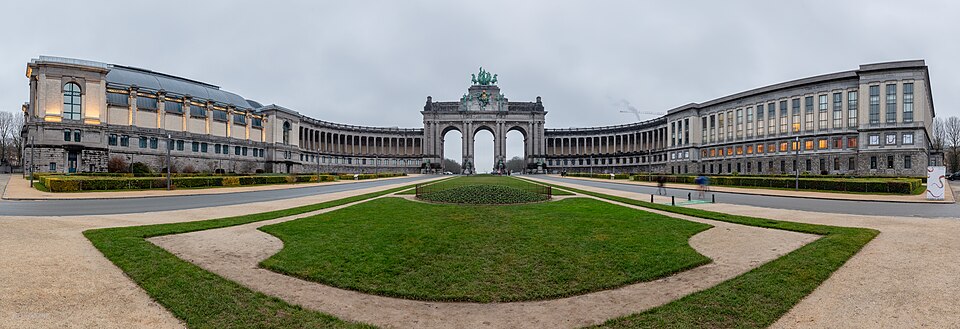
1905 · Gédéon Bordiau
The centrepiece is a triple arch carrying a bronze quadriga: a chariot drawn by horses and driven by a female figure raising a flag, set within a park at the point where two long straight avenues converge.
Raised in 1905 to a design by Gédéon Bordiau, who died the year before its completion, the arcade forms the centrepiece of a park in eastern Brussels. Its triple arch is topped by a bronze quadriga showing a female charioteer personifying a province and raising the national flag. The monument faces the city centre along an avenue that passes through the Leopold Quarter toward the Royal Quarter, and on its other side opens onto the avenue leading to the former Palace of the Colonies, now the Royal Museum for Central Africa.
- Its designer, Gédéon Bordiau, died in 1904, the year before the arch was completed.
- It stands where two avenues meet, one leading toward a former colonial palace, the other toward the seat of national government.
Photo: Diego Delso (CC BY-SA 4.0)
Grand-Place
A paved square dating from the 11th century, ringed by Baroque guildhalls, the Flamboyant Town Hall and the neo-Gothic King's House. French bombardment in the 1695 Nine Years' War destroyed most of it, sparing only the Town Hall's façade, tower and a few stone walls.
Royal Palace
The official palace of the King and Queen of the Belgians, though not used as a residence since the family lives at Laeken. There the King exercises Head of State duties, grants audiences, and the Grand Marshal of the Court's offices are housed.
Palace of Justice
The country's most important court building, seat of Belgium's Court of Cassation, Assizes and Appeal courts. Designed by Joseph Poelaert in an eclectic Greco-Roman style and built between 1866 and 1883, it is reputed to be the largest building constructed in the 19th century.
Cinquantenaire
A 30-hectare park in the European Quarter, its U-shaped complex commissioned by King Leopold II for the 1880 National Exhibition marking Belgium's 50th anniversary. Its centrepiece, the Cinquantenaire Arch, was erected in 1905, replacing an earlier temporary arcade.
Basilica of the Sacred Heart
A Catholic minor basilica inspired by the Sacré-Cœur in Paris, whose first stone King Leopold II laid in 1905; construction, halted by two world wars, finished only in 1970. It is the 17th largest church in the world by area and the largest in Belgium.
Berlaymont building
An office building on the Robert Schuman Roundabout housing the European Commission's headquarters, the EU's executive branch. Its distinctive architecture appears in the Commission's official emblem, and it takes its name from the former Convent of the Ladies of Berlaymont on the site.
King's House
A historic building on the Grand-Place opposite the Town Hall, erected between 1504 and 1536 and rebuilt in neo-Gothic style by Victor Jamaer in the 19th century. It houses the Brussels City Museum and has been UNESCO-listed since 1998 as part of the square.
Bourse Palace
A former stock exchange building designed by Léon-Pierre Suys in an eclectic neo-Renaissance and Second Empire style, erected from 1868 to 1873 on the site of the old Butter Market. Its upper floors have housed the Belgian Beer World museum since 2023.
La Monnaie
An opera house in central Brussels that gives its name to the National Opera of Belgium, which is housed there. As Belgium's leading opera house, it is among the few institutions funded by the federal government, unlike regional houses such as the Vlaamse Opera.
Centre for Fine Arts
A multi-purpose cultural venue known as BOZAR, designed by Victor Horta in Art Deco style and completed in 1929 at the instigation of banker Henry Le Bœuf. It includes exhibition rooms, a cinema, and a concert hall home to the Belgian National Orchestra.
Royal Saint-Hubert Galleries
An ensemble of three glazed shopping arcades, the King's, Queen's and Princes' Galleries, designed by architect Jean-Pierre Cluysenaar and built between 1846 and 1847. They predate other famous 19th-century arcades such as Milan's Galleria Vittorio Emanuele II and Saint Petersburg's Passage.
Royal Museums of Fine Arts of Belgium
A group of art museums comprising six institutions, including the Oldmasters, Magritte, Fin-de-Siècle, Modern, Wiertz and Meunier museums. Their combined holdings exceed 20,000 drawings, sculptures and paintings, spanning the early 15th century to the present, including works by Bruegel, van der Weyden and Rubens.
Mont des Arts
An urban complex including the Royal Library of Belgium, the National Archives, a convention centre and a public garden by René Pechère. It began in the late 19th century under King Leopold II; the first version opened in 1910, with a redesign completed by 1969.
Hôtel Tassel
A town house designed by Victor Horta for scientist Emile Tassel, built 1892–1893 and considered one of the first Art Nouveau buildings for its innovative plan and materials. It was added to the UNESCO World Heritage list in 2000 alongside three other Horta houses.
Belgian Comic Strip Center
A museum dedicated to Belgian comics, housed in an Art Nouveau building designed by Victor Horta on rue des Sables. It can be reached from both the Brussels-Congress and Brussels-Central railway stations.
Flagey Building
Also known as the Radio House, a Streamline Moderne building in Ixelles designed by architect Joseph Diongre and completed in 1938. It served as headquarters of the National Institute of Radio Broadcasting until 1974, when it was refurbished into a cultural centre.
Congress Column
A monumental column commemorating the 1830–31 National Congress that created the Belgian Constitution, inspired by Trajan's Column and built 1850–1859 to a design by Joseph Poelaert. It is topped by a statue of King Leopold I, with the Tomb of the Unknown Soldier below.
Place Royale
A neoclassical square built 1775–1782 to replace the former Palace of Coudenberg, modelled on the French royal square. Measuring 77 by 113 metres, it centres on an equestrian statue of Godfrey of Bouillon and is flanked by the Church of St. James.
Palace of Laeken
The official residence of the King and Queen of the Belgians, 5 km north of the centre in the private Royal Domain of Laeken. Built 1782–1784 as the Palace of Schonenberg, it was partly destroyed by fire in 1890 and later rebuilt and extended.
Royal Greenhouses of Laeken
A complex of heated greenhouses in the Royal Palace of Laeken's park, holding tropical, subtropical and cold houses and the Royal Botanic Collection. Commissioned by King Leopold II and built 1874–1905, they were designed by Alphonse Balat and, after his death, by Maquet and Girault.
Brussels Park
The largest urban public park in central Brussels, still sometimes called the Royal Park, and the city's first public park. Laid out between 1776 and 1783 in neoclassical style by Gilles-Barnabé Guimard and Joachim Zinner, it covers 13.1 hectares.
Royal Library of Belgium
The national library of Belgium, holding collections including the Library of the Dukes of Burgundy and a deposit of every book published in the country. Its history traces to the 15th-century Dukes of Burgundy, and it was formally established in 1837.
Japanese Tower
A five-storey Japanese pagoda in Laeken, standing nearly 50 metres tall, built for King Leopold II between 1900 and 1904 as part of a three-museum complex. Considered of genuine historical interest in Belgium and Japan, it has been closed to visitors since a 2013 renovation.
Great Mosque
A former exhibition pavilion in the Cinquantenaire park, built in 1897 and turned into a Muslim place of worship in 1978 by Saudi Arabia, which ran it forty years. From 2019 to 2023 it was run by Belgium's Muslim Executive, and remains popular with converts.
Church of St. John the Baptist at the Béguinage
A Catholic parish church whose original Gothic building dates from the late 13th century, part of the Great Beguinage of Brussels. Partially destroyed by Calvinists in 1584 and rebuilt in Brabantine Baroque style attributed to Lucas Faydherbe, it was designated a historic monument in 1936.
History
Brussels began as a small settlement on the river Senne and grew around the market square known today as the Grand-Place. Its Town Hall went up in stages between 1401 and 1455, becoming the square's only surviving medieval building, while the nearby cathedral's Romanesque origins were rebuilt in Gothic form over the following centuries, reaching largely their present state by the 16th century. A bronze fountain figure, redesigned in 1619, added a smaller, informal landmark to the same old quarter. After Belgium's growth as a young independent state through the 19th century, the city added grand set-piece architecture away from its centre: a triple triumphal arch rose in 1905 at the heart of a new formal park to the east. In 1958, the city hosted a world's fair, leaving behind a single large modernist structure of steel spheres on its northern edge.