Landmarks in Kyiv
Baroque churches and a rebuilt medieval gate rise from steep hills above the Dnieper.
The landmarks cluster on the steep hills above the Dnieper's right bank, spanning almost a millennium of building. The oldest, an eleventh-century cathedral and a cave monastery founded in 1051, date to the era when the city was capital of Kyivan Rus'; a fortified gate from the same fortifications survives only as a 1982 reconstruction, since the original was dismantled centuries ago. Ukrainian Baroque additions and rebuildings, visible in the cathedral's present exterior and the monastery's above-ground buildings, layer over those medieval cores. An eighteenth-century church by an imported Italian architect, set on a hillside overlooking the river, represents the later wave of Orthodox Baroque construction that reshaped the skyline.
Saint Sophia Cathedral
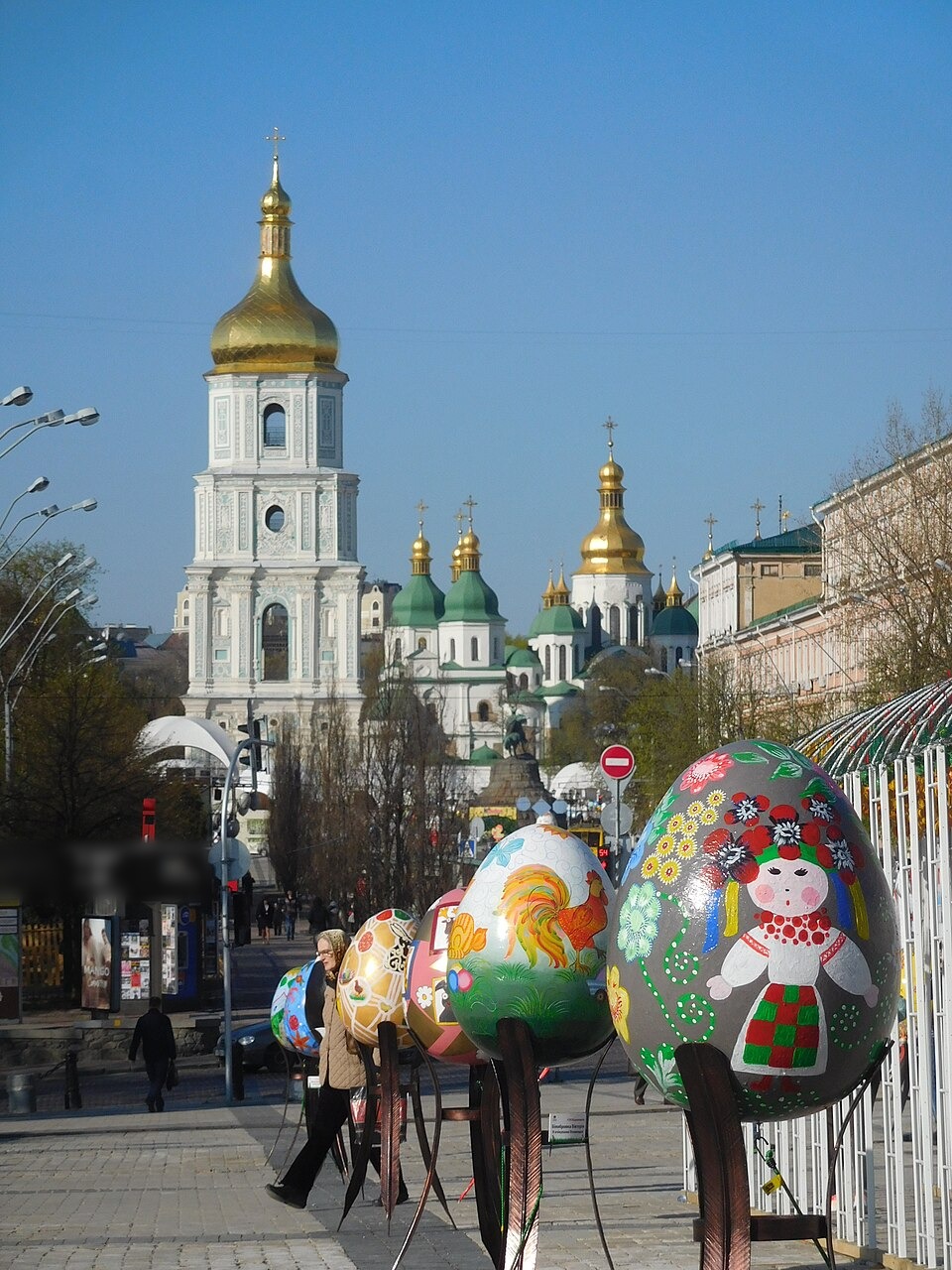
1037
The cathedral's present Baroque-styled exterior wraps an eleventh-century core, and its walled grounds still hold a separate bell tower and the former Metropolitan's residence alongside the main church.
Raised in 1037 as an Orthodox cathedral of Kyivan Rus', the complex became the first heritage site in Ukraine to enter the World Heritage List, alongside a nearby cave monastery; the two were confirmed as a single joint listing in 2013. Beyond the main church, the grounds hold a separate bell tower and the former Metropolitan's residence. No longer an active place of worship, the cathedral now operates as a museum and forms the core of a national reserve that also oversees four other historic sites.
- In 2011, oversight of the site moved from Ukraine's ministry of regional development to its ministry of culture, partly to resolve a mismatch: the cathedral and a nearby monastery were recognized abroad as one UNESCO listing while run at home by two separate government agencies.
Photo: Віктор Полянко (CC BY-SA 4.0)
Kyiv Pechersk Lavra
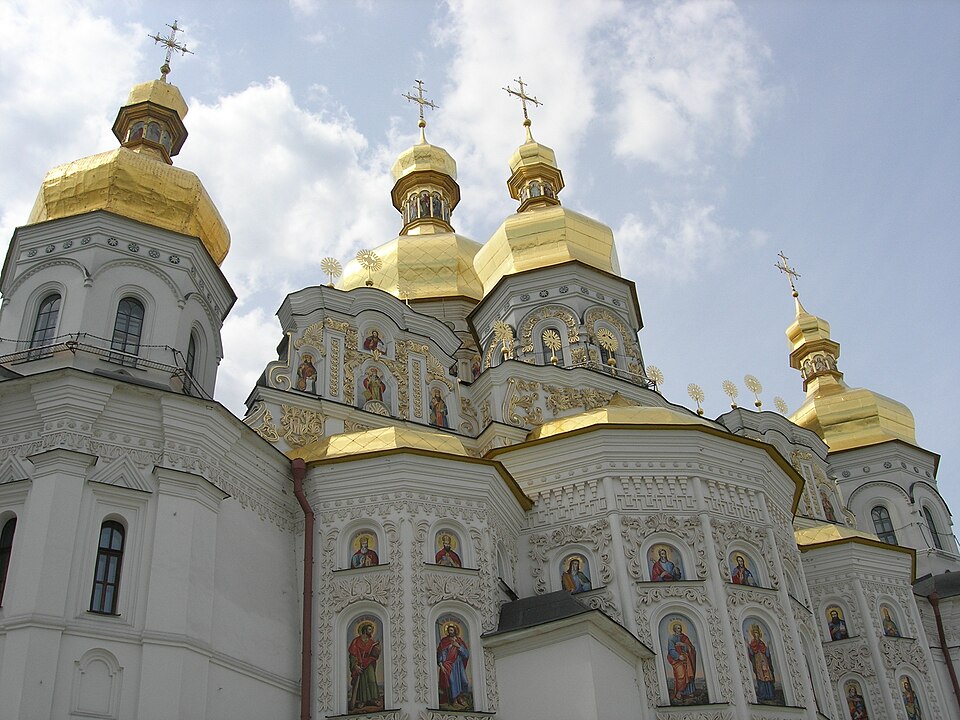
1051
The monastery's original hermit dwellings lie underground in a network of caves beneath the aboveground complex, which is built largely in the Ukrainian Baroque style.
Founded in 1051 as a cave monastery, the Lavra became a leading center of Eastern Christianity in Eastern Europe. It gave its name to the district that grew around it, and today's complex is built largely in the Ukrainian Baroque style. Its historic printing house played an early role in the development of printing in Ukraine, and the site remains recognized as part of a UNESCO World Heritage listing shared with a nearby cathedral.
- Its historic printing house was among the earliest presses to operate in Ukraine.
- The monastery gave its name to the city district that grew up around it.
Photo: Роман Днепр (CC BY-SA 3.0)
Golden Gate
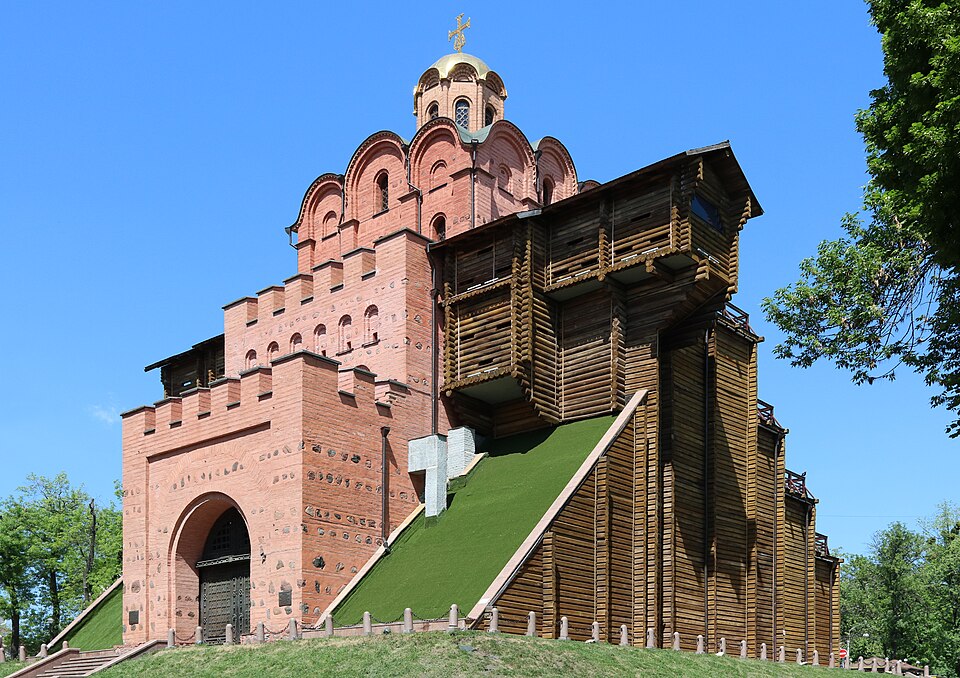
1037–1982
A single free-standing gateway whose stonework is entirely modern despite representing an eleventh-century original: a full reconstruction based on competing theories about its appearance rather than any surviving image.
The Golden Gate was the principal entrance in the fortifications built around the city in the 11th century, likely named in imitation of a comparable gate at Constantinople. The original structure was dismantled during the Middle Ages, leaving almost nothing behind, and in 1982 Soviet authorities rebuilt it in its entirety, a reconstruction based on competing theories rather than any surviving image. The rebuilt gate now houses a branch of a museum, and its name is shared with a nearby theatre and metro station.
- No image of the original gate survives, so its 1982 rebuild rests on competing theories about its appearance rather than evidence.
- Its name is shared by a nearby theatre and a metro station.
Photo: George Chernilevsky (Public domain)
St. Andrew's Church
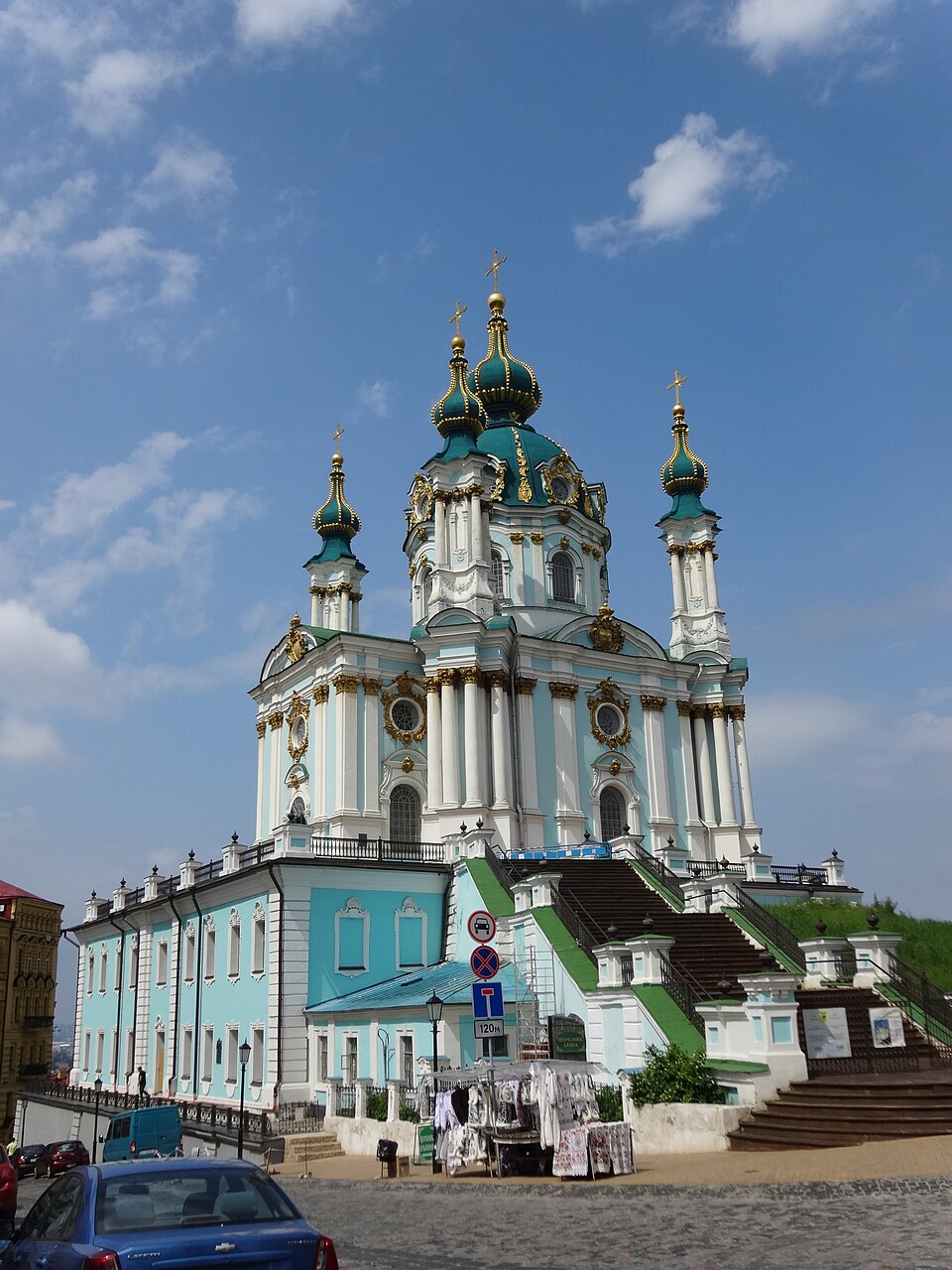
1747–1754 · Francesco Bartolomeo Rastrelli
The church stands at the edge of a steep hillside, its compact form counted among the rare surviving examples of the Ukrainian Baroque style.
Built between 1747 and 1754 to a design by the Italian architect Francesco Bartolomeo Rastrelli, the church stands on a steep hillside, a site tradition holds was blessed by the apostle Andrew as the future site of a great Christian city. A wooden predecessor on or near the spot was demolished in 1726 to make way for the current building. Owned by the Ukrainian state and designated a museum in 1968, it has since been used by more than one Orthodox jurisdiction and underwent major renovation in the late 2010s after its foundations grew unstable.
- In October 2018, ahead of a unification council of Ukraine's Orthodox churches, use of the building passed to the Ecumenical Patriarchate of Constantinople.
Photo: JøMa (CC BY-SA 3.0)
House with Chimaeras
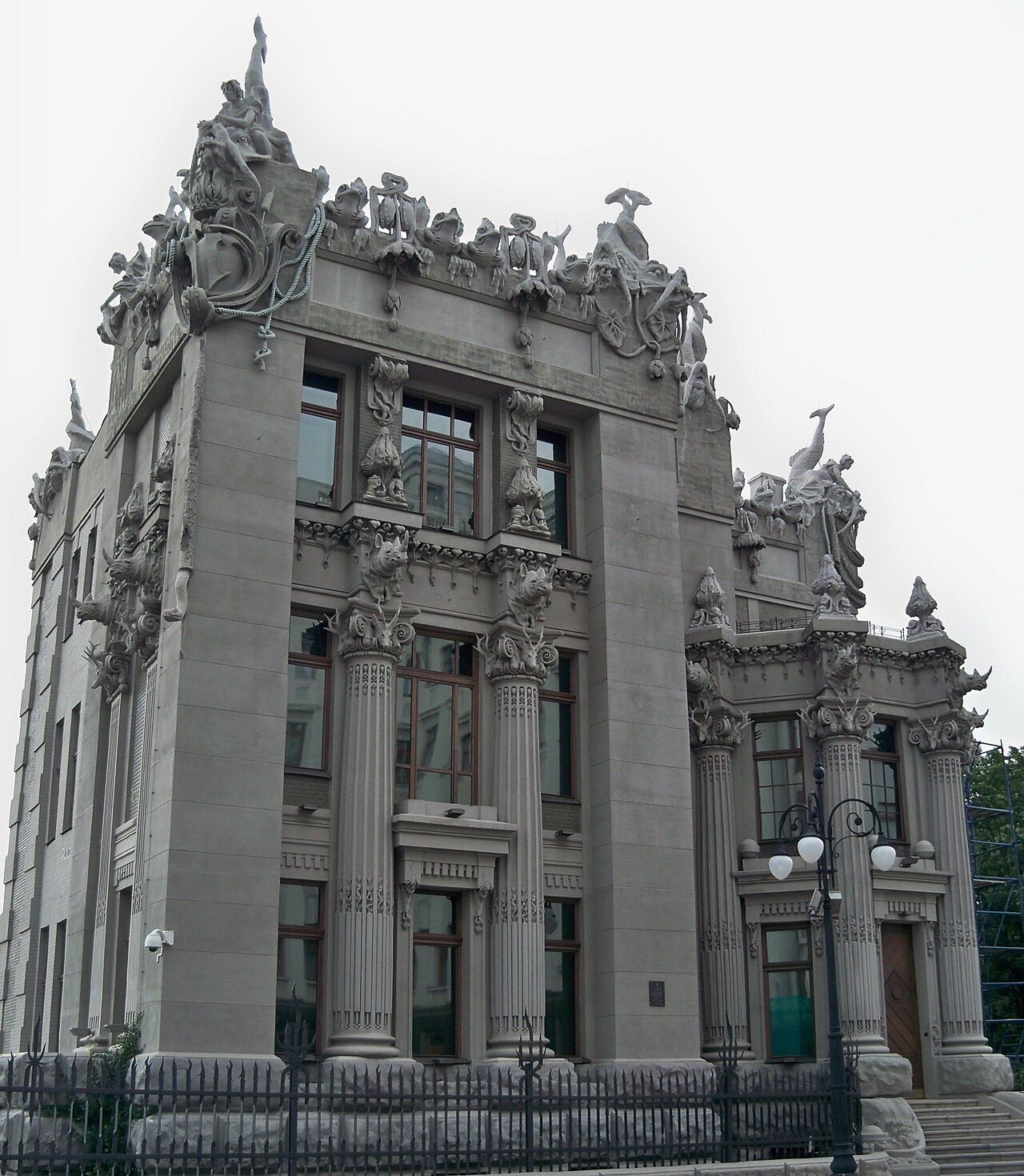
1901–1902 · Władysław Horodecki
The exterior is covered in sculpted reliefs of exotic animals and hunting scenes, the source of the building's popular nickname; the current decor is a faithful early-2000s reconstruction of the architect's original design, redone after decades of institutional use had let it decay.
Władysław Horodecki built this Art Nouveau apartment building for himself in 1901–1902, financing the work with borrowed money and occupying its top floor. Financial trouble forced him to sell in 1913, and after several changes of owner the building became an elite Communist Party polyclinic, used until the early 2000s. Only the Ukrainian president's intervention persuaded the clinic to vacate. Its interior and exterior were then fully restored to Horodecki's original plans, and since 2005 the building has hosted official and diplomatic ceremonies.
- Horodecki kept a cowshed on the property for fresh milk, sited so its smell would not reach tenants, alongside a miniature alpine garden and fountain.
- Decades of use as a polyclinic left the building nearly split in half, with one section sinking 22 centimeters and a crack about 40 centimeters wide opening in its structure.
- The animal and hunting-scene sculptures were carved by the Italian sculptor Emilio Sala, reflecting Horodecki's own passion for big-game hunting.
Photo: Neovitaha777 (CC BY-SA 4.0)
Kyiv Opera House
Officially the National Academic Opera and Ballet Theatre named for Taras Shevchenko, designed by Victor Schröter in Renaissance Revival style, opened in 1901. It replaced an earlier theatre, destroyed by fire in 1896, and in 1911 Russian Prime Minister Pyotr Stolypin was mortally wounded there.
Maidan Nezalezhnosti
The central town square, on Khreshchatyk Street, containing the iconic Independence Monument. Since 1990 it has been the traditional site for political rallies, including the 1990 Revolution on Granite, the 2004 Orange Revolution and the 2013–14 Euromaidan.
Mother Ukraine
A monumental Soviet-era statue, part of the National Museum of the History of Ukraine in the Second World War. In 2023, its shield's Soviet heraldry was replaced with Ukraine's coat of arms, the tryzub, in response to the Russo-Ukrainian War.
Olympic Stadium
Also called Olimpiyskiy National Sports Complex, a sports facility on Cherepanova Hora, Ukraine's premier venue and Europe's sixteenth largest of its type. Often used by FC Dynamo Kyiv without being its official home, it has hosted Shakhtar Donetsk's matches since 2020 over the Donbas war.
Bell Tower of Saint Sophia Cathedral
A Ukrainian Cossack Baroque monument built in 1699–1706 at the expense of Hetman Ivan Mazepa, standing 76 metres tall. Rebuilt in 1744–1748 to Gottfried Johann Schädel's design and given a fourth tier in 1851–1852, it is UNESCO-listed as part of the Saint Sophia monastic complex.
Arch of Freedom of the Ukrainian People
A monument opened 7 November 1982, formerly the Peoples' Friendship Arch, marking the USSR's 60th anniversary and the 1654 'reunification' with Russia. Its sculpture of a Ukrainian and Russian worker was removed in 2022, and in 2024 its official status was revoked, allowing dismantling.
Verkhovna Rada building
In central Kyiv on Constitution Square, the building where the Ukrainian parliament holds its regular and ceremonial sessions. Erected in 1936–38 under Stalin to a Socialist Classicalist design by Volodymyr Zabolotnyi, who won the State Prize for it in 1940.
Mariinskyi Palace
The official residence of the president of Ukraine, an Elizabethan Baroque palace on the right bank of the Dnipro River. It adjoins the neoclassical Verkhovna Rada building, the seat of Ukraine's parliament.
St Volodymyr's Cathedral
A cathedral in the city centre, one of Kyiv's major landmarks at the junction of Ivan Franko Street and Shevchenko Boulevard. Since a 2018 unification council it fell under the Orthodox Church of Ukraine, having previously been mother church of the Kyiv Patriarchate.
Karaite Kenesa
A former Karaite Jewish synagogue near the Golden Gates of Kyiv, listed as a monument of Architectural Heritage of National Importance. Since 1981 the building has housed the Ukrainian House of Actors, also called the Actor's House.
Great Choral Synagogue
Also known as the Podil Synagogue or Rozenberg Synagogue, built in 1895 in the historic Podil neighborhood. It has been led since 1990 by Rabbi Yaakov Dov Bleich, Chief Rabbi of Kyiv and Ukraine.
Bohdan Khmelnytsky Monument
A monument to Bohdan Khmelnytsky, first Hetman of the Zaporizhian Host, built in 1888, one of Kyiv's oldest sculptural monuments. It dominates Sophia Square on the axis linking the Sophia Cathedral and St. Michael's Monastery belltowers, near where Khmelnytsky's Cossacks entered on 23 December 1648.
TV Tower
A 385-metre lattice metal tower, the tallest structure in the country, built in 1973 during Soviet Ukraine. Once the tallest freestanding metal structure in the world, it broadcasts radio and television, is closed to the public, and remains the world's second-tallest lattice tower.
Hotel Ukraine
A four-star hotel on the Alley of Heroes of the Heavenly Hundred, designed under Stalin as Hotel Moskva and opened in 1961. It replaced Kyiv's first skyscraper, the Ginzburg House, and was renamed Hotel Ukraine in 2001, marking ten years of independence.
Khanenko Museum
An art museum holding the country's biggest collection of European, Asian and ancient art, established in 1919 under the will of collector Bohdan Khanenko. It occupies two 19th-century buildings on Tereshchenkivska Street, the Khanenkos' former mansion housing European art from the 14th to 18th centuries.
Brodsky Synagogue
An Orthodox Jewish synagogue completed in 1898 in Romanesque Revival style resembling a classical basilica, with a tripartite facade echoing Moorish Revival synagogues such as Vienna's Leopoldstädter Tempel. It is the second largest synagogue in the city, currently led by Rabbi Moshe Reuven Azman.
St. Cyril's Monastery
A medieval monastery containing St. Cyril's Church, an important example of 12th-century Kievan Rus' architecture combining 17th- and 19th-century elements. Though largely Ukrainian Baroque on the outside, the church retains its original Kievan Rus' interior.
Church of the Saviour at Berestove
A church just north of Kyiv Pechersk Lavra, in the area known as Berestove. Though outside the Lavra's fortifications, it is part of the Lavra complex and its related World Heritage Site.
Mystetskyi Arsenal
Ukraine's flagship public cultural institution, a museum and art exhibition complex with 60,000 square metres of exhibition space, one of the largest in Europe. In 2018 it drew 173,550 visitors across six exhibitions and two festivals, and it hosts Ukraine's biggest annual book fair.
National Art Museum of Ukraine
A museum dedicated to Ukrainian art in Kyiv.
Bridge over Saint Volodymyr Descent
Also known as the Klitschko Glass Bridge, a pedestrian and cycling bridge linking Saint Volodymyr Hill and Khreshchatyi Park. Built over five months at a cost of 275 million hryvnia, it was opened by Kyiv mayor Vitali Klitschko on 25 May 2019.
Gulliver
A state-owned 35-story mixed-use skyscraper near the city centre, the country's second-highest building and tallest office building. It pairs the office tower with a 10- to 16-story shopping mall of cinemas and restaurants, and was named 'Gulliver' in 2011 after Jonathan Swift's novel.
Saint Volodymyr Hill
A 10.6-hectare park on the right bank of the Dnipro, best known for the Monument to Prince Volodymyr. Overlooking the left bank's panorama, the monument is a symbol of Kyiv shown in paintings and photographs, and the hill offers views over the river and Podil.
Funicular
A steep-slope railroad on Kyiv Hills, connecting the historic Uppertown with the lower commercial neighborhood of Podil. Running over the Volodymyrska Hill above the Dnieper, the line has just two stations and is operated by the city enterprise Kyivpastrans.
History
According to legend the city takes its name from Kyi, one of four founding siblings, and it was already functioning as a trading center by the 5th century, sited on the route linking Scandinavia to Constantinople. A tributary of the Khazars, it was seized by Varangian rulers in the mid-9th century and became capital of Kyivan Rus', the first East Slavic state — the period that produced the cathedral, gate and monastery still standing today. The Siege of Kiev in 1240 left the city in ruins, and it took centuries to recover its former influence. It re-emerged as a center of Eastern Orthodox learning in the 16th century, then prospered again during the Russian Empire's industrial expansion of the late 19th century.