Landmarks in Vilnius
A Gothic hill-top tower overlooks an old town rebuilt in Baroque and Neoclassical waves.
The four landmarks recorded here sit in or above a compact old town, one of Europe's largest and best preserved, listed by UNESCO in 1994. A brick Gothic tower crowns a wooded hill at its edge, the last standing piece of a castle that once housed the country's rulers. In the old town itself, a flamboyant Gothic parish church went up in brick on a riverbank around 1500, a fortified gate followed a couple of decades later, and the main cathedral was rebuilt in strict Neoclassical form in the 1780s after starting life centuries earlier on the same site. The result is a skyline shaped less by one dominant style than by repeated rebuilding on ground already sacred or fortified for generations.
Gediminas' Tower
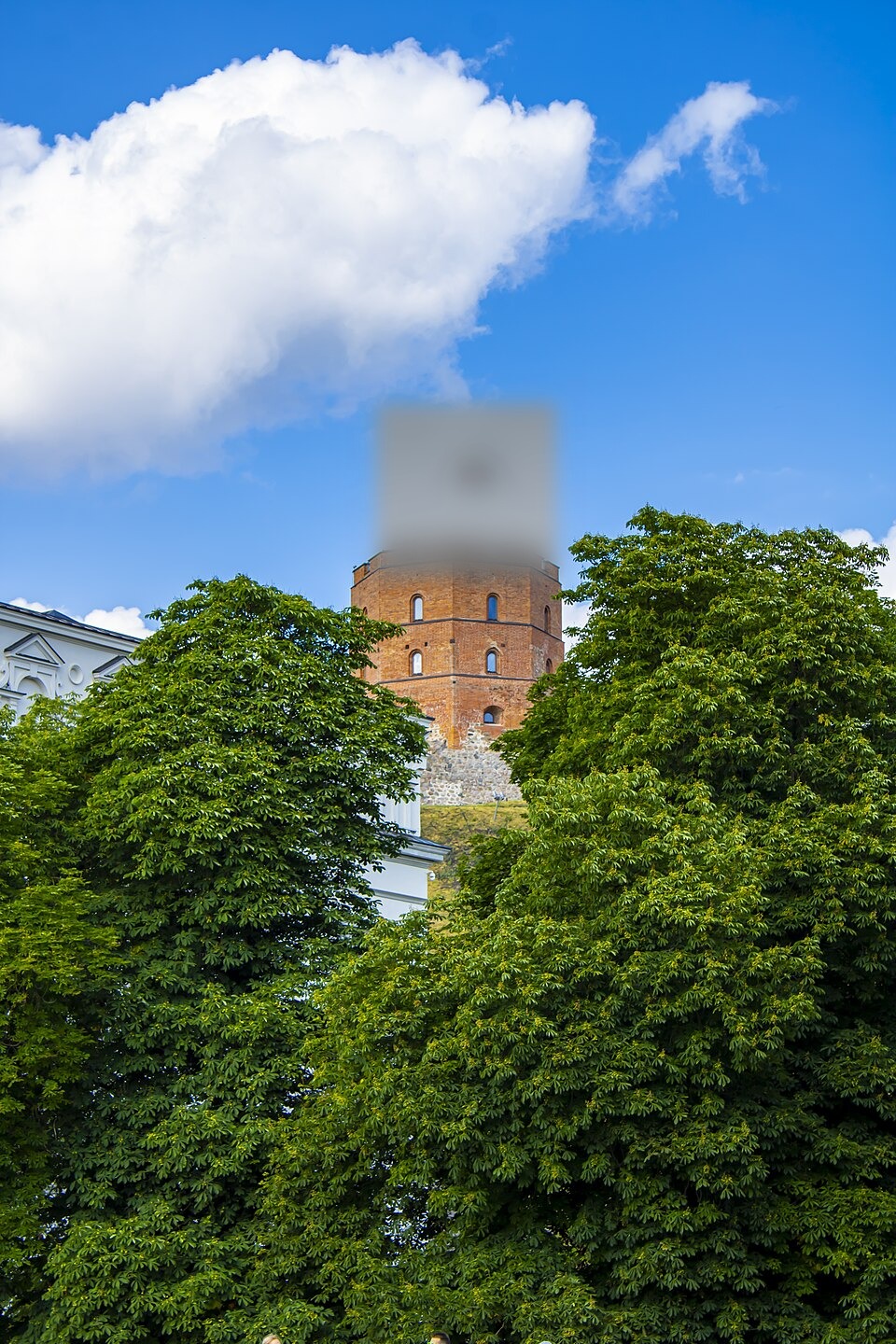
1409
A squat, reddish octagonal brick tower standing alone on a green hill above the rooftops, with a viewing platform at its top rather than a roof.
This tower is what remains of the Upper Castle that once crowned a hill above the old town. Built of brick in the Gothic style, it served the defensive complex that was home to the country's rulers before falling into ruin around it. Today only the tower still stands, fitted with a platform giving views over the old town and the modern business district beyond. It has become a state symbol, closely tied to national identity.
- It once appeared on the design of the country's former paper currency, the litas.
- It is mentioned by name in numerous patriotic poems and folk songs.
Photo: Terminator216 (CC BY-SA 4.0)
Vilnius Cathedral
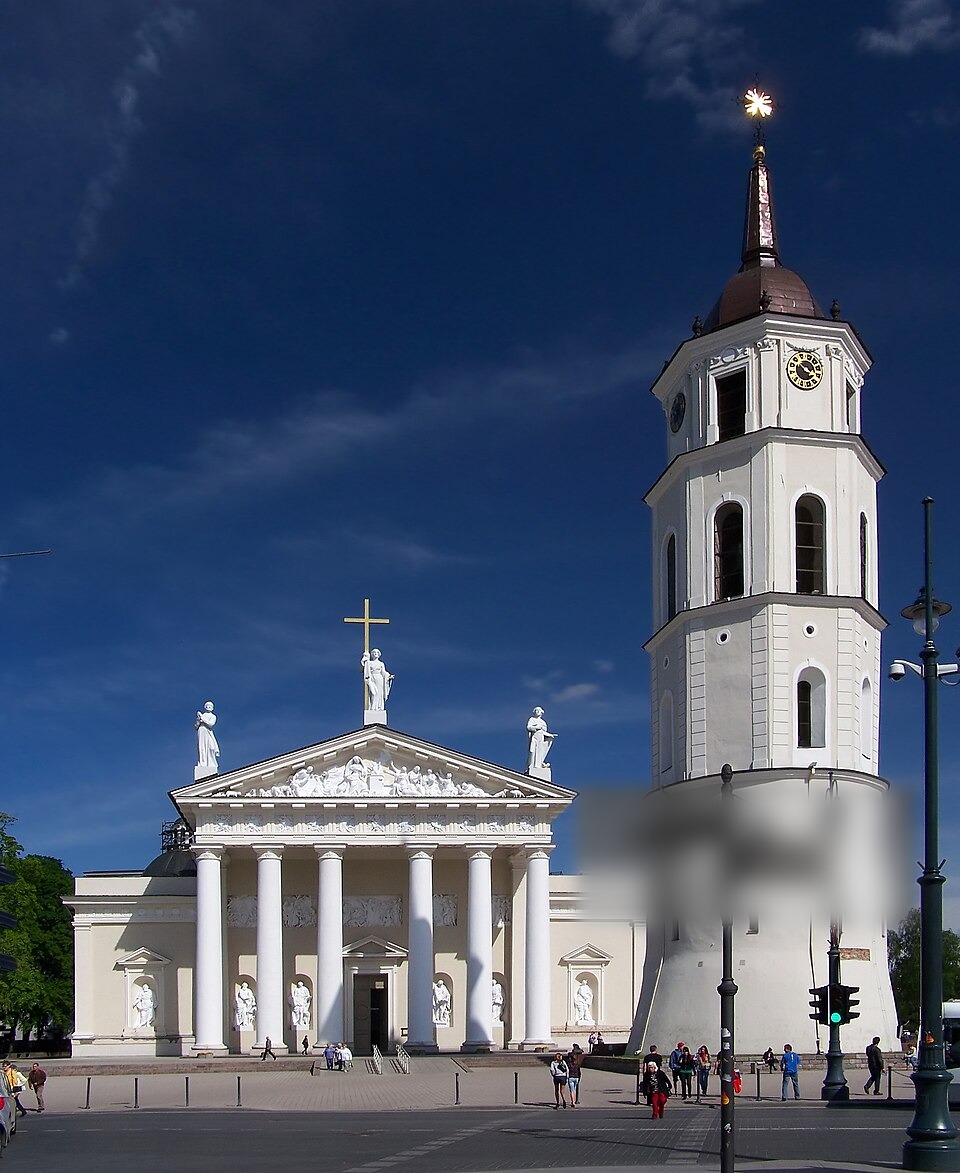
1387–1783 · Laurynas Gucevičius
A pale, temple-fronted cathedral with a row of columns and a triangular pediment, standing free at the head of an open square rather than hemmed in by streets.
This cathedral is the main Catholic church in the country, standing just off a large square in the old town. A stone church first stood on the site in the late fourteenth century; the building seen today was rebuilt in strict Neoclassical style, completed in 1783. It was once the setting for the inauguration of monarchs, who were crowned there with a ceremonial cap. In modern times it hosts services marking the inauguration of elected presidents.
- Monarchs were once inaugurated there using a ceremonial headpiece known as Gediminas' Cap.
Photo: Lestat (Jan Mehlich) (CC BY-SA 3.0)
Gate of Dawn
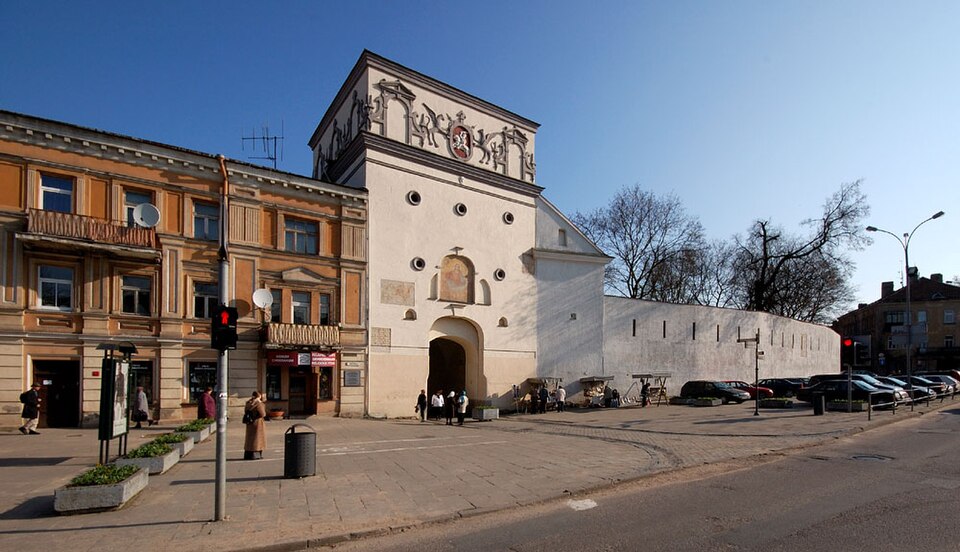
1522
A stone archway set directly into the old town wall, with the road running straight through it, its religious function now more visible than its military one.
This gate was built into the fortifications of the old town and ranks among its most important religious, historical and cultural monuments. Rather than remaining purely a defensive structure, it became a major site of Catholic pilgrimage, a role that has long outweighed its original military purpose. It survives as one of the clearest reminders that the old town was once a walled and gated settlement, with traffic still passing beneath it on the street below.
Photo: Kontis Šatūnas (Public domain)
St. Anne's Church
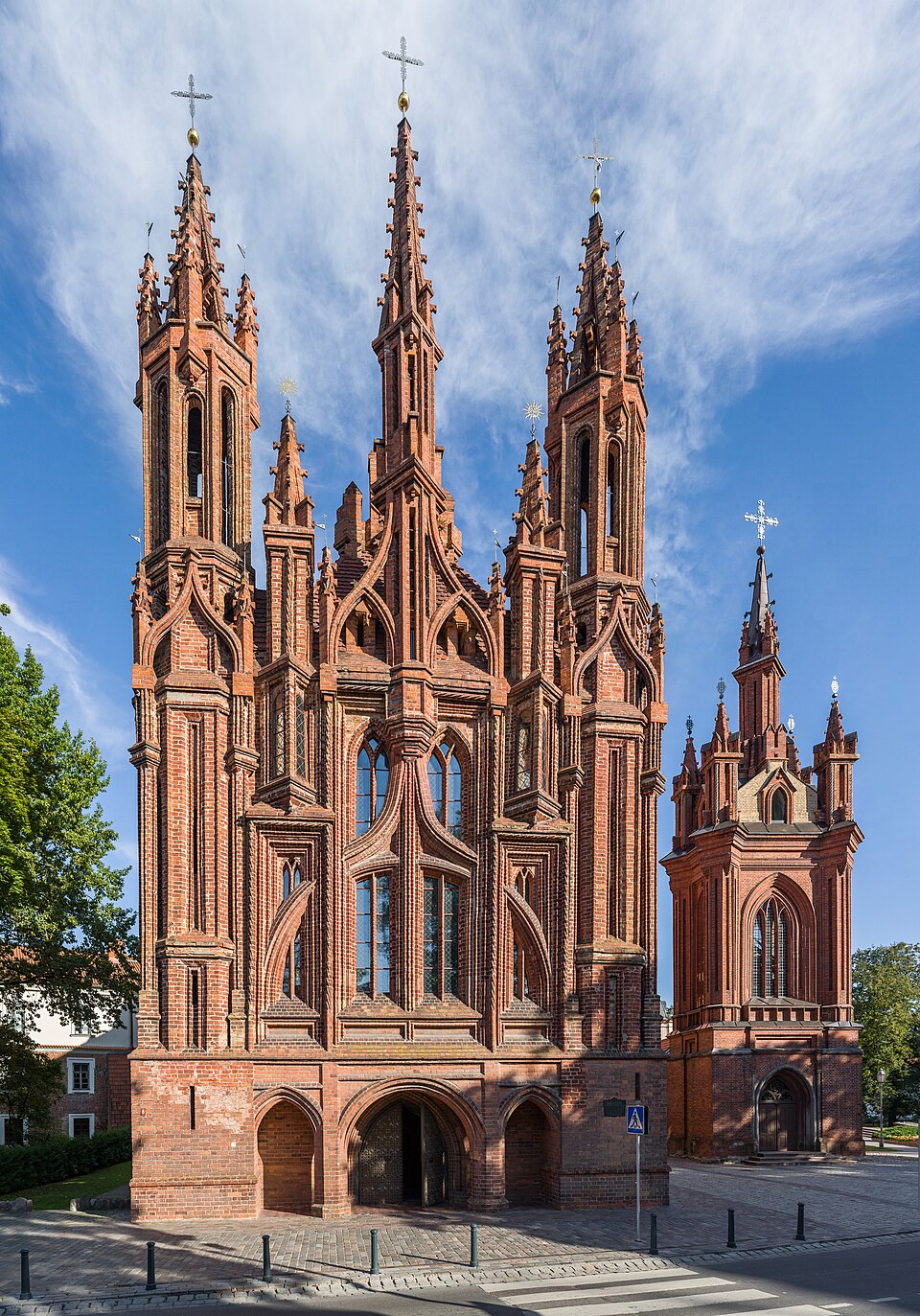
1495–1500 · Benedikt Rejt
A compact red-brick church whose gabled facade is built up from thin, moulded brick into flame-like Gothic tracery rather than carved stone.
This Roman Catholic church stands on the right bank of a small river running through the old town, built around 1495 to 1500. It combines Flamboyant Gothic design with the Brick Gothic building tradition, and is counted among the most interesting examples of Gothic architecture in the country. Its presence in the old town was one of the reasons the district as a whole was recognised as a UNESCO World Heritage Site.
- It helped the old town around it qualify for UNESCO World Heritage status.
Photo: Diliff (CC BY-SA 3.0)
Palace of the Grand Dukes of Lithuania
A palace in Vilnius's lower castle, originally built in the 15th century for the rulers of the Grand Duchy of Lithuania, demolished in 1801. Reconstruction on the site began in 2002 and took 16 years to complete, rebuilding the palace in a Renaissance style.
Church of St. Peter and St. Paul
A Roman Catholic church in the Antakalnis neighbourhood, designed and built by Jan Zaor of Kraków. Its interior holds about 2,000 stucco figures by Giovanni Pietro Perti, funded by Michał Kazimierz Pac to mark the expulsion of Muscovite forces from Vilnius.
Town Hall
A historical town hall in the square of the same name, in the Old Town of Vilnius.
Vilnius Old Town
One of the largest surviving medieval old towns in Northern Europe, a UNESCO World Heritage Site with 1,487 buildings. Founded by Grand Duke and King of Poland Jogaila in 1387 under Magdeburg rights, it blends Gothic, Renaissance, Baroque, and other European architectural styles.
Three Crosses
A monument on the Hill of Three Crosses, where wooden crosses have stood since the early 17th century. A concrete version designed by Antoni Wiwulski replaced them in 1916, was torn down by Soviet authorities in 1950, and was later recreated by Stanislovas Kuzma.
Presidential Palace
The official residence and workplace of the president of Lithuania, dating back to the 14th century as the residence of the Bishop of Vilnius. Reconstructed by architects Laurynas Gucevičius and Vasily Stasov, it once housed European monarchs and became the president's official seat in 1997.
Vilnius Castle Complex
A group of historic defensive structures on the Neris River, made up of three castles: the Upper, the Lower, and the Crooked. The Crooked Castle burned down in 1390 and was never rebuilt; the whole complex was finally captured in the 1655 Battle of Vilnius.
Church of St. Theresa
A Roman Catholic church in the Old Town, close to the Gate of Dawn, completed in 1650 and dedicated to Teresa of Ávila. Built in a mix of Baroque, Rococo, and Classicism styles, it is the oldest towerless Baroque monument in present-day Lithuania.
Monastery of the Holy Spirit
An Orthodox monastery operating continuously since 1609, once a major center of Orthodoxy in the Polish-Lithuanian Commonwealth. Since 1845 it has served as the residence of the Bishops of Vilnius and Lithuania, and its church holds relics of the Vilnius martyrs Anthony, John, and Eustathius.
Cathedral Square
The main square of the Vilnius Old Town, in front of the neo-classical Vilnius Cathedral at the crossing of the city's main streets. It regularly hosts fairs, military parades, religious and official events, and concerts, making it one of Lithuania's most widely known symbols.
House of the Signatories
A historic landmark on Pilies Street, previously known as Sztral's House. On 16 February 1918, twenty members of the Council of Lithuania signed the Act of Independence of Lithuania here.
Seimas Palace
The seat of the Seimas, Lithuania's parliament, located in the capital Vilnius.
Vilnius TV Tower
A 326.5-meter tower in the Karoliniškės district, the tallest structure in Lithuania and the 29th-tallest self-supporting tower in the world. It belongs to the Lithuanian Radio and Television Centre.
Choral Synagogue
An Orthodox synagogue on Pylimo Street, designed by Daniel Rosenhaus and Aleksejus Polozovas in a mix of Romanesque and Moorish Revival styles, completed in 1903. It is the only synagogue in use in Vilnius; all others were destroyed or desecrated in World War II.
Church of St. Catherine
A Roman Catholic church in the Old Town of Vilnius, founded in 1618. It was established by Jan Karol Chodkiewicz, Hetman of the Grand Duchy of Lithuania and Voivode of Vilnius.
Lukiškės Prison
A former prison in the center of Vilnius, near Lukiškės Square. It was operational from 1837 until 2019.
Church of St. Francis and St. Bernardino
A Roman Catholic church in the Old Town, also known as the Bernardine Church, next to St. Anne's Church. Dedicated to Saints Francis of Assisi and Bernardino of Siena, it is an important example of Gothic architecture in Lithuania.
Radvila Palace
A Late Renaissance palace in the Old Town of Vilnius.
Verkiai Palace
An 18th-century neoclassical mansion in Verkiai, Vilnius.
Adam Mickiewicz Monument
A monument near St. Anne's Church and the Bernardine Monastery, along Maironio Street by the Neris River. The street was known as St. Anne's Street before 1945.
Vilna Gaon Museum of Jewish History
A museum dedicated to the historical and cultural heritage of Lithuanian Jewry.
Cathedral of the Theotokos
The episcopal see of the Russian Orthodox Diocese of Lithuania. Between 1415 and 1795 it was the mother church of the Ruthenian Orthodox Church and, after the 1596 Union of Brest, the Ruthenian Uniate Church within the Grand Duchy of Lithuania.
History
The city has been the country's capital since at least 1323, when a ruling grand duke first named it so in a letter. From the thirteenth century until the mid-seventeenth, a hill-top castle complex served as the residence of its monarchs, and the fortified town grew up around it in brick and stone. Italian influence arrived through royal marriage: in 1517 an Italian princess married the reigning grand duke, and their son continued the connection, bringing Italian architects and craftsmen to design and decorate the town's churches and palaces. That wave of building gave rise to a local Baroque style named after the city itself, among the easternmost and largest of its kind. Centuries of rebuilding on the same sites followed, layering Gothic, Baroque and Neoclassical work into the old town recognised by UNESCO in 1994.