Landmarks in Minsk
Baroque, neo-Romanesque and Soviet landmarks trace a capital's six changes of rule.
Minsk's landmarks read as a sequence of ruling powers rather than a single architectural period. The oldest surviving structures cluster in the Upper City, among them the Belarusian Baroque Holy Spirit Cathedral, raised as a Bernardine monastery chapel under the Polish–Lithuanian Commonwealth and returned to Orthodox use in the nineteenth century. Minsk City Hall, nominally dated to 1600, carries a later Neoclassical facade from further building campaigns. On Independence Square stands a very different note: a red-brick, neo-Romanesque Catholic church completed in 1910, privately funded rather than built by any ruling power. The National Opera and Ballet Theatre, set apart in its own park on Trinity Hill, dates from the Soviet period, its company founded in 1933 ahead of a purpose-built stage finished in 1939.
Church of Saints Simon and Helena
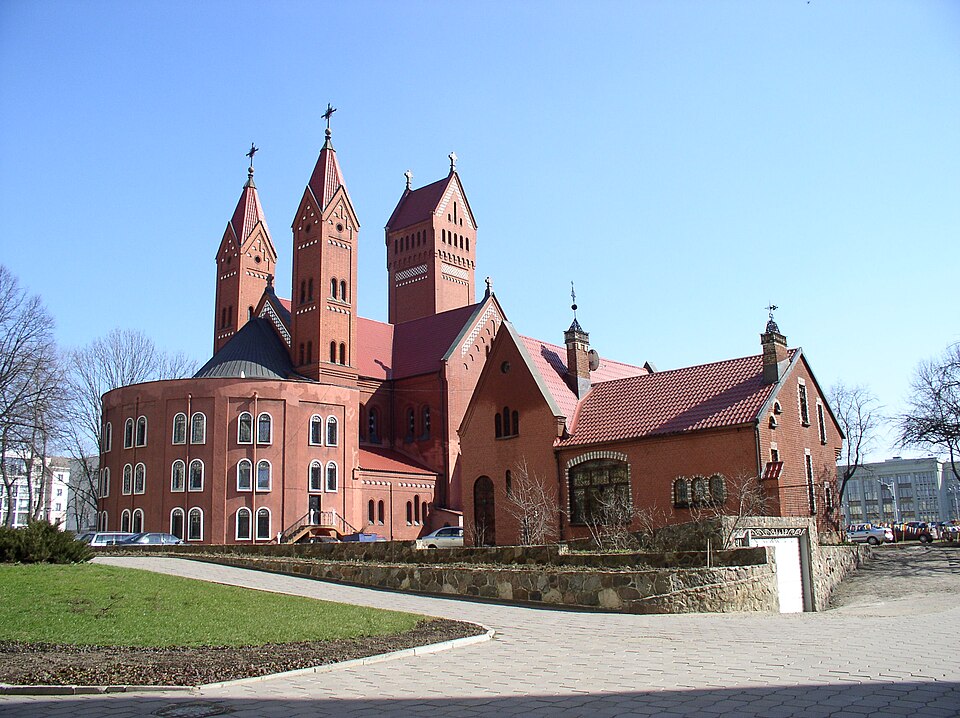
1905–1910 · Tomasz Pajzderski
Built of red brick with round-arched neo-Romanesque openings alongside Gothic Revival and Art Nouveau detailing, it is popularly known as the Red Church for its colour and stands on Independence Square.
This Roman Catholic church on Independence Square was designed in a neo-Romanesque style by the Polish architects Tomasz Pajzderski and Władysław Marconi, with construction running from a 1905 cornerstone to completion in 1910. Its founder, the landowner and civic activist Edward Woyniłłowicz, named it for his two children, Szymon and Helena, who had died young. Long known locally as the Red Church for its brick colour, it functioned as a working parish until a fire in September 2022, after which officials closed it to worship and have refused to reopen it.
- The bricks for its walls travelled from Częstochowa and the roof tiles from Włocławek, both in present-day Poland.
- It was named for two children, Szymon and Helena, who died young; their father funded the building in their memory.
- A small fire in 2022 led officials to close it to worship, and requests to reopen it have been refused.
Photo: Hanna Zelenko (CC BY-SA 4.0)
Holy Spirit Cathedral
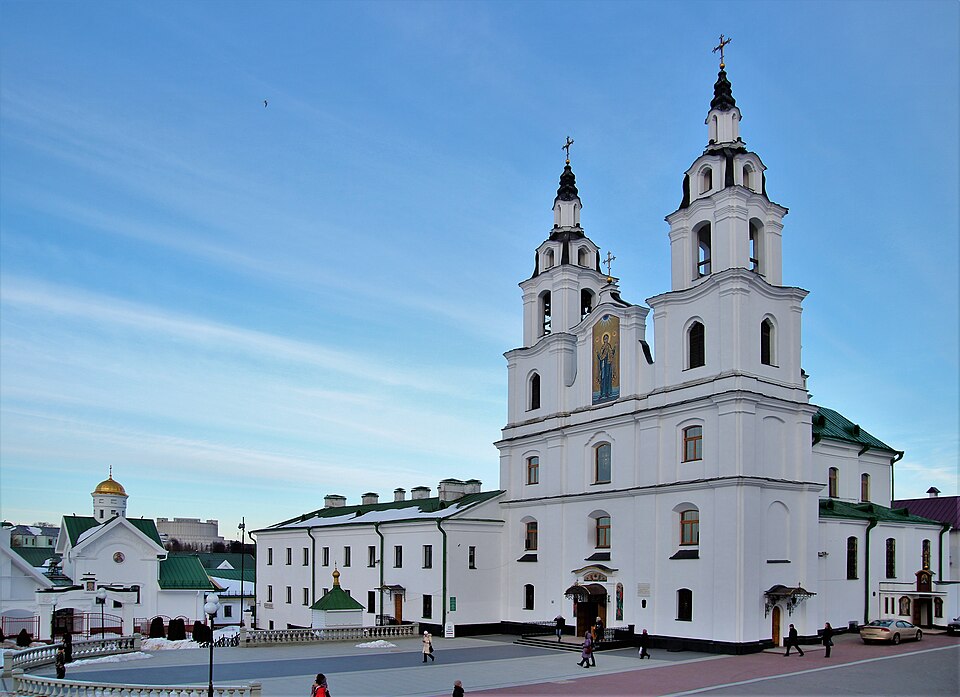
1633–1642
Its Belarusian Baroque massing marks it as one of the principal landmarks of Minsk's Upper City, the country's Orthodox mother church since the site returned to Orthodox use in 1860.
Begun in 1633 and completed in 1642, this cathedral started life as the chapel of a Bernardine monastery within the Polish–Lithuanian Commonwealth, built on a site that had earlier held Orthodox monasteries. Its Catholic origins ended in 1860, when the site returned to Orthodox use, and it now serves as the mother church of the Belarusian Orthodox Church. Built in the Belarusian Baroque style, it stands among the principal landmarks of Minsk's Upper City and is protected as a cultural heritage object of Belarus.
Photo: Insider (CC BY-SA 3.0)
National Opera and Ballet Theatre
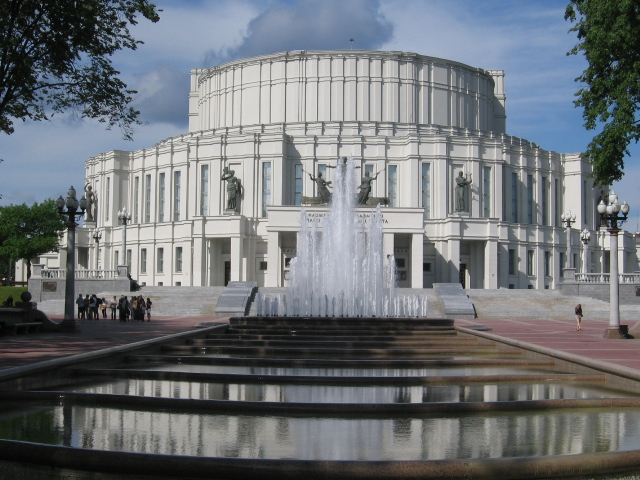
1939
Standing apart in its own park in the Trinity Hill district rather than fronting a street, it is known locally simply as the "Opierny Teatr".
The National Academic Grand Opera and Ballet Theatre stands in a park in Minsk's Trinity Hill district, though its resident company predates the building by several years: the troupe gave its opening performance on 15 May 1933 while still without a stage of its own, performing instead at the Belarusian Drama Theatre until 1938. Locals shorten its name to "Opierny Teatr", the Opera and Ballet Theatre. The purpose-built theatre that eventually housed the company was completed in 1939, becoming the permanent home of Belarusian opera and ballet.
- Locals often call it simply the "Opierny Teatr" — the Opera and Ballet Theatre.
- The resident company started performing five years before its own theatre building was ready, using the Belarusian Drama Theatre in the meantime.
Photo: Gruszecki (Public domain)
Minsk City Hall
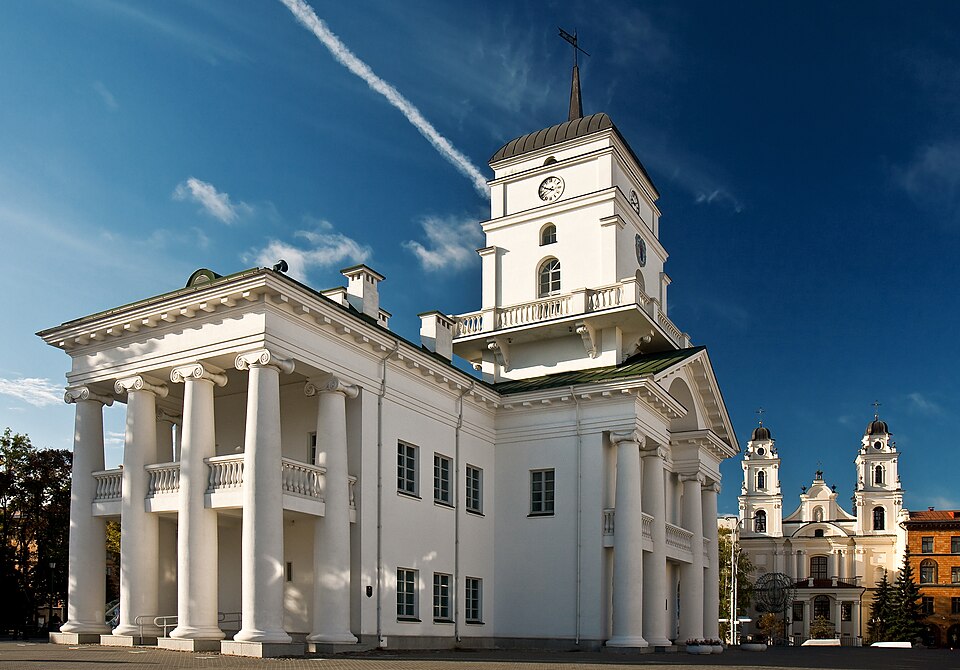
1600
Among Minsk's landmarks, City Hall reads as distinctly Neoclassical — a plainer, more formal civic silhouette than the city's baroque and Gothic Revival churches.
Minsk City Hall was built in 1600 as the seat of the city's administration. Its present Neoclassical design is credited to the architects Fyodor Kramer and Kazimierz Chrzczonowicz, alongside a third architect whose name was not recorded, all linked to the building's later development. The gap of two centuries between that founding date and the architects' recorded lifetimes points to substantial rebuilding not detailed in the available record. It is registered as a Cultural heritage site of Belarus.
Photo: Zedlik (CC BY-SA 3.0)
Government House
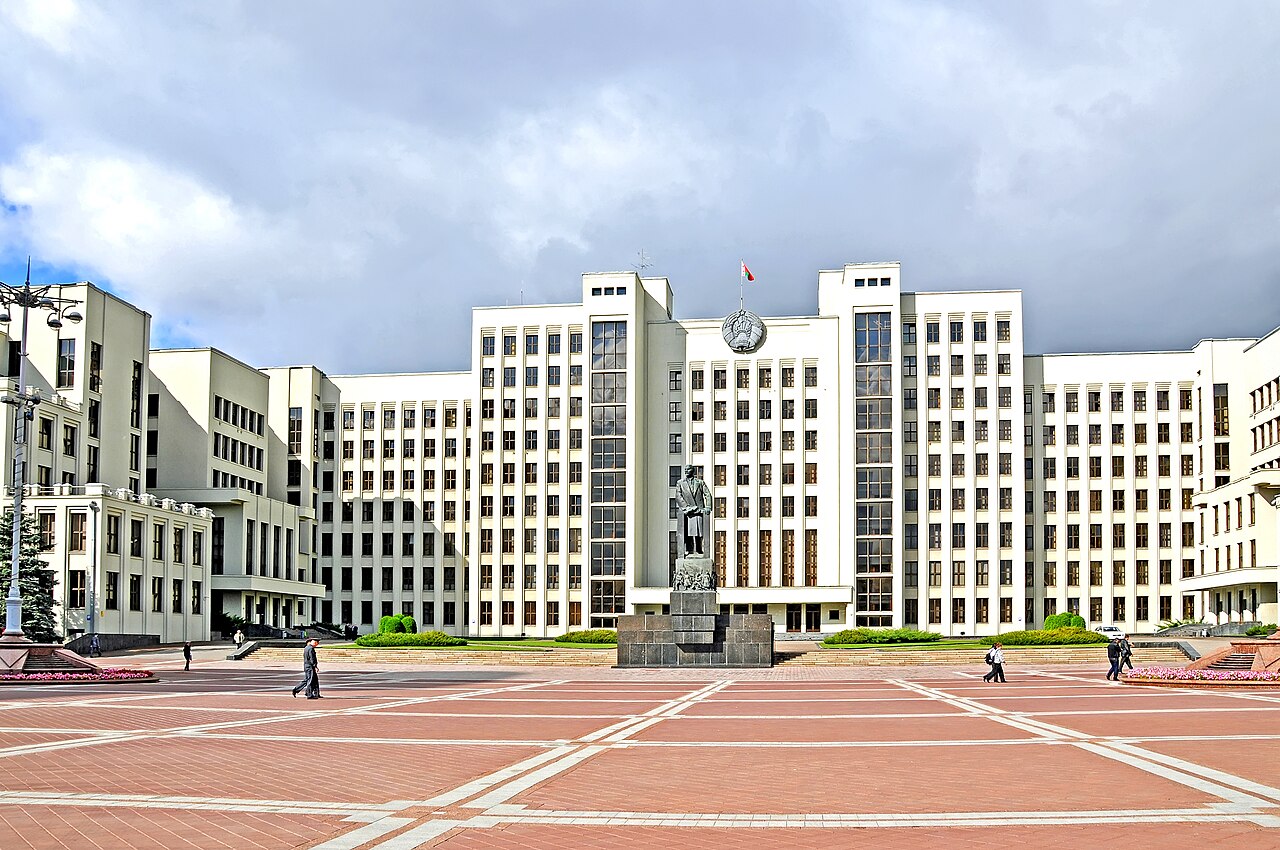
1930–1934 · Iosif Langbard
The building's plain, symmetrical Constructivist facade faces Independence Square, with a statue of Vladimir Lenin in front — the tallest such statue erected in the Soviet Union — and busts of Karl Marx and Friedrich Engels flanking the staircase inside.
Completed in 1934 to a design by Iosif Langbard, this government building was the largest public structure in the pre-war Belarusian SSR and remains an example of Constructivist architecture. It houses the National Assembly, the country's two-chamber parliament. During the German occupation of Belarus in the Second World War it held the local Gestapo headquarters, and the statue of Lenin in front of it was toppled and taken to Germany, where it was melted down; it was restored in 1945 using the original casting preserved in Leningrad. It was one of few buildings in the city to survive the war.
- Iosif Langbard won the honorary title of Honoured Artist of the Belarusian SSR for designing this building and the square around it.
- An identical government building, the House of Soviets in Mogilev, was built between 1938 and 1940 as part of a plan to move the republic's capital there.
- The first presidential inauguration of the newly independent republic was held inside its Oval Hall in July 1994, ten days after the election.
Photo: Dennis G. Jarvis (CC BY-SA 2.0)
Independence Square
One of the largest public squares in Europe, located on Independence Avenue in Minsk. The National Assembly of Belarus and Minsk City Hall stand on it, and during the Soviet era it was called Lenin Square.
National Library of Belarus
The largest library in Belarus, housing the country's largest collection of Belarusian printed materials. Its collection of Russian-language books is the third largest of its kind, behind only the Russian State Library in Moscow and the Russian National Library in St Petersburg.
Palace of the Republic
A palatial government building in Minsk used for official state functions, including forums, meetings, and conventions. It also hosts multi-genre concerts, symphony orchestras, and New Year's events.
Independence Palace
A palace on Pieramožcaŭ Avenue, near the BelExpo exhibition centre, State Flag Square, and Victory Park. It hosts state events and meetings with foreign delegations, honours large families, and holds ceremonies admitting children into pioneer organisations.
Central House of Officers
A former Red Army building completed in 1939, designed by Soviet architect Iosif Langbard, now the main cultural institution of the Belarusian Armed Forces. It was one of the only Langbard buildings to survive World War II and today hosts weddings, concerts, and lectures.
Janka Kupala National Theatre
The oldest existing theatre in Belarus, located in Minsk. It is included on the country's list of cultural heritage sites.
The National Art Museum of the Republic of Belarus
The largest art museum in Belarus, formerly known as the State Art Gallery. It holds more than thirty thousand works arranged in twenty collections, built mainly around two holdings: national art and art from other countries.
St. Joseph Church
A Baroque former Roman Catholic church in the Upper City district, completed in 1752. Closed in the 1860s, it became an Eastern Orthodox church and has served since the late 19th century as an archive store.
Minsk TV Tower
A television tower near Victory Square, originally built to about 200 metres. In July 1976 its top 40 metres were removed and replaced with an eight-antenna platform, cutting it to 170 metres once broadcasting duties passed to the new Kolodischi TV Mast.
State Flag Square
A square on Victors Avenue in Minsk. It lies between the avenue and the BelExpo Exhibition Center.
Minsk Cathedral Mosque
A mosque in the Tsentralny District of Minsk. It is the largest mosque in Belarus.
Cold Synagogue
A former synagogue on Niamiha Street in central Minsk, considered the city's oldest masonry synagogue. It was never used for study and, being unheated, became known as the Cold Synagogue.
Dinamo Stadium
A multi-purpose stadium that opened in 1934 and reopened after renovation in 2017. It has served as the home ground of Dinamo Minsk, FC Minsk, and the Belarus national football team, with capacity reduced to 22,246 in the process.
Tatarskaya Slabada
A historical settlement on the low left bank of the Svislach river, northwest of Minsk's old centre, first recorded in 1428. It was settled by Lipka Tatars and remained a distinct community until the mid-20th century.
Wańkowicz Manor
A historic manor house and park complex situated on Filimonava Street in Minsk. It is classified as a monument of Classicist architecture.
History
Minsk is first recorded in 1067, when it was capital of the Principality of Minsk, itself dependent on Polotsk. The Grand Duchy of Lithuania annexed the town in 1242, and it gained formal town privileges in 1499. From 1569 it governed Minsk Voivodeship within the Polish–Lithuanian Commonwealth, the period that produced the Baroque monastery chapel now known as Holy Spirit Cathedral and the earliest phase of the City Hall. The Russian Empire absorbed the city in 1793 after the Second Partition of Poland, a rule under which the Church of Saints Simon and Helena was built by private funders in 1910. From 1919 Minsk led the Byelorussian Soviet Socialist Republic, a status formalised within the Soviet Union in 1922; the National Opera and Ballet Theatre, founded in 1933, belongs to that era. Independence in 1991 made Minsk capital of Belarus.