Landmarks in Chisinau
A Russian-imperial core rebuilt in Socialist Realist and Brutalist blocks after war.
Chisinau's oldest surviving monuments cluster around Piața Marii Adunării Naționale in the centre: a Neoclassical cathedral and a matching triumphal arch, raised in the 1830s and 1840s under Russian imperial rule, stand across the square from a government building. A few streets away, a turn-of-the-century city hall and a water tower, both dated to the end of the nineteenth century, show the eclectic and Italian Gothic-inflected taste that followed. The engineer Alexander Bernardazzi worked on more than one of these projects. Little of this fabric survived untouched: the Second World War and later earthquakes damaged much of central Chisinau, so Socialist Realist and Brutalist blocks now stand beside careful postwar reconstructions rather than unbroken originals.
Nativity Cathedral
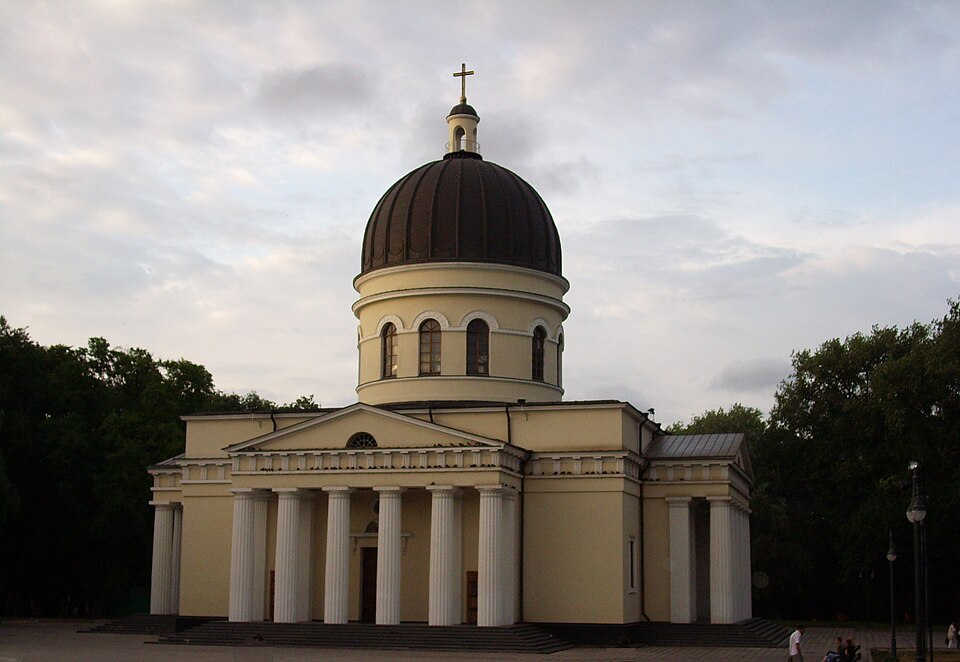
1830 · Avraam Melnikov
The bell tower reads visibly newer than the main body of the church: it dates only to 1997, a replacement for the one demolished in 1962, so tower and nave show two different builds side by side.
The Cathedral of Christ's Nativity is the principal church of the Moldovan Orthodox Church, raised in 1830 to a Neoclassical design by Avraam Melnikov. Its original bell tower stood until 1962, when it was pulled down; during the Soviet period the cathedral itself was repurposed as an exhibition centre rather than a place of worship. It returned to religious use afterward, and a new bell tower was finally built in 1997, replacing the one lost thirty-five years earlier.
- The bell tower was demolished in 1962 and not replaced until 1997, thirty-five years later.
- Under Soviet rule the cathedral building served as an exhibition centre rather than a church.
Photo: Mirek237 (Public domain)
Triumphal Arch
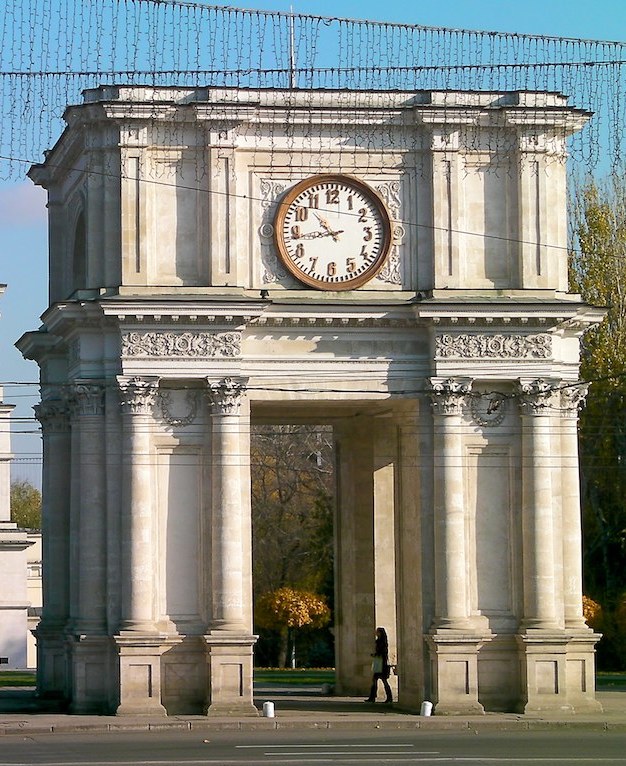
1841
A single arch standing free in an open square, attached to no other building, with an Orthodox cathedral immediately on one side and a government building facing it across the plaza.
The Triumphal Arch is a freestanding Neoclassical monument completed in 1841 in central Chisinau. It stands in Piața Marii Adunării Naționale, immediately beside the Nativity Cathedral and directly across from Government House, closing one side of the same ceremonial square. As a standalone arch rather than part of a larger building, it functions purely as a monument, marking the square's approach without any further civic or religious use of its own.
Photo: Tony Bowden from Tallinn, Estonia (CC BY-SA 2.0)
Chisinau City Hall
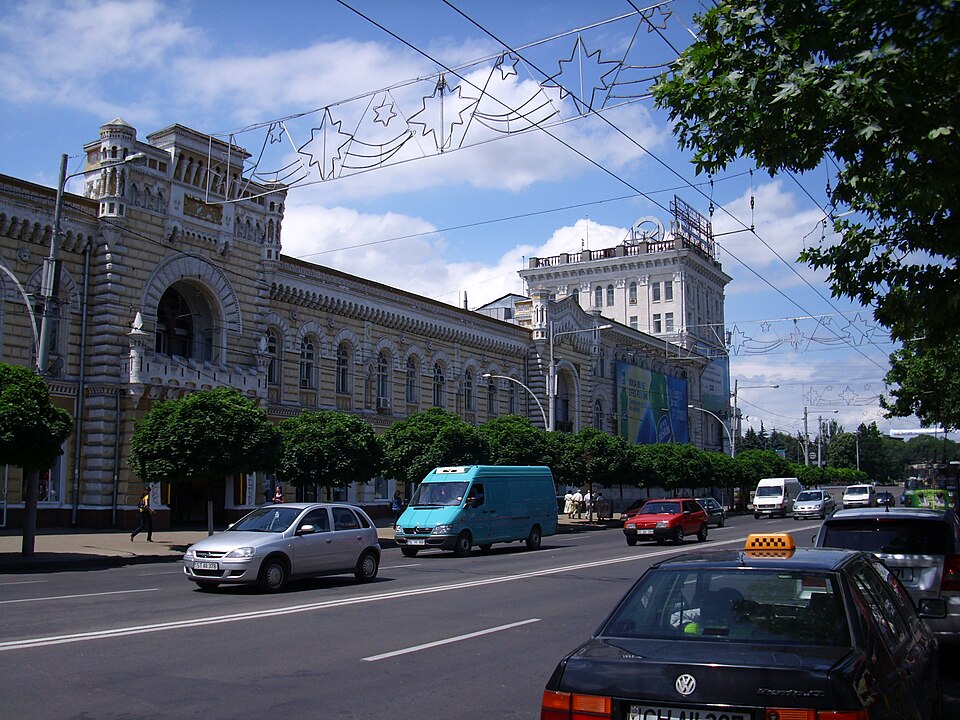
1901
A civic building in an eclectic, Italian Gothic-inflected style; its current fabric is a faithful postwar reconstruction rather than an unbroken original, rebuilt from old photographs after the wartime structure was reduced to ruins.
Chisinau City Hall is a municipal building completed in 1901 to house the city Duma, in an eclectic style with Italian Gothic detailing. During the Second World War it was nearly destroyed, leaving little more than fragments of the original structure standing. It was rebuilt afterward using surviving photographs and the original construction plans to guide the work, and today it is recognised as a historical and architectural monument of national importance in Moldova.
- The building standing today is a faithful postwar reconstruction, built from old photographs after the original was nearly destroyed in the Second World War.
Photo: Mirek237 (Public domain)
Chisinau Water Tower
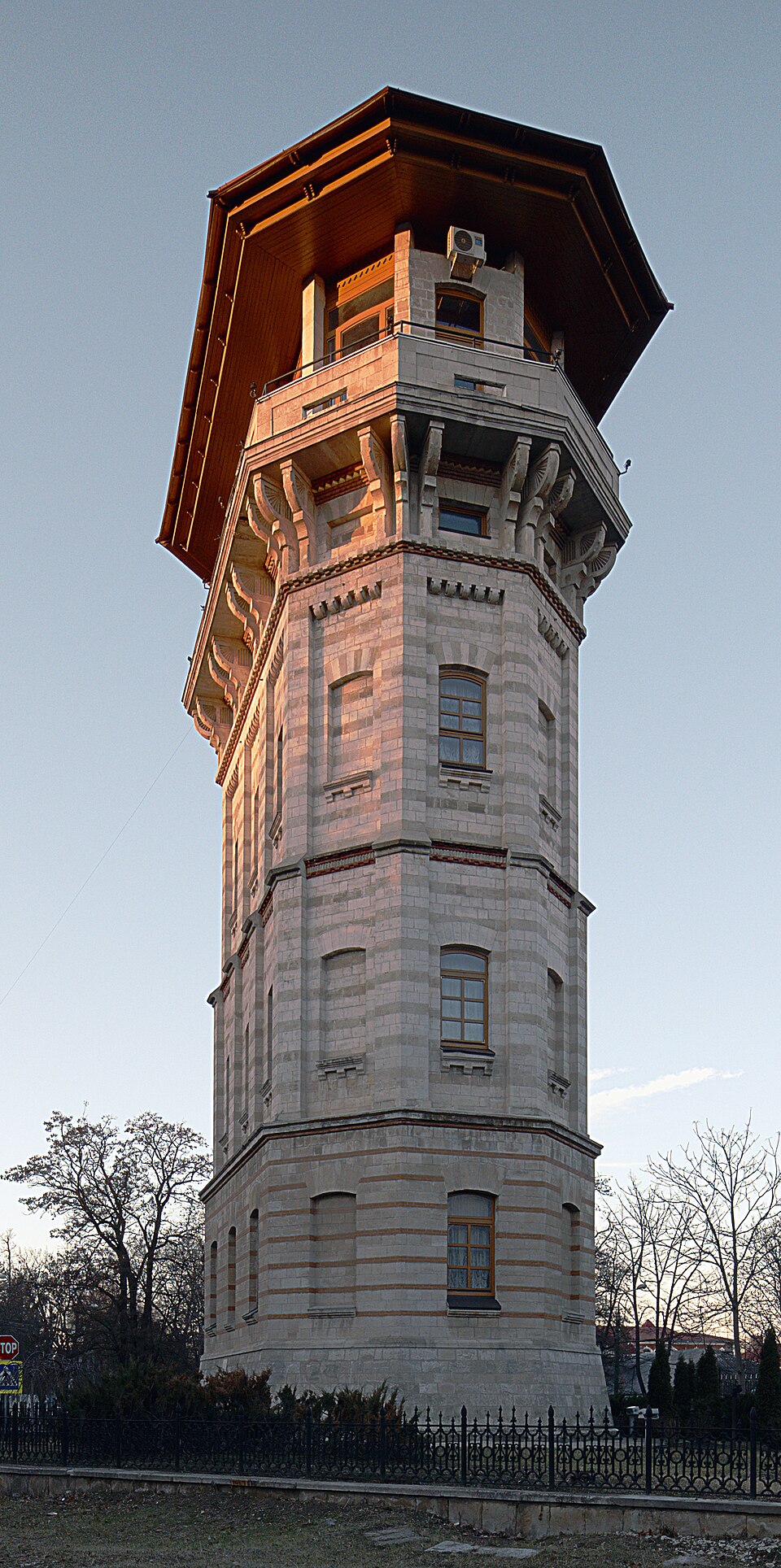
1892–1983 · Alexander Bernardazzi
A tower with two visibly different builds stacked together: an older masonry base from the 1890s and a rebuilt upper section dating only to the early 1980s, after an earthquake destroyed the original wooden top, which now holds exhibition space.
The Chisinau Water Tower was built at the end of the nineteenth century to a design by Alexander Bernardazzi, forming part of the city's original water supply system. Its upper level was originally built of wood and was later destroyed by an earthquake; that section was not rebuilt until 1980–1983. The tower now houses the Chisinau City Museum, with collections ranging from the fifteenth to the twentieth century and exhibition space in its rebuilt upper level for both historical and contemporary art.
- The tower's wooden upper section was destroyed by an earthquake and stood unrebuilt for decades, until 1980–1983.
- It now houses a city museum with items dating from the 15th to the 20th century.
Photo: andrez1 (CC BY-SA 3.0)
Stephen the Great Central Park
Moldova's oldest park, spanning about 7 hectares in central Chișinău and nicknamed 'The Park of the Lovers' for its popularity with couples. It holds 50 species of trees, including mulberries and acacias between 130 and 180 years old, and contains the Alley of Classics.
Government House
The seat of Moldova's government, on Great National Assembly Square, designed by Semyon Fridlin in 1964 as a six-storey reinforced-concrete structure shaped like the Cyrillic letter П. The Monument to the Victims of the Soviet Occupation was unveiled in front of it in 2010.
Presidential Palace
The official residence of the President of Moldova.
National History Museum of Moldova
A museum in Central Chişinău, Moldova.
Sfatul Țării Palace
A building in Chișinău, Moldova.
Alley of Classics
A sculptural complex located in the Stephen the Great Park in Central Chișinău, Moldova.
Capitoline Wolf
A monument in Central Chișinău. It stands in front of the National History Museum of Moldova.
Mihai Eminescu National Theatre
A neoclassical historical and architectural monument in Central Chișinău, originally built in 1931 to house various cultural activities. Its purpose and name changed several times before it was renamed in 1988 in honor of the poet Mihai Eminescu, and it now hosts plays and concerts.
Maria Bieșu National Opera and Ballet Theatre
One of the leading opera and ballet theatres in Eastern Europe, housed in a building on Boulevard Stefan the Great, one of Chișinău's main roads. It was given its current name in 2012, honoring the renowned opera singer Maria Bieșu.
Chișinău Choral Synagogue
A former Liberal Jewish congregation and synagogue on Vlaicu Pircalab Street, once the most famous synagogue in the country. The building was repurposed as a theater in the 1950s.
Cathedral of Divine Providence
A neoclassical Roman Catholic cathedral built in 1836 by architect Avraam Melnikov with grants from Tsar Nicholas I, and seat of the Diocese of Chișinău. Closed under Soviet rule from 1963, it was returned to the parish in 1989 and restored between 2002 and 2004.
Chișinău Botanical Garden of the Academy of Sciences
A botanical research institution and public garden in the Botanica sector, founded in 1950 and relocated to its current 104-hectare site in 1965. Developed from 1966 to 1971, it includes a dendrarium, rose garden, rock garden and decorative lakes, gaining research institute status in 1975.
Măzărache Church
A church in Chişinău, Moldova.
Transfiguration Church
A Moldovan Orthodox church in Chișinău.
National Library of Moldova
The state's main library, responsible for conserving and protecting the country's written cultural heritage as part of the European Digital Library. Founded in 1940, it traces its roots to the Gubernatorial Public Library of Bessarabia, established in 1832.
Chișinău Central Cemetery
A cemetery in the Sectorul Centru, within the triangle formed by Alexei Mateevici, Vasile Alecsandri and Pantelimon Halippa streets. Founded in 1811, it is the resting place of many prominent figures in Moldova's history and culture.
Ciuflea Monastery
A Moldovan Orthodox monastery dedicated to Saint Theodore of Amasea.
Victims of Chișinău Pogrom
A memorial stone to the victims of the 1903 Chișinău pogrom, unveiled in Alunelul Park in 1993. It consists of two marble blocks, the first placed in 1993 and the second added in 2003.
Liberation Tower, Bessarabia
A 30-metre stone tower built in 1942 near Ghidighici, on a hill outside the city, by more than 500 workers over 60 days using local quarry stone. King Michael I of Romania and Foreign Minister Mihai Antonescu attended its opening ceremony on 1 November 1942.
History
Chisinau's built character was set in the nineteenth century under the Russian Empire, when a Neoclassical cathedral, a triumphal arch, and later an eclectic city hall and water tower went up around the central square; the architect Alexander Bernardazzi worked on several of them, and the central railway station was raised in the same Russian-Imperial idiom. The Second World War brought heavy destruction, and earthquakes did further damage to a city built largely in masonry and timber: the water tower's wooden upper storey came down and the city hall was reduced to fragments. Soviet-era rebuilding replaced much of what was lost, following old photographs where they survived, and added the Socialist Realist and Brutalist blocks that now stand beside the reconstructed nineteenth-century monuments.