Landmarks in Jakarta
Its oldest buildings trace the walled Dutch port town that grew into Batavia.
Jakarta's landmarks sit in two clusters shaped by three centuries of Dutch rule. Around Fatahillah Square, in the old walled trading post once fortified as Batavia's centre, stands the former Stadhuis, a city hall raised in 1710 that now houses the Jakarta History Museum, alongside other former civic buildings. Several kilometres south, around Merdeka Square, the colonial administration later built a government and cultural quarter: a neo-Gothic cathedral consecrated in 1901 and a museum building that grew into the National Museum of Indonesia. The two quarters were built a century and a half apart for different purposes, a fortified port town and then an administrative capital, so their materials, scale and street layouts still differ noticeably today.
National Museum of Indonesia
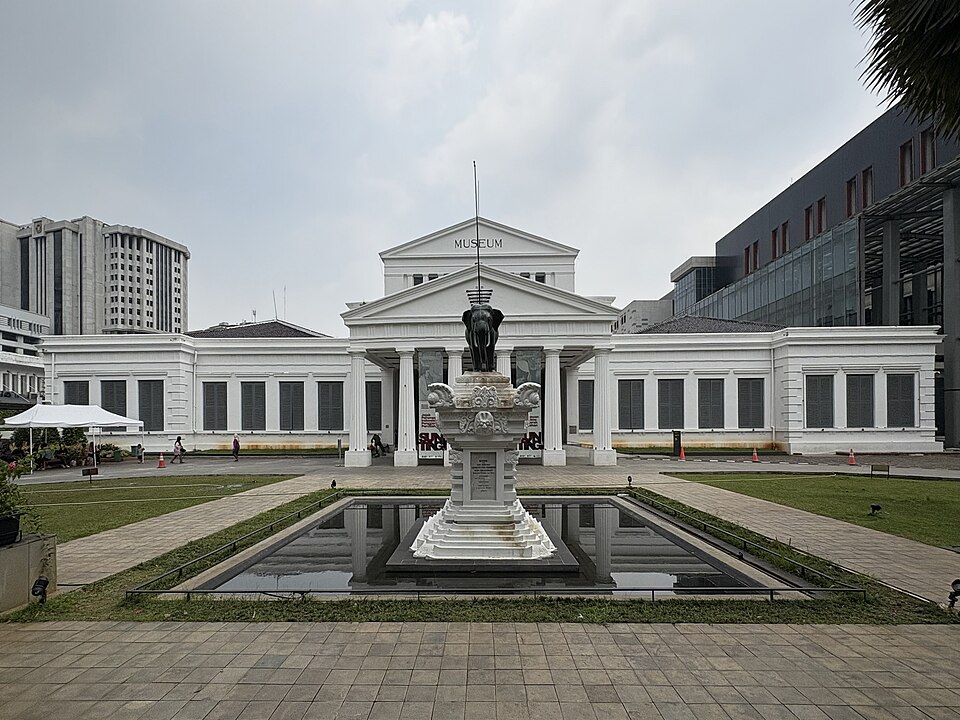
1778–1868
Popularly nicknamed for a bronze elephant statue standing in its forecourt, the museum's halls hold Hindu-Buddhist stone statuary from ancient Java and Sumatra alongside an extensive collection of Asian ceramics.
Popularly called the Elephant Museum after the bronze elephant statue in its forecourt, the museum holds archaeological, historical, ethnological and geographical collections covering nearly all of Indonesia's territory and history. Regarded as one of the most complete collections in Southeast Asia, it preserves about 141,000 objects, ranging from prehistoric artefacts to Hindu-Buddhist stone statues from ancient Java and Sumatra and extensive Asian ceramics. A fire damaged parts of the older building in September 2023, closing the museum for renovation until October 2024.
- Its popular nickname, the Elephant Museum, comes from a bronze elephant statue in the forecourt.
- A fire in September 2023 closed the museum until October 2024.
Photo: Chainwit. (CC BY 4.0)
Jakarta Cathedral
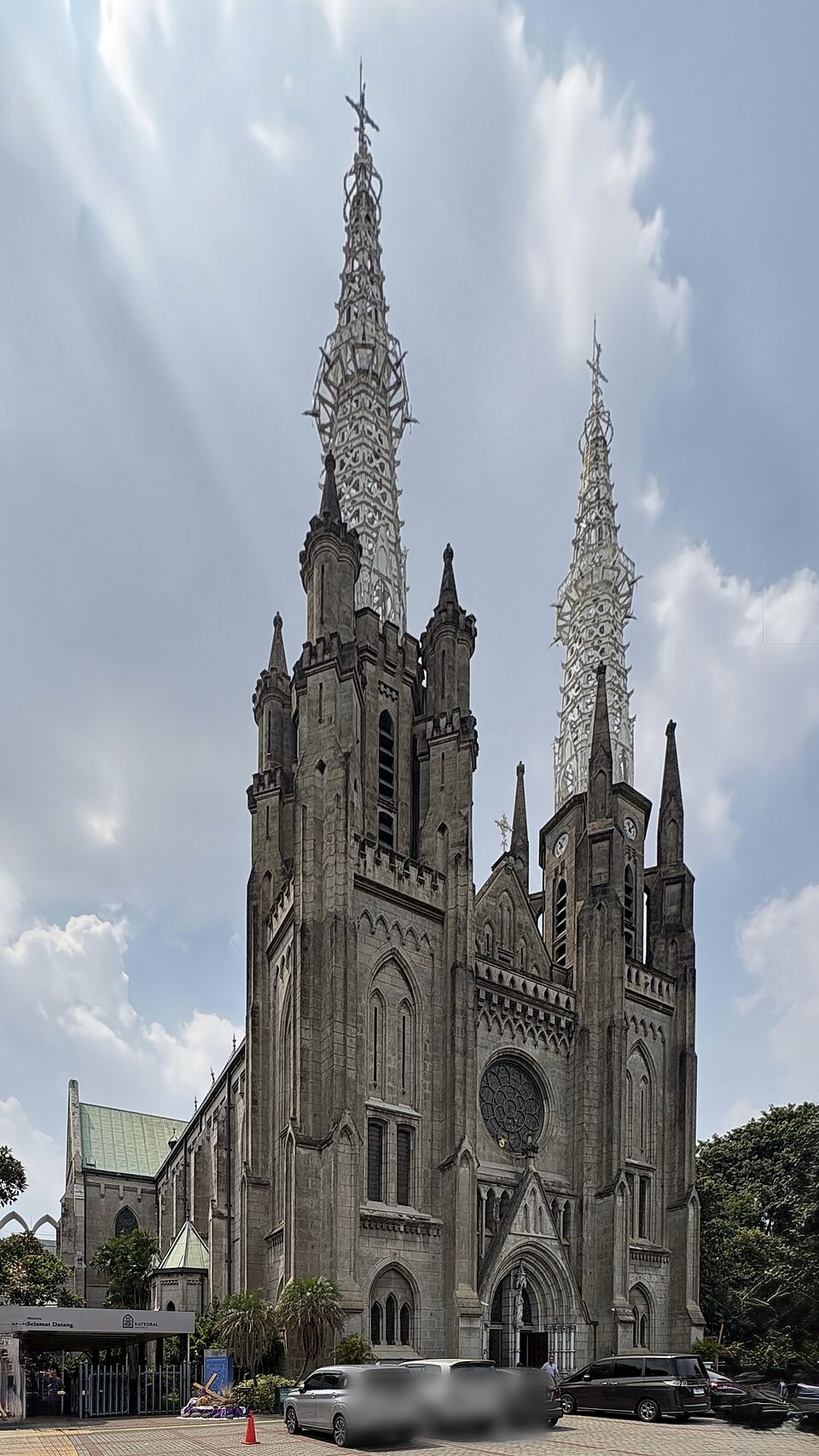
1901
A neo-Gothic Catholic cathedral in Central Jakarta, standing immediately beside the Istiqlal Mosque and near Merdeka Palace and Merdeka Square; its pointed arches and spires sit in deliberate contrast to the mosque next door.
Officially the Church of Our Lady of the Assumption, this Latin Catholic cathedral is the seat of the Archbishop of Jakarta. The present building was consecrated in 1901 and built in the neo-Gothic style, a common choice for church architecture of that period. It stands in Central Jakarta near Merdeka Square and Merdeka Palace, immediately next to the Istiqlal Mosque.
- Its official English name, Church of Our Lady of the Assumption, translates the original Dutch dedication.
- The Istiqlal Mosque stands immediately next to the cathedral.
Photo: Chainwit. (CC BY 4.0)
Jakarta History Museum
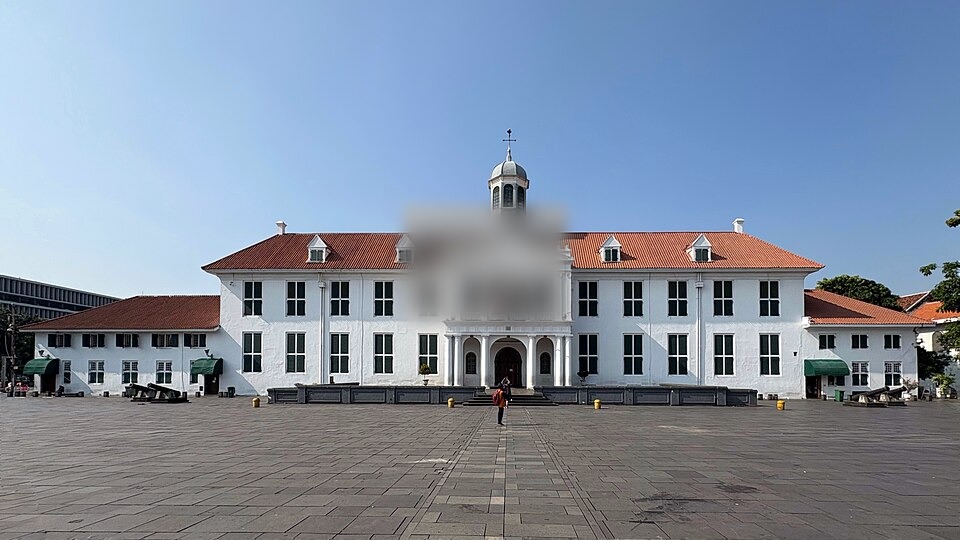
1710
A Dutch colonial city hall block believed to be modelled on Amsterdam's Dam Palace, fronting the large paved square once used as Batavia's town square and flanked by the Wayang Museum and the Fine Art and Ceramic Museum.
Built in 1710 as the Stadhuis, or city hall, of Batavia, the building anchors the south side of Fatahillah Square in Jakarta's Old Town, Kota Tua. It opened as a museum in 1974, displaying objects from the region's prehistory, the founding of Jayakarta in 1527, and Dutch colonial rule up to Indonesian independence in 1945. Also known as the Fatahillah Museum or Batavia Museum, it stands near the Wayang Museum and the Fine Art and Ceramic Museum.
- The building is believed to have been modelled on Amsterdam's Dam Palace.
- It also goes by the names Fatahillah Museum and Batavia Museum.
Photo: Chainwit. (CC BY 4.0)
Istiqlal Mosque
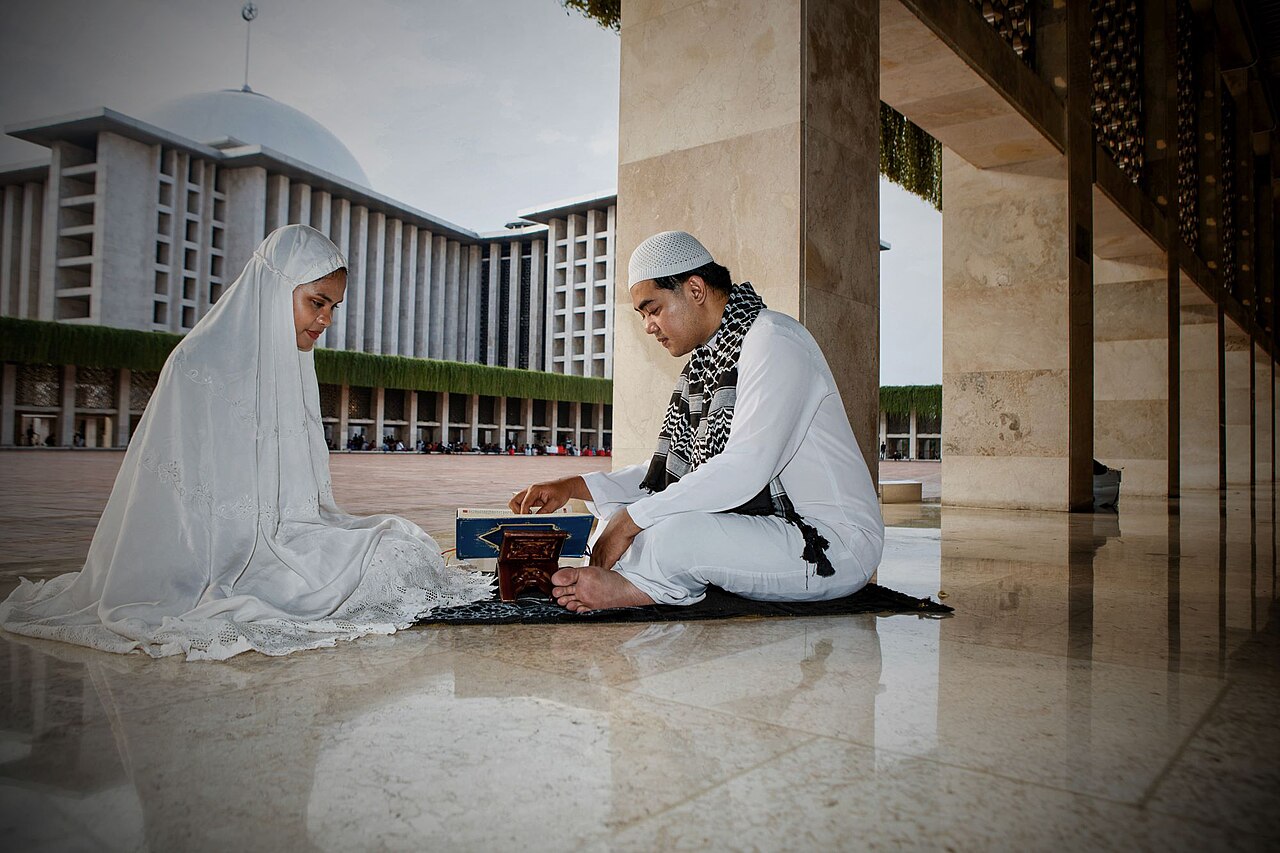
1961–1978 · Friedrich Silaban
A vast rectangular prayer hall is crowned by a spherical dome roughly 45 metres across, topped with a stainless-steel crescent-and-star pinnacle; seven gates, each named for one of the 99 Names of God, lead into a hall ringed by four levels of balconies on rectangular piers.
Built to commemorate a nation's independence, this mosque held a design competition won by Friedrich Silaban, though the site itself required demolishing an 1837 Dutch citadel first. President Sukarno laid the foundation stone in 1961, and construction continued for seventeen years before President Suharto inaugurated the building in 1978. With a capacity above 120,000, it ranks among the largest mosques in the world. It stands deliberately close to a Catholic cathedral and a Protestant church, and a 2019–2020 renovation later earned it a green-building certification, the first for any place of worship.
- The site was previously occupied by a Dutch fortress, the Citadel Prins Frederick, built in 1837 and demolished to make way for the mosque.
- Architect Friedrich Silaban was the son of a Lutheran pastor from the Batak Protestant Christian Church.
- An underground passage known as the Tunnel of Friendship connects the mosque to the Catholic cathedral next door.
Photo: Dikyedarling (CC BY-SA 4.0)
Selamat Datang Monument
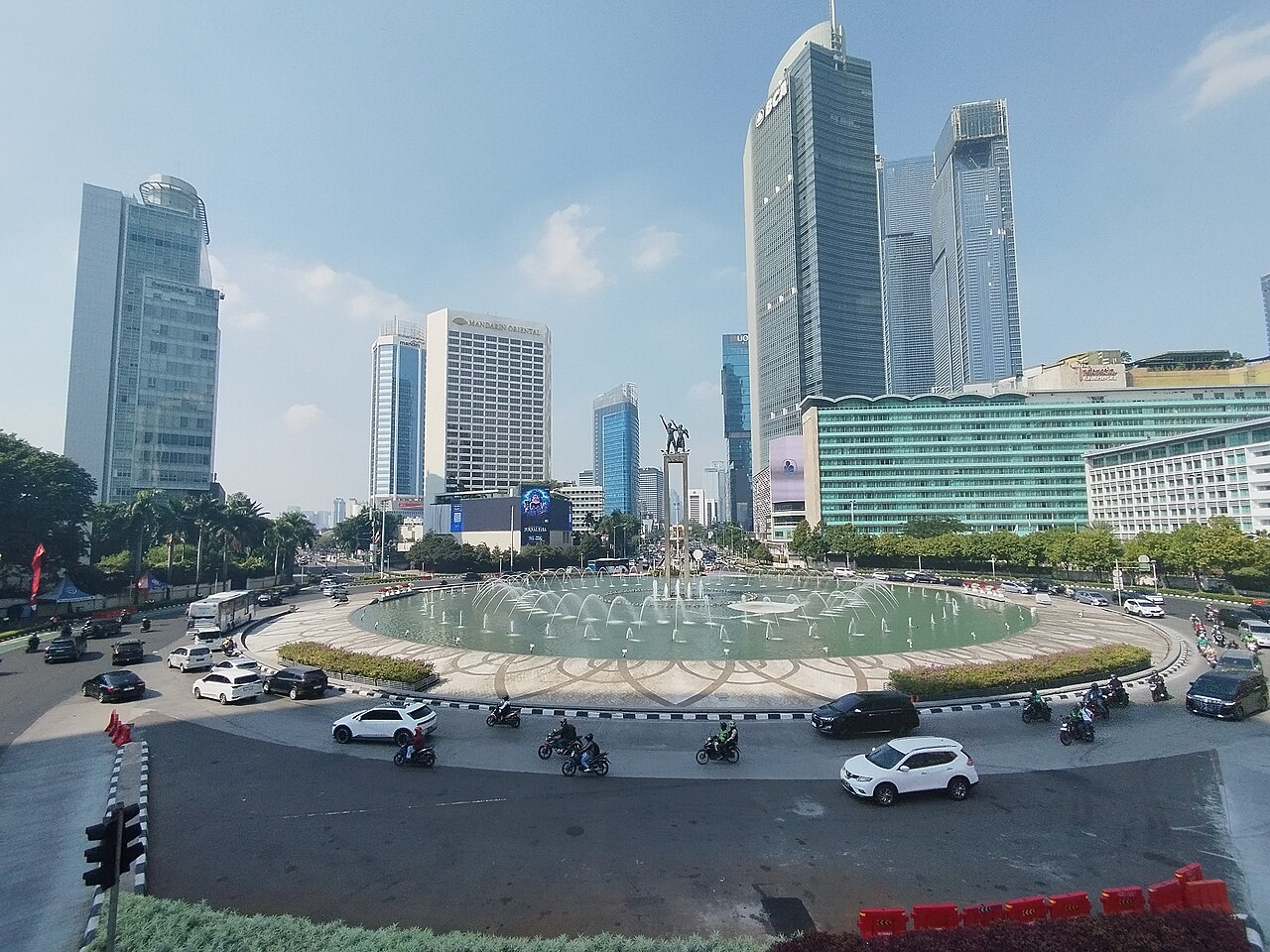
1961–1962 · Edhi Sunarso
Two five-metre bronze figures, a man and a woman holding a flower bouquet, stand atop a stepped pedestal reaching about thirty metres in total, executed in a Soviet-influenced socialist-realist style, at the centre of a round pond ringed by fountains in the middle of a busy roundabout.
Also known as Monumen Bundaran HI, the monument stands at the centre of the roundabout in front of Hotel Indonesia. Vice governor Henk Ngantung sketched the design, sculptor Edhi Sunarso executed the two bronze figures, and Trubus Sudarsono coordinated the project for President Sukarno, who commissioned it to welcome visitors to the 1962 Asian Games. The man and woman, each about five metres tall, stand atop a pedestal that brings the whole structure to roughly thirty metres, waving toward arriving visitors.
- The statues' style, evoking Soviet sculptor Vera Mukhina's socialist realism, has been noted as an influence on the design.
- Henk Ngantung's original name for the sculpture was "Indonesian people greet their future."
- The plaza around the monument has become a regular gathering point for civic demonstrations, as well as joggers and street photographers during Jakarta's car-free Sundays.
Photo: Baqotun0023 (CC BY-SA 4.0)
National Monument
A 132-metre obelisk at the centre of Merdeka Square, built to commemorate the struggle for Indonesian independence and crowned with a flame covered in gold leaf. Construction began in 1961 under President Sukarno, and the monument opened to the public in 1975.
Fatahillah Square
The historical centre of old Batavia, at the heart of Jakarta's Old Town. Today it is a tourist area, home to the Jakarta History Museum, the Wayang Museum and the Fine Art and Ceramics Museum.
Merdeka Square
A large square at the centre of Jakarta, covering about 100 hectares, more than twice the size of Tiananmen Square. The National Monument stands at its centre, surrounded by a park with a musical fountain and a deer enclosure.
Merdeka Palace
One of Indonesia's seven presidential palaces, on the north side of Merdeka Square, once the residence of the Dutch East Indies governor-general. Renamed Merdeka Palace, meaning 'freedom', in 1949, it forms part of the 6.8-hectare Jakarta Presidential Palace Complex.
Istana Negara
The State Palace, one of Indonesia's seven presidential palaces, on Veteran Street, with the Merdeka Palace just to its south. It forms part of a 68,000-square-metre compound that also includes Bina Graha, the state guest house Wisma Negara, and the Ministry of State Secretariat.
MPR/DPR/DPD building
The seat of Indonesia's legislative branch, officially the Parliamentary Complex of Indonesia. It houses the People's Consultative Assembly, the House of Representatives and the Regional Representative Council.
Sunda Kelapa
The old port of Jakarta, at the estuary of the Ciliwung River, once the main port of the Sunda Kingdom. Now a minor port operated by the state-owned Pelindo, it still berths pinisi, traditional two-masted wooden schooners used for inter-island freight.
Wisma 46
A 261.9-metre, 46-floor office tower in the BNI City complex, completed in 1996 to a design by Zeidler Roberts Partnership and DP Architects. It was the tallest building in Indonesia until 2016, when it was surpassed by the Gama Tower.
Thamrin Nine
A mixed-use complex covering about 570,000 square metres of offices, retail, residential and hotel space, designed by Kohn Pedersen Fox Associates. Its centrepiece, the 389.9-metre Autograph Tower, is the tallest building in the Southern Hemisphere.
Gelora Bung Karno Stadium
A multi-purpose stadium named after President Sukarno, who conceived the surrounding sports complex, opened before the 1962 Asian Games with a capacity of 110,000. Renovations have twice reduced its capacity, first to 88,306 in 2006 and then to 77,193 seats for the 2018 Asian Games.
International Stadium
A retractable-roof football stadium in Tanjung Priok, home ground of Persija Jakarta and occasional venue for the national team. With a seating capacity of 82,000, it is the largest stadium in Indonesia and the largest football-specific stadium in Asia, completed in 2022.
Kim Tek Ie Temple
A Chinese temple, or klenteng, in the Chinatown neighbourhood of Glodok, also known as Vihara Dharma Bhakti. Completed in 1650, it is the oldest Chinese temple in Jakarta.
Gereja Sion
A Protestant church with a structure dating to the late 17th century, the oldest building in Jakarta still serving its original function. Its roots trace to 1676 as a modest chapel for the Mardijker people, later rebuilt by the Dutch East India Company.
West Irian Liberation Monument
A postwar modernist monument at the centre of Lapangan Banteng, formerly Waterloo Square, in Central Jakarta. President Sukarno commissioned it in 1963, following the dispute in which Indonesia received Western New Guinea from the Netherlands.
Bank Indonesia Museum
A bank museum opened in 2009, housed in the former headquarters of De Javasche Bank, the central bank of the Dutch East Indies. Nationalized as Bank Indonesia in 1953 after independence, it stands next to the Mandiri Museum in Jakarta's Old Town.
National Archives Building
The building of the Government Museum, formerly a late 18th-century private residence built for Governor-General Reinier de Klerk. It is considered an archetypal example of the earliest Indies-style architecture.
Taman Prasasti Museum
A museum housed in a former cemetery built by the Dutch colonial government in 1795, possibly the oldest modern cemetery in the world. Notable burials include Olivia Mariamne Raffles, first wife of governor Thomas Stamford Raffles, and Indonesian activist Soe Hok Gie.
Mandiri Museum
The corporate museum of Bank Mandiri, housed in the former headquarters of the Netherlands Trading Society, one of the primary ancestors of ABN AMRO. It stands in Jakarta's Old Town, next to the Bank Indonesia Museum and facing Jakarta Kota Station.
Candra Naya
An 18th-century building, home to the Khouw family of Tamboen, whose most senior member was Batavia's last Majoor der Chinezen. Once among the grandest colonial residences in the capital, it was almost entirely demolished by its new owners, saved only by heritage protests.
Angke Mosque
One of the oldest mosques in Jakarta, officially known as Masjid Jami Angke or Masjid Al-Anwar, in Tambora. Well-preserved in its original form, historian Denys Lombard called it one of the most elegant mosques of the old town.
Maritime Museum
A museum in the old Sunda Kelapa harbour area, inaugurated inside former Dutch East India Company warehouses. It displays models of Indonesian fishing boats and the Pinisi schooners of the Bugis people, though much of it was destroyed by a fire in January 2018.
Toko Merah
A Dutch colonial building known as the 'Red Shop', built in 1730 on the west side of the main canal, Kali Besar. One of the oldest buildings in Jakarta, it once hosted William Bligh among its guests.
History
The site was Sunda Kelapa, a port of the Sunda Kingdom, before forces of the Demak Sultanate took it in 1527 and renamed it Jayakarta. The Dutch East India Company seized the settlement in 1619 and rebuilt it as Batavia, a walled town run as the company's regional headquarters; its Stadhuis, built in 1710 on the town square, still stands as the oldest civic building from that period. As Batavia grew into the Dutch colonial capital, later administrations moved new institutions to a wider government district around what is now Merdeka Square, where a Catholic cathedral was consecrated in 1901 and public collections were gathered into what became the National Museum. Japanese occupation during the Second World War ended Dutch rule, after which Jakarta became independent Indonesia's capital.