Landmarks in Sydney
Concrete shells, riveted steel and Victorian sandstone sit within sight of one harbour.
Sydney's most photographed landmarks cluster around the harbour that gives the city its shape. The Opera House occupies Bennelong Point on the foreshore, its white-tiled concrete shells rising over the water in an expressionist departure from anything built in the country before it. A few hundred metres away, a riveted steel arch finished four decades earlier, in 1932, carries road and rail across the same harbour to the North Shore, its plain industrial form a contrast to the Opera House's curves. Inland, in the central business district's grid, the Queen Victoria Building keeps a different register: sandstone, copper domes and round-arched windows, built in the 1890s as a produce market and later restored as a shopping arcade.
Sydney Opera House
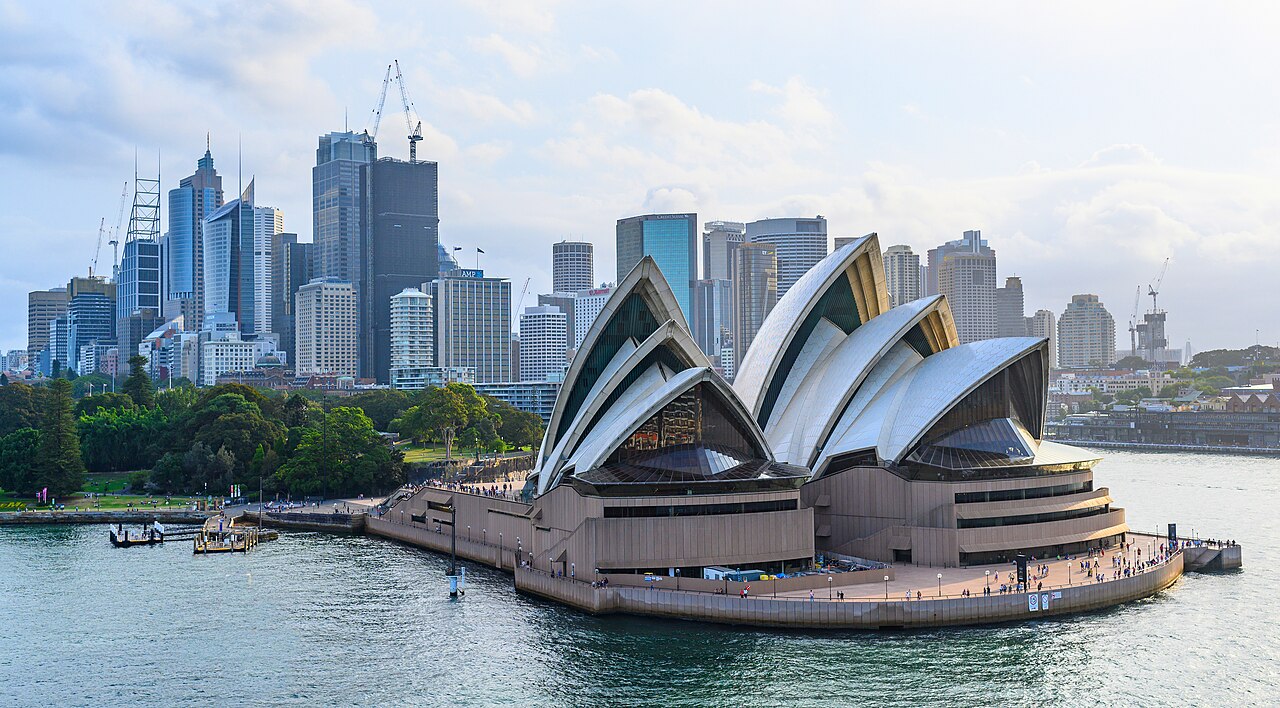
1973 · Peter Hall
A cluster of white-tiled, sail-like concrete shells rising in ascending rows over the water, their curved profiles set against a harbour skyline.
Danish architect Jørn Utzon won an international design competition in 1957 and directed construction after the New South Wales government, led by premier Joseph Cahill, authorised the project in 1958. Utzon resigned before completion amid cost and scheduling disputes, and an Australian team led by Peter Hall finished the building, which Queen Elizabeth II formally opened on 20 October 1973. It occupies Bennelong Point between Sydney Cove and Farm Cove and now houses multiple venues used by resident companies including Opera Australia, staging more than 1,800 performances a year for over 1.4 million attendees.
- Jørn Utzon won the design competition in 1957 but resigned before the building was finished, following disputes over cost and schedule.
- It stages more than 1,800 performances a year for over 1.4 million attendees.
Photo: Bengt Nyman from Vaxholm, Sweden (CC BY 2.0)
Sydney Harbour Bridge
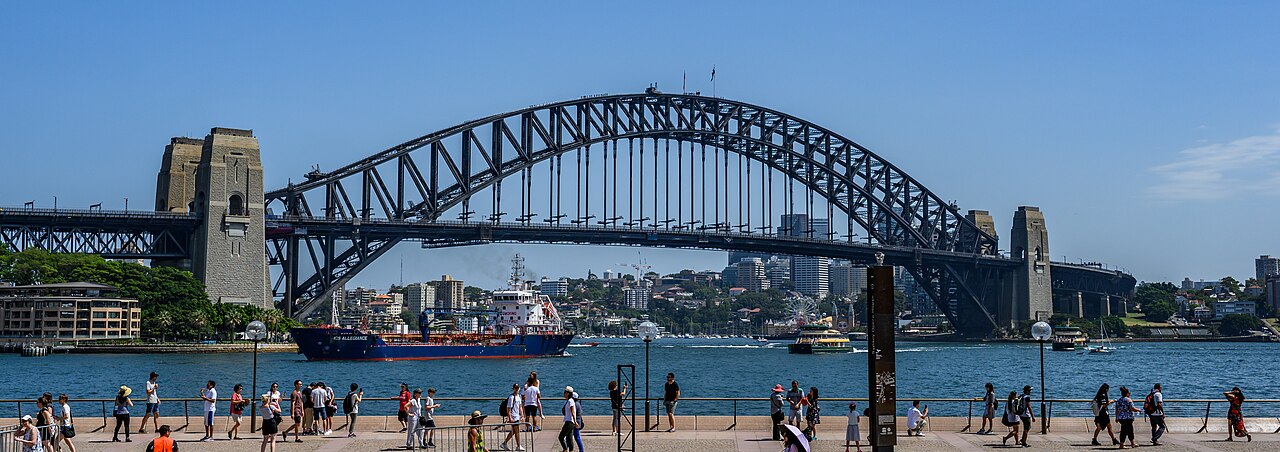
1932
A grey riveted steel arch spanning the water in a single shallow curve, with a stone pylon at each end and a lattice of girders visible along its underside.
John Bradfield of the New South Wales Department of Public Works directed the project, and the British firm Dorman Long designed and built the bridge, which opened in 1932 to link the central business district with the North Shore. It carries rail, road, bicycle and pedestrian traffic and is nicknamed "the Coathanger" for its arch. Its overall scheme echoed New York's Hell Gate Bridge, though Dorman Long's winning tender drew on its own Tyne Bridge. Measuring 134 metres from top to water level, it was the world's widest long-span bridge until Vancouver's Port Mann Bridge overtook it in 2012.
- Nicknamed "the Coathanger" for its arch-based design.
- Its general scheme was a rough copy of New York's Hell Gate Bridge, though the winning tender drew on Dorman Long's own Tyne Bridge.
- It was the world's widest long-span bridge until Vancouver's Port Mann Bridge was completed in 2012.
Photo: Bengt Nyman from Vaxholm, Sweden (CC BY 2.0)
Queen Victoria Building
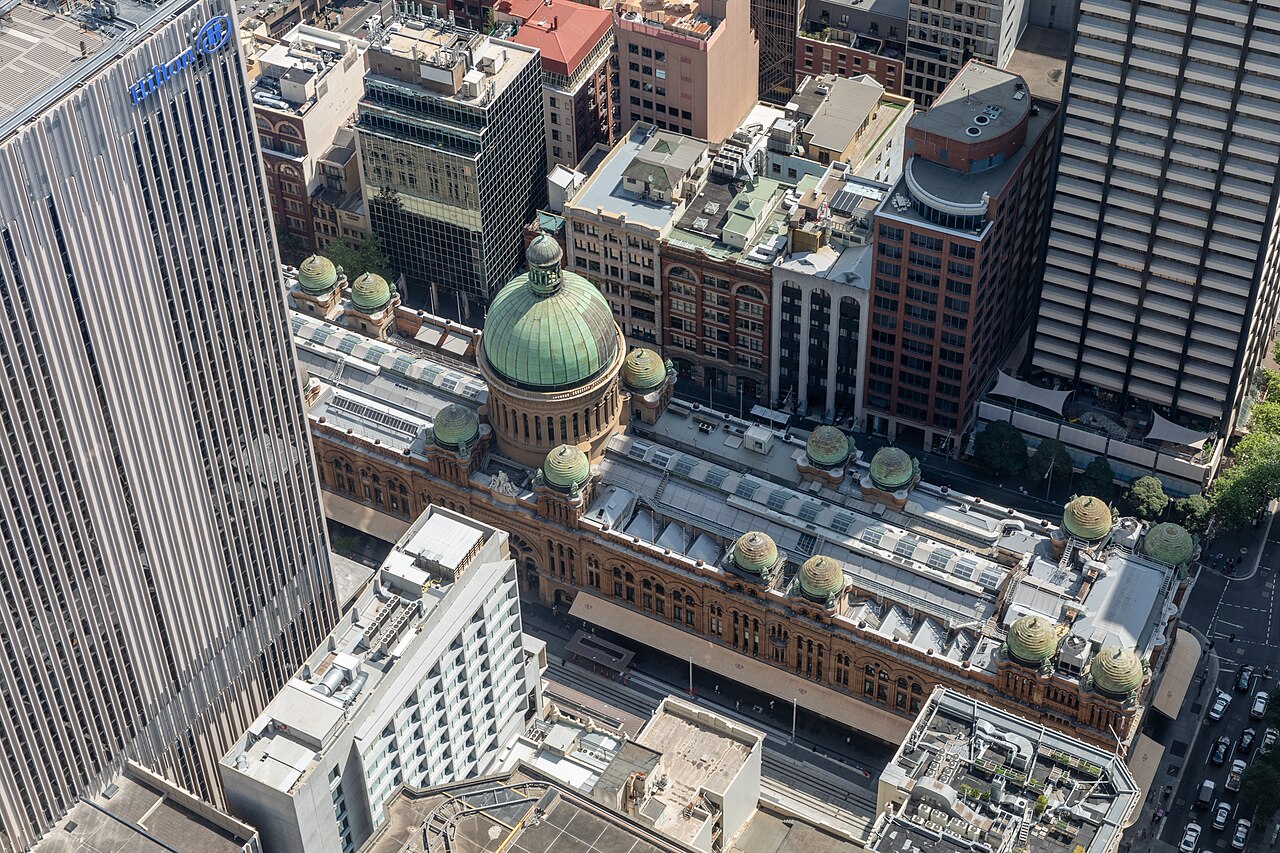
1893–1898 · George McRae
A long sandstone building with a row of copper domes along its roofline, the central dome the largest, and round-arched windows running the length of the block.
George McRae designed the building in the Romanesque Revival style, and it was constructed between 1893 and 1898 on a block bounded by George, Market, York and Druitt streets in the Sydney central business district. It measures 30 metres wide by 190 metres long, and its domes were built by Ritchie Brothers, a firm that also made trains, trams and farm equipment. Conceived as a marketplace, it was later put to other uses and fell into decay before being restored to retail use in the late twentieth century, and is now co-owned by the City of Sydney and Link REIT.
- Its domes were built by Ritchie Brothers, a company that also made trains, trams and farm equipment.
- It runs 190 metres long, the length of an entire city block.
Photo: Dietmar Rabich (CC BY-SA 4.0)
General Post Office
1866–1891 · James Barnet
A pale sandstone facade stretching 114 metres along a public square, its ground floor a continuous arcade of round-arched openings beneath a central tower.
James Barnet, the Colonial Architect, designed the building, built in two stages from 1866 using sandstone quarried at Pyrmont. Its main facade, 114 metres long, has been called the finest example of Victorian Italian Renaissance style in New South Wales. The building served as the headquarters of Australia Post until 1996, when it was privatised and refurbished; a scaled-back counter service continues on its George Street side as the GPO Post Shop. Despite extensive internal remodelling, the facade survives largely unchanged and is listed on both the Commonwealth Heritage List and the State Heritage Register.
- The building's central axis lines up with the ANZAC Cenotaph, a war memorial in the square it faces.
- The public square in front of it, now known as Martin Place, is said to have taken shape largely because of the building, whose construction led to the clearing of the narrow lane it once fronted.
Photo: Simon_sees from Australia (CC BY 2.0)
St Mary's Cathedral
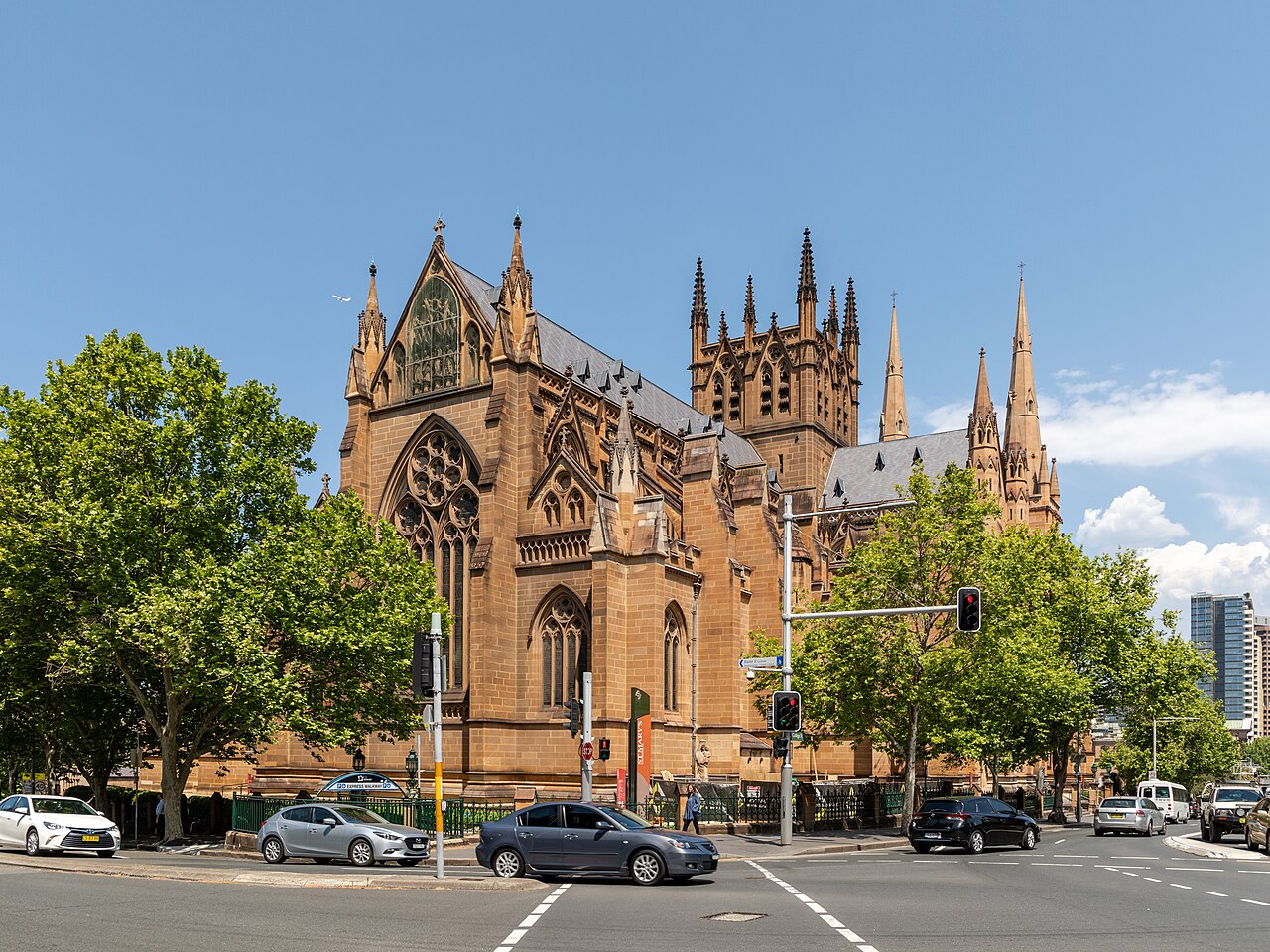
1866–2000 · William Wardell
A sandstone Gothic Revival church with two spired towers flanking its main facade and a taller central tower further back, pointed arches and buttresses running the length of its nave.
The present cathedral is the third church on this site: the first, begun in 1821, burned down in 1865, and a temporary wooden replacement also burned, in 1869. Archbishop Polding laid the foundation stone for the current building, designed by William Wardell in the Gothic Revival style, in 1868; his successors saw it through further stages, with the nave dedicated in 1928 under architects Hennessy, Hennessy and Co. Wardell's planned spires were not added until 2000. Pope Pius XI raised the church to the status of minor basilica in 1932.
- The parish priest who requested the site reported having a vision in 1821 of twin spires rising above the city, a vision fulfilled only after three buildings and roughly 180 years.
- Prime Minister Joseph Lyons, who died in office in 1939, lay in state inside for several days before burial in Tasmania.
Photo: Dietmar Rabich (CC BY-SA 4.0)
Hyde Park Barracks
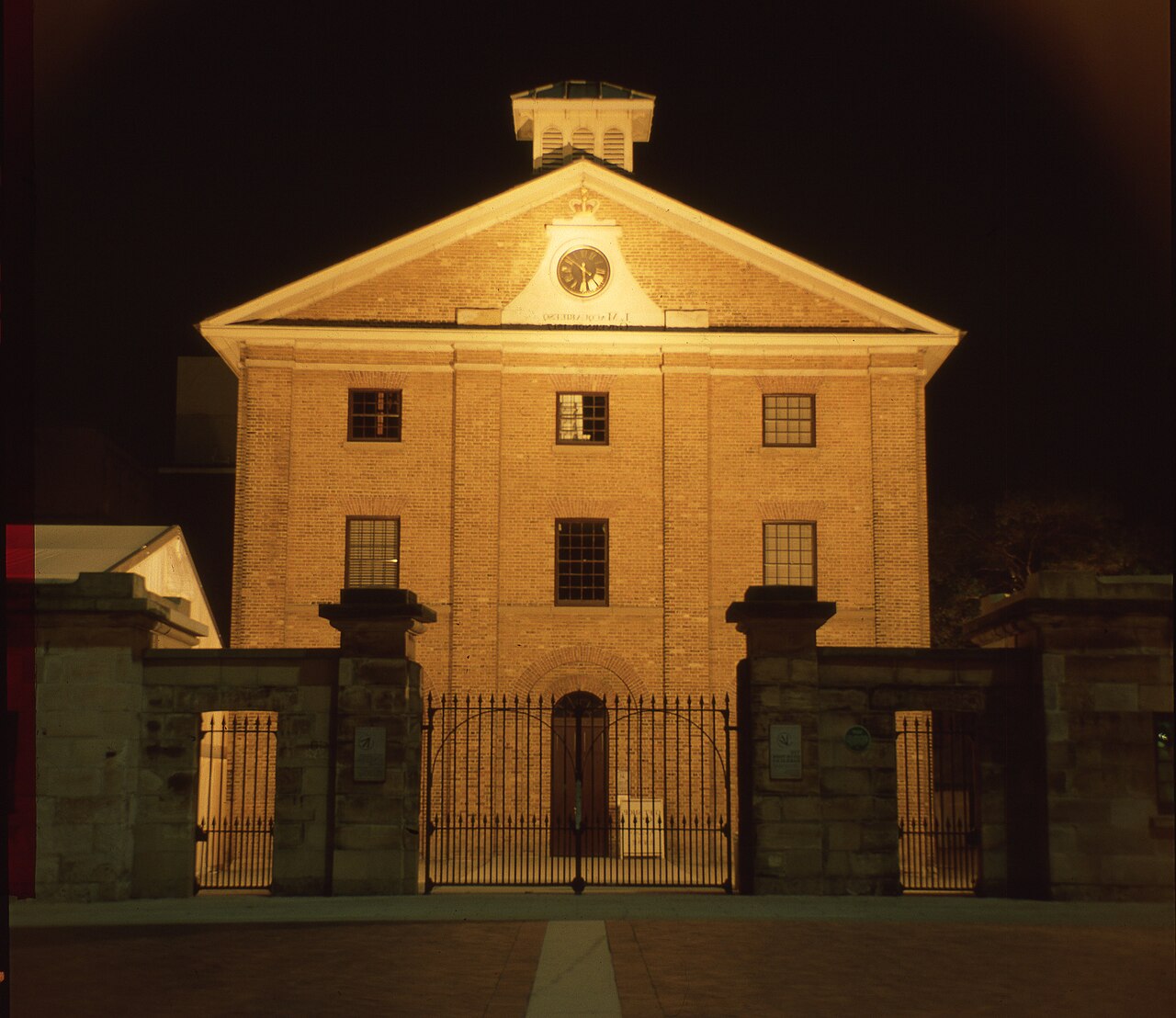
1817–1819 · Francis Greenway
A plain brick building and compound in the Neoclassical style, standing on Macquarie Street among the city's other early colonial civic buildings.
Governor Lachlan Macquarie commissioned Francis Greenway, himself a convict transported for forging signatures, to design barracks housing 600 men; construction began in 1817 and the building opened in 1819, after which Macquarie granted Greenway a full pardon. As convict transportation wound down, the buildings held a female immigrants' depot from 1848 and an asylum for destitute women from 1862 to 1886, before passing to the courts. Now a museum, the site is one of eleven Australian Convict Sites inscribed on the UNESCO World Heritage List and reopened in 2020 after an $18 million restoration.
- Each of the largest rooms slept 70 men, with every hammock allotted a space of just 2.1 by 0.6 metres.
- The building has also been known as the Mint Building, the Rum Hospital and Queen's Square Courts, reflecting its many later uses.
Photo: Sardaka (CC BY-SA 3.0)
Fort Denison
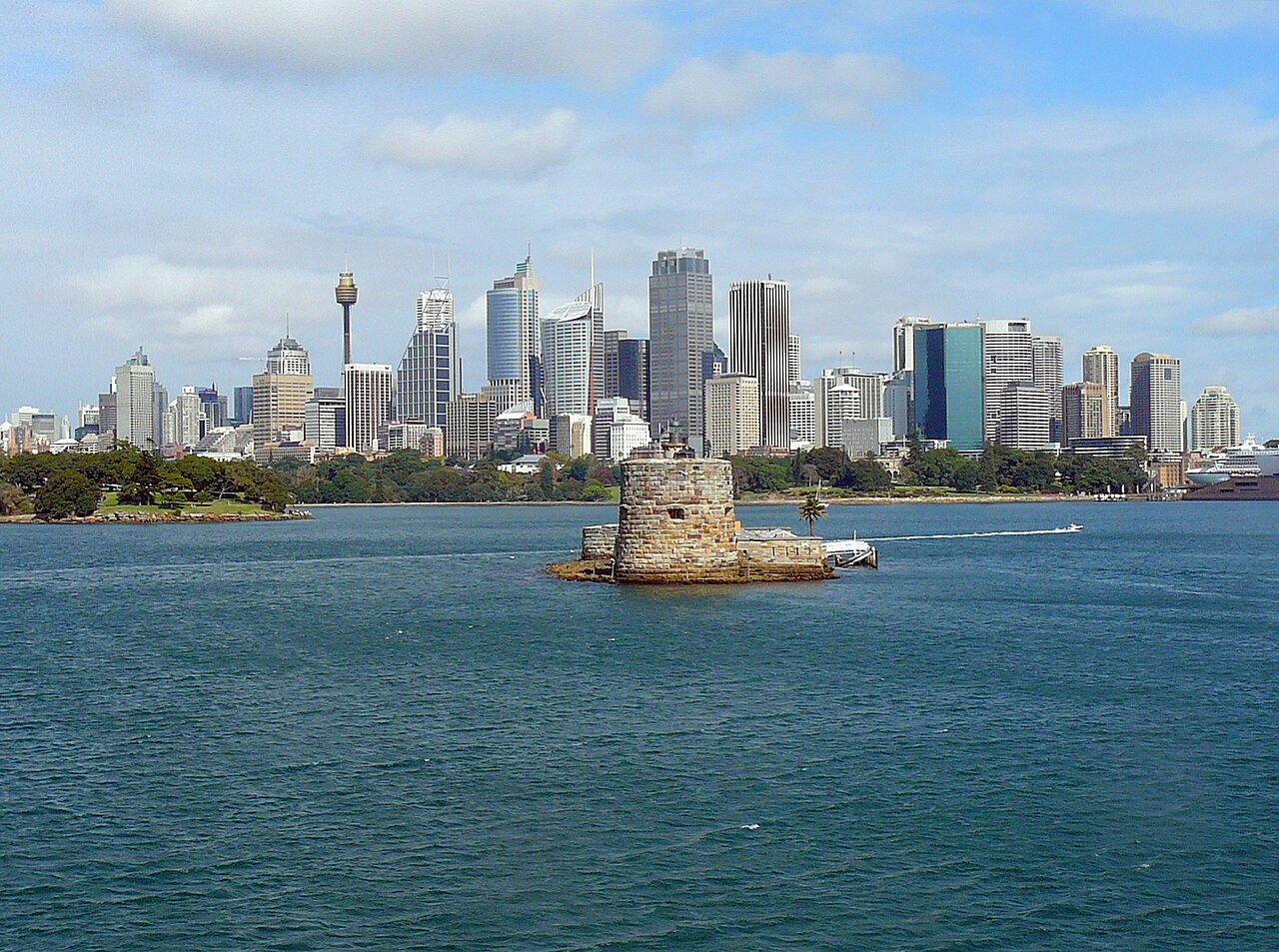
1841–1857 · George Barney
A round, thick-walled sandstone tower dominates a tiny island in open water, its cannon embrasures now mostly empty and its upper courses scarred by shell damage from a wartime attack; a small lighthouse lantern tops the roofline where a gun once stood.
This small island in the harbour, once called Pinchgut, held convicts sentenced to isolation from 1788 and displayed an executed murderer's gibbeted body in the 1790s. Concern over foreign attack led engineer George Barney to recommend fortifying it; construction began in 1841, stalled, then resumed in 1855 during Crimean War fears of Russian attack, finishing in 1857. Its Martello tower, built from 8,000 tonnes of sandstone with walls up to 6.7 metres thick, held three muzzle-loading cannon too cramped to fire effectively. A 1913 lighthouse replaced a rooftop gun, and 1942 shellfire from an Allied warship still marks the tower.
- The executed convict Francis Morgan's body was gibbeted in chains on the island for four years after his 1796 hanging.
- In 1900, three sailors, one of them Charles Lightoller, later the most senior officer to survive the Titanic's sinking, rowed out at night and fired a blank cannon shot to fake a raid, fooling nobody but shattering some windows.
- The tower's cannon embrasures were cut too small to aim properly, and by the time a gun was reloaded any ship it targeted would already have sailed past.
Photo: James Porteous, CSIRO (CC BY 3.0)
Royal Botanic Garden
A 30-hectare botanical garden at Farm Cove on the edge of the central business district, opened in 1816 as Australia's oldest scientific institution. Its layout was shaped chiefly by Charles Moore and Joseph Maiden, with earlier work by Allan and Richard Cunningham.
Luna Park
An amusement park on the northern shore of Sydney Harbour at Milsons Point, built in 1935 and one of the city's most famous landmarks. Its site is protected by the Luna Park Site Act 1990, which reserves it specifically for use as an amusement park.
Tower
An observation and telecommunications tower standing 309 metres above the central business district on Market Street, the tallest structure in Sydney. It sits above the Westfield Sydney shopping centre and ranks as the second-tallest observation tower in the Southern Hemisphere.
Circular Quay
A former shipping port at Sydney Cove, between Bennelong Point and The Rocks, now a passenger terminal, public piazza and transport hub. Often called the gateway to the city, it commands views of the Harbour Bridge and Opera House and draws New Year's Eve crowds.
Art Gallery of New South Wales
The most important public gallery in Sydney, founded as the New South Wales Academy of Art in 1872 and located in The Domain. Its first exhibition opened in 1874, and a dedicated Asian Gallery, added to the free general collection, opened in 2003.
Hyde Park
Australia's oldest public parkland, a 16.2-hectare rectangle on the eastern edge of the city centre, built up between 1810 and 1927. Its design involved several hands, including Sir John Sulman's 1927 plan, and it was formerly known as Sydney Common and Government Domain.
Museum of Contemporary Art Australia
A contemporary art museum on George Street in The Rocks, housed in the former Maritime Services Board building with a modern wing added in 2012. Established in 1991, its collection traces back to a 1943 bequest by artist J. W. Power.
The Domain
A 34-hectare open space on the eastern fringe of the central business district, separating it from Woolloomooloo and adjoining the Royal Botanic Garden. It hosts outdoor concerts, open-air events and political rallies, and was added to the state heritage register in 1999.
Observatory
An astronomical observatory and science museum on Observatory Hill in Millers Point, designed by William Weaver and built between 1857 and 1859. The site began as an early 19th-century fort known as Windmill Hill.
Government House
The vice-regal residence of the Governor of New South Wales, built between 1837 and 1843 in the Gothic Revival style beside the Royal Botanic Garden. It has served as the Governor's residence since Sir George Gipps, apart from interruptions in 1901-1914 and 1996-2011.
State Theatre
A 2,034-seat theatre on Market Street, designed by Henry Eli White with John Eberson and built between 1926 and 1929. It has hosted the annual Sydney Film Festival since 1974, alongside live theatre and musical performances.
Crown
A 271.3-metre, 75-storey skyscraper in Barangaroo designed by WilkinsonEyre, the tallest building in Sydney. Developed by Crown Resorts as a hotel and residential tower with a casino, construction began in October 2016 and the building opened to the public in December 2020.
Australian National Maritime Museum
A federally operated maritime museum in Darling Harbour, designed by architect Philip Cox and opened in 1991 after construction delays pushed back its planned 1988 debut. It is the only one of the six federally run museums located outside the Australian Capital Territory.
Pyrmont Bridge
A swing bridge across Cockle Bay in Darling Harbour, opened in 1902 to carry vehicle traffic between the city centre and Pyrmont. Since 1981 it has carried only pedestrians and cyclists, and it joined the state heritage register in 2002, its centenary year.
Sirius Building
An apartment complex in The Rocks, designed in 1978-1979 by Tao Gofers for the Housing Commission of New South Wales, a Brutalist example. Built to rehouse tenants displaced by a controversial redevelopment, it held 79 apartments and is the only high-rise in The Rocks.
Customs House
A building at Circular Quay designed by Mortimer Lewis and built in 1845 under Governor Sir George Gipps. It served as a customs house until 1990 and has belonged to the City of Sydney Council since 1994, now used as a museum and performance space.
Campbell's Stores
A former warehouse in The Rocks, built between 1850 and 1861 in the Victorian Georgian style to serve as maritime bonded stores. It faces Campbells Cove, and was converted into tourist-oriented restaurants and bars during the 1970s.
Cadmans Cottage
The second-oldest surviving residential building in Sydney, built in 1816 at 110 George Street in The Rocks to house government coxswains and their crews. It also claims the distinction of being the first building erected on the shoreline of The Rocks.
Mint
The oldest surviving public building in Sydney's central business district, built between 1811 and 1816 as the southern wing of the Rum Hospital. A mint was established there in 1854, and the building now serves as head office of Museums of History NSW.
Garrison Church
The first military church built in colonial Australia, on Argyle Street, built between 1840 and 1846 to designs by Henry Ginn and Edmund Blacket. It remains an active Anglican church, sharing a joint parish with St Philip's Church since 2013.
Great Synagogue
The oldest Jewish congregation in Sydney, worshipping in a heritage-listed synagogue at 187a Elizabeth Street opposite Hyde Park. Home to around 550 families, it holds Orthodox services every day except Sunday.
History
Aboriginal Australians, including the Darug, Dharawal and Eora clans, had lived around the harbour for at least 30,000 years before James Cook charted the coast in 1770. In 1788 the First Fleet founded Sydney as a British penal colony, the first European settlement on the continent, and the colonial-era street grid still shapes the central business district. The Queen Victoria Building rose there in the 1890s as a produce market, part of the same Victorian building boom that gave Sydney its sandstone civic architecture. Engineering ambition followed: the Harbour Bridge opened in 1932 to link the CBD with the North Shore. Decades later, after post-war migration reshaped the city, an international design competition produced the Opera House, opened in 1973 as a deliberately modern counterpoint on the harbour foreshore.