Landmarks in Auckland
A volcanic isthmus city between two harbours, pairing Edwardian halls with a modern tower.
Auckland's landmarks sit across a narrow isthmus dotted with volcanic cones, between a harbour facing the Tasman Sea and one facing the Pacific. The recorded landmarks span barely a century: an Edwardian civic hall from 1911, a neoclassical war memorial museum raised in phases through the 1920s and 1950s, and a telecommunications tower completed in 1997. The two older buildings sit within the central city and its adjoining park, on a main street and the flank of a dormant volcano, both built in period revival styles typical of an early colonial capital. The Sky Tower breaks that pattern, rising from the central business district as a slender modern structure attached to a casino complex, and remains the skyline's dominant landmark decades after the older civic buildings were finished.
Sky Tower
1997
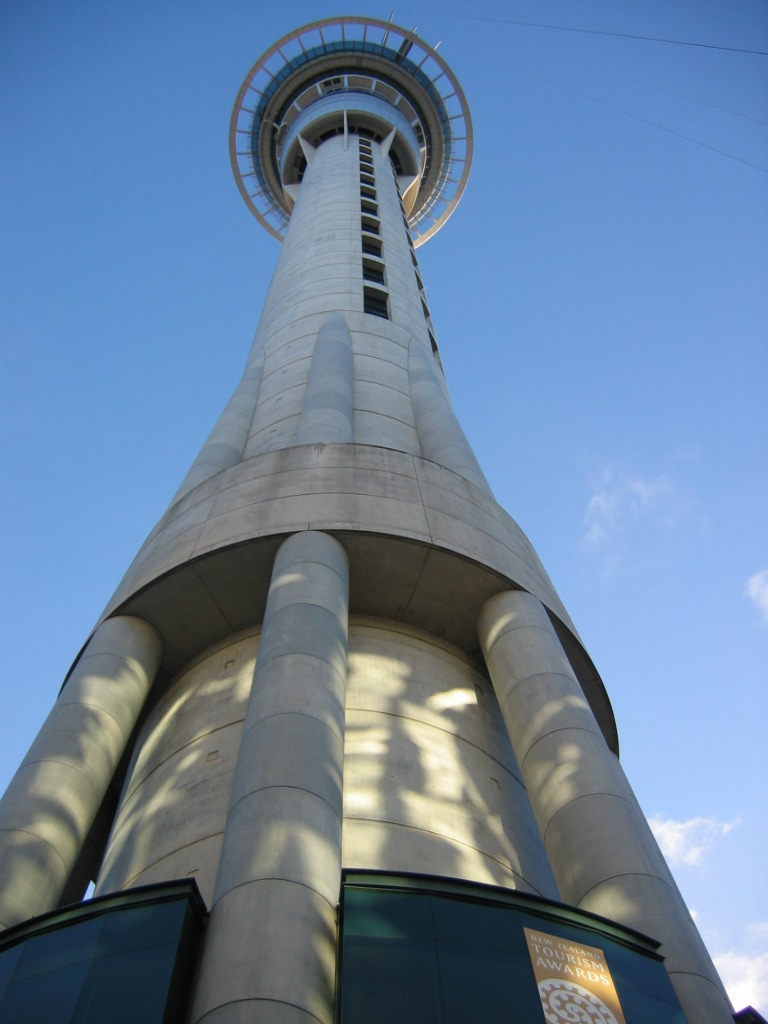
A tall, tapering concrete tower with a bulging observation deck partway up and a thin mast continuing above it, standing apart from a low casino complex at its base.
The Sky Tower is a telecommunications and observation tower built as part of the SkyCity Auckland casino complex, constructed between 1994 and 1997 for Harrah's Entertainment. Measured from ground level to the top of its mast it stands 328 metres tall, making it, since completion, the tallest freestanding structure in the Southern Hemisphere until 2022 and the second-tallest since. Several upper levels are open to the public, drawing an average of roughly 1,150 visitors a day, more than 415,000 a year.
- It is the 28th-tallest tower in the world.
- It held the title of tallest freestanding structure in the Southern Hemisphere from 1996 until 2022, when it was overtaken by Jakarta's Autograph Tower.
- Its casino complex was originally built for the operator Harrah's Entertainment.
Photo: Orderinchaos (CC BY-SA 4.0)
Auckland Town Hall
1911 · John James Clark
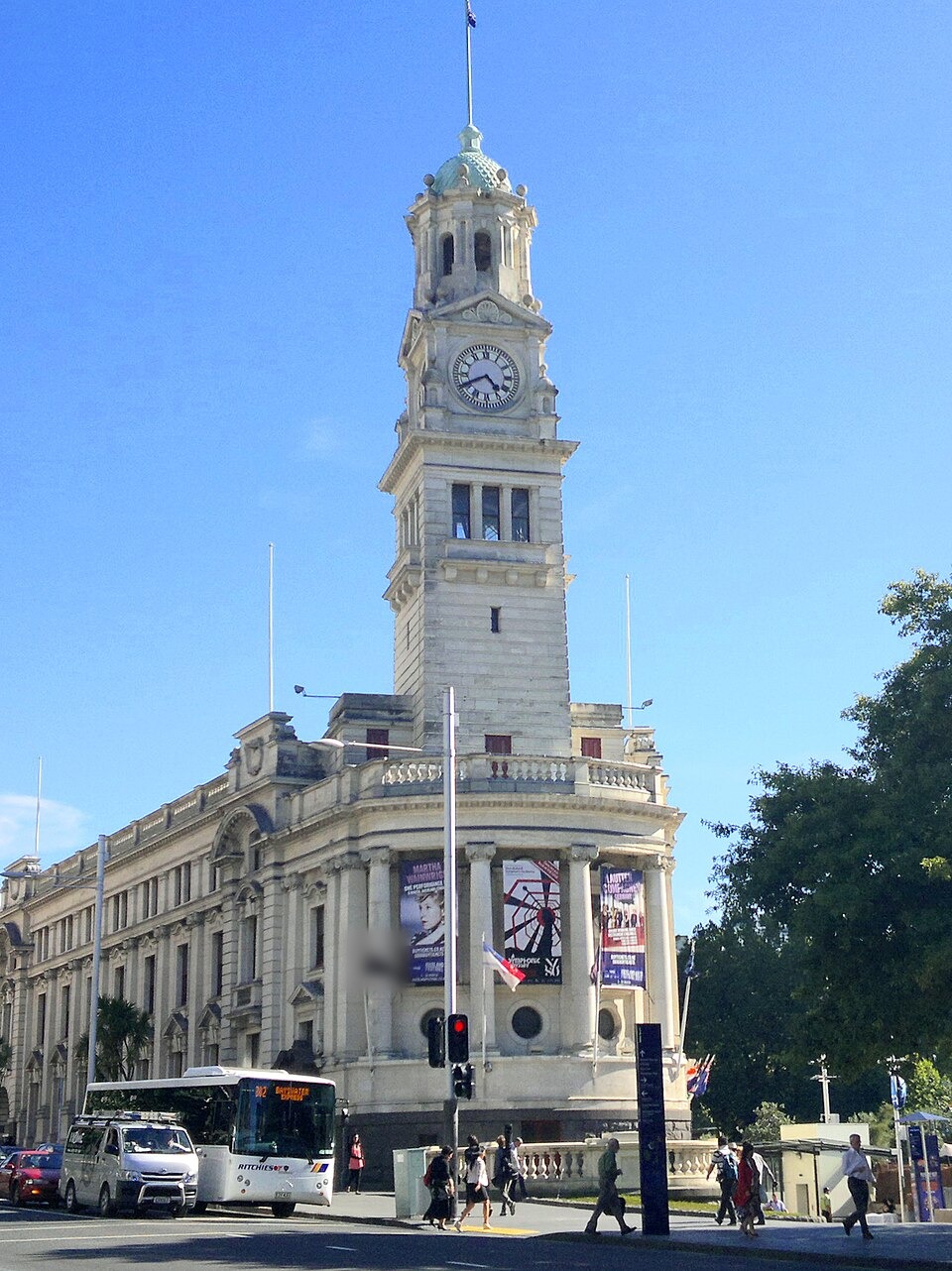
A formal Edwardian facade in a Renaissance Revival manner, fronting two distinct performance spaces set side by side inside, a Great Hall and a separate Concert Chamber.
The Auckland Town Hall is an Edwardian building completed in 1911 to designs by John James Clark, built in a Renaissance Revival style on the city's main street. It combines administrative offices with a Great Hall and a separate Concert Chamber, and continues to host council meetings and public hearings alongside performances. The building and its surrounding context are protected as a Category A heritage site in the local district plan and registered by Heritage New Zealand as a Category 1 historic place.
- Its heritage protection extends beyond the building itself to the streetscape around it.
- The architect, John James Clark, died only four years after the hall's completion.
Photo: ChewyPineapple (CC BY-SA 3.0 nz)
Auckland War Memorial Museum
1929–1950s · Grierson, Aimer and Draffin
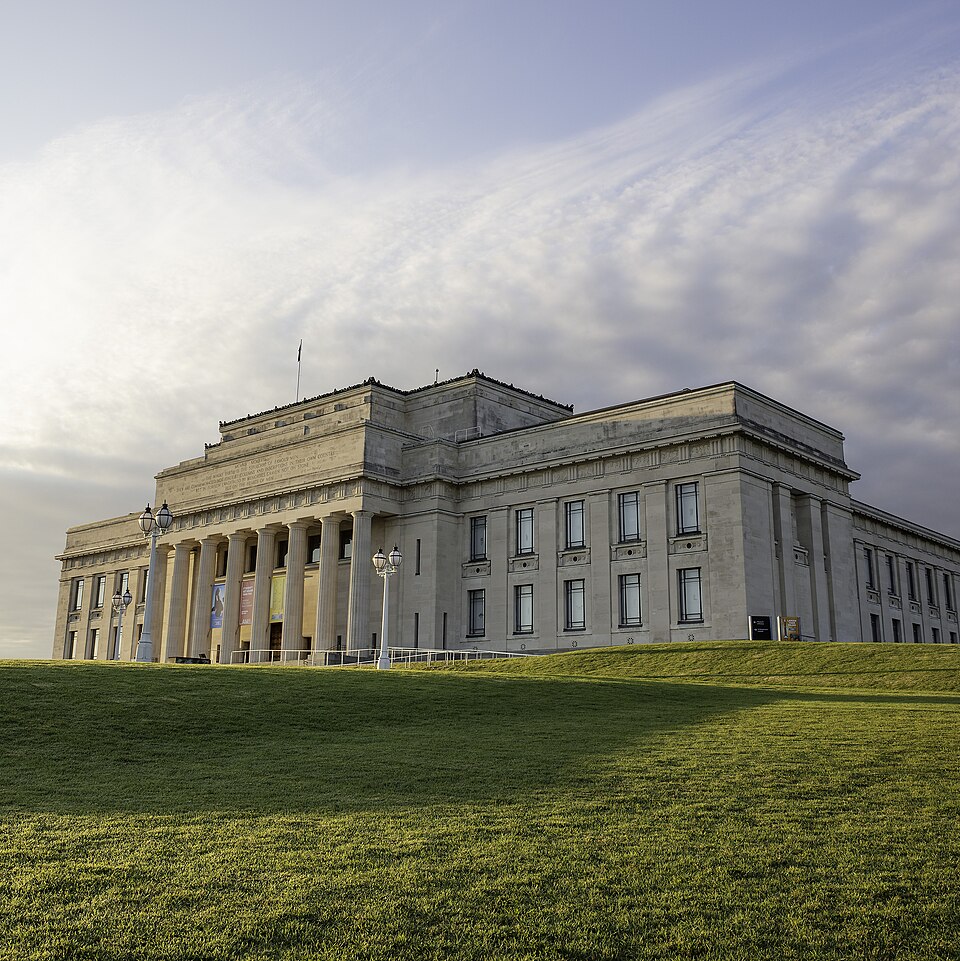
A neoclassical facade set on a hillside within a large park, with a later wing added decades after the original building opened, marking its expansion in the 1950s.
The Auckland War Memorial Museum, also known as Auckland Museum, is a neoclassical building on Observatory Hill, the remains of a dormant volcano within the Auckland Domain park. Designed by Grierson, Aimer and Draffin, it opened under this name in 1929 and was extended in the 1950s. It serves both as a war memorial and as a museum, with collections in New Zealand history, natural history and military history that trace back to 1852, when they were held by a predecessor institution later renamed Auckland Institute and Museum.
- Its collections trace back to 1852, seventy-seven years before the war memorial building itself opened.
- It stands on Observatory Hill, the remains of a dormant volcano.
- Its Māori name was changed to Te Papa Whakahiku for a period between 1991 and 2003.
Photo: Daan Hoffmann / Auckland War Memorial Museum Tāmaki Paenga Hira (CC BY 2.0)
Eden Park
A sports venue with a nominal capacity of 50,000, serving as New Zealand's national stadium for rugby union in winter and cricket in summer. The All Blacks have gone unbeaten there in 53 consecutive test matches since 1994.
Auckland Domain
A 75-hectare park in the suburb of Grafton, the oldest in the city, occupying the crater and tuff ring of the extinct Pukekawa volcano. The Auckland War Memorial Museum sits prominently on the crater rim, with the Domain Wintergardens' glasshouses nearby.
Auckland Art Gallery
The principal public art gallery in the country, established in 1888 as New Zealand's first permanent art gallery below Albert Park. It originally shared its building with the public library, opening with collections donated by Governor Sir George Grey and James Tannock Mackelvie.
Holy Trinity Cathedral
An Anglican cathedral in the suburb of Parnell, the mother church of the Anglican Diocese and seat of the Bishop. The current main church building was consecrated in 1973.
St Matthew-in-the-City
A historic Anglican church in the central business district, completed in 1905 and renowned for its Gothic Revival style. It was designed by English architect Frank L. Pearson.
Grafton Bridge
A reinforced-concrete road bridge over Grafton Gully, built in 1910 to connect the central business district with Grafton. At 97.6 metres, it contained the largest reinforced concrete arch in the world when it was constructed.
Aotea Square
A large paved public square in the central business district, officially opened in 1979 next to Queen Street. It hosts open-air concerts, markets and political rallies, and was substantially redeveloped in 2010 to hold crowds of up to 20,000.
SkyCity Auckland
An entertainment complex and casino hotel in the central business district, built at the base of the Sky Tower. It was the second casino in New Zealand, and remains the only one in Auckland.
Commercial Bay
A 41-floor mixed-use office tower and retail development, completed and opened on 27 July 2020, replacing the former Downtown Shopping Centre on the site. Rising 180.1 metres, it is the tallest building in New Zealand and the second-tallest structure in Auckland, after the Sky Tower.
Auckland High Court
A Gothic Revival courthouse in the central city, one of three locations nationwide used by the High Court of New Zealand. It is registered as a Category I heritage building by Heritage New Zealand.
Kelly Tarlton's Sea Life Aquarium
A public aquarium opened in 1985, the brainchild of marine archaeologist and diver Kelly Tarlton. Built inside disused sewage storage tanks, it pioneered curved acrylic viewing tunnels and was among the first aquariums to use moving walkways.
Museum of Transport and Technology
A transport and technology museum in Western Springs, known as MOTAT, established in 1960 and opened in 1964 to preserve trams and early New Zealand transport technology. It holds large collections of civilian and military aircraft and runs a working tramway linking its two sites.
New Zealand Maritime Museum
A maritime museum on Hobson Wharf, next to the Viaduct Harbour in the central city. Its exhibitions span the country's maritime history, from the first Polynesian explorers and settlers to the modern-day America's Cup.
Auckland Zoo
A 16.35-hectare not-for-profit wildlife conservation zoo next to Western Springs Park, opened in 1922. By 1930, it had built a sizeable animal collection, and a zoological society had formed around it.
Spark Arena
A multipurpose arena at Quay Park in Parnell, built as New Zealand's first large public-private partnership at a cost of about $94 million. Ratepayers contributed $68 million toward the project, and the venue's first concert, Rock Star Supernova, took place on 24 March 2007.
Stardome Observatory
A planetarium and observatory on Maungakiekie / One Tree Hill, offering immersive planetarium shows, telescope viewing and hands-on exhibits. It runs year-round Māori astronomy shows alongside a winter season of Matariki shows.
Chelsea Sugar Refinery
A sugar refinery on the northern shore of the Waitematā Harbour in Birkenhead, established in 1884 and still the country's main source of sugar products. It has one of the region's deepwater ports, importing raw sugar globally every six weeks.
Cornwall Park
Parkland in Epsom surrounding Maungakiekie Pā, or One Tree Hill, totalling 670 acres with heritage sites and a working farm. Mayor John Logan Campbell gave 230 acres to a trust in 1901, naming it after the Duke of Cornwall and York, later George V.
Pah Homestead
A historic homestead in the suburb of Hillsborough, within Monte Cecilia Park, now owned by the city council. It operates as an art gallery, housing the Arts House Trust's collection of New Zealand art.
Alberton
A 19th-century house in Mount Albert, listed by Heritage New Zealand as a Category I structure. It was built in the 1860s for Allan Kerr Taylor.
Western Springs Pumping Station
A pumping station built between 1875 and 1877 to supply Auckland's first public water system, with a twin beam engine housed in brick buildings. It remained in use until the late 1920s and was decommissioned in 1936, later becoming MOTAT's first buildings.
Auckland Hebrew Congregation
A Modern Orthodox synagogue on Remuera Road, tracing back to the Princes Street Synagogue founded in 1885. The congregation moved to a Greys Avenue building in 1968 and to a former girls' school campus in 2022, and now serves about 500 families.
Auckland Women's Suffrage Memorial
A public mural at Khartoum Place, on the stairs linking Kitchener and Lorne Streets to the Art Gallery. Designed by Jan Morrison and Claudia Pond Eyley for the centenary of women winning the vote, it is one of the country's few dedicated suffrage memorials.
History
Auckland was first settled around 1350 on a fertile volcanic isthmus, and its Māori population had grown to an estimated 20,000 by the time Europeans arrived. After Britain established a colony in New Zealand in 1840, Lieutenant-Governor William Hobson chose Auckland as the new capital, and the city's earliest surviving civic buildings date from the decades of growth that followed. The Auckland Town Hall, completed in 1911 in a Renaissance Revival style, and the Auckland War Memorial Museum, whose neoclassical building went up in phases between the 1920s and 1950s over a museum collection begun in 1852, both belong to this period of civic building in an Edwardian colonial capital. The Sky Tower, finished in 1997 as part of a casino complex, is the one landmark built after Auckland had grown into New Zealand's largest and most populous city.