Landmarks in Oslo
A medieval fortress, a neoclassical palace and a marble opera house line one fjord shore.
Oslo's principal landmarks sit within a short walk of one another around the inner Oslofjord. Akershus Fortress occupies a rocky spur guarding the harbour, its medieval stone bulk predating the rest of the centre by centuries. A few streets inland, the neoclassical Royal Palace closes the head of the city's main avenue, fronted by a square and backed by a park. Facing the water again, red-brick Oslo City Hall raises twin towers over the harbour front, finished at mid-century after a wartime pause. Newest of all, the Oslo Opera House meets the fjord directly in the Bjørvika district, its angled marble and granite surfaces built to look as though the structure is rising out of the water.
Akershus Fortress
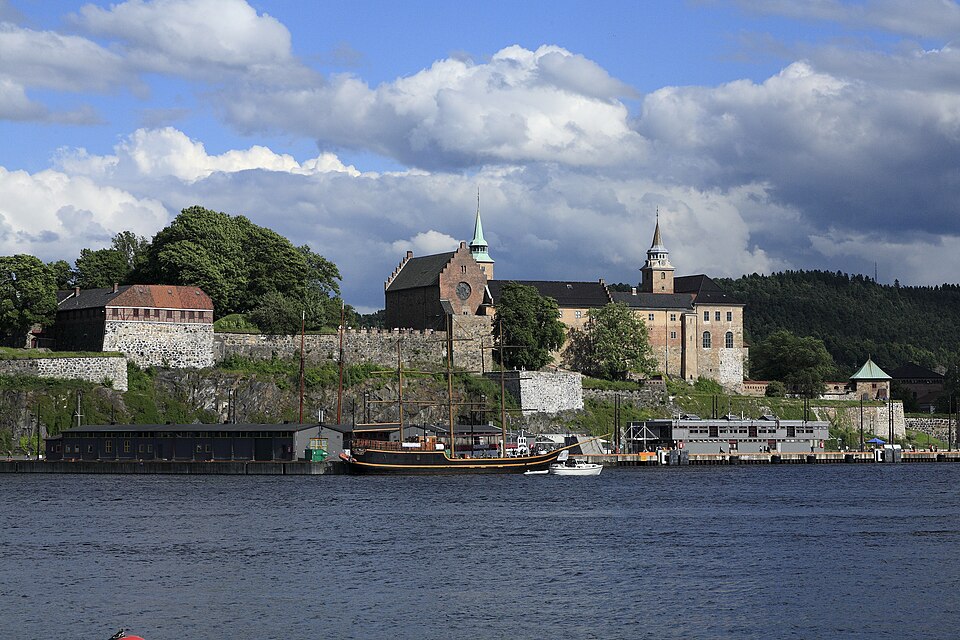
1299
Pale stone ramparts and a cluster of steep-roofed towers stand directly above the water on a rocky spur, a compact medieval bulk beside newer harbourside development.
Akershus Fortress rose on a promontory above the Oslofjord as a combined stronghold and royal residence, built to protect the young city and give its rulers a base overlooking the harbour. For centuries it lent its name to the surrounding county, one of Eastern Norway's four historic main regions, and remained the seat of a smaller sub-county until 1842 and of the larger county until 1919. Beyond its military role, the fortress has served as a prison, and its buildings now house the Norwegian prime minister's temporary office.
- It gave its name to one of Norway's four historic main regions, Akershus.
- Its buildings currently serve as the temporary office of the Norwegian prime minister.
Photo: Falk2 (CC BY-SA 4.0)
Royal Palace
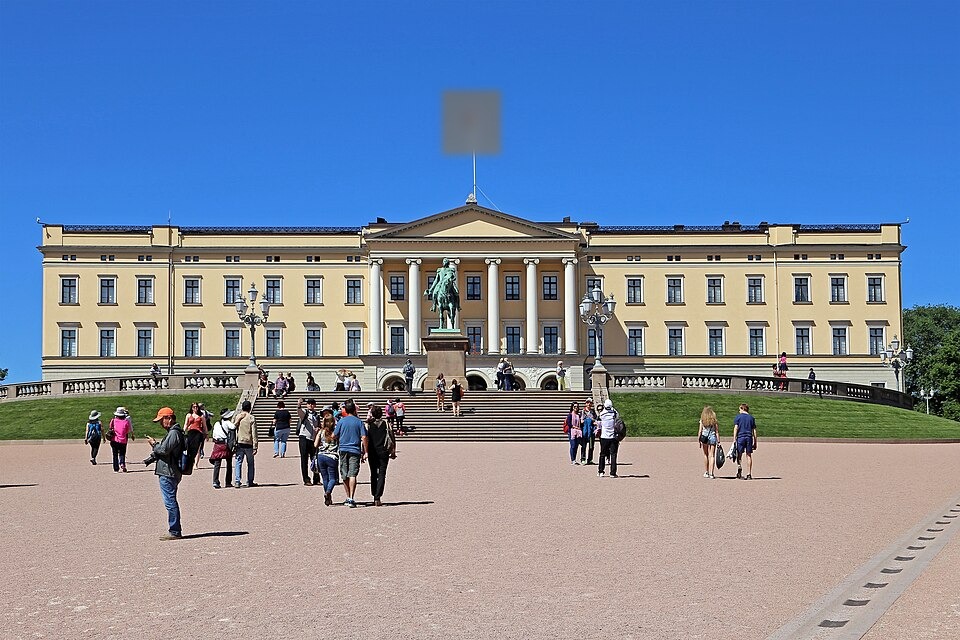
1849 · Hans Linstow
A symmetrical, colonnaded neoclassical block standing at the head of a long central avenue, an open square before its main front and a landscaped park spreading behind it.
The Royal Palace was built in the first half of the nineteenth century as the Norwegian residence of Charles XIV John, a French-born ruler who held the crowns of Norway and Sweden in personal union. Designed in the neoclassical style, it stands at the end of a long central avenue, fronted by an open square and backed by a landscaped park. It remains the working residence of the reigning monarch, while the crown prince's household is based at Skaugum, outside the city.
- It was built for a king born in France who reigned over two separate northern kingdoms at once.
- The reigning monarch lives here, but the crown prince's household is based elsewhere, at Skaugum.
Photo: W. Bulach (CC BY-SA 4.0)
Oslo Opera House
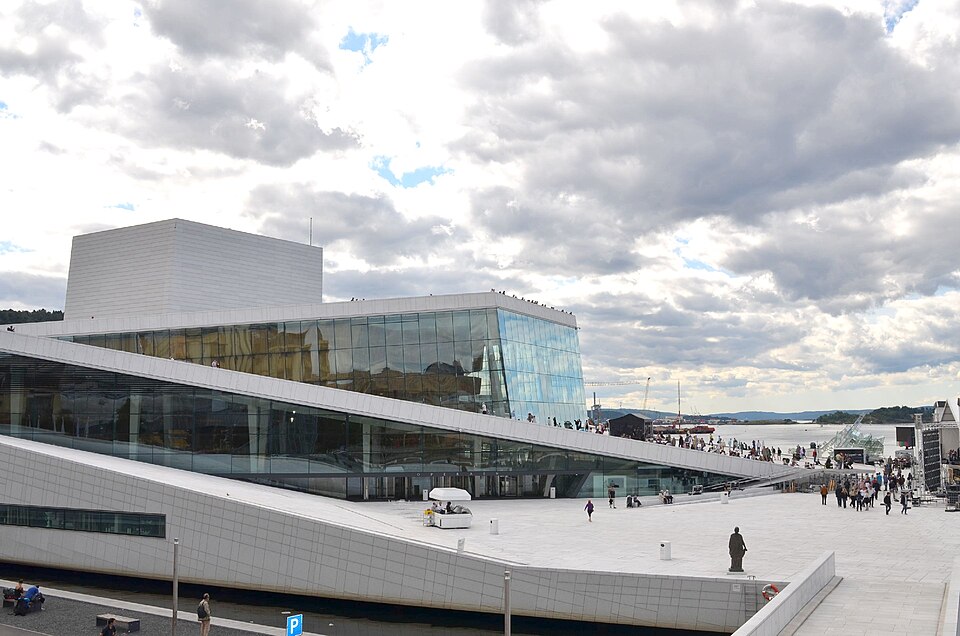
2008 · Snøhetta
Angled white surfaces faced in Carrara marble and granite slope up from the fjord's edge, giving the building a low, tilted silhouette that appears to emerge from the water itself.
Completed in 2008 to a design by the firm Snøhetta, the Oslo Opera House is home to the national opera and ballet companies and is the largest cultural building erected in Norway since Nidaros Cathedral was finished around 1300. Spread across 49,000 square metres, it holds 1,100 rooms, including a main auditorium seating 1,364 people alongside two smaller halls, plus a main stage 16 metres wide and 40 metres deep. A government property agency operates the building, sited at the head of the Oslofjord.
- Its exterior is faced in marble quarried at Carrara, in Italy.
- It is the largest cultural building raised in Norway since Nidaros Cathedral, finished around the year 1300.
Photo: Ignaz Wiradi (CC BY-SA 3.0)
Oslo City Hall
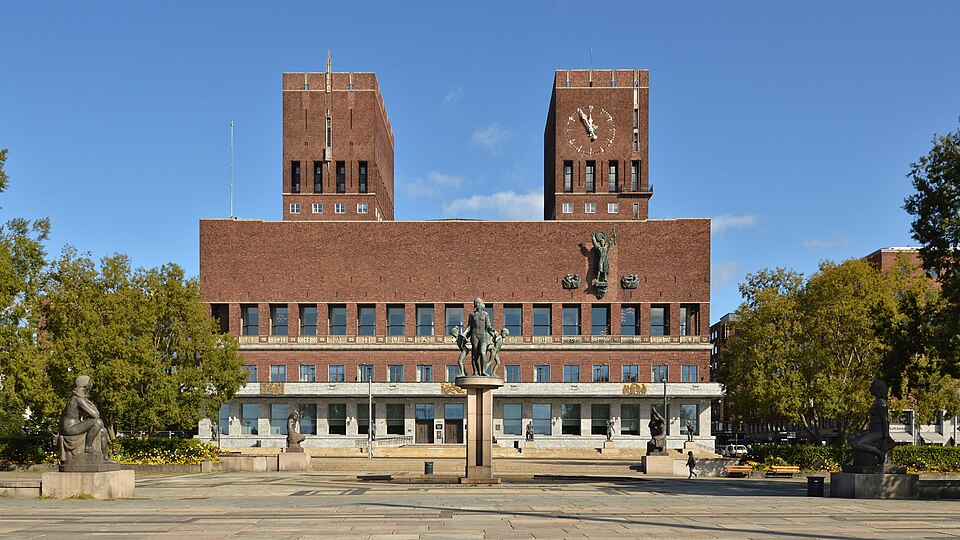
1931–1950 · Arnstein Arneberg and Magnus Poulsson
Two brick towers of slightly different heights, 63 and 66 metres, rise from a red-brick block on the harbour front, the taller one carrying a 49-bell carillon.
Oslo City Hall took nearly two decades to complete: construction began in 1931 and was halted for several years by the Second World War before finishing in 1950. Arnstein Arneberg and Magnus Poulsson designed the red-brick building, using oversized bricks made locally at Hovin Teglverk, closer in size to medieval brickwork than to standard bricks of the 1930s. It houses the city council and municipal administration and hosts the Nobel Peace Prize ceremony each December beneath its taller, carillon-fitted tower.
- It hosts the Nobel Peace Prize ceremony every December.
- Its bricks were made to a size closer to medieval brickwork than to standard bricks of its own era.
Photo: Ryan Hodnett (CC BY-SA 4.0)
Viking Ship Museum
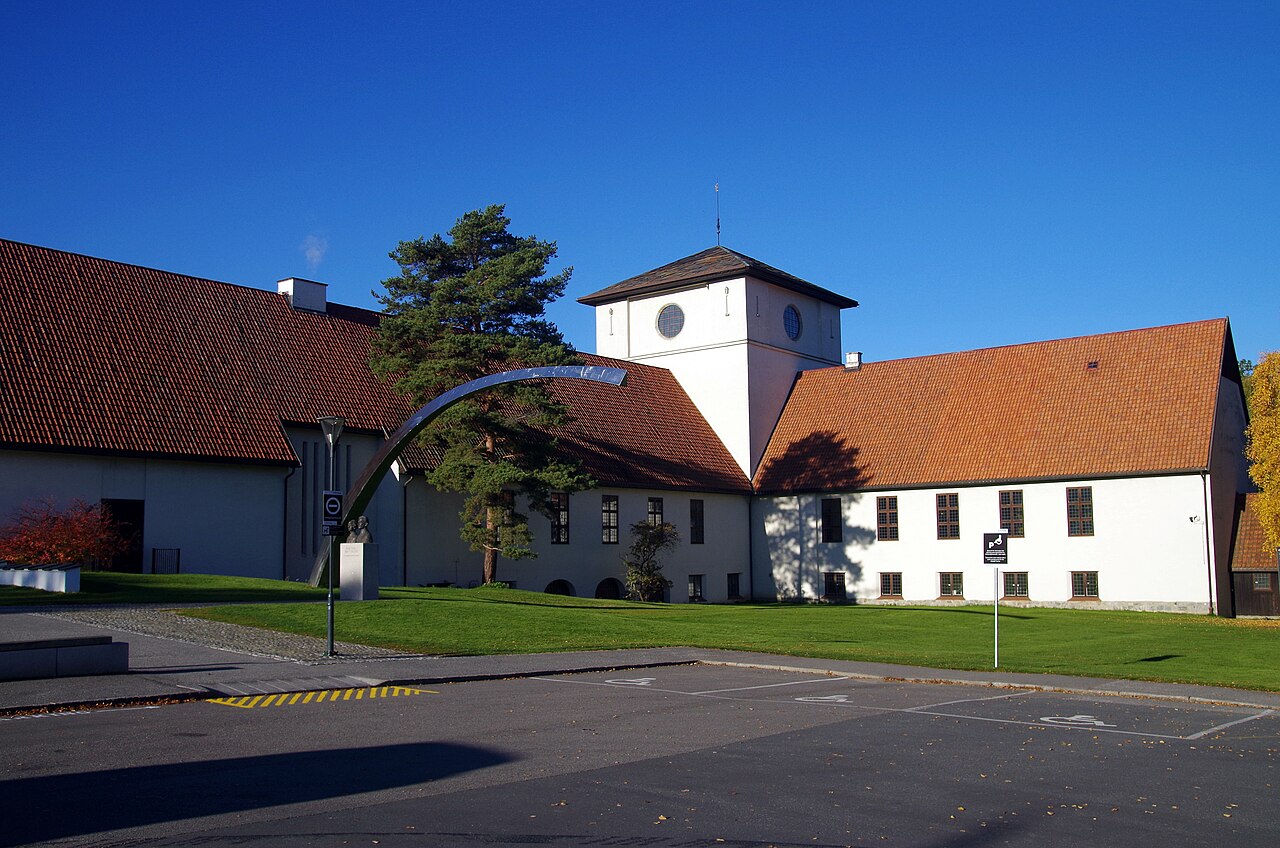
1926–1957 · Arnstein Arneberg
The complex has been closed since 2021 for an expansion project due to reopen in 2027; when open, its principal hall displays the intact hull of a ship recovered from the largest known ship burial ever excavated, alongside two further burial-ship halls built in stages during the twentieth century.
Arnstein Arneberg won a competition to design a home for Viking Age ships unearthed at Tune, Gokstad and Oseberg, with construction proceeding in stages: the hall for the intact Oseberg ship, from the largest known ship burial in the world, opened in 1926; halls for the Gokstad and Tune ships followed in 1932; a final hall delayed by the Second World War finished in 1957. The complex, part of the University of Oslo's Museum of Cultural History, has been closed since 2021 for an expansion designed by the Danish firm AART Architects, due to reopen in 2027.
- The Oseberg ship, displayed intact, comes from the largest known ship burial ever excavated.
- Construction of the final hall was delayed for years, partly by the Second World War, and only finished in 1957.
- The museum's 2016 extension design, by the Danish firm AART Architects, was named "NAUST".
Photo: Balou46 (CC BY-SA 4.0)
National Museum of Norway
An art, architecture and design museum holding the Norwegian state's public collection of over 400,000 works, including the first version of Edvard Munch's The Scream from 1893. Formed in 2003 by merging five earlier museums, it opened a new building at Vestbanehallen in 2022.
National Theatre
One of Norway's largest and most prominent venues for the performance of dramatic arts.
Norwegian Museum of Cultural History
A museum of cultural history on the Bygdøy peninsula, with extensive collections from all social groups and regions of the country. It incorporates an open-air museum of more than 150 relocated buildings, standing near the Viking Ship, Fram and Kon-Tiki museums.
Munch Museum
An art museum dedicated to Edvard Munch, first opened at Tøyen in 1963, a century after the artist's birth. It moved to a new building in Bjørvika in 2021 and has been marketed simply as MUNCH since 2020.
Frogner Park
The city's largest park, historically part of Frogner Manor and home to the Vigeland installation of sculptures by Gustav Vigeland. It also holds the manor house, now the Oslo Museum, and the country's largest rose collection, with 14,000 plants of 150 species.
Gol Stave Church
A 12th-century stave church originally built in Gol, in the Hallingdal region of Buskerud county. It was later reconstructed as a museum piece at the Norwegian Museum of Cultural History on Bygdøy.
Old Aker Church
A medieval-era church regarded as the oldest existing building in the city, and still an active parish today. It stands surrounded by the Old Aker Cemetery.
Ekebergparken Sculpture Park
A sculpture park and national heritage site at Ekeberg, covering 25.5 acres with panoramic views of the city. Initiated and financed by collector Christian Ringnes, it opened in September 2013 with 31 sculptures, many depicting women, and was fully established by February 2015.
Bygdøy Royal Estate
A royal estate and manor house occupying much of the northwestern Bygdøy peninsula. It serves as the official summer residence of the King of Norway.
Vigeland Museum
A museum dedicated to sculptor Gustav Vigeland (1869–1943), housed in his former studio and residence next to Frogner Park. His ashes rest in an urn he designed himself, placed in the museum's tower above his old apartment.
Cemetery of Our Saviour
A cemetery in the Gamle Aker district, created in 1808 in response to famine and cholera during the Napoleonic Wars and extended in 1911. Closed to new burials since 1952, it became a preferred cemetery of the bourgeoisie and includes Æreslunden, Norway's honorary burial ground.
Oscarshall
A small royal pleasure palace, or maison de plaisance, on the shore of the Frognerkilen fjord on Bygdøy.
Frogner Manor
A manor house and former estate whose grounds now form most of Frogner Park, with 18th-century buildings on site housing the Oslo City Museum. Once ecclesiastical property held mostly by Hovedøya Abbey, it was confiscated by the Crown in 1532, ahead of the Reformation.
Astrup Fearnley Museum of Modern Art
A privately owned contemporary art museum founded in 1993, with a collection focused on American appropriation artists of the 1980s. In 2012 it moved into two new buildings designed by Renzo Piano in Tjuvholmen.
Oslo Cathedral
The main church of the Diocese of Oslo, in a building dating from 1694 to 1697 and formerly known as Our Savior's Church. Used by the royal family for public events, it closed for renovation in 2006 and reopened in 2010.
St. Hallvard's Cathedral
A former cathedral that fell into disrepair in the 17th century and is now in ruins. Its site lies between Bispegata and St. Halvards gate.
Gjøa
A museum ship and the first vessel to transit the Northwest Passage, a three-year voyage completed in 1906. It was captained by Roald Amundsen with a crew of six.
Oslo Synagogue
An Orthodox Jewish synagogue in the St. Hanshaugen district, its congregation established in 1892 and its present building erected in 1920. Described as resembling a simple, charming country chapel, it was visited by King Harald V and Crown Prince Haakon in 2009.
Vestre gravlund
The largest cemetery in Norway at 60 acres, inaugurated in September 1902 in the Frogner borough. Its chapel, built in 1900 to a design by architect Alfred Christian Dahl, holds stained glass added in 1970 by artist Oddmund Kristiansen.
Chat Noir
A cabaret and revue theatre established in 1912 by Bokken Lasson. It is currently directed by Tom Sterri.
The Queen Sonja Art Stable
A museum, art gallery and concert hall housed in the former stables of the Royal Palace.
St. Hanshaugen Park
A large public park just north of downtown, within the borough that takes its name from it. It borders Geitmyrsveien, Colletts gate, Ullevålsveien and Knud Knudsens plass, near Bislett Stadium.
Carl Johan Theater
A theater initially located in the Christiania Tivoli amusement park from 1893 to 1895, staging works including Henrik Ibsen's Ghosts. It became a silent film cinema in 1914, later reopening as a renovated theater stage on 6 October 1931.
History
Oslo was founded near the end of the Viking Age, around 1040, and became a bishopric in 1070 and, around 1300, a royal capital under Haakon V, the period that produced Akershus Fortress on the fjord's edge. Long spells in personal union with Denmark reduced the city's independence, and in 1624 a fire destroyed the medieval settlement outright. King Christian IV had a new city built on the opposite shore, closer to the fortress for protection, and renamed it Christiania after himself, fixing the layout of today's centre. Oslo served again as a national capital during the 1814-1905 union with Sweden, the period behind the Royal Palace and the avenue leading to it. It became a formal municipality in 1838, was renamed Oslo in 1925, and absorbed the neighbouring municipality of Aker in 1948, after which its mid-century and contemporary landmarks followed.