Landmarks in Copenhagen
Fire, plague and an 1807 bombardment forced this low capital to keep rebuilding itself.
Copenhagen's principal landmarks cluster around the old royal core on Slotsholmen and the neighbouring district of Frederiksstaden, rather than spreading across the wider city. Successive building campaigns layered one fashion over another: Dutch Renaissance and early Baroque under a single seventeenth-century building king, then Rococo and Classical work a century and a half later when the crown laid out a purpose-built royal quarter of four matching palaces. Fires forced rebuilding more than once, and the seat of government has stood in three different forms on the same islet, while an eighteenth-century plague and an 1807 bombardment left their own mark. The result is a compact core where a seventeenth-century observatory tower, a spiral-staircase church, and royal residences of different centuries stand close together.
Rosenborg Castle
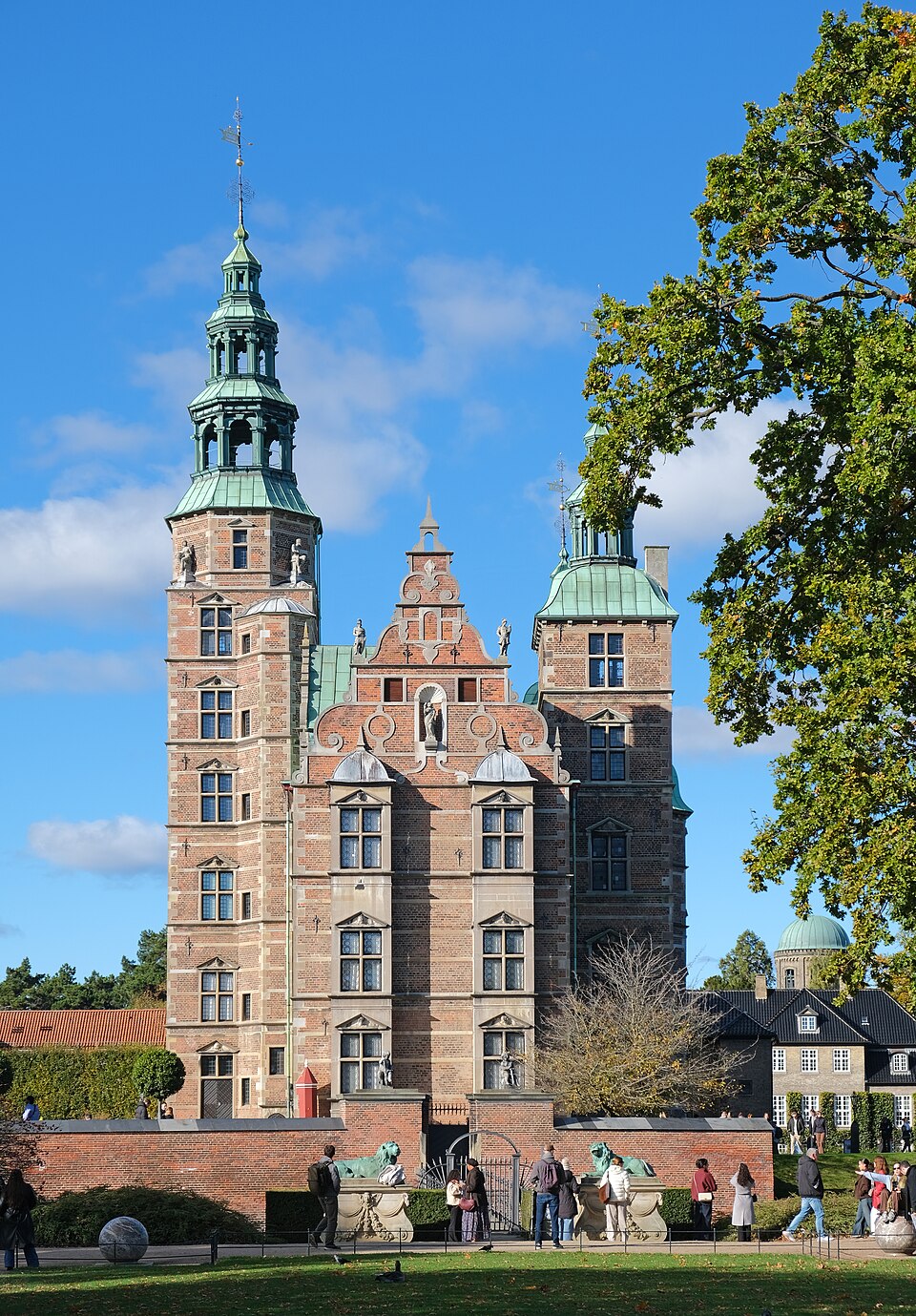
1624 · Hans van Steenwinckel the Younger
The uneven, additive massing — a summerhouse enlarged in stages across nearly two decades — gives it a layered silhouette in the ornamented Dutch Renaissance idiom, rather than the single symmetrical block of a palace built all at once.
Rosenborg began in 1606 as a country summerhouse for the Danish crown and was enlarged repeatedly until reaching its present form in 1624, built in the Dutch Renaissance style typical of the period. Hans van Steenwinckel the Younger, together with Bertel Lange, is credited with its structural planning. It later passed from royal residence to public collection and today operates as a museum.
- It took nearly two decades of expansion, from 1606 to 1624, to reach the form recognised today.
Photo: kallerna (CC BY-SA 4.0)
Amalienborg
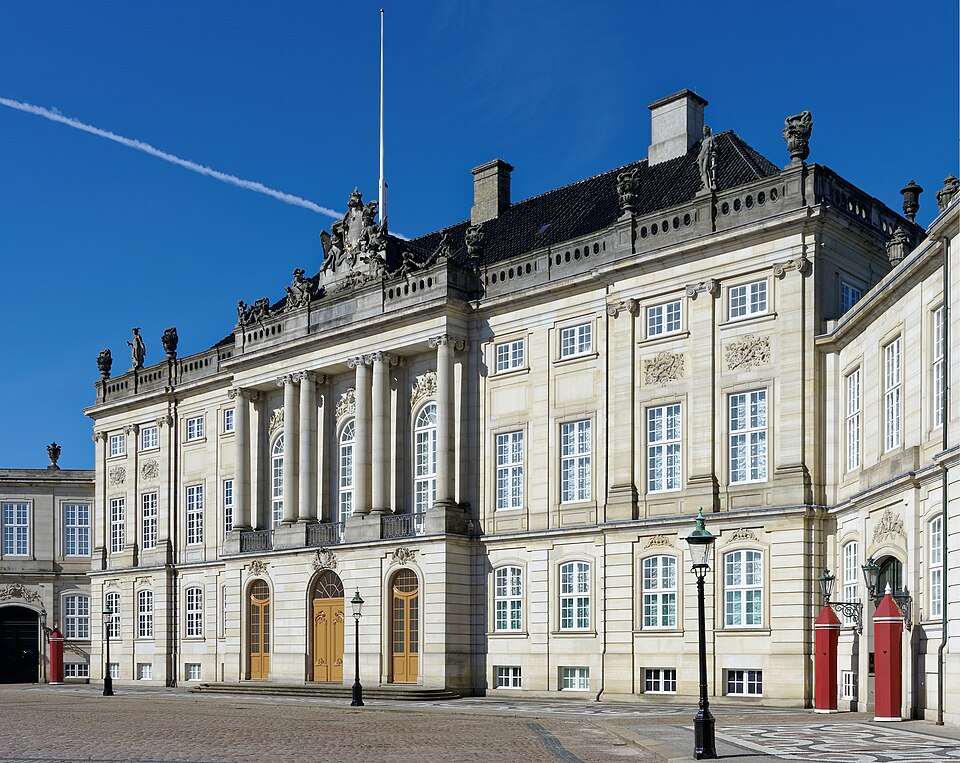
1760 · Nicolai Eigtved
The complex reads as four matching Classical façades set around an octagonal square, with a large equestrian statue of Frederick V rising from the centre — a set of paired palace fronts rather than one single building.
Amalienborg comprises four identical Classical palace fronts with Rococo interiors, built from 1760 for four noble families and arranged around an octagonal square centred on an equestrian statue of Frederick V. Nicolai Eigtved is credited as its architect. After Christiansborg Palace burned down in 1794, the royal family bought the complex and moved in; various monarchs and their families have lived there since, including today's King Frederik X and Queen Mary.
- It was originally built as private residences for four noble families, not for royalty.
Photo: Jakub Hałun (CC BY-SA 4.0)
Christiansborg Palace
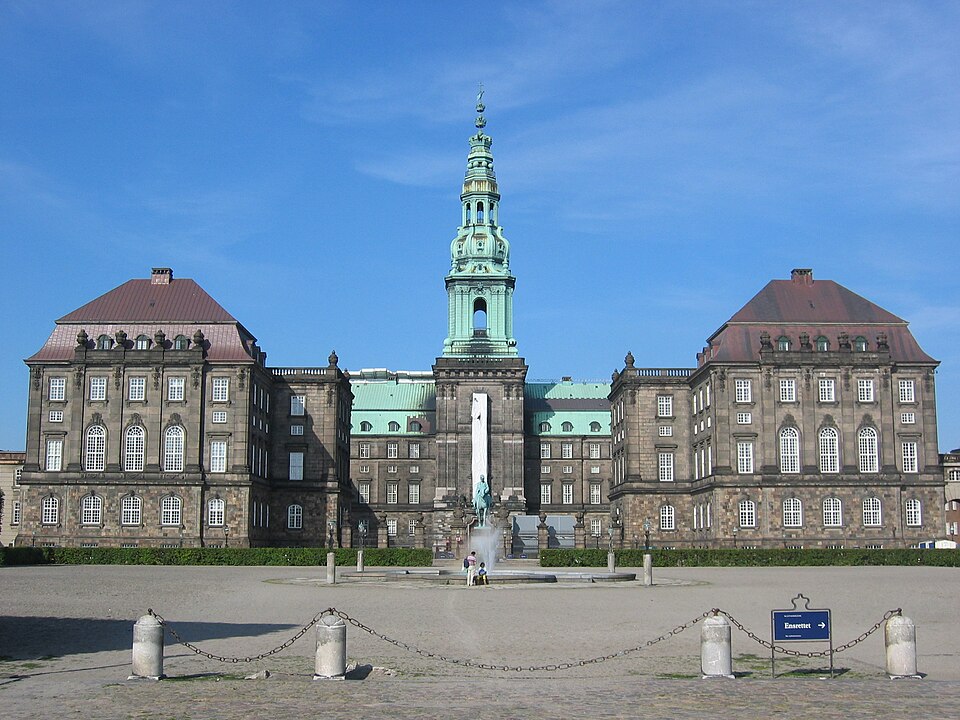
1928
Built as the third palace on the same site after two major fires, it combines three distinct eras of architecture in one building and occupies its own islet, Slotsholmen, separated from the surrounding old town.
The current Christiansborg is the third palace on the islet of Slotsholmen, following two fires that destroyed its predecessors; a castle has stood on the site since 1167. It now houses the Danish Parliament, the Prime Minister's Office and the Supreme Court, making it the only building anywhere that combines a country's executive, legislative and judicial powers, while the monarch retains the Royal Reception Rooms, the Palace Chapel and the Royal Stables within it.
- A castle has stood on this site since 1167, more than 850 years before the present building.
- It is the only building in the world that houses a country's executive, legislative and judicial powers together.
- It is colloquially known simply as Borgen, 'the castle'.
Photo: eimoberg from Changwon, South Korea (CC BY 2.0)
Church of Our Saviour
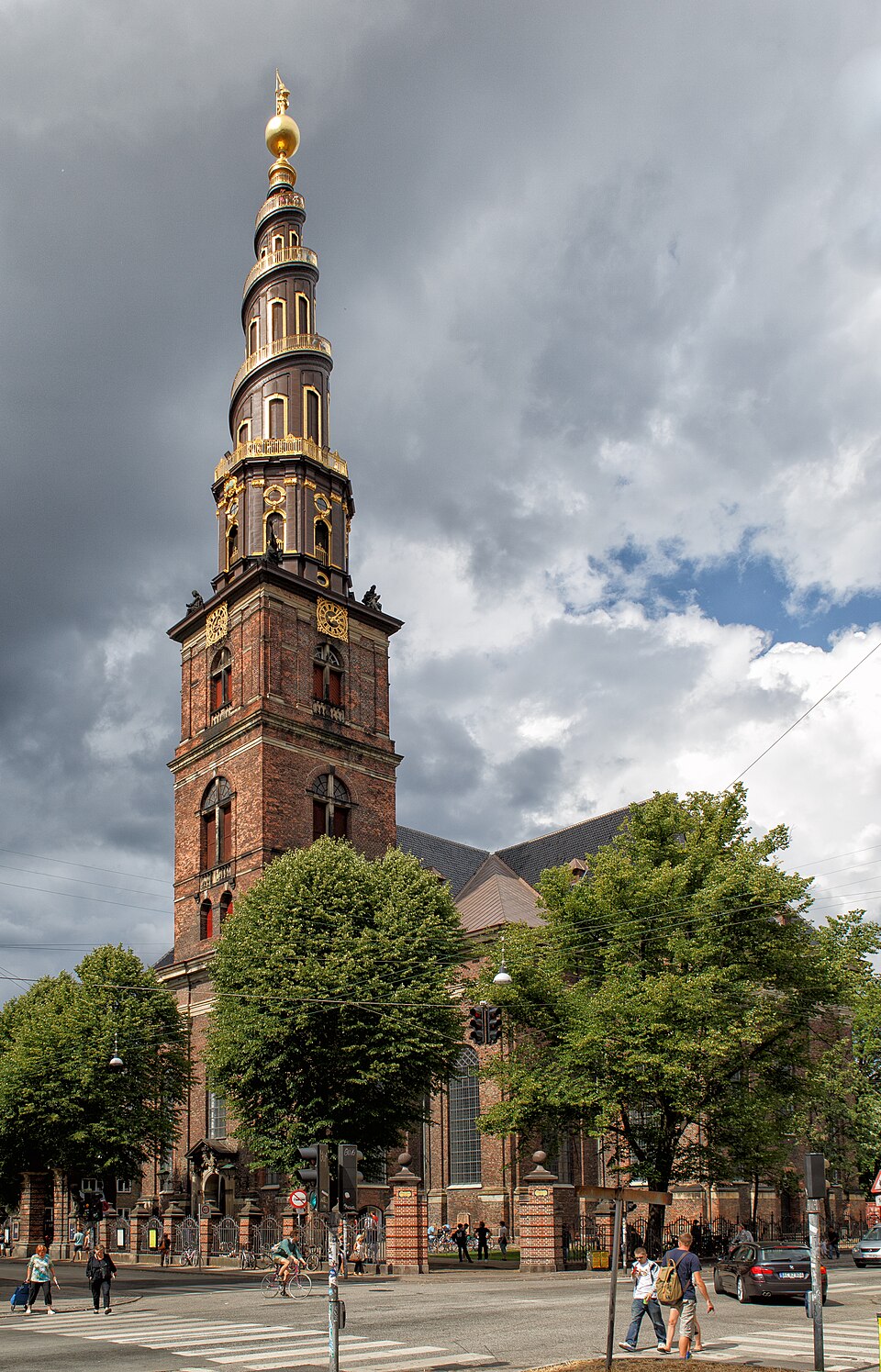
1695 · Lambert van Haven
Its most distinctive feature is the external spiral staircase that winds up around the outside of the tower to the top, rather than being enclosed within it; the tower's carillon also plays melodies every hour between 8 am and midnight.
Completed in 1695 in the baroque style, the Church of Our Saviour was designed by Lambert van Haven, who died the same year it was finished. It is best known for the external spiral staircase that winds around its tower and can be climbed to a platform with views over central Copenhagen, and for a carillon that rings out melodies every hour between 8 am and midnight.
- Its architect, Lambert van Haven, died in 1695, the same year the church was completed.
Photo: Avda (CC BY-SA 3.0)
Round Tower
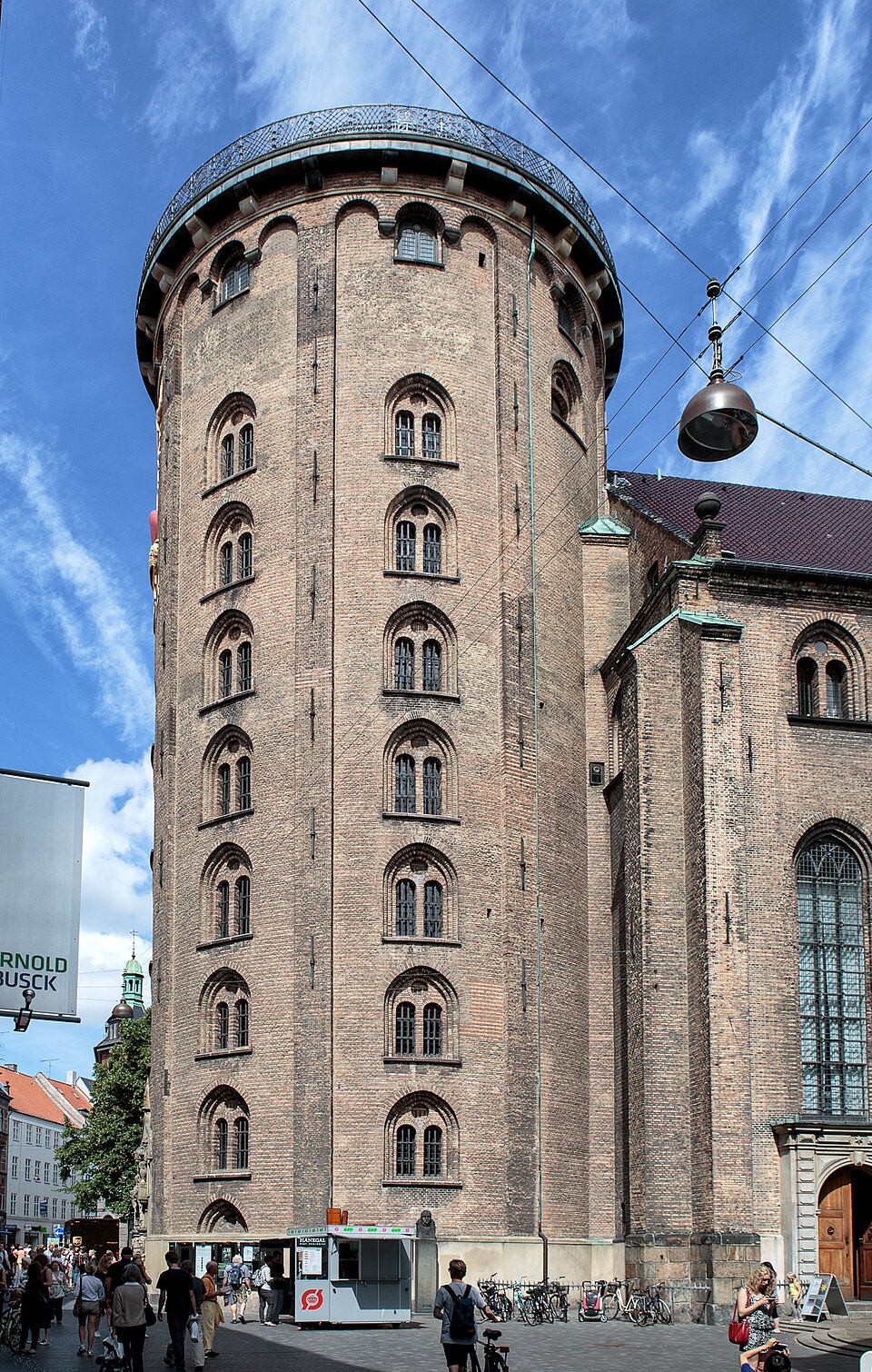
1642 · Hans van Steenwinckel the Younger
Inside, a 7.5-turn helical ramp — not stairs — spirals up to a platform 34.8 metres above the ground; the tower adjoins a chapel, a church, and an academic library as part of a single shared complex.
The Round Tower was completed in 1642 as an astronomical observatory, one of several architectural projects commissioned by Christian IV. Hans van Steenwinckel the Younger, credited as its architect, died three years before the tower was finished. In place of stairs, a 7.5-turn helical ramp, the equestrian staircase, leads to a platform 34.8 metres above ground. The tower forms part of the Trinitatis Complex, which also includes a chapel, a church, and an academic library founded in 1482.
- Its architect died three years before the tower he designed was completed.
- The academic library it adjoins traces back to 1482, making that institution older than the tower by 160 years.
Photo: Avda (CC BY-SA 3.0)
Børsen
A 17th-century commodity exchange built under Christian IV between 1619 and 1640, beside Christiansborg Palace on Slotsholmen. Its spire, twisted from the tails of four dragons and rising 56 meters, toppled when fire severely damaged the building on 16 April 2024.
Church of Our Lady
Copenhagen's Lutheran cathedral, standing on Frue Plads next to the University of Copenhagen's historic main building. The present Neoclassical structure was designed by architect Christian Frederik Hansen and completed in 1829.
Nikolaj Church
A contemporary arts center occupying the former St. Nicholas Church, one of the city's oldest churches, near Amagertorv and Strøget. Its fanciful Neo-Baroque spire runs 90 meters long and is the third-tallest in Copenhagen.
Rosenborg Castle Gardens
The oldest and most visited park in central Copenhagen, laid out in the early 17th century as the private grounds of King Christian IV's Rosenborg Castle. It also holds Rosenborg Barracks, home to the Royal Guards, along with numerous statues and monuments.
Trinitatis Church
One of Denmark's best examples of Gothic Survival architecture, part of the 17th-century Trinitatis Complex alongside the Round Tower and the university library. Originally serving Copenhagen University's students, its interior was badly damaged by fire in 1728 and rebuilt by 1731.
Moltke Mansion
A Baroque town mansion at the corner of Bredgade and Dronningens Tværgade, built for Ulrik Frederik Gyldenløve between 1700 and 1702, predating the surrounding Frederiksstaden district. Renamed after Adam Wilhelm Moltke acquired it in 1842, it features sandstone reliefs of elephants and lion heads.
Royal Library
Denmark's national library and the academic library of the University of Copenhagen, among the largest in the Nordic countries. It holds a copy of nearly every work printed in the country since the 17th century, including Danish books back to 1482.
History
Copenhagen grew from a Viking-era fishing village near Gammel Strand into Denmark's capital in the early 15th century, then into the seat of the Kalmar Union's monarchy during the 16th, when it flourished as Scandinavia's cultural and economic centre. Christian IV's building campaigns in the early 17th century gave the city an observatory tower and a country palace inside its walls. Plague and fires scarred the 18th century, prompting the crown to lay out the prestigious Frederiksstaden district and its four matching palaces, alongside new institutions such as the Royal Theatre and the Royal Academy of Fine Arts; the same period saw the city become the centre of the Danish slave trade. The old seat of government, damaged repeatedly by fire, was rebuilt for a third time in the early 20th century, while the city itself was bombarded in 1807.