Landmarks in Tallinn
A hilltop castle, a Gothic town hall and a soaring church spire share one walled old town.
Landmarks here split across two levels of a walled old town. On Toompea hill stands a castle first raised after a thirteenth-century conquest, its halls now given over to a national parliament. Below, around the medieval market square, a two-storey Gothic town hall reached its present form by 1404, its spire carrying a weather vane fixed there since 1530; nearby, a Gothic church tower climbs to almost 124 metres, tallest of its kind in the country, tracing its congregation back to a community of merchants. Closer to the hill, a domed cathedral in the Russian Revival style, raised at the very end of the nineteenth century under a since-departed imperial power, adds a fifth, later layer of building to the skyline.
Toompea Castle
1219
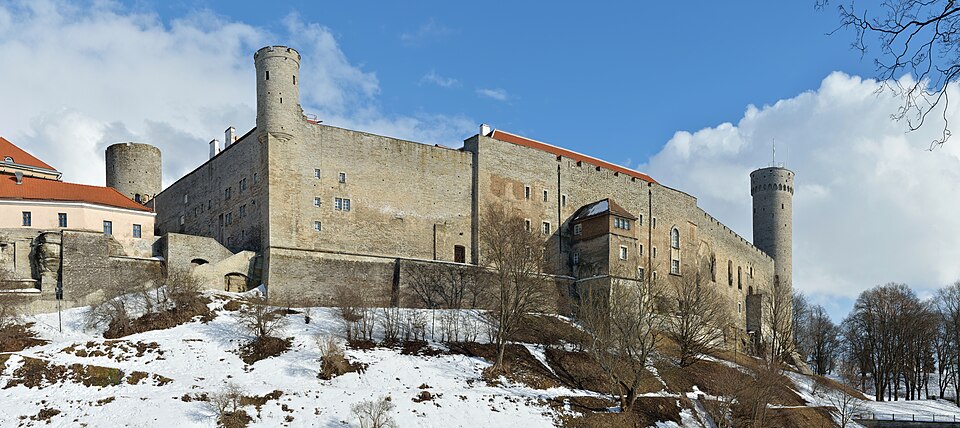
A castle occupying the flat summit of a hill above the surrounding old town, its historic stone walls enclosing a modern legislative chamber rather than standing empty as a ruin.
A medieval castle on Toompea hill in central Tallinn, its origins tied to a Danish conquest of the area in 1219, part of the wider Northern Crusades that brought Christianity to one of the last pagan regions left in Europe. It changed hands repeatedly under the succession of foreign powers that ruled the city over the following centuries. It no longer serves any defensive purpose: its halls today house the Riigikogu, Estonia's parliament, making it one of the few medieval castles anywhere still occupied by a sitting legislature.
Photo: Ivar Leidus (CC BY-SA 3.0 ee)
Alexander Nevsky Cathedral
1894–1900 · Mikhail Preobrazhensky
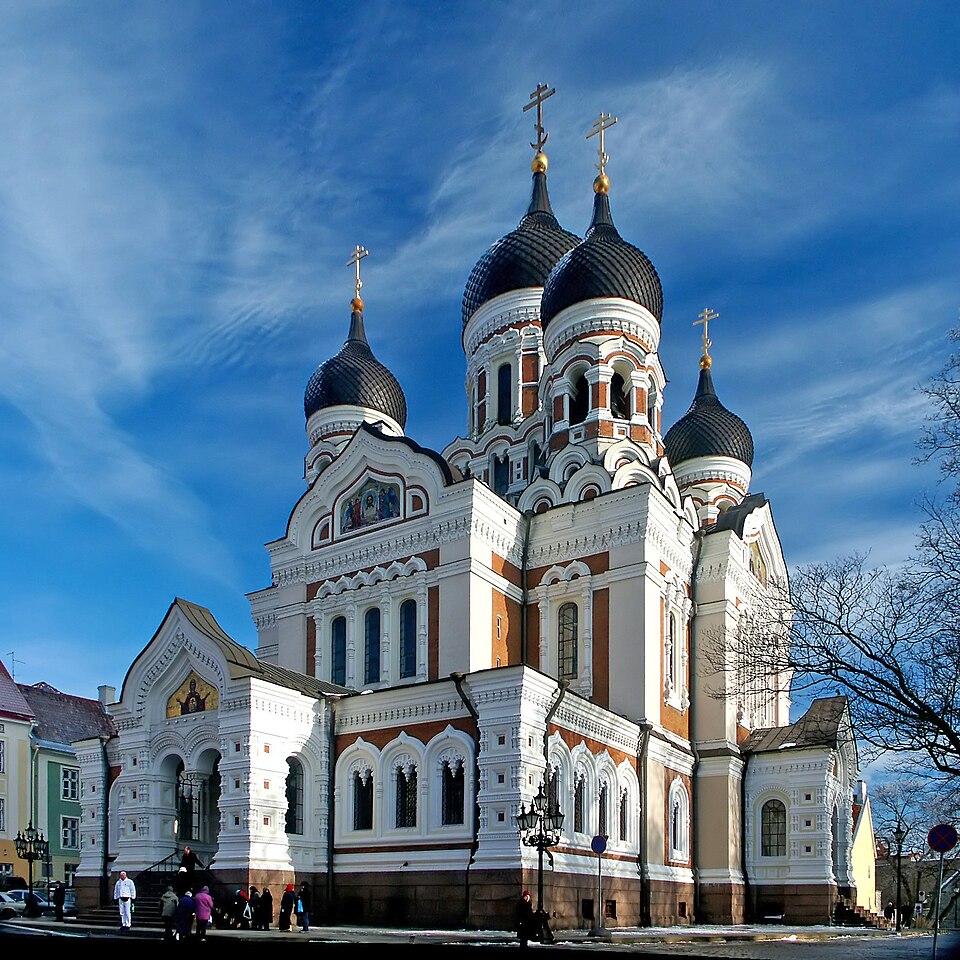
A cathedral in the Russian Revival style crowned with a cluster of cupolas larger than that of any other church in the city, its ornamented, domed profile standing apart from the plainer Gothic stonework nearby.
An Eastern Orthodox cathedral built in 1894–1900 in central Tallinn, while Estonia lay within the Russian Empire, to a design by Mikhail Preobrazhensky in the Russian Revival style. It remains the city's largest cupola church and serves as the primary cathedral of the semi-autonomous Estonian Orthodox Church under the Moscow Patriarchate. The future Patriarch Alexy II of Moscow, who lived from 1929 to 2008, began his priestly ministry within its walls before later rising to lead the Russian Orthodox Church.
- The future Patriarch Alexy II of Moscow began his priestly ministry there.
- It is the largest cupola church in the city.
Photo: Georg Mittenecker, perspektivisch entzerrt von User:Ikiwaner (CC BY-SA 2.5)
Tallinn Town Hall
1404
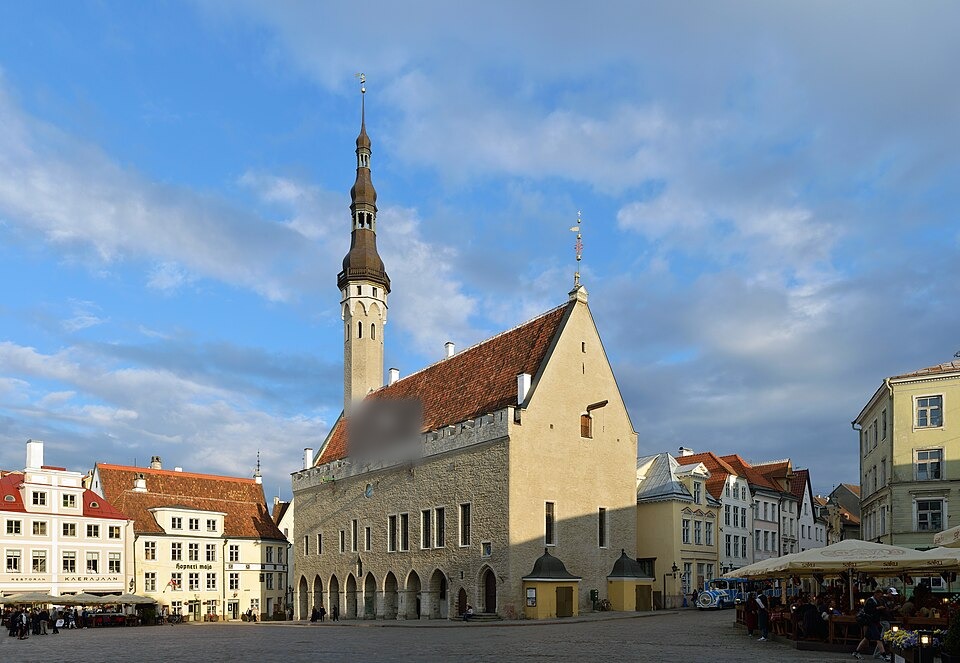
A long, two-storey Gothic building with an arcaded façade facing directly onto an open market square, a slender 64-metre spire rising from one end and topped by a weather vane figure in place since 1530.
A two-storey Gothic building on the south side of Tallinn's Old Town market square, 36.8 metres long with an arcaded ground floor and a spacious basement below. The square reached its current size in the 1370s, the hall gained a board roof in 1374, and the building had taken its present form by 1404. Its 64-metre spire carries the weather vane known as Old Thomas, in place since 1530 and long counted among the city's best-known symbols. It is the oldest town hall of its kind still standing anywhere in the Baltic Sea region and Scandinavia.
- The weather vane on its spire, known as Old Thomas, has stood there since 1530.
- It is the oldest surviving town hall building in the whole Baltic Sea region and Scandinavia.
- One of the city's shortest streets runs directly behind the building.
Photo: Ivar Leidus (CC BY-SA 3.0 ee)
St. Olaf's Church
1267
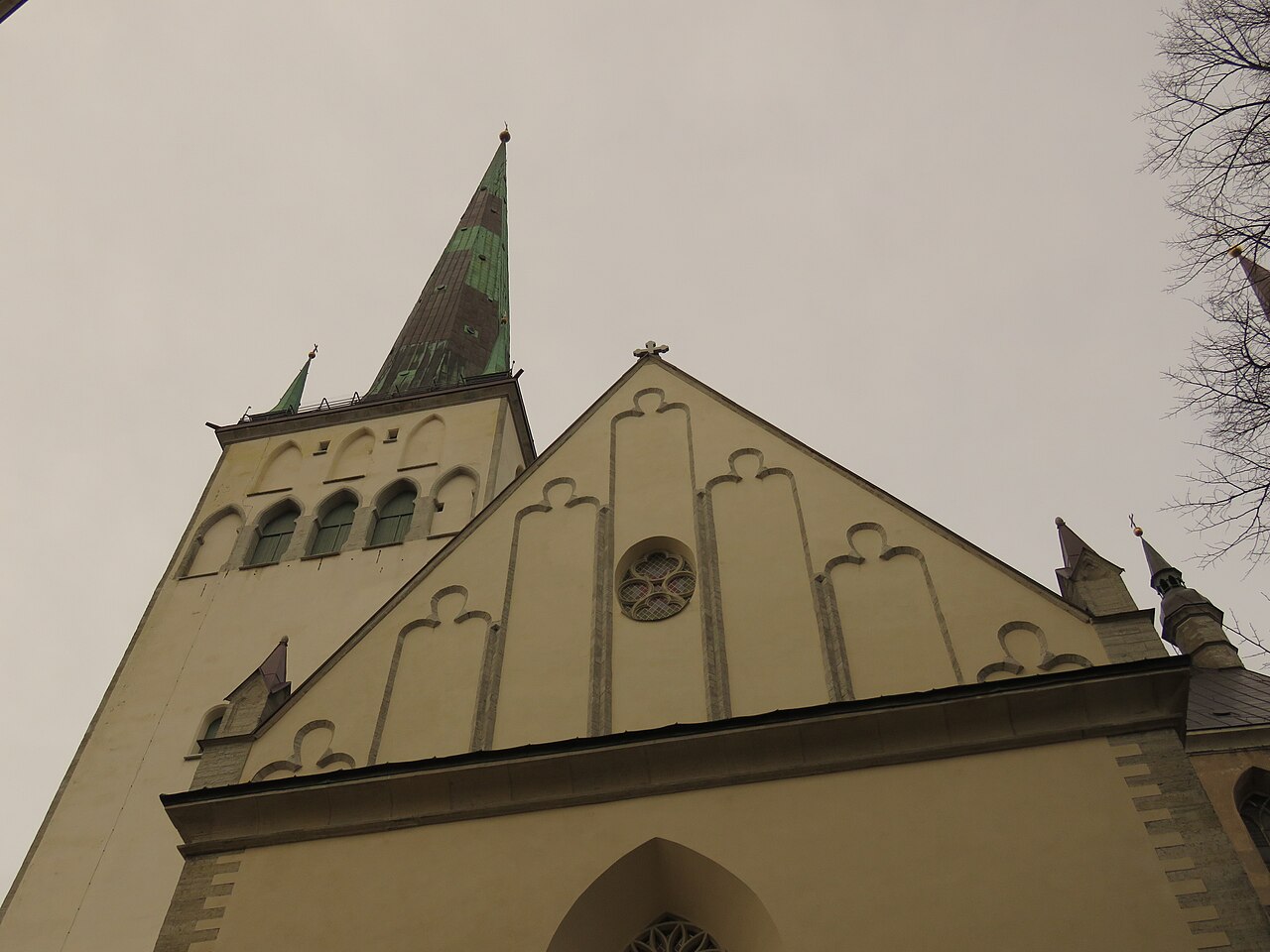
A tall Gothic church with a slender, needle-like spire rising to nearly 124 metres above the surrounding rooftops, its silhouette visible across the old town, with a public viewing platform partway up the tower at 60 metres.
A church in central Tallinn built in the Gothic style, originally Roman Catholic, then Lutheran after the Reformation, and today home to a Baptist congregation. At 123.7 metres it is the tallest church building in Estonia, with an observation platform set into its tower at a height of 60 metres. It takes its name from Olav II Haraldsson, a Norwegian king canonised as Saint Olaf and venerated as a patron saint of seafarers. A church is assumed to have stood on the same site before the 12th century, built by a community of merchants, predating the structure that stands today.
- It has served three different congregations in turn: Catholic, then Lutheran, then Baptist.
- Its namesake, a canonised Norwegian king, is venerated as a patron saint of seafarers.
Photo: Olga Itenberg (CC BY 2.0)
St. Nicholas Church
A medieval church built in the 13th century and dedicated to Saint Nicholas, patron of fishermen and sailors, turned Lutheran during the 1520s Reformation. Partly destroyed in Soviet bombing in World War II, it now houses the Niguliste Museum of ecclesiastical art and hosts concerts.
St. Mary's Cathedral
A Lutheran cathedral on Toompea hill, established in the 13th century as Estonia's oldest church and the only Toompea building to survive a 17th-century fire. Originally Roman Catholic after Denmark's conquest of northern Estonia, it became Lutheran in 1561 and seats the Archbishop of Tallinn.
Church of the Holy Spirit
A medieval Lutheran church in the Old Town, standing behind Raekoja plats, the Town Hall Square. It faces the Great Guild and Maiasmokk, Tallinn's oldest café.
Gatehouse of the Viru Gate
A defensive structure built in the 14th century as part of the Tallinn city wall, its two surviving watchtowers often mistaken for the original Viru Gate. That original gate, once known as Savivärav or the Narva Gate, was demolished in 1842 during the city's expansion.
Kadriorg Palace
An 18th-century Petrine Baroque palace built between 1718 and 1725 to Nicola Michetti's designs by Gaetano Chiaveri and Mikhail Zemtsov. It now houses the Kadriorg Art Museum, displaying foreign art from the 16th to 20th centuries, near the Kumu branch of Estonian art.
Estonia Theatre
A Jugendstil landmark designed by Finnish architects Armas Lindgren and Wivi Lönn, built from 1911 to 1913 and opened in 1913 as the largest building in Tallinn. It houses the Estonian National Opera and hosted the Estonian Constituent Assembly in April 1919, after 1918 independence.
St. John's Church
A large Lutheran parish church dedicated to Saint John the Evangelist. Construction began in 1862 and the church opened in 1867.
Stenbock House
A prominent neo-classical building on Toompea hill, the official seat of the Government of Estonia.
Kumu
One of the largest art museums in Northern Europe, and a branch of the Art Museum of Estonia. Its collection spans Estonian art from the 18th century, including Socialist Realist and Nonconformist work, and it won the European Museum of the Year Award in 2008.
Seaplane Harbour
A maritime museum that opened in spring 2012 inside a hangar originally built for seaplanes at Peter the Great's Naval Fortress. The 8,000-square-metre hall, disused since Soviet times, was renovated from 2010 with 70 percent of funding from the European Regional Development Fund.
Raeapteek
A pharmacy opposite the Tallinn Town Hall, in continuous operation in the same building since the early 15th century, among the oldest in Europe. It is also Tallinn's oldest commercial enterprise and oldest medical establishment, first pictured in an 1800 painting by Gustav Adolph Oldekop.
Linnahall
A semi-abandoned multipurpose venue in the harbour beyond the Old Town walls, completed in 1980 as the V. I. Lenin Palace of Culture and Sports. It also includes a heliport and a small seaport.
Patarei Prison
A former sea fortress in Kalamaja district, built from 1830 to 1837 on the order of Emperor Nicholas I and later converted to barracks in 1864. After Estonian independence in 1918, it was reconstructed as a prison in 1919 and operated as one until 2005.
Freedom Square
A plaza at the southern end of the Old Town, used for state functions and concerts and bounded to the east by St. John's Church. Its western edge holds a 2009 Victory Column commemorating the Estonian War of Independence of 1918–1920.
St. Peter and St. Paul's Cathedral
The cathedral church of the Roman Catholic Diocese of Tallinn, on Vene Street in the Old Town.
Tallinn Synagogue
An ultramodern, privately funded synagogue in central Tallinn, inaugurated in 2007 as the first to open in Estonia since World War II. Seating 180, with room for up to 230 at concerts, it is named Beit Bella after Bella Barskaya, wife of economist Mihhail Bronštein.
Estonian Knighthood House
A building on Toompea's Kiriku plats, or Dome Square, in the historic upper town of Tallinn. The Dome Church stands on the same square.
Estonian Drama Theatre
A repertory theatre in a historic building in central Tallinn, established in 1920 and often called Estonia's unofficial national drama theatre. Its permanent troupe of more than 30 actors stages over 20 productions each season, including 10 to 12 new premieres a year.
Linda
A monument by sculptor August Weizenberg, completed in 1920 and standing on Linda Hill. It is officially registered as cultural heritage.
Tallinn TV Tower
A 313-metre free-standing tower near Pirita, built for the 1980 Moscow Olympics sailing regatta and opened on 11 July 1980. Its 170-metre viewing platform closed for renovation in 2007 and reopened to visitors in 2012; it is the tallest nonbuilding structure in Tallinn.
Tallinn Power Plant
A former power plant designed by Volta and architect Hans Schmidt, opened on 24 March 1913 on the site of the former Stuart fortress. Originally coal-fired, it switched to peat and wood in 1919–1920 and to oil shale in 1924.
Song Festival Grounds
The grounds where the Estonian Song Festival, Laulupidu, is held every five years.
Estonian Maritime Museum
A maritime museum housed in the Fat Margaret tower in Old Town, presenting the history of ships and navigation in Estonia. Its other branches include a mine museum and the Seaplane Harbour, and it claims to be one of Estonia's largest and most popular museums.
History
Human settlement here reaches back nearly five thousand years, but the built city's recorded history starts with the Northern Crusades: a Danish raid in 1219 was followed by the granting of Lübeck city rights in 1248, converting one of the last pagan populations left in Europe. A stronghold on Toompea hill followed the conquest and was rebuilt over the centuries into the castle occupied today. In the market square below, a stone town hall was under construction by the 1370s and had taken its lasting form by 1404, the oldest of its kind still standing in the region. A church tied to a merchant community, later named for a canonised Norwegian king, is thought to have had a predecessor on the site before the 12th century. Centuries after, Russian rule added the domed Alexander Nevsky Cathedral, built in 1894–1900 by Mikhail Preobrazhensky.