Landmarks in Hong Kong
Brick and granite colonial landmarks survive within blocks of Central's supertall towers.
Hong Kong's landmarks sit on opposite shores of Victoria Harbour and beyond. Central, on Hong Kong Island, holds a Neoclassical former courthouse finished in 1912 and the triangular, glass-clad Bank of China Tower, completed in 1990 on the site of a Victorian barracks building later re-erected across the water in Stanley. Kowloon keeps a red-brick and granite clock tower, the sole survivor of a former railway terminus. Wan Chai preserves a rare balcony-type tenement block from the 1920s, painted in the colour that gives it its name. Away from the two peninsulas, a bronze Buddha stands beside a monastery on Lantau Island. The mix runs from nineteenth-century brick and granite to steel-framed towers raised as the territory grew into a financial centre.
Bank of China Tower
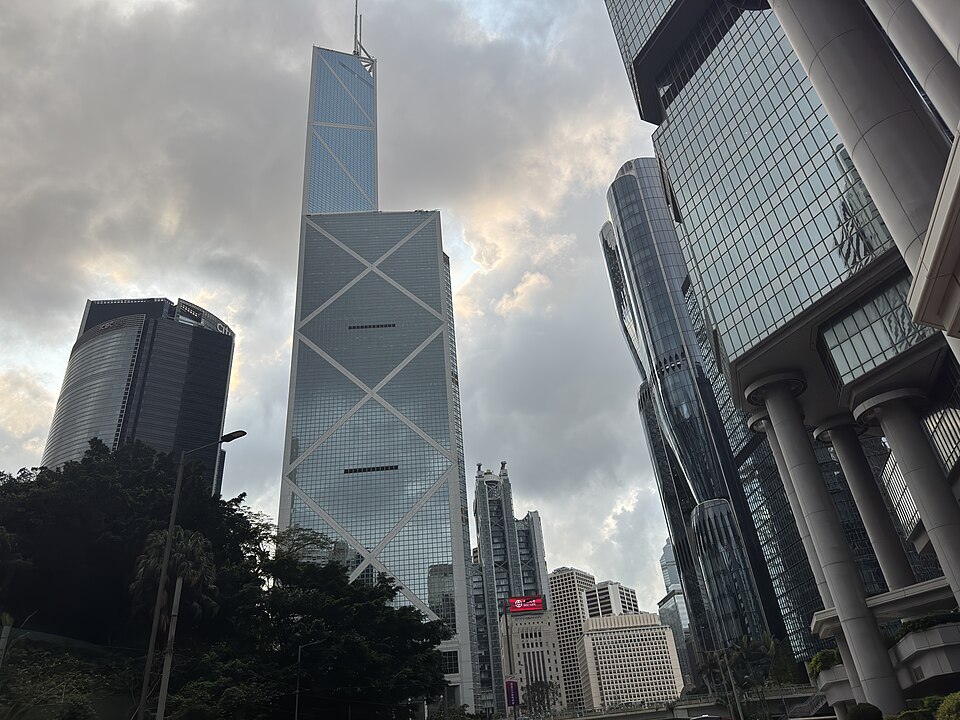
1990 · I. M. Pei
A cluster of angular, knife-edged triangular shafts sheathed in glass over a visible steel frame, tapering upward to a slender spire that pushes its total height past 367 metres.
Headquarters of the Bank of China (Hong Kong) in Central, designed by I. M. Pei with L. C. Pei of I. M. Pei and Partners. Construction began on 18 April 1985 on the former site of Murray House and finished in 1990. Its steel-column structure rises 315 metres, reaching 367.4 metres including the spire. It was the tallest building in Hong Kong and Asia until Central Plaza overtook it on the same island in 1992.
- It stands on the former site of Murray House, a Victorian building later dismantled and rebuilt across the harbour in Stanley.
- It was the first supertall skyscraper — over 305 metres — built outside the United States.
Photo: LN9267 (CC BY-SA 4.0)
Tian Tan Buddha
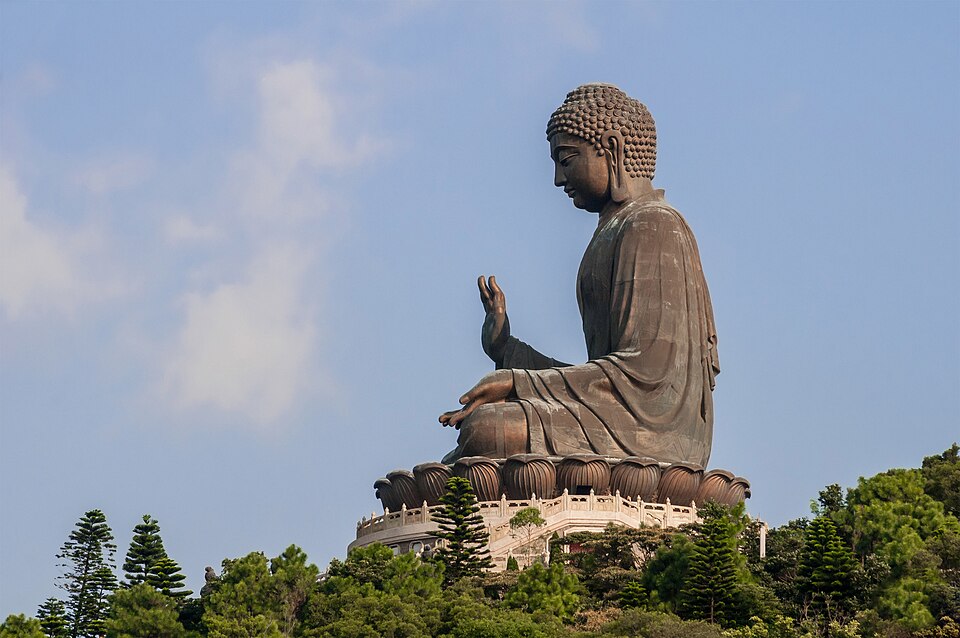
1990
A colossal bronze statue of a seated Buddha, dark-toned and monumental in scale, rising above the grounds of the monastery it overlooks.
A large bronze statue of a seated Buddha at Ngong Ping, on Lantau Island, standing beside Po Lin Monastery. Completed in 1990, it is described as the second-largest outdoor bronze Buddha statue in the world. The available record gives no further detail on its construction, dimensions, or materials beyond bronze.
- It is considered the second-largest outdoor bronze Buddha statue in the world.
Photo: Béria Lima de Rodríguez (CC BY-SA 3.0)
Hong Kong Clock Tower
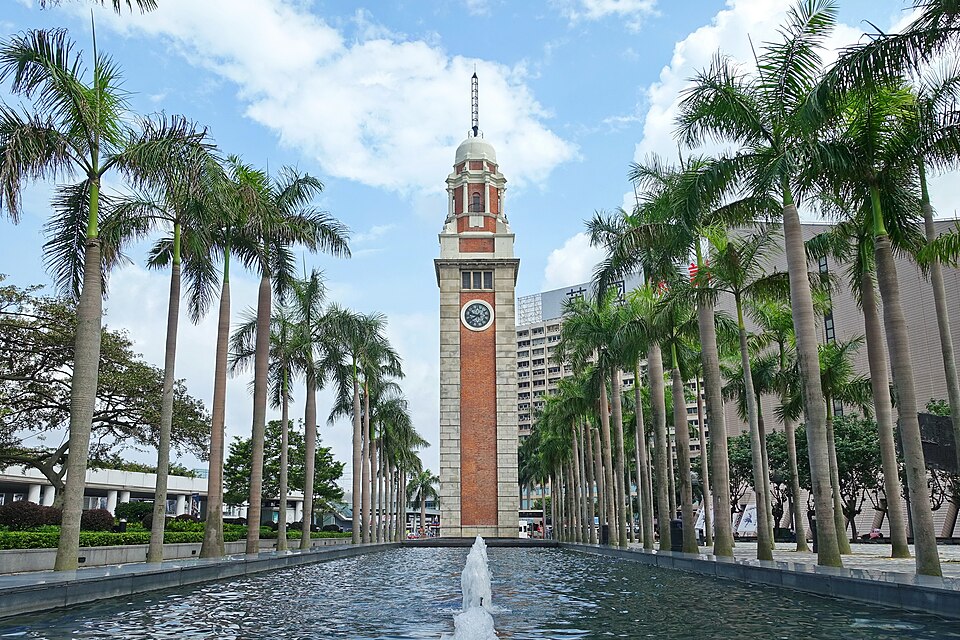
1915
A tower of red brick and granite topped by a lightning rod, standing alone at the harbourfront with no station building left around it.
Officially the Former Kowloon-Canton Railway Clock Tower, this is the only remnant of the original Kowloon station of the Kowloon–Canton Railway, standing on the southern shore of Tsim Sha Tsui near Victoria Harbour and the western end of Salisbury Road. Built of red brick and granite, it peaks at 44 metres and is topped by a 7-metre lightning rod. The Tsim Sha Tsui Ferry Pier stands nearby. It has been a declared monument in Hong Kong since 1990.
- A wooden staircase inside once let visitors climb the tower; the interior is currently closed for maintenance.
Photo: Mk2010 (CC BY-SA 4.0)
Blue House
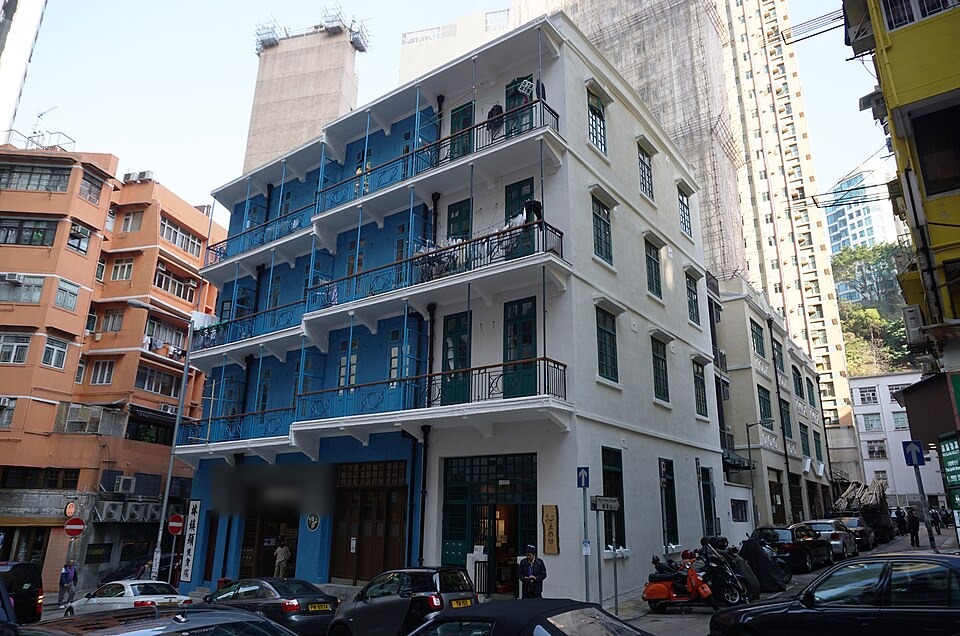
1922
A four-storey tenement building with balconies on each floor, its exterior walls painted a distinctive blue that gives the block its name.
A four-storey balcony-type tenement block, or tong lau, at 72-74A Stone Nullah Lane in Wan Chai, named after the blue colour painted on its external walls. Completed in 1922, it is one of the few remaining examples of balcony-type tong lau construction still standing in Hong Kong and is listed as a Grade I historic building.
Photo: Prosperity Horizons (CC BY-SA 4.0)
Murray House
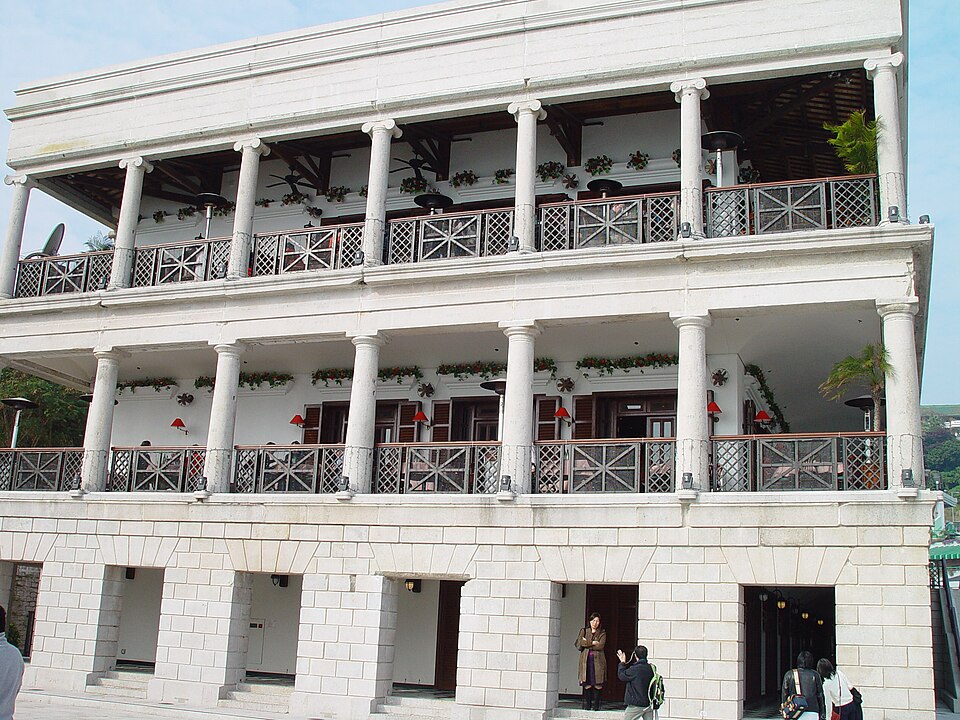
1846
A Victorian-era stone building moved as a complete structure from Central to a waterfront site in Stanley, now filled with restaurants and shops in place of the soldiers' quarters it once housed.
Built in 1846 in what is now Central as officers' quarters for the Murray Barracks, this Victorian-era building was dismantled and reconstructed on the south side of Hong Kong Island, in Stanley, during the 2000s, with the rebuilding completed by 2002. It later housed the Hong Kong Maritime Museum before the museum relocated elsewhere in Stanley, and the building now holds restaurants and shops.
- Its original site in Central is now occupied by the Bank of China Tower, completed in 1990.
- It once housed the Hong Kong Maritime Museum before the museum moved elsewhere in Stanley.
Photo: en:User:MichaelJanich (CC BY-SA 3.0)
Court of Final Appeal Building
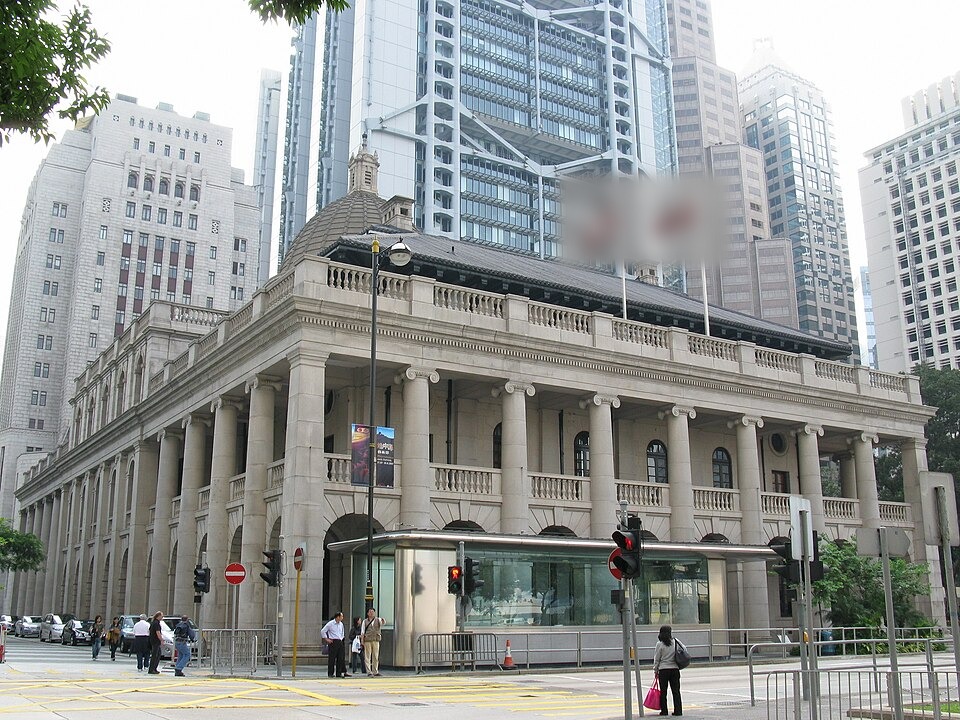
1912 · Aston Webb
A neoclassical building overlooking a public square, crowned by a blindfolded statue of Lady Justice holding a sword in one hand and scales in the other.
Designed by British architects Aston Webb and Ingress Bell and completed in 1912 in the Neoclassical style, the building stands at 8 Jackson Road on the eastern side of Statue Square, west of Chater Garden. It housed the Supreme Court from 1912 to 1983 and the Legislative Council from 1985 to 2011, and now serves as the Court of Final Appeal. A blindfolded statue of Lady Justice, holding scales and a sword, stands atop the building.
- Since 1984, only the building's exterior — not its interior — has been protected as a declared monument.
Photo: Baycrest (CC BY-SA 2.5)
International Finance Centre
1998–2003 · César Pelli
Two glass office towers of different heights rise beside a waterfront shopping mall and a hotel block; the taller tower's exterior columns are gathered into eight thick clusters, linked at intervals by visible diagonal outrigger trusses rather than continuous vertical lines.
This waterfront complex combines two office towers, a shopping mall and a hotel above an airport-rail station. The shorter tower, One IFC, opened in 1998 near the end of the Asian financial crisis; the taller, Two IFC, opened in 2003 during the SARS epidemic and rises 412 metres over what is officially counted as 88 storeys, with several unlucky-numbered floors omitted from that count. Outrigger trusses tied to eight column clusters give the taller tower its lateral stability. Design credit is shared between César Pelli and Rocco Yim. The hotel and mall opened later, in 2005.
- In 2003, an advertisement covering 19,000 square metres and more than 50 storeys of the taller tower's facade was, at the time, reportedly the largest ever placed on a skyscraper.
- Two IFC is fitted with double-deck lifts, a feature found in only a handful of buildings worldwide.
- A film character leaps between the two towers in one Hollywood production, and another leaps from the taller tower while it was still under construction in an earlier film.
Photo: Huichimai Fang (CC BY-SA 4.0)
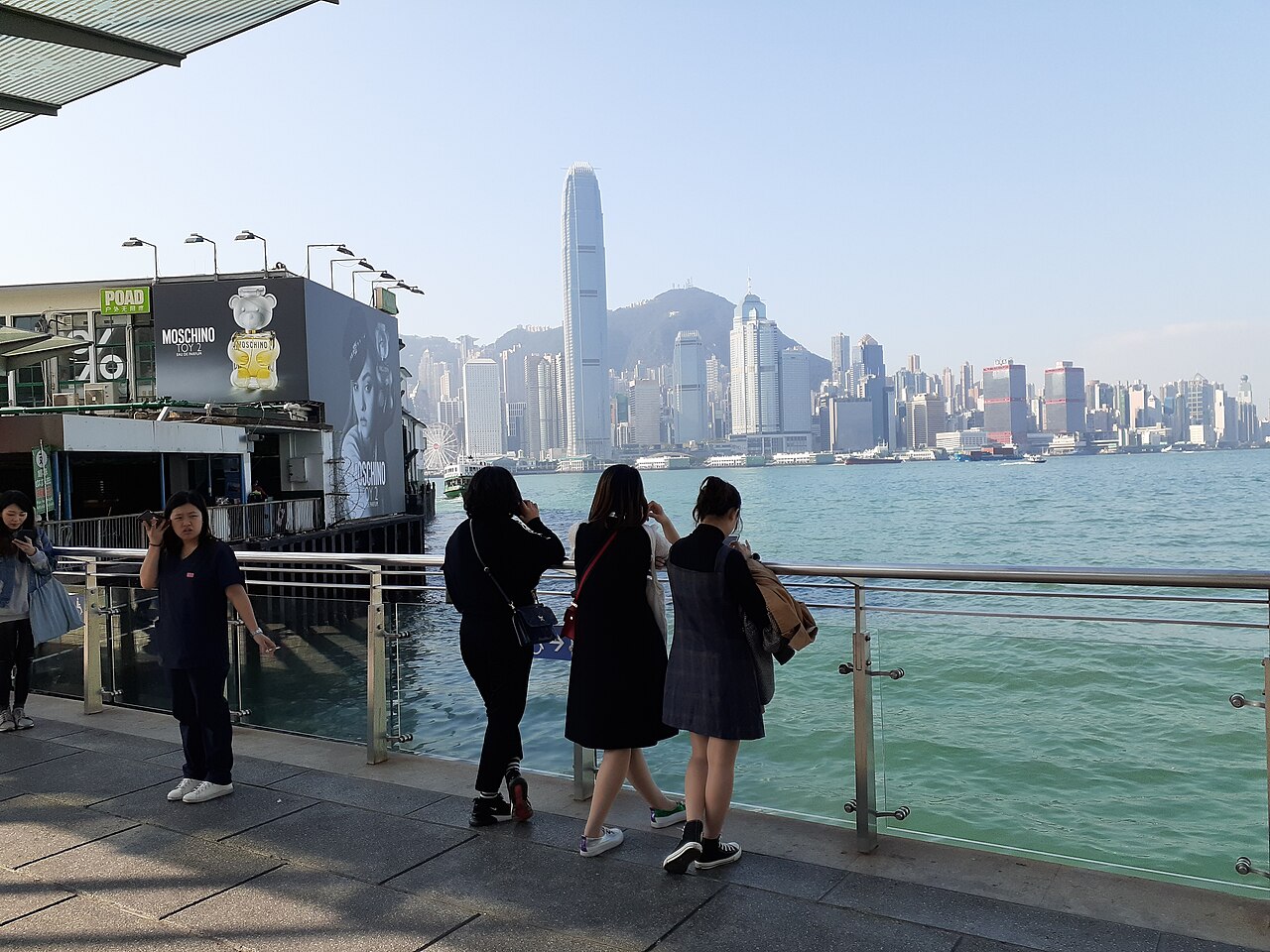
Victoria Harbour
Skyscraper-lined shores face each other across open water, with passenger ferries crossing between them and a backdrop of steep green ridges rising behind the taller buildings on one side.
This natural harbour separates an island from a peninsula, its deep, sheltered waters and position on a major sea route helping establish the surrounding territory as a colonial trading post in 1841. Originally called Hong Kong Harbour, British authorities renamed it after Queen Victoria to assure safe anchorage for the fleet. Reclamation has narrowed both shorelines over the decades, prompting environmental objections and, in one case, the demolition of a historic ferry pier despite public opposition. The harbour remains a working port and a tourist draw, known for its night skyline and an annual Lunar New Year fireworks display.
- The earliest known reference to the harbour appears on a Chinese admiral's sailing charts from around 1425, centuries before European mapmakers surveyed it.
- Its waters swallowed a passenger jet in 1993 after the aircraft overran the runway at the old airport in a storm — the first hull loss ever recorded for that model of Boeing 747.
- A society formed specifically to oppose a planned waterfront reclamation still saw the works go ahead, including the demolition of a historic ferry pier despite public protest.
Photo: MZHACUNG GWI 0002 (CC BY-SA 4.0)
HSBC Building
The headquarters of HSBC, standing on the southern side of Statue Square at 1 Queen's Road Central. It replaced an earlier HSBC building from 1935, which itself stood near the site of the old City Hall, demolished in 1933.
Victoria Peak
The tallest hill on Hong Kong Island at 552 metres, also known as Mount Austin and, locally, simply 'The Peak.' A major tourist attraction with views over Central, Victoria Harbour and Lamma Island, its actual summit holds a telecommunications facility closed to the public.
Cathedral of the Immaculate Conception
A late 19th-century English Gothic Revival cathedral on Caine Road, begun in 1883 after its predecessor burned down and opened on 7 December 1888. Consecrated in 1938, it was damaged during the Battle of Hong Kong three years later but survived the Japanese occupation.
Central–Mid-Levels escalator
The second-longest outdoor covered escalator system in the world, opened in 1993 to link Central with the Mid-Levels. It covers more than 800 metres and climbs over 135 metres, and is lined with restaurants, bars and shops.
City Hall
A building at Edinburgh Place in Central providing municipal services, including performing venues and libraries. Unlike most city halls, it never held city government offices, since colonial Hong Kong was governed by an Urban Council, which met here until its dissolution in 1999.
Zoological and Botanical Gardens
The oldest park in Hong Kong, founded in 1864 with its first stage opening to the public in 1871. It occupies 5.6 hectares on the northern slope of Victoria Peak and, though smaller than Hong Kong Park, holds more plants, animals and facilities.
Statue Square
A public square built on reclaimed land at the end of the 19th century, split into two sections by Chater Road. Once lined with statues of British royalty removed during the Japanese occupation, it now holds a statue of early HSBC banker Sir Thomas Jackson.
Central Plaza
A 78-storey, 374-metre skyscraper in Wan Chai, completed in August 1992 on a triangular floor plan. It was the tallest building in Asia from 1992 to 1996, and its roof still displays the time via a four-bar neon clock.
St John's Cathedral
The Anglican cathedral of Hong Kong Island, seat of the Archbishop of Hong Kong, standing on Garden Road among towers including the Bank of China Tower and the HSBC Main Building. It is one of five cathedrals in the territory.
Government House
The official residence of Hong Kong's Chief Executive, built in 1855 in Colonial Renaissance style on a 24,000-square-metre plot in Central. Remodelled during the Japanese occupation into its current Japanese-neoclassical hybrid form, it housed 25 of the territory's 28 governors between 1855 and 1997.
Tai Kwun
A heritage complex combining three declared monuments, the former Central Police Station, the Former Central Magistracy and Victoria Prison. After a heritage revitalisation, it reopened to the public on 29 May 2018 as a centre for heritage and arts.
Convention and Exhibition Centre
One of Hong Kong's two major convention and exhibition venues, built along Victoria Harbour in Wan Chai North. It was designed by Skidmore, Owings & Merrill with Wong & Ouyang, and is linked by covered walkways to nearby hotels and commercial buildings.
Béthanie
A former sanatorium in Pok Fu Lam, built in 1875 by the Paris Foreign Missions Society. Reopened in 2006 after renovation for the Hong Kong Academy for Performing Arts, it now holds two performance venues, an exhibition hall, a chapel and a museum.
Dr Sun Yat-sen Museum
A museum dedicated to revolutionary and statesman Sun Yat-sen, housed in Kom Tong Hall on Castle Road. It opened on 12 December 2006 to mark the 140th anniversary of Sun's birth, and is run as a branch of the Hong Kong Museum of History.
Nam Koo Terrace
A Grade I Historic Building on Ship Street in Wan Chai, popularly nicknamed 'The Wan Chai Haunted House.' It is currently owned by Hopewell Holdings, a major Hong Kong property developer.
Legislative Council Complex
The seat of the Legislative Council of Hong Kong, facing Victoria Harbour as part of the Central Government Complex. Officially opened in September 2011, it was the first purpose-built building for the territory's legislature, replacing the former Supreme Court Building.
Pedder Building
A Beaux-Arts commercial building on Pedder Street, built in 1923 and the last surviving pre-World War II structure there. Once known for its art galleries and high rents, it is now more than half vacant and nicknamed the 'ghost building.'
History
Hong Kong began as scattered farming and fishing villages before the Qing dynasty ceded Hong Kong Island to Britain in 1841–42 after the First Opium War, with Kowloon added in 1860 and the New Territories leased for 99 years in 1898. Victorian building continued through this period: officers' quarters went up in Central in 1846, later dismantled and rebuilt in Stanley, and a Neoclassical courthouse rose in 1912, followed by a railway terminus in 1915 of which only the clock tower still stands. Balcony-type tenement blocks, like one in Wan Chai, date from the 1920s. Japanese occupation interrupted development from 1941 to 1945. Hong Kong was handed over from Britain to China in 1997; three years earlier, construction had already turned toward finance, with the triangular Bank of China Tower, finished in 1990, anticipating a skyline that has since risen well past it.