Landmarks in Havana
Colonial forts and churches share Havana's harbour with a 1920s neoclassical capitol.
Havana's surviving landmarks span nearly four centuries around a single harbour. The walled colonial core, Old Havana, holds the city's oldest stone building: a sixteenth-century bastion fort that proved too far inside the bay to defend it and was turned into a governor's residence instead. Nearby stands a baroque cathedral, built through the mid- and late eighteenth century on a compact rectangular plan, its stone facade fronting a small square. Both belong to the fortified Spanish port that grew up around the harbour entrance. Away from that old town, a large neoclassical capitol was raised in the late 1920s as the seat of the legislature, built on a scale and in a style borrowed from government architecture elsewhere rather than from the colonial city around it.
El Capitolio
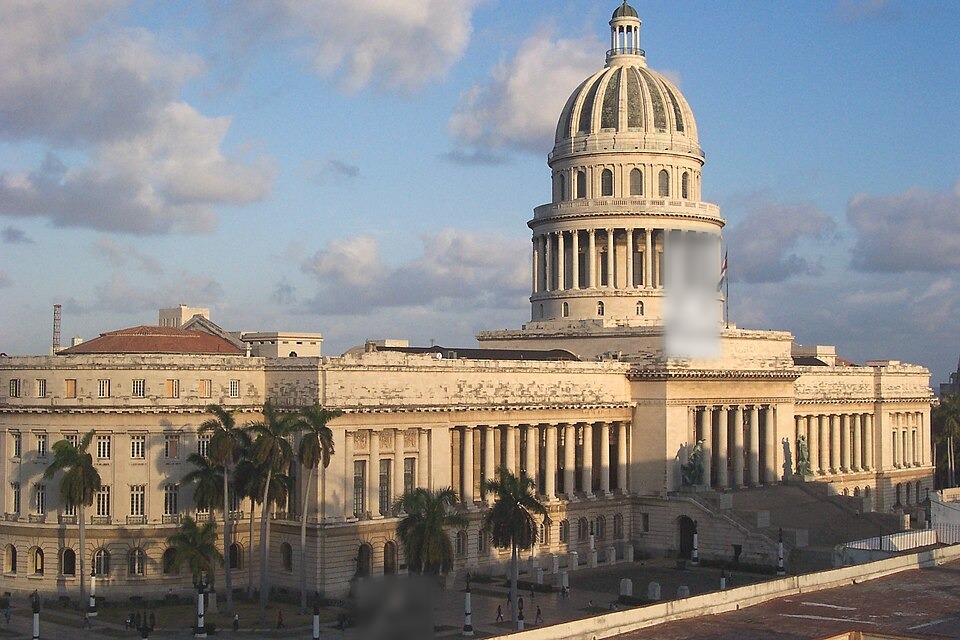
1926–1929 · Eugenio Rayneri Piedra
A large, strictly symmetrical neoclassical facade with a colonnaded entrance, built at a scale and formality that set it apart from the streets around it.
El Capitolio was commissioned by Cuban president Gerardo Machado and built between 1926 and 1929, under the direction of architect Eugenio Rayneri Piedra. Designed as a large neoclassical public building, it originally served as the seat of the Cuban legislature. It has since become the seat of the National Assembly of People's Power, continuing the same function within a different political system rather than being repurposed as a museum.
Photo: Yomangani (Public domain)
Havana Cathedral
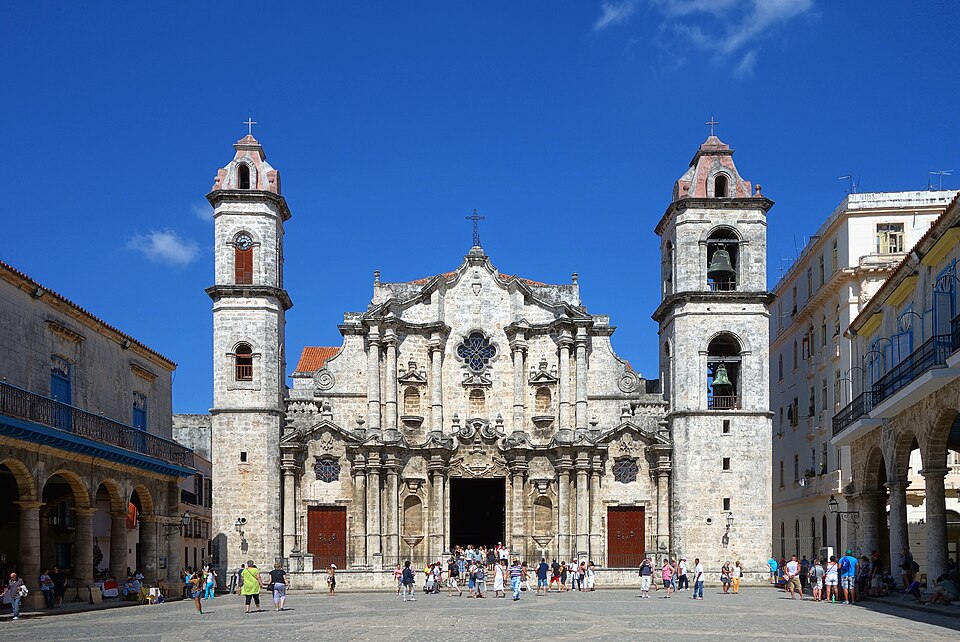
1748–1777
A relatively small baroque church built of stone on a plain rectangular plan, thirty by forty-nine metres, forming one side of a modest square in the old town.
Havana Cathedral is a Roman Catholic church in Old Havana, seat of the Archdiocese of San Cristóbal de la Habana and one of eleven Catholic cathedrals on the island. It was built between 1748 and 1777 and consecrated in 1782. Faced in stone on a rectangular plan measuring thirty by forty-nine metres, it stands on the Plaza de la Catedral. Christopher Columbus's remains were kept inside between 1796 and 1898, before being taken to Seville Cathedral.
- For over a century, the church held remains believed to be those of Christopher Columbus, before they were moved to Seville Cathedral in Spain.
- It is one of eleven Catholic cathedrals on the island of Cuba.
Photo: Velvet (CC BY-SA 4.0)
Castillo de la Real Fuerza
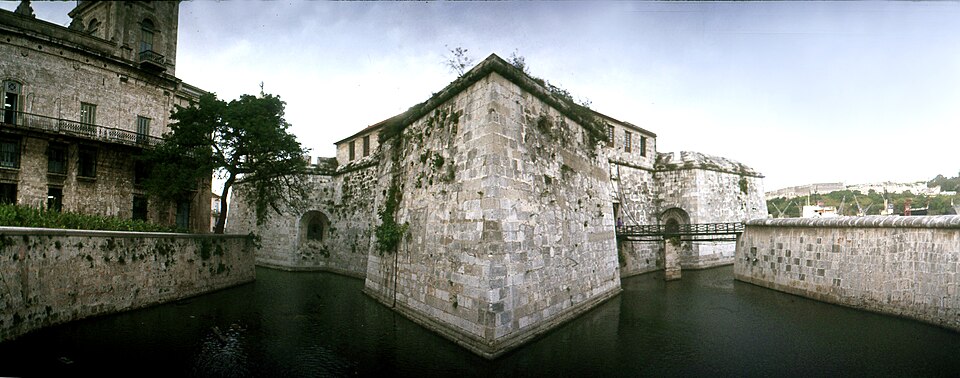
1558–1577
A low, thick-walled stone bastion fort with angular corner bastions, set back from the harbour entrance and fronting a public square rather than the open sea.
Built as a defensive stronghold at the inner edge of Havana's harbour, the fort was intended to protect the city from pirate attack. Its position proved impractical: set too far back from the harbour mouth to intercept raiders, it was converted instead into the residence of the Governor of Havana. It is regarded as the oldest surviving stone fort in the Americas. In 1982 it was listed, together with the rest of Old Havana's fortifications, as part of a UNESCO World Heritage Site.
Photo: LBM1948 (CC BY-SA 4.0)
Castillo de los Tres Reyes Del Morro
A fortress guarding the entrance to Havana harbor, designed by Italian engineer Battista Antonelli. British forces captured it in 1762 before it returned to Spain the next year under the Treaty of Paris, remaining the harbor's primary defense until La Cabaña was completed in 1774.
Hotel Nacional de Cuba
A Spanish eclectic-style hotel opened in 1930 on the seafront of the Vedado district. It stands atop Taganana Hill, with commanding views over the sea and the city.
Colon Cemetery
A cemetery founded in 1876 in the Vedado neighborhood, named for Christopher Columbus and built to replace the older Espada Cemetery. It holds an estimated 500 or more elaborately sculpted mausoleums, after centuries in which Havana's dead were interred in church crypts.
La Cabaña
An 18th-century fortress complex, the third-largest in the Americas, rising alongside Morro Castle on a 60-metre hilltop at the harbor entrance. It forms part of the Old Havana World Heritage Site, designated in 1982.
Plaza de la Revolución
A square and surrounding municipality, one of the 15 that make up Havana, stretching from the plaza down to the sea at the Malecón. The municipality, which includes the Vedado district, had a population of 139,135 in 2022.
Museum of the Revolution
The former presidential palace of Cuba, home to every president from Mario García Menocal to Fulgencio Batista, in Old Havana. Attacked by the Directorio Revolucionario 13 de Marzo in 1957, it became the Museum of the Revolution after the Cuban Revolution.
Palacio de los Capitanes Generales
The former residence of Spanish colonial governors of Havana, later the city hall, facing Plaza de Armas in Old Havana. Considered the city's most notable Colonial Baroque building, it houses the Museum of the City of Havana, its rooms kept in original colonial decoration.
Malecón
An 8-kilometre esplanade and seawall running from the mouth of Havana Harbor through Centro Habana and Vedado to the mouth of the Almendares. It was built to protect the city from the sea, especially the cold fronts that drove waves against facades along San Lázaro.
Gran Teatro
A theatre on the Paseo del Prado, designed by architect Paul Belau and built in 1914 on the site of the former Teatro Tacón. Home to the Cuban National Ballet, it has hosted the International Ballet Festival of Havana every two years since 1960.
Bacardi Building
An Art Deco landmark designed by architects Esteban Rodríguez-Castells and Rafael Fernández Ruenes, completed in 1930. It stands on a 1,320-square-metre lot at the corner of Calles Monserrate and San Juan de Dios in Las Murallas, Old Havana.
José Martí Memorial
A memorial to national hero José Martí on the northern side of Plaza de la Revolución, centered on a star-shaped tower and a statue of Martí ringed by six columns. It is billed as the largest monument to a writer anywhere in the world.
Plaza Vieja
A plaza in Old Havana that also gives its name to one of the seven wards, or consejos populares, of the Old Havana municipality. The ward has a residential population of 17,426.
Plaza de Armas
The oldest town square in Habana Vieja.
Basilica of San Francisco de Asís
A Catholic minor basilica and Franciscan convent whose construction began in 1548, was damaged by storms and a hurricane between 1680 and 1694, and was rebuilt into its current form from 1716. In 1842 the building became Cuba's General Post Office headquarters.
Castillo San Salvador de la Punta
A fortress positioned at the entrance to Havana's bay.
Hotel Ambos Mundos
A five-floor hotel with an eclectic 20th-century design, built in 1924 at the corner of Calle Obispo and Mercaderes in Old Havana. It draws visitors chiefly because Ernest Hemingway lived there for seven years during the 1930s.
Tropicana Club
An open-air cabaret set in a 36,000-square-metre tropical garden estate, opened on 30 December 1939 at Villa Mina in Marianao. It stands next to the former Colegio de Belén, now the Instituto Técnico Militar.
Real Fabrica de Tabacos Partagás
A cigar factory and museum across the street from Havana's Capitol building, producing the world-famous habanos cigars. It still ranks among Cuba's oldest cigar factories.
Hotel Habana Libre
A 25-floor tower in Vedado with 572 rooms, opened in 1958 as the Habana Hilton. After the revolutionaries captured Havana, it served as the residence of Fidel Castro and others throughout 1959.
Hotel Sevilla
A historic hotel in Havana.
Hotel Inglaterra
The oldest hotel in Havana. It stands at Paseo del Prado #416, between San Rafael and San Miguel.
Finca Vigía
A house in the San Francisco de Paula ward, built in 1886 and later home to Ernest Hemingway. Like his house in Key West, it is now preserved as a museum.
López Serrano Building
Cuba's tallest residential building until the FOCSA was completed in 1956, designed by architect Ricardo Mira in 1929. Often compared to the Bacardi Building, it was home to congressman and presidential candidate Eduardo Chibás, who died there by suicide in August 1951.
Estadio Latinoamericano
A baseball stadium built in 1946 as the top ballpark in Latin America, opened as the Gran Estadio de La Habana. Nicknamed the Colossus of Cerro for its neighborhood, it holds about 55,000 and ranks as the second-largest baseball stadium in the world by capacity.
Our Lady of Kazan Orthodox Cathedral
A Russian Orthodox cathedral in Old Havana, under the jurisdiction of the Russian Orthodox Church. It was built on the shores of Havana Harbour, on the corner of San Pedro Avenue and Santa Clara.
History
Havana was founded by the Spanish Empire in 1519 and, thanks to its harbour, overtook Santiago as the island's leading settlement by the mid-sixteenth century, becoming the colonial capital in 1552. Naval attack was a constant threat, and the crown answered with stone fortification: a bastion fort went up beside the harbour mouth, though it stood too far inside the bay to defend it and became a governor's residence instead. Religious building followed at a similar scale: the cathedral in what is now Old Havana was built between 1748 and 1777 and consecrated in 1782, its Baroque facade fronting a small colonial square. Only with the twentieth-century republic did Havana build on a different scale, raising in the late 1920s a neoclassical capitol sized to a modern legislature rather than a colonial garrison town.