Landmarks in Miami
Its 300-tower skyline rose around a handful of 1910s-20s Revival-style survivors.
Miami's landmark buildings date almost entirely from one boom in the 1910s and 1920s, when developers borrowed Mediterranean and Renaissance Revival styles from Spain and Italy to sell the city as a subtropical resort. Vizcaya, a Renaissance Revival villa and gardens on Biscayne Bay, was built in Coconut Grove for businessman James Deering. A few miles away in Coral Gables, the Biltmore Hotel opened as a Mission Revival resort with a tower modeled on a Seville cathedral's. Downtown, the Freedom Tower rose in the same decade as a newspaper's Mediterranean Revival headquarters. All three now stand apart from the high-rise skyline built up around them since: over 300 towers, 70 of them above 492 feet, as the city grew into a center of finance and international trade.
Freedom Tower
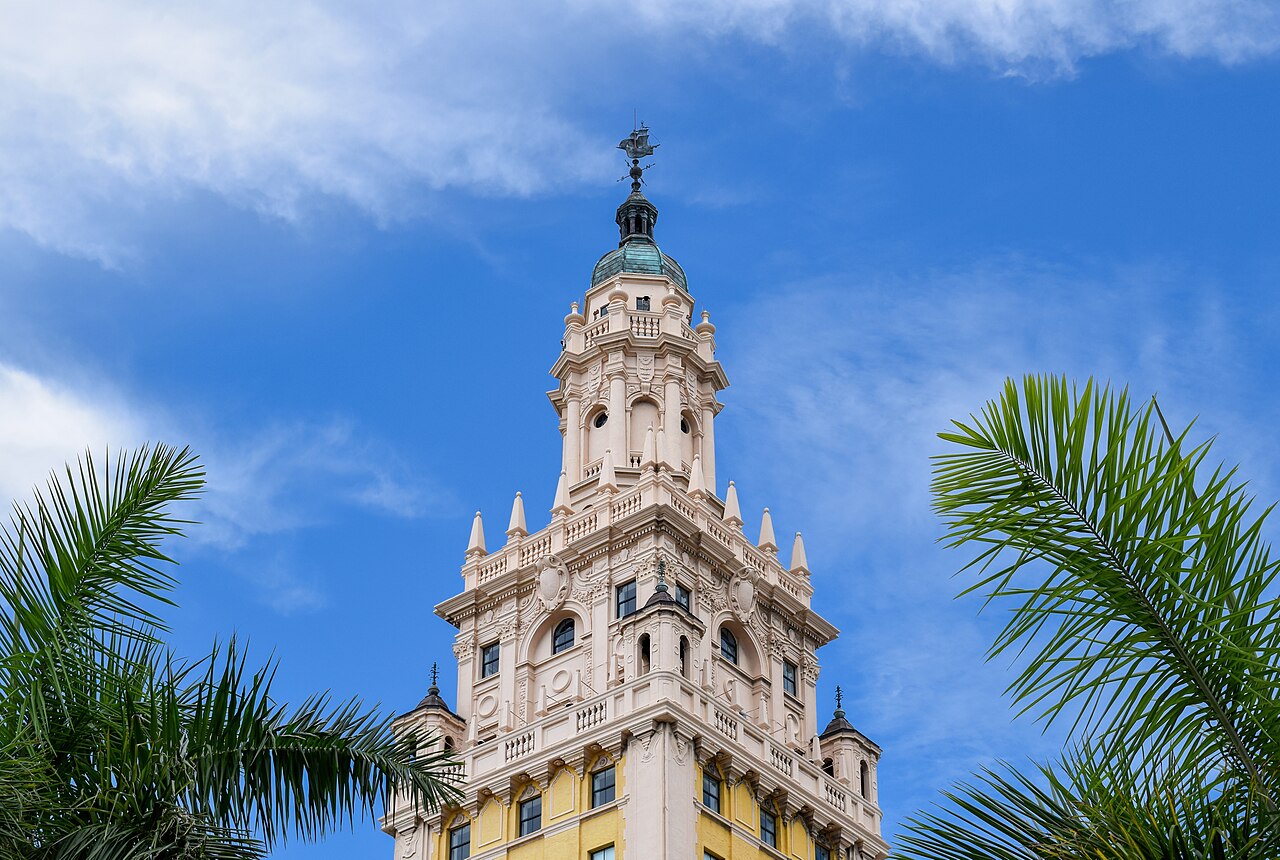
1925 · Schultze and Weaver
A Mediterranean Revival skyscraper on a wide downtown boulevard, one of the city's earliest tall towers, its historic ornamentation set apart from the glass high-rises around it and its base folded into a college campus that now uses it as an art museum.
The Freedom Tower opened in 1925 as the Mediterranean Revival headquarters of a Miami newspaper. It gained an unrelated second role decades later: through the 1960s the federal government used the building to process and assist Cuban refugees arriving after the 1959 revolution, work that gave the tower its current name. It was added to the National Register of Historic Places in 1979 and designated a National Historic Landmark in 2008. Miami Dade College now uses the building as a contemporary art museum and offices for its arts programs.
- The tower's current name comes from its use, in the 1960s, as a processing center for Cuban refugees fleeing the 1959 revolution.
- It was originally known as the Miami News and Metropolis Building, after the newspaper it was built for.
Photo: Photograph: Radomianin (Public domain)
Vizcaya Museum and Gardens
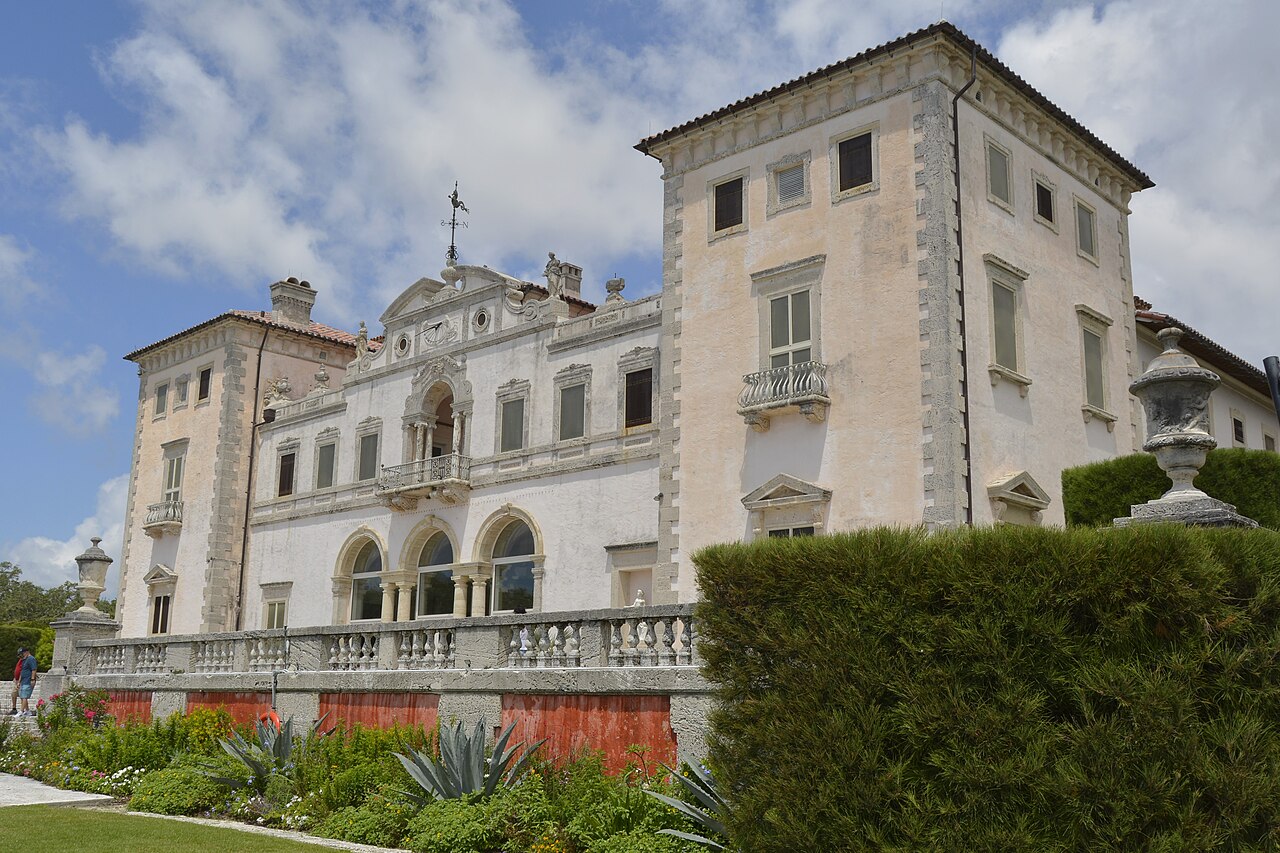
1914 · F. Burrall Hoffman
A Renaissance Revival villa with Baroque touches standing on a bay, fronted by formal Italian Renaissance-style gardens, native woodland, and a compound of historic outbuildings that together make up the wider estate.
Vizcaya was built in 1914 on Biscayne Bay as the villa and estate of businessman James Deering, of the Deering McCormick-International Harvester fortune. F. Burrall Hoffman designed the main house, Paul Chalfin directed the design, and Diego Suarez laid out the Italian Renaissance-style gardens; Iwahiko Tsumanuma, working as associate architect under the name Thomas Rockrise, also contributed. Miami-Dade County now owns the estate, which is open to the public as a museum despite also being listed among America's most endangered historic places.
- The associate architect, Iwahiko Tsumanuma, worked under the adopted name Thomas Rockrise.
- Despite its National Historic Landmark status, the estate has been listed among America's Most Endangered Historic Places.
Photo: Leslie Platt (CC BY 2.0)
Miami Biltmore Hotel
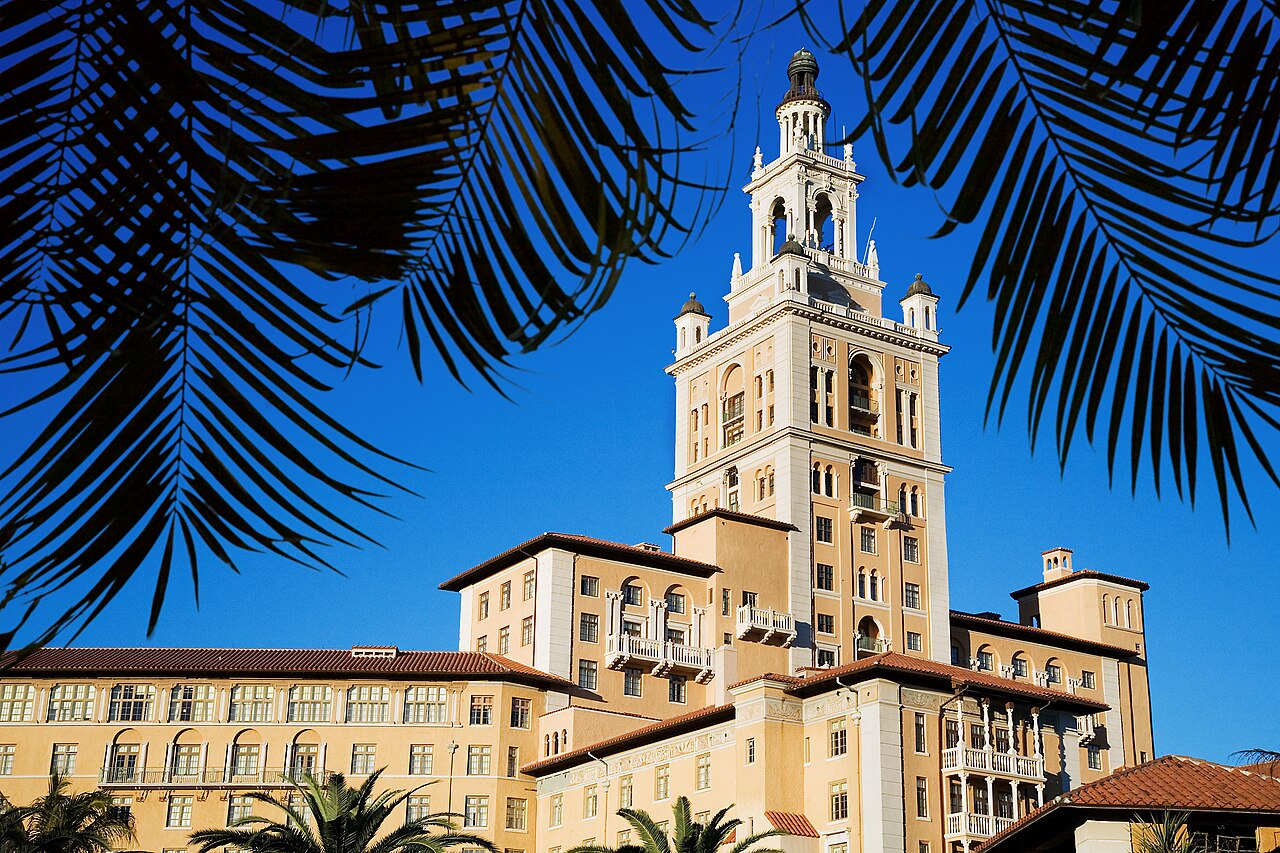
1926 · Schultze & Weaver
A Mission Revival resort building fronted by a tall tower modeled on Seville Cathedral's Giralda, set beside what was once the largest swimming pool in the world.
The Miami Biltmore Hotel opened in 1926 in Coral Gables, designed by Schultze & Weaver for developers John McEntee Bowman and George Merrick as part of the Biltmore hotel chain. Its tower, modeled on Seville Cathedral's Giralda, briefly made it Florida's tallest building until 1928. The hotel's pool, once the largest in the world, employed swimming instructor Johnny Weissmuller, later the screen Tarzan. The building went on to serve as a wartime hospital and a University of Miami medical campus until 1968, then stood empty for years before reopening as a hotel in 1987.
- Its pool, once the largest in the world, employed a swimming instructor who later played Tarzan on screen.
- It served as a hospital and medical school campus before standing empty for years and reopening as a hotel only in 1987.
Photo: Jorge Royan (CC BY-SA 3.0)
Venetian Pool
A public swimming pool in Coral Gables, Florida, completed in 1924. It was designed by architect Phineas Paist together with Denman Fink.
Ocean Drive
A major thoroughfare in the South Beach neighborhood of Miami Beach, Florida.
Miami Tower
A 47-story office skyscraper in downtown Miami, previously known as the CenTrust Tower and Bank of America Tower. In 2012, Florida's AIA chapter named it one of the state's 100 defining works of architecture from the past century.
Kaseya Center
A multi-purpose arena on Biscayne Bay that opened in 1999 as American Airlines Arena and has been renamed twice since, becoming Kaseya Center in 2023. It is the home of the Miami Heat and seats up to 19,500 people, including 80 luxury suites.
Marine Stadium
A waterfront grandstand on Virginia Key, completed in 1963 as the first stadium in the United States purpose-built for powerboat racing. It was declared unsafe and abandoned in 1992 after Hurricane Andrew, though it was added to the National Register of Historic Places in 2018.
Fairchild Tropical Botanic Garden
An 83-acre botanic garden in Coral Gables that opened to the public in 1938, holding collections of rare tropical plants including palms, cycads, and flowering trees. Since 2012 it has also been home to the American Orchid Society, and today counts some 45,000 members.
Adrienne Arsht Center for the Performing Arts
A performing arts center in Miami and one of the largest in the United States, presenting artists from around the world alongside three resident companies. Since 2020 it has also staged more than 100 free pop-up performances at hospitals, parks, and libraries across Miami-Dade County.
Phillip and Patricia Frost Museum of Science
A science museum, planetarium, and aquarium that opened in 1960 at a Coconut Grove site across from Vizcaya Museum and Gardens. It moved to Maurice A. Ferré Park in 2017, next to the Pérez Art Museum Miami, after the Coconut Grove site closed in 2015.
Bayfront Park
A 32-acre public, urban park in downtown Miami on Biscayne Bay.
Lyric Theater
A historic theater in the Overtown neighborhood that served Miami's African American community and is considered the city's oldest legitimate theater. It was added to the National Register of Historic Places in 1989 and is now called the Black Archives Historic Lyric Theater.
1111 Lincoln Road
A parking garage at the western end of Lincoln Road Mall, designed by the Swiss firm Herzog & de Meuron and opened in 2010. It can hold about 300 cars and has drawn attention for a structure that looks nothing like a typical parking garage.
Miami-Dade County Courthouse
A 28-story courthouse tower built between 1925 and 1928 that was, at completion, the tallest building in Miami, Florida, and the entire South. It remains in use as Miami-Dade County's main civil courthouse, even as a replacement building nearby is due to open in 2025.
The Barnacle Historic State Park
The 1891 home of Ralph Middleton Munroe, now a 5-acre state park in Coconut Grove and the oldest house still on its original site in Miami-Dade County. Munroe co-founded Coconut Grove and designed sailing yachts; the state acquired the site from his descendants in 1973.
Lincoln Road
A street in Miami Beach whose most famous stretch, Lincoln Road Mall, runs as a pedestrian-only strip between 16th and 17th Streets. Once open to cars, it is now lined with shops, restaurants, and galleries between Washington Avenue and Alton Road.
Bacardi Buildings
A former Bacardi USA headquarters complex in Midtown Miami, made up of the Bacardi Imports Tower, completed in 1963, and the Administration Annex known as 'The Jewel Box,' added in 1973. Both buildings were listed on the National Register of Historic Places in 2018.
Olympia Theater
A theater in downtown Miami designed by John Eberson in his atmospheric style and opened in 1926. It received historic designation in 1984 and is one of only four atmospheric theatres still standing in Florida.
Glenn Curtiss Mansion
A historic home in Miami Springs, at the northern edge of Miami International Airport. It is open to the public as an event space or for private tours by prior arrangement.
One Thousand Museum
A 62-story residential tower at 1000 Biscayne Boulevard, also known as the Scorpion Tower, completed in 2019 to a design begun by Zaha Hadid. It stands 707 feet tall with a curving exoskeleton that doubles as structural support while partly obscuring the balconies.
Gesu Church
A Roman Catholic church built in 1896, making it the oldest Catholic church in Miami. It was added to the National Register of Historic Places in 1974.
LoanDepot Park
A retractable-roof stadium in Little Havana, built on the site of the former Miami Orange Bowl and completed in 2012. Home to the Miami Marlins, it was certified the greenest ballpark in Major League Baseball that year and hosted the 2017 MLB All-Star Game.
Wolfsonian–FIU
A museum, library, and research center in Miami Beach's Art Deco District, holding some 180,000 pieces from 1885 to 1945. The collection spans furniture, industrial design, glass, ceramics, and rare books, and the museum has been part of Florida International University since 1997.
Colony Theatre
A performing arts venue on Lincoln Road that opened as a Paramount Pictures movie house in 1935 with room for 1,200 people. Now a 417-seat theater managed by Miami New Drama, it hosts music, dance, and theater performances.
Torch of Friendship
A monument at the northwest corner of Bayfront Park, built in 1960 with a gas-fed flame meant as a welcoming beacon for immigrants from Latin America and the Caribbean. It was re-dedicated in 1964 to the memory of President John F. Kennedy.
Bay of Pigs Museum
The official museum dedicated to the Bay of Pigs Invasion's Brigade 2506, located in Little Havana. It is also known as the Brigade 2506 Museum and Library.
History
Vizcaya, the earliest of the three, went up in 1914 as the Biscayne Bay estate of businessman James Deering, its villa and Italian Renaissance-style gardens designed with F. Burrall Hoffman as architect. The Freedom Tower followed in 1925 as the Mediterranean Revival headquarters of a Miami newspaper, and the Miami Biltmore Hotel opened in 1926 as a Mission Revival resort in Coral Gables, briefly the tallest building in Florida until the Dade County Courthouse overtook it in 1928. The Freedom Tower later gained a second identity: through the 1960s it processed Cuban refugees fleeing the 1959 revolution, work that helped earn it National Historic Landmark status in 2008. Downtown Miami's skyline has since grown into the third-largest in the United States, with more than 300 high-rises rising around these older, lower buildings.