Landmarks in San Salvador
Neoclassical palaces and a modern cathedral share a volcano-ringed highland capital.
San Salvador's landmarks cluster around the historic centre, where government and church stand close together in a city that functions as the country's political, cultural, educational and financial hub. The National Palace, a neoclassical building finished in 1911 with materials imported from Germany, Italy and Belgium, once held the seat of government; nearby, the eclectic Metropolitan Cathedral, completed only in 1999, gives the skyline a modern silhouette rather than a colonial one. A third church, Iglesia El Rosario, adds a mid-twentieth-century building recognized for its religious heritage value. Set in the Salvadoran highlands among volcanoes and subject to frequent earthquakes, the city's built fabric reflects repeated rebuilding rather than one architectural era.
Metropolitan Cathedral of San Salvador
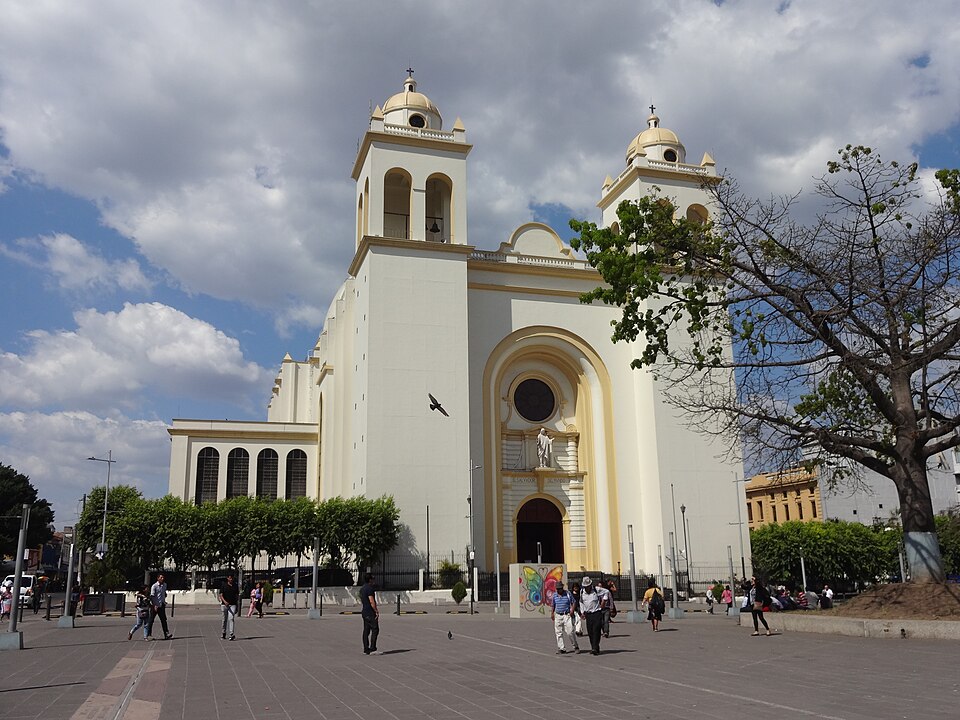
1999
Its facade and massing mix decorative elements from different periods rather than presenting one unified style, an eclectic composition that sets it apart from cathedrals built to a single design.
The Metropolitan Cathedral of the Holy Savior is the cathedral church of the Roman Catholic Archdiocese of San Salvador, serving as its principal place of worship. The present building was completed in 1999 in an eclectic style, drawing on several architectural traditions rather than one. As a cathedral, it houses the seat of the archbishop and stands as the most prominent Catholic institution in the capital, reflecting the city's standing as a religious as well as political and cultural center.
Photo: Rômulo Gama Ferreira from Vitória-ES (CC BY 2.0)
National Palace of El Salvador
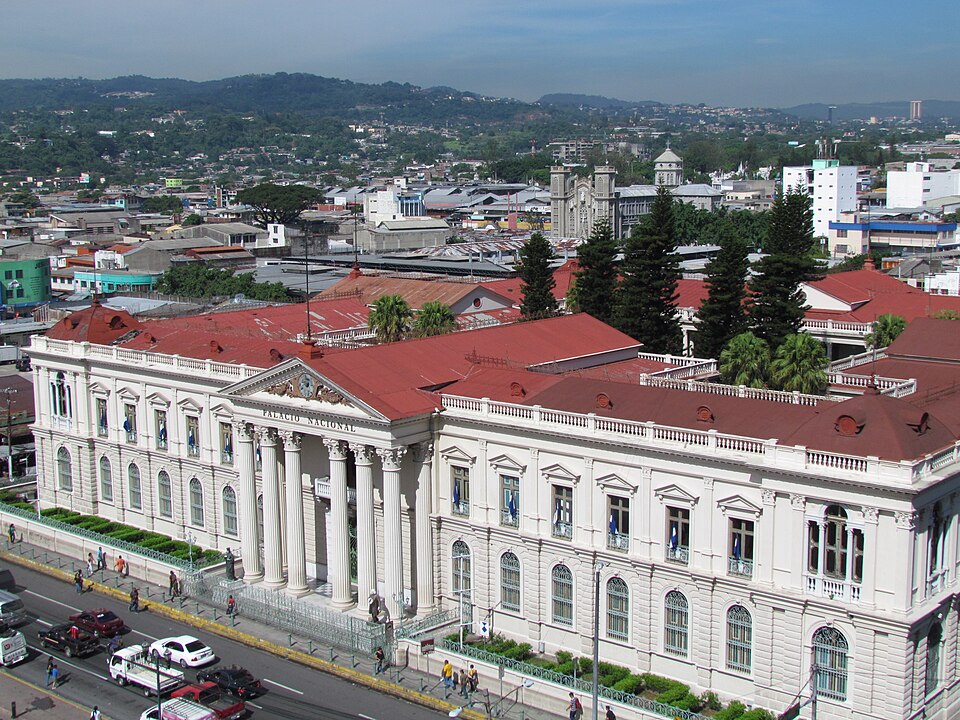
1905–1911 · Pascasio González Erazo
Its four principal rooms are traditionally identified by colour, red, yellow, pink and blue, the Blue Room distinguished by classical Ionic, Corinthian and Roman detailing as the historic meeting place of the legislature.
The present National Palace replaced an earlier building of 1866 to 1870 that burned down in December 1889. Built between 1905 and 1911 under engineer José Emilio Alcaine and foreman Pascasio González Erazo, it was financed by a tax levied on every quintal of coffee exported, and its materials were shipped in from Germany, Italy and Belgium. Government offices occupied the palace until 1974. Inside, four main rooms, each identified by colour, once housed the Foreign Ministry, the presidency, the Supreme Court and, in the Blue Room, the Legislature, alongside 101 smaller rooms.
- Construction was paid for by a tax collecting one colón for every quintal of coffee exported.
- Building materials were imported from three different countries: Germany, Italy and Belgium.
- The Blue Room, seat of the Legislature since 1906, is decorated with Ionic, Corinthian and Roman architectural elements.
Photo: Jose Quintanilla (CC BY-SA 3.0)
Iglesia El Rosario
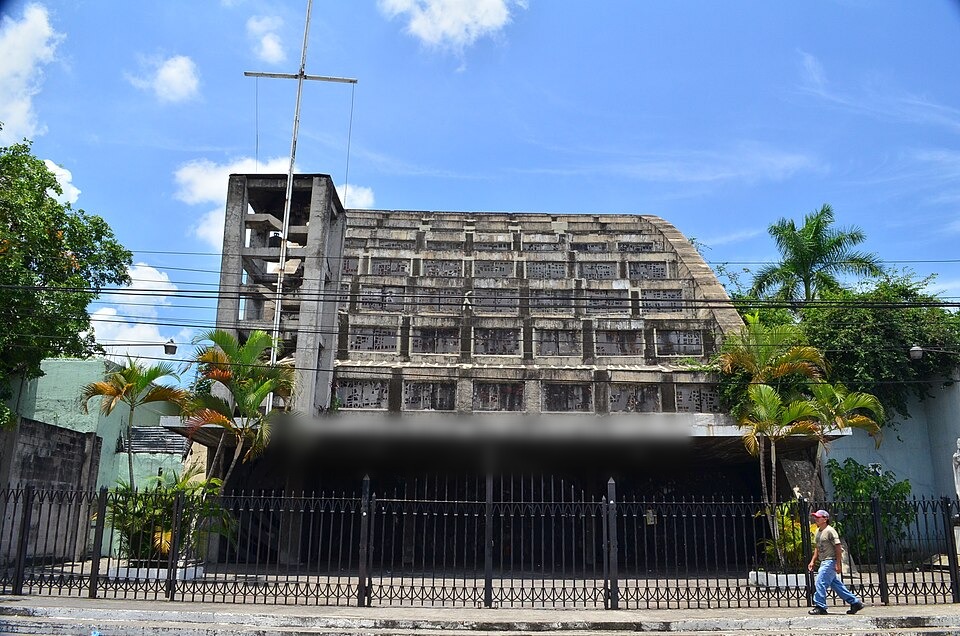
1971 · Rubén Martínez
No visual description survives in the available record beyond its status as a mid-twentieth-century parish church; it is identified administratively, through its heritage listing, rather than by any noted architectural feature.
Iglesia El Rosario is a Catholic parish church in San Salvador, recognized as a cultural property under the country's Religious patrimony heritage designation. The building was completed in 1971 to a design credited to Rubén Martínez, who died in 2023.
Photo: Cesar Lainez (CC BY-SA 3.0)
Monumento al Divino Salvador del Mundo
A monument on the Plaza El Salvador del Mundo, showing a statue of Jesus Christ standing atop a globe on a tall four-sided concrete pedestal. It is a symbol that represents both El Salvador and Salvadorans around the world.
Teatro Nacional de El Salvador
A French Renaissance-style theatre begun on 3 November 1911 by French architect Daniel Beylard and inaugurated on 1 March 1917. Decorated by Italian architect Lucio Cappellaro, its Great Hall is considered one of the most beautiful and elegant in Central America.
Plaza Gerardo Barrios
A plaza in the historic centre, home to a bronze equestrian statue of president Gerardo Barrios by Francisco Durini, inaugurated in 1909. Ringed by the National Palace and the Metropolitan Cathedral, it was also the site of the 1913 assassination attempt on president Manuel Araujo.
San Salvador El Salvador Temple
The 135th temple of the Church of Jesus Christ of Latter-day Saints, and the first to be built in El Salvador, announced in 2007. Designed by VCBO Architecture, it broke ground on 20 September 2008 in a ceremony led by Don R. Clarke.
National Library of El Salvador
A national library in the historic centre, opened in November 2023 on the former site of the Francisco Gavidia National Library. It was built with the cooperation of the People's Republic of China.
Casa Presidencial
The official residence and offices of the President of El Salvador.
Cuscatlán Stadium
A football stadium inaugurated in 1976, with a capacity of 53,400, the largest in Central America and the Caribbean. It has been renovated several times, most recently in 2020 with a new 4K screen and updated floodlights.
Salvadoran Museum of Art
An art museum that first opened on 22 May 2003. It is open to the public and receives more than half a million visitors a year.
Estadio Jorge "El Mágico" González
A football stadium named for Salvadoran star player Mágico González, with a capacity of 30,000 and formerly called Estadio Nacional Flor Blanca. It was restored in 2001 to host the Central American and Caribbean Games in August 2002.
Cemetery of Distinguished Citizens
A cemetery that, together with the Cemetery of La Barmeja, forms the Cemetery General of San Salvador. It is the burial place of prominent families and many outstanding figures from the country's history.
Military Museum of the Armed Forces of El Salvador
A museum housed inside the former El Zapote barracks of the Salvadoran Army. It is owned by the Ministry of National Defense of El Salvador.
Torre Cuscatlán
An office tower in Antiguo Cuscatlán, completed in 1989 at 79 metres and 19 floors, with a glass-clad modern exterior. It was El Salvador's tallest building from 1989 until 2009, losing the title to the Torre Pedregal, and ranked third tallest as of 2022.
Dar-Ibrahim Mosque
A mosque in San Salvador.
Comunidad Israelita de El Salvador
A Conservative Jewish congregation and synagogue in San Salvador.
History
Government building in San Salvador has been shaped by disaster and rebuilding. An earlier National Palace, raised between 1866 and 1870, burned down in December 1889; its neoclassical replacement took from 1905 to 1911 to complete, funded by a tax on coffee exports and built from materials shipped in from Germany, Italy and Belgium. It served government offices until 1974, its four colour-coded rooms once housing the presidency, the Supreme Court and the Legislature. Religious architecture followed a slower, later timeline: Iglesia El Rosario was completed in 1971, and the present Metropolitan Cathedral, seat of the Catholic Archdiocese of San Salvador, was not finished until 1999, giving the capital a modern rather than colonial-era cathedral. Set among volcanoes in the Salvadoran highlands and prone to earthquakes, its institutions have rarely stood in their original buildings for long.