Landmarks in Cairo
Stone pyramids at Giza and a thousand minarets of medieval Cairo share one skyline.
Cairo's landmarks split across two very different eras and settings. On the desert plateau at the city's edge stand a stone pyramid and a rock-cut sculpture raised in the third millennium BC, part of a settled landscape that already included the ancient cities of Memphis and Heliopolis. Within the built-up city itself, medieval Islamic Cairo, founded in 969 and expanded through the Ayyubid and Mamluk centuries, is dense enough with minarets to earn the description "city of a thousand minarets." Its fortified centre, a hilltop citadel begun under Saladin in 1176, still dominates the skyline from high ground, a legacy of the political power that made Cairo, rather than its predecessor Fustat, the region's capital for centuries after.
Great Pyramid of Giza
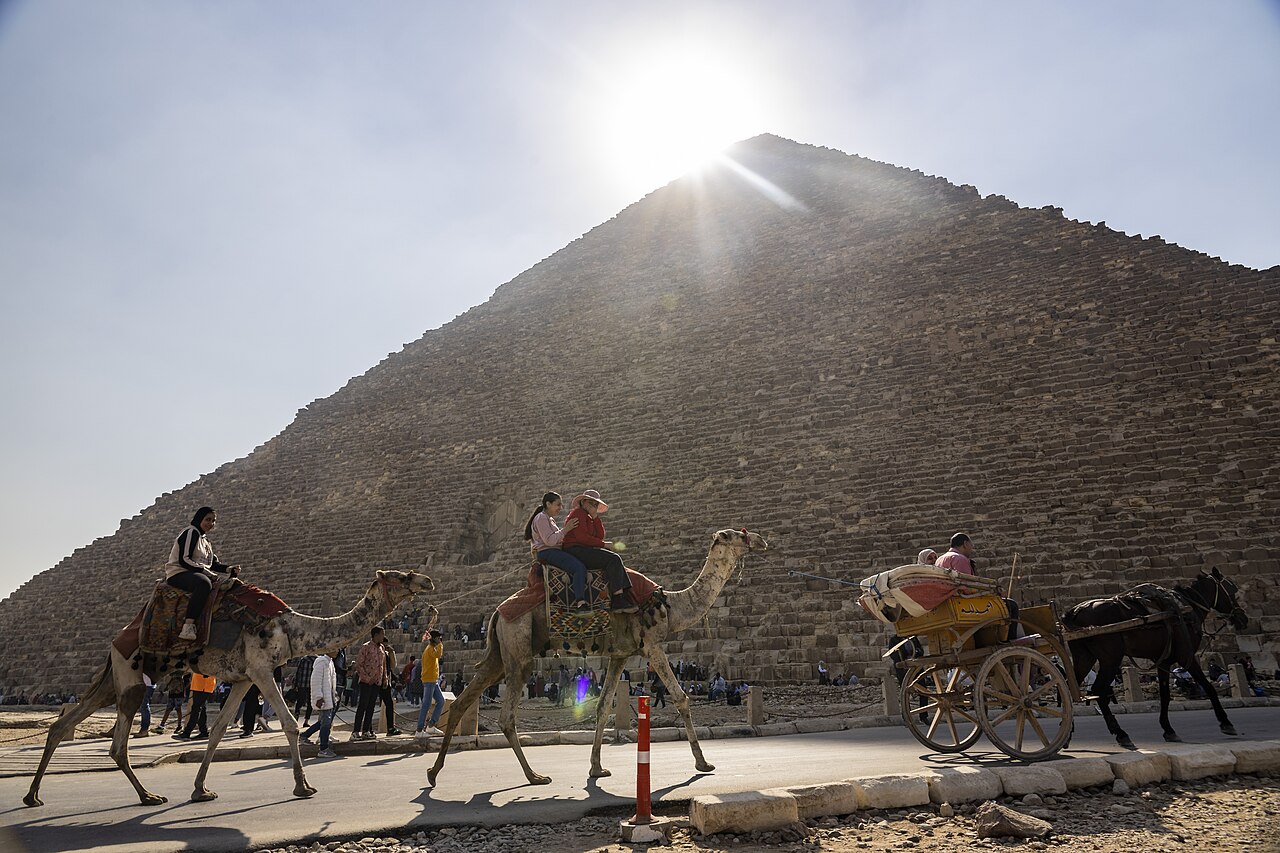
c. 2600 BC · Hemiunu
A sharply tapering mass of pale, weathered limestone blocks rising from a flat desert plateau, its once-smooth white casing long since stripped away to expose a rougher, stepped-looking core, alongside smaller pyramids and tombs on the same plain.
This pyramid served as the tomb of the pharaoh Khufu, built over about 26 years by quarrying an estimated 2.3 million blocks weighing roughly 6 million tonnes in total, most only roughly dressed and bound with mortar. Standing originally at 146.6 metres, it lost height to 138.5 metres as its smooth limestone casing was stripped away over time. It is the oldest of the Seven Wonders of the Ancient World and the only one to survive largely intact.
- It held the record as the tallest human-made structure on Earth for more than 3,700 years.
- Its base sides run about 230 metres each, enclosing a volume of roughly 2.6 million cubic metres.
Photo: Fora do Eixo (CC BY-SA 2.0)
Great Sphinx of Giza
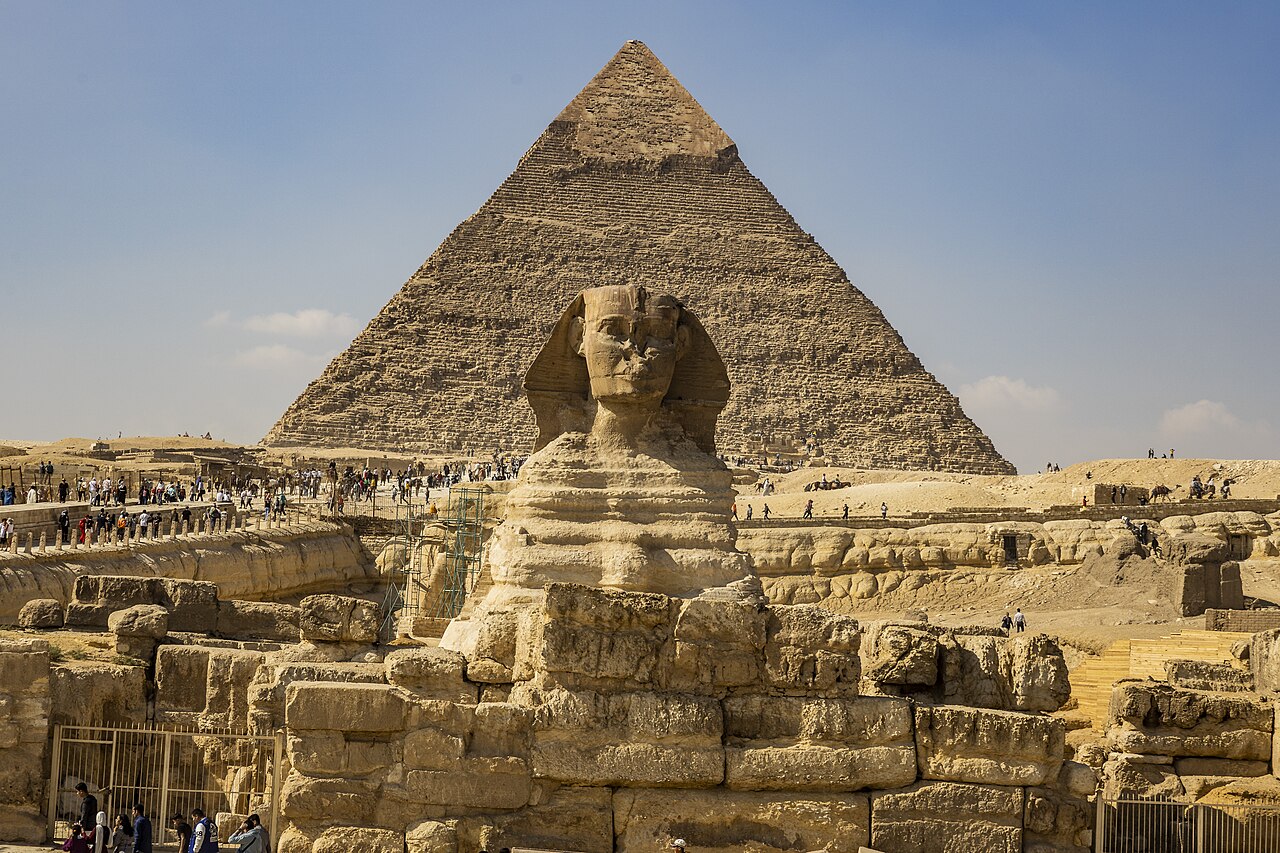
c. 2590–2532 BC
Carved from one outcrop of pale bedrock rather than built up from blocks, its long reclining body shows a weathered, rounded surface, a broken nose, and a missing beard, lying low beside much taller pyramids nearby.
Cut from the limestone bedrock of the Giza plateau, this is the oldest known monumental sculpture in Egypt, part of the wider Memphite Necropolis. It was carved during the Old Kingdom, in the reign of either Khufu or Khafre, and scholars still dispute whose face it represents. It has undergone several restorations, most recently replacing limestone blocks around its base. It measures 73 metres long, 20 metres high and 19 metres wide at the haunches.
- Its missing nose is often blamed on cannon fire, but tool marks show it was deliberately removed long before that story took hold.
- No consensus exists on which pharaoh's face it was carved to represent, despite over a century of study.
Photo: Fora do Eixo (CC BY-SA 2.0)
Cairo Citadel
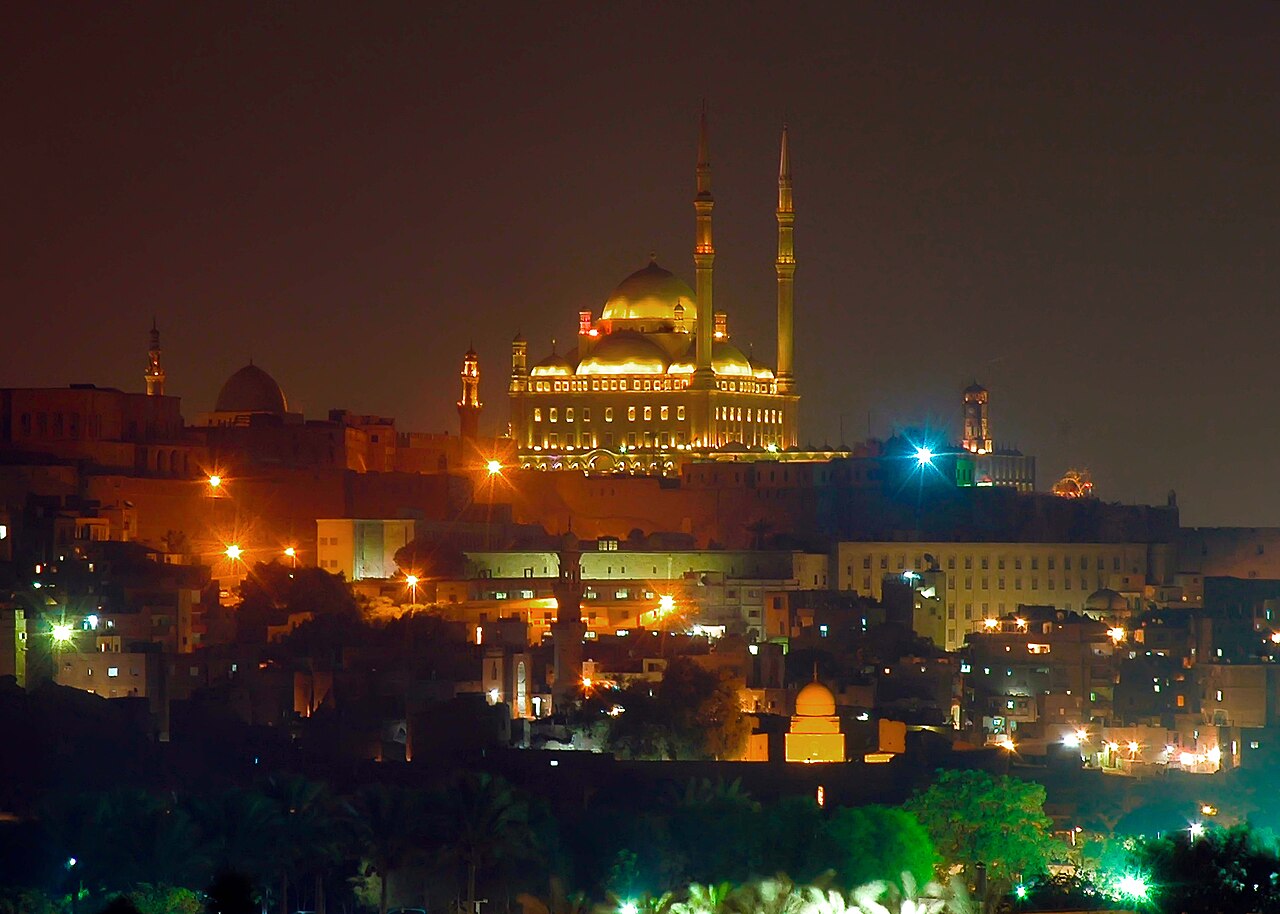
1176–early 19th century
A fortified compound of stone walls and towers crowning a limestone spur, its bulk dominating the surrounding rooftops from high ground, with mosques and museums enclosed within its walls.
Begun in 1176 as a defensive fortification, this citadel served as the seat of government and residence of Egypt's rulers for nearly 700 years. Later Mamluk sultans expanded it, and in the early 19th century Muhammad Ali Pasha demolished many older structures and rebuilt palaces and monuments across the site, giving it much of its present form. It served as a military garrison through the 20th century before opening to the public in 1983.
- It remained a working military garrison, first British and then Egyptian, until it finally opened to the public in 1983.
Photo: Jean nagah (CC BY-SA 4.0)
Pyramid of Khafre
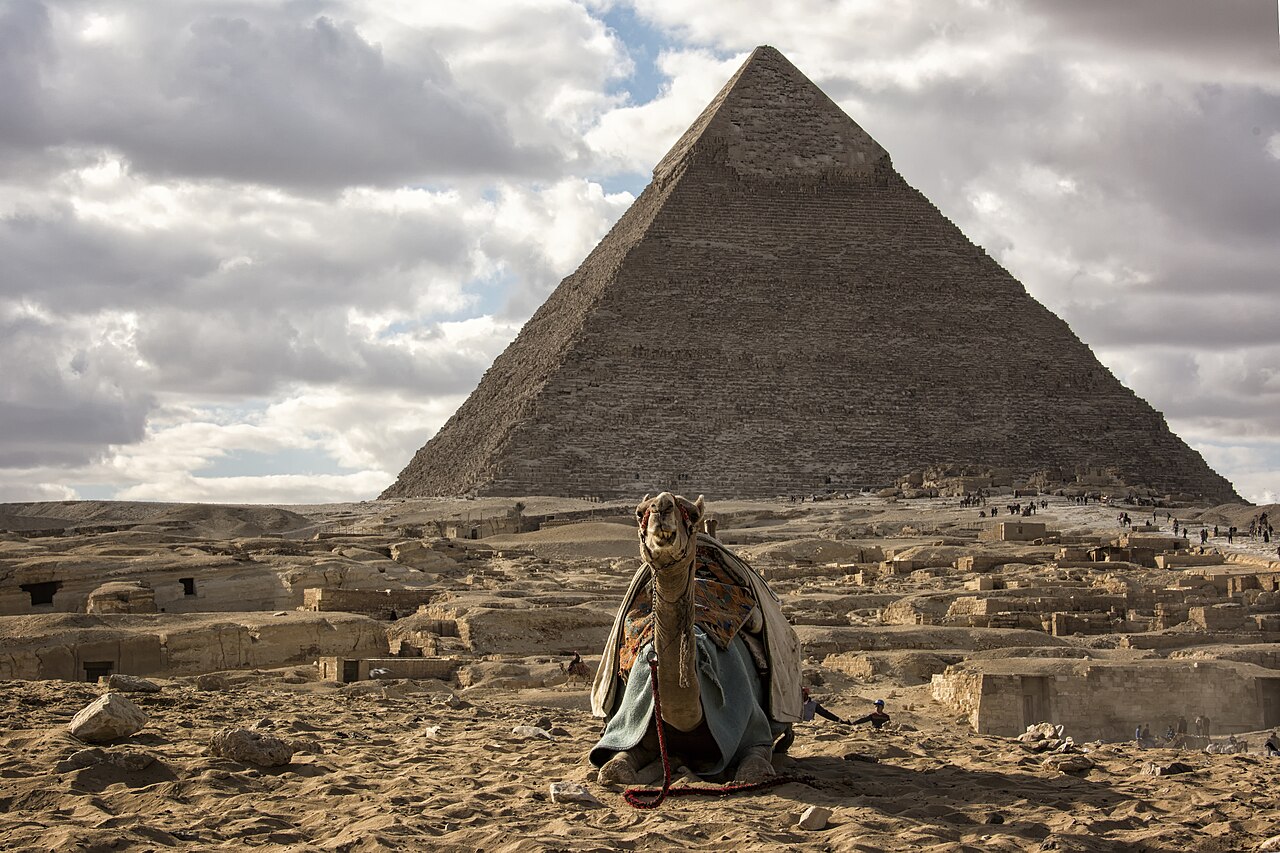
c. 2558–2532 BC
A pyramid appearing taller than its larger neighbor because it stands on higher bedrock, still wearing pale limestone casing across its upper third while the lower two-thirds show a rougher, stepped core, with a course of pink granite visible at its base.
Cut into the plateau's bedrock at the northwest corner and built up at the southeast to compensate for the slope, this pyramid holds the tomb of the pharaoh for whom it was raised, in the reign given as roughly 2558 to 2532 BC. Two offset passages descend from the north face to a rock-cut burial chamber roofed in gabled limestone beams, where explorer Giovanni Belzoni found only an open sarcophagus and animal bones in 1818. A 1960s scan using cosmic-ray muons searched part of its interior for hidden chambers and found none.
- In 1932, an American mountaineer died after falling from the pyramid's outer face while climbing it.
- Modern surveying shows the pyramid's sides align almost exactly with true north, evidence Old Kingdom builders used precise astronomical methods.
- The remaining casing stones are staggered by only a few millimetres at their corners, possibly from ancient seismic settling.
Photo: Myousry6666 (CC BY-SA 4.0)
Egyptian Museum
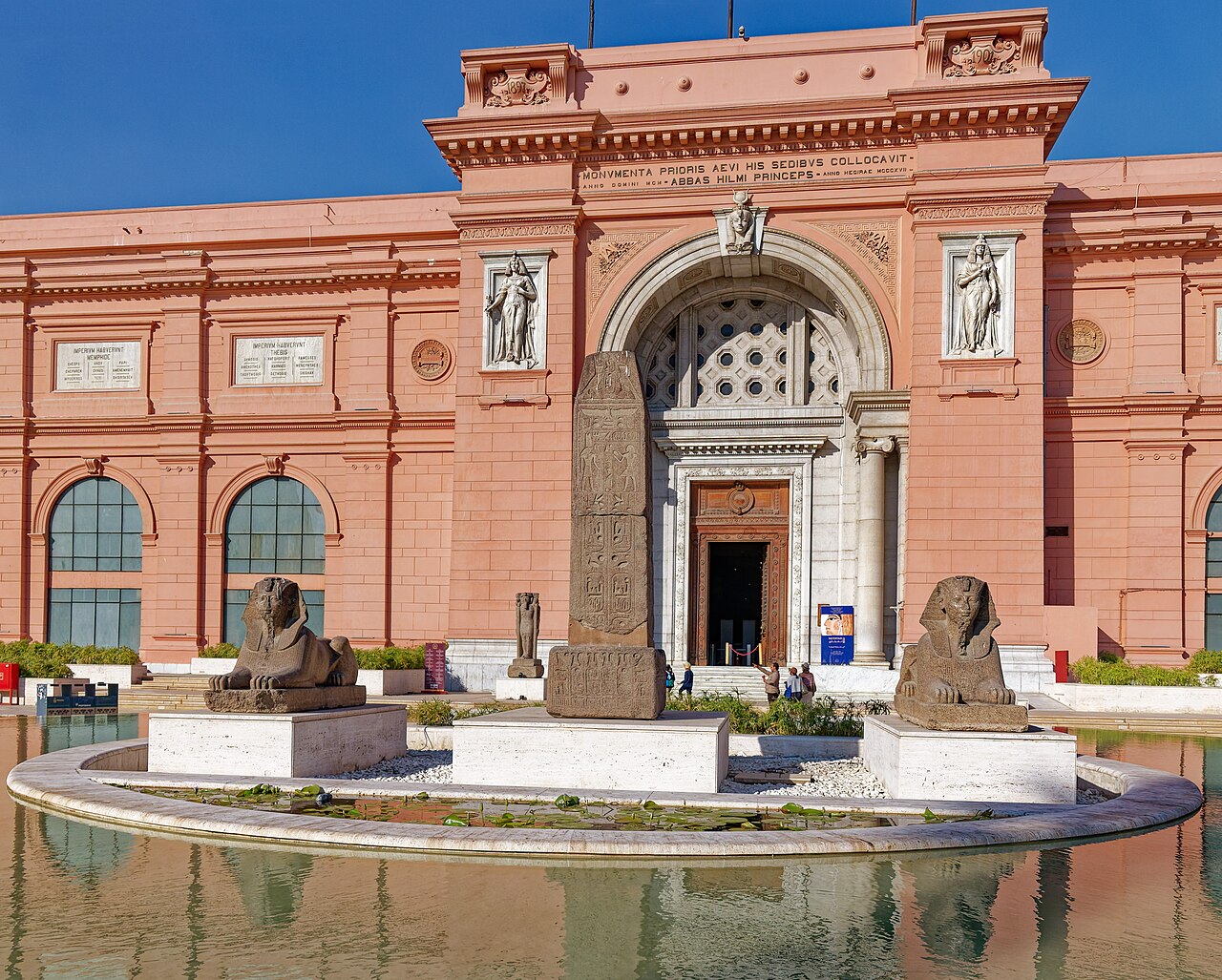
1897–1902 · Marcel Dourgnon
Galleries so densely packed with statues, coffins and funerary objects that the collection has been compared to a storage facility, with large stone statues arranged on the ground floor and funerary items displayed upstairs in chronological order, in a building facing a large open square.
Designed in 1897 by French architect Marcel Dourgnon and completed by German architect Hermann Grabe, this building on Tahrir Square opened on 15 November 1902 to house Egypt's national antiquities collection, after earlier homes at Ezbekieh Garden, Boulaq and a Giza palace proved too small or flood-prone. Its halls were arranged chronologically, with large stone statues on the ground floor and funerary objects upstairs; the collection grew so dense that one director compared it to a storage facility.
- During the 2011 uprising the museum was broken into; two mummies were destroyed and 54 objects were stolen, though most were later recovered.
- Part of an earlier royal collection was given away in 1855 to an Austrian archduke and is now held in Vienna's Kunsthistorisches Museum.
- Moving the collection to its current building in 1902 took roughly five thousand wooden carts and two trains that made about nineteen round trips.
Photo: Holger Uwe Schmitt (CC BY-SA 4.0)
Grand Egyptian Museum
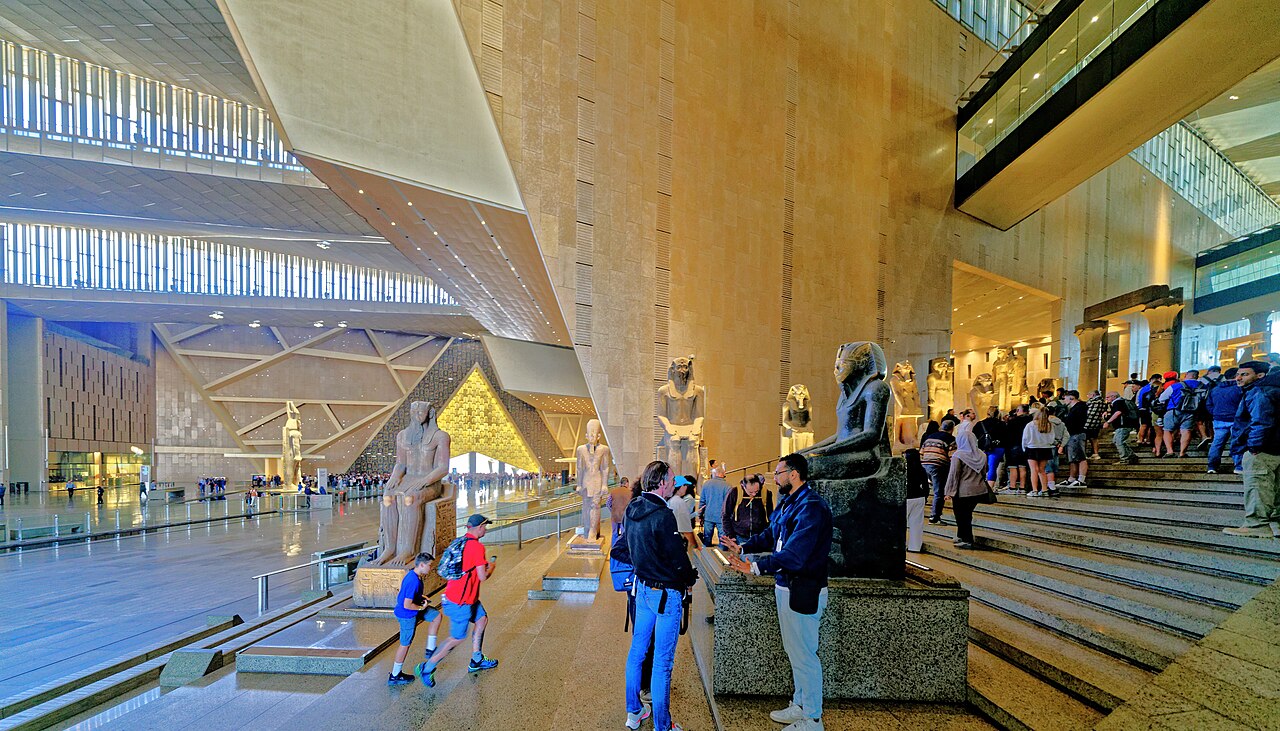
2005–2023 · Heneghan Peng
A vast glass-fronted building whose atrium offers a view of the pyramids outside, with a six-story staircase gallery lined with statues that rises toward an upper terrace looking out at the same view.
Designed by the Irish firm Heneghan Peng, led by Roisin Heneghan, this museum stands about two kilometres from the Giza pyramid complex and is the largest museum in the world dedicated to a single civilization. Construction began in 2005 and finished in 2023 at a cost of $1.2 billion, though repeated delays pushed the official opening to 1 November 2025. Its glass-roofed atrium displays an eleven-metre statue of Ramesses II, moved there in 2018, while a six-story staircase gallery leads visitors up through four thematic sections toward an upper terrace.
- The project was first announced in 1992 but faced so many delays that its 2025 opening came 33 years after the idea was proposed.
- The statue of Ramesses II in the atrium was moved from Ramses Square in Cairo in 2006 and not placed in its final spot until 2018.
- Its opening in July 2025 was postponed at the last minute because of the Twelve-Day War between Iran and Israel.
Photo: Holger Uwe Schmitt (CC BY-SA 4.0)
Al-Azhar Mosque
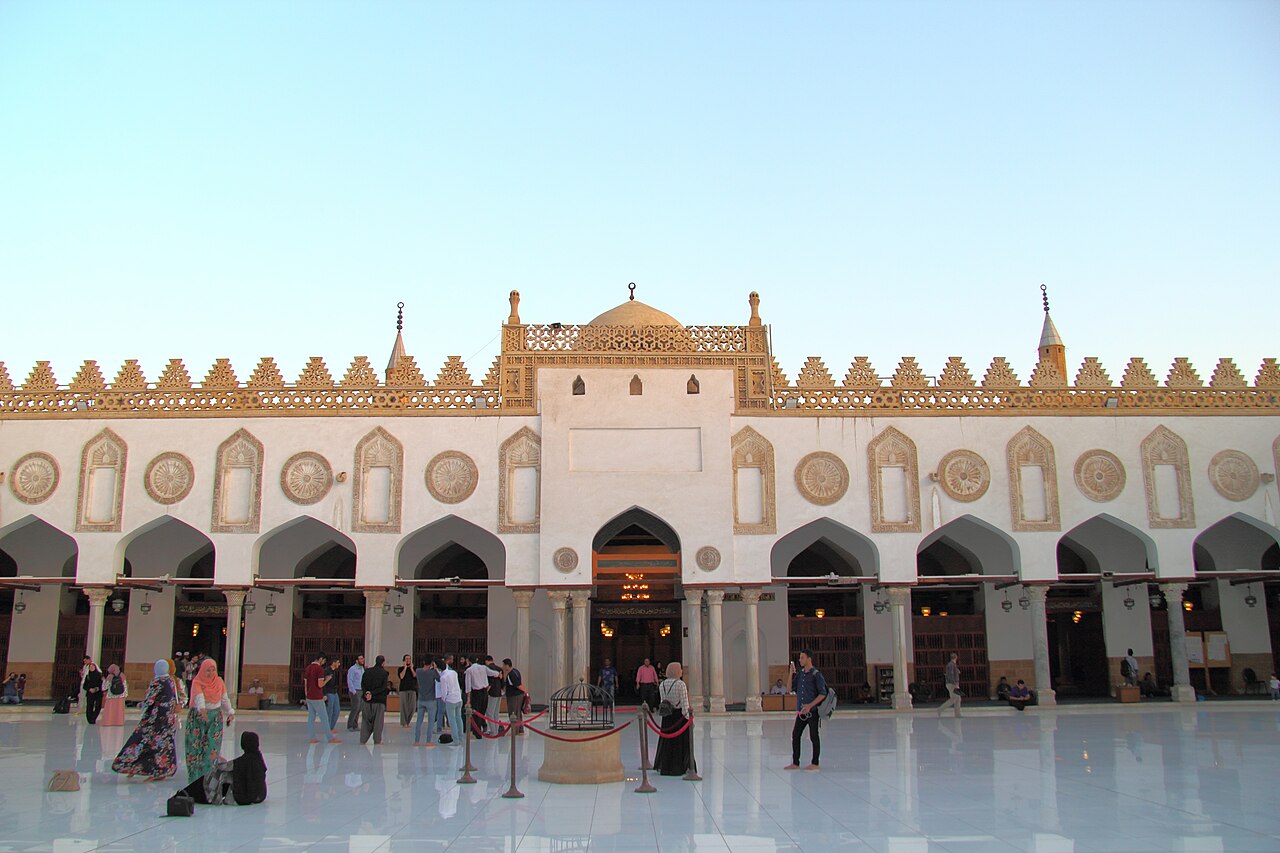
970–972
A limestone mosque courtyard bordered by pointed, keel-shaped stone arches and carved stucco decoration, with a domed portal marking the entrance to the covered prayer hall behind it.
Built of limestone quarried from the nearby Mokattam Formation, this mosque was commissioned in 970 by the general who founded the new Fatimid capital, with construction beginning that April and the first Friday prayers held in June 972. Sunni rulers who followed the Shia Fatimids initially stripped it of its congregational status, but Mamluk sultans restored and expanded it; a twelfth-century renovation under caliph al-Hafiz added the keel-shaped arches, carved stucco and domed entrance still visible in its courtyard. Its attached school became an independent university in 1961.
- Its name is thought to honor Fatima, daughter of the Prophet Muhammad, through her epithet "the shining one", though the theory is unconfirmed in Arabic sources.
- After the Sunni Ayyubid dynasty took power under Saladin, the mosque lost its status as a congregational mosque and its teachers went unpaid, a demotion later reversed under the Mamluks.
- Its university, folded into the mosque since its founding, was only made a separate, nationalized institution in 1961, after the Egyptian revolution of 1952.
Photo: Djehouty (CC BY-SA 4.0)
Mosque-Madrasa of Sultan Hasan
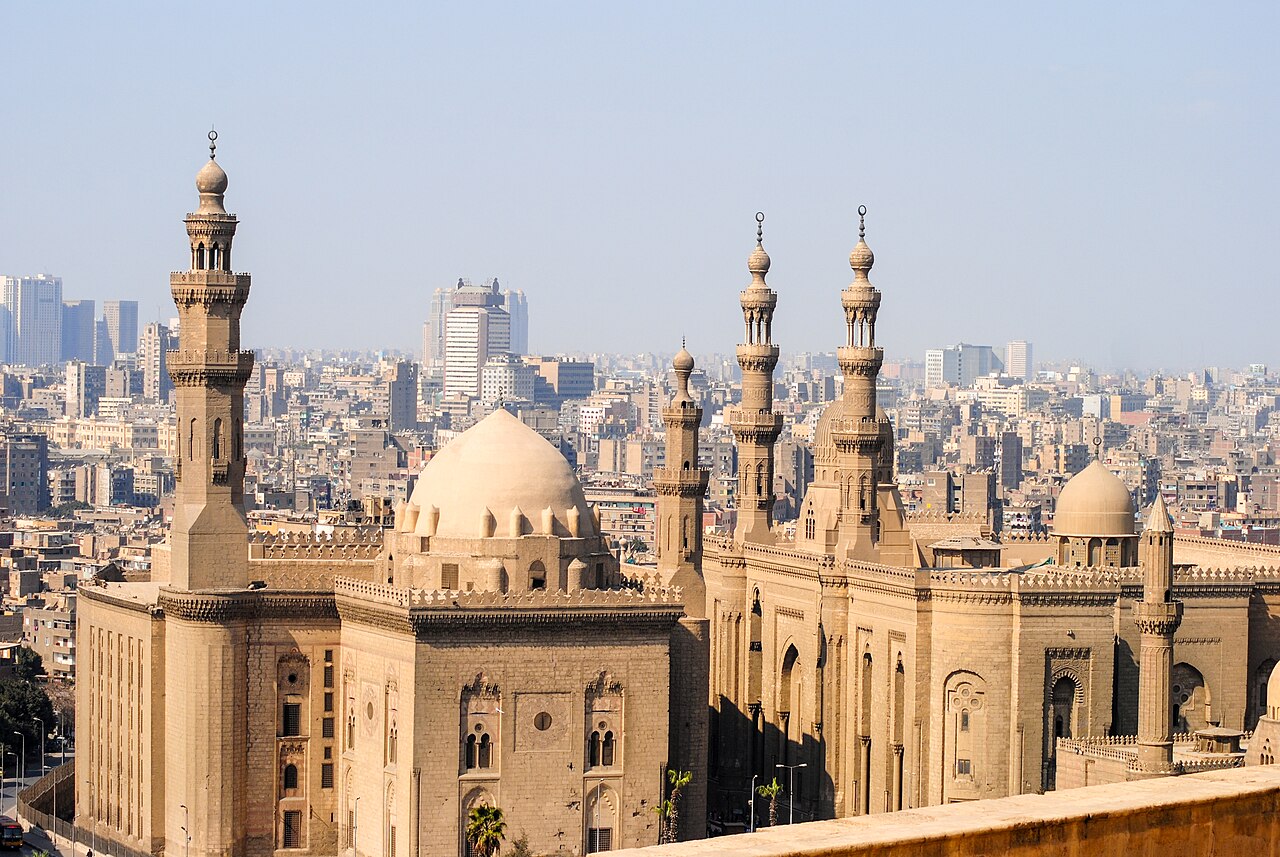
1356–1363
A vast, fortress-like limestone complex with towering plain walls and a soaring entrance portal, its scale rivaling the largest religious buildings of its era; a squat, differently shaped minaret and dome, rebuilt in the 1670s after the originals collapsed, distinguish it from its unaltered neighbors.
Commissioned by a sultan and built between 1356 and 1363 during repeated outbreaks of plague, this mosque and religious school in Cairo's historic quarter was financed partly by wealth the state seized from the estates of Mamluk emirs who died in the epidemic. Its enormous scale and cost, reportedly exceeding one million dinars, made it the most expensive mosque raised in medieval Cairo, drawing craftsmen from across the Mamluk empire. Because of its bulk and position near the citadel, rebels repeatedly used its roof to fire on the fortress, prompting several failed attempts to have it demolished.
- Limestone quarried from the Giza pyramids is believed to have been reused in its construction.
- The sultan who commissioned it was assassinated before its completion, and his body was never recovered — the mausoleum built for him never held him.
- In 1517 the last Mamluk sultan hid inside the mosque as Ottoman forces took the city, who responded by bombarding the building with cannonballs from the citadel above.
Photo: Hesham Ebaid (CC0)
Mosque of Ibn Tulun
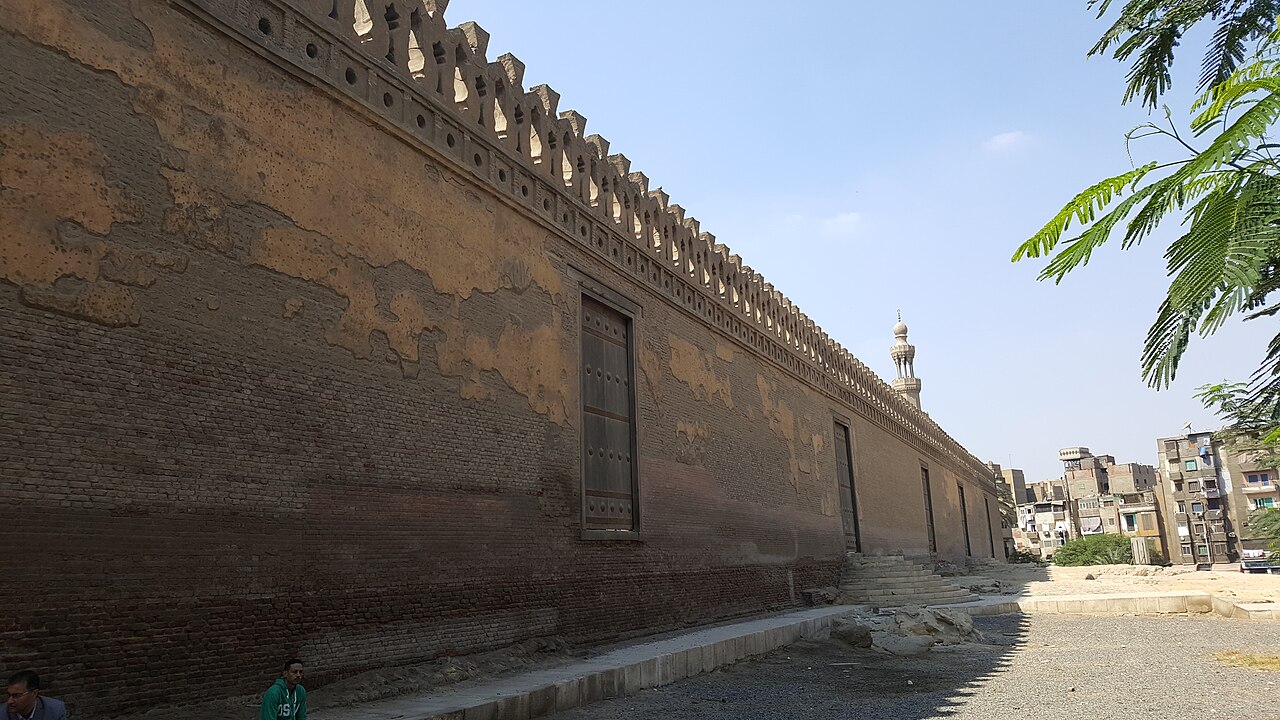
876–879 · al-Nasrani
A vast open courtyard ringed by tiers of plain, pointed brick arches on square piers, enclosed by an outer perimeter wall, with a squat minaret whose external spiral staircase winds around the outside of its shaft rather than climbing within it.
Commissioned around 876 by the Abbasid governor whose name it bears, this is the oldest well-preserved mosque in Egypt, raised as the congregational mosque of a short-lived administrative capital built northwest of Fustat. Its design followed the ninth-century mosques of Samarra in Abbasid Iraq: a huge courtyard ringed by arcades on square piers within an outer enclosure wall. When the surrounding capital was razed in 905, only the mosque and the governor's adjoining palace survived. After centuries of use and decades of nineteenth-century neglect as a hospital, warehouse and asylum, it was restored in the twentieth century.
- Local legend places the mosque's low hill as the spot where Noah's Ark came to rest, rather than Mount Ararat.
- A tenth-century historian names the architect only as "al-Nasrani" — literally "the Christian" — identifying him by religion rather than by a personal name.
- In the nineteenth century the building served in turn as a military hospital, a salt warehouse, a blacksmith's workshop and a mental asylum before restoration began.
Photo: Ovedc (CC BY-SA 4.0)
Muhammad Ali Mosque
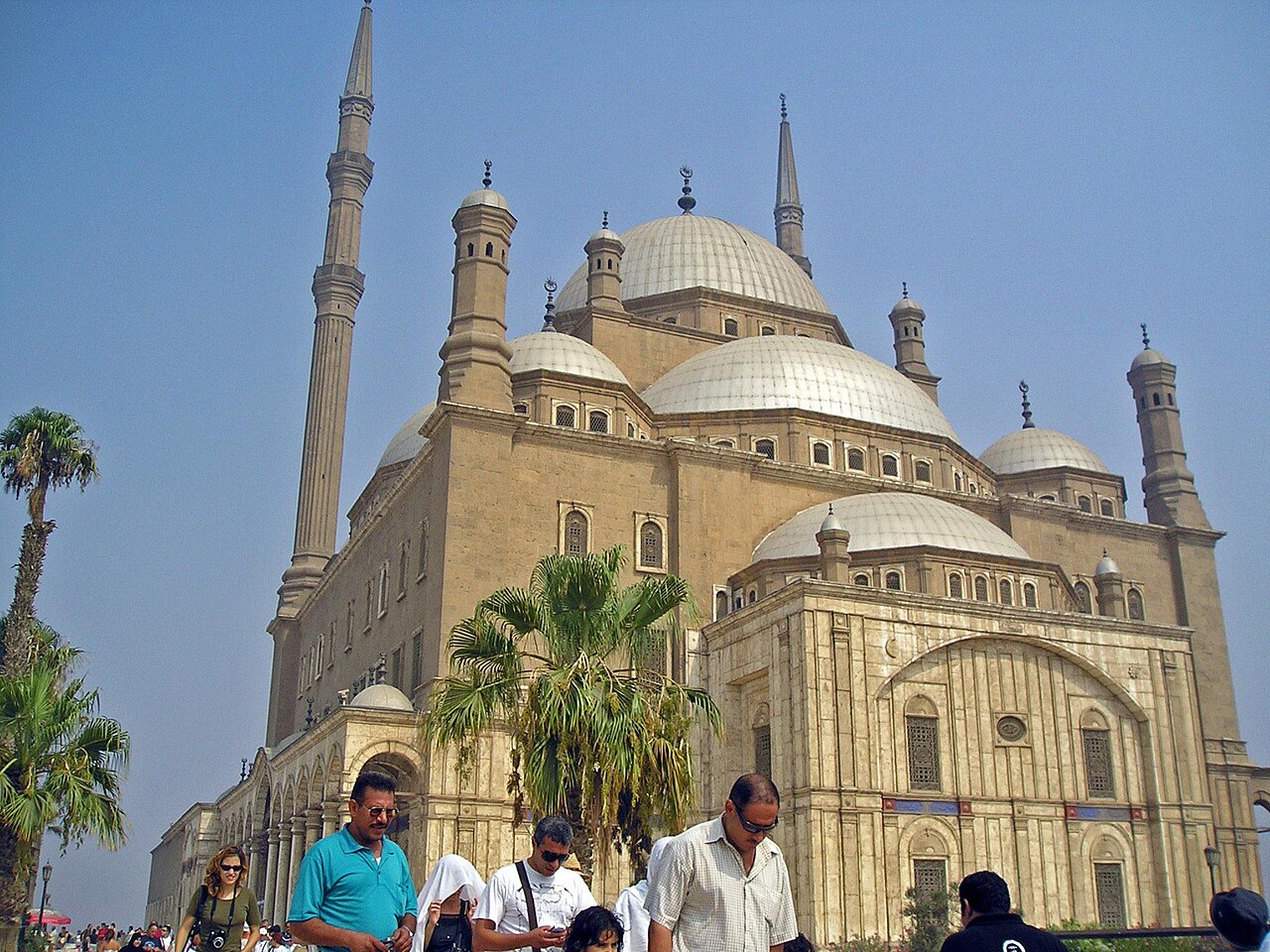
1832–1857
A large central dome, rebuilt in the 1930s to match its original silhouette, rises above smaller domes over a mosque whose lower walls and courtyard are faced in pale, faintly translucent alabaster, overlooking the city from high on a citadel.
Founded in 1830 inside the Cairo Citadel on a site cleared of older Mamluk palaces, this mosque was commissioned by the same Ottoman governor whose modernizing rule it commemorates. An initial neo-Mamluk design by French architect Pascal Coste was rejected in favor of an entirely Ottoman-style building begun in 1832, whose architect went unrecorded. Alabaster sheathes its lower walls and courtyard, chosen partly to revive a declining local industry. Structural problems forced its central dome to be dismantled and rebuilt in the 1930s to match the original design; decoration was only completed in 1857.
- Alabaster was used to sheathe the walls partly to revive a local industry that was then in decline, even though the material was otherwise ill-suited to construction.
- Structural faults found in the 1930s forced engineers to dismantle and rebuild the central dome using scaffolding weighing 590 tonnes, then decorate it to match the original so closely that the change is invisible today.
- The mosque's founder is buried inside in a tomb carved from Carrara marble, though his body was not moved there until 1857, decades after the building was founded.
Photo: Magellan (CC BY-SA 3.0)
Pyramid of Menkaure
The smallest of the three main pyramids of the Giza complex, built as the tomb of King Menkaure. With about a tenth of the volume of the pyramid of Khufu, it was left unfinished at the king's death and completed by successor Shepseskaf.
Sultan al-Ghuri Complex
A Mamluk funerary complex built by Sultan Qansuh al-Ghuri between 1503 and 1505, with two buildings facing each other on al-Mu'izz li-Din Allah Street. One side holds the sultan's mausoleum, a khanqah and a sabil; the other is a mosque-madrasa still open for prayer.
Manial Palace and Museum
A former Alawiyya dynasty palace on Rhoda Island in the Nile, preserved as a historic house museum. Its five distinctively styled buildings blend Fatimid, Mamluk, Ottoman, Andalusian, Persian and Levantine influences, set within Persian gardens inside a larger English landscape park.
Hanging Church
One of the oldest churches in Egypt, dating to the third century. Formally named Saint Virgin Mary's Coptic Orthodox Church, it belongs to the Coptic Orthodox Church of Alexandria and is commonly known as the Hanging Church.
Cairo Tower
A free-standing concrete tower on Gezira Island in the Nile, standing 187 metres tall. It was the tallest structure in Egypt for 37 years until 1998, and is often ranked as Egypt's second most famous landmark after the Pyramids of Giza.
Babylon Fortress
An ancient Roman fortress on the eastern bank of the Nile, built around 300 AD by Emperor Diocletian. Built to guard a canal linking the Nile to the Red Sea, its enclosure in Old Cairo now holds the Coptic Museum, a convent and several churches.
Aqsunqur Mosque
A mosque in the Tabbana Quarter of Islamic Cairo, between Bab Zuweila and the Citadel, also known as the Blue Mosque. It also serves as a funerary complex, holding the mausoleums of its founder Shams ad-Din Aqsunqur and its principal restorer, Ibrahim Agha al-Mustahfizan.
Mausoleum of Imam al-Shafi'i
A mausoleum in the City of the Dead honoring al-Shafi'i, founder of a school of Sunni jurisprudence, who died in 819. Built in Ayyubid style, its turbah and madrasa were established by Sultan Salah ad-Din in 1176, with a decorated coffin added in 1178.
Gayer-Anderson Museum
An art museum beside the Mosque of Ibn Tulun, in a house occupied from 1935 to 1942 by Major Robert Grenville Gayer-Anderson Pasha. It is a rare surviving example of 17th-century domestic architecture in Cairo, and displays his collection of furniture, carpets and curios.
Amr ibn al-As Mosque
The first mosque built in Egypt and one of the first in Africa, founded around 642 CE as the centre of Fustat, Egypt's new capital. For 600 years it was a major centre of Islamic learning, though reconstruction has left little of the original structure.
Ben Ezra Synagogue
A former synagogue in the Fustat part of Old Cairo, no longer active and now mainly a tourism site and Jewish museum. Its storeroom yielded the Cairo Geniza, a 19th-century find of about 400,000 manuscripts in Hebrew, Aramaic and Judeo-Arabic.
Church of St. George
A Greek Orthodox church within the Babylon Fortress in Coptic Cairo, dating to the 10th century or earlier. The present structure was rebuilt after a 1904 fire, with construction completed in 1909.
Coptic Museum
A museum in Coptic Cairo holding the largest collection of Coptic Christian artifacts in the world, founded by Marcus Simaika in 1908. Its facade was made to resemble that of the 12th-century Al-Aqmar Mosque, on land donated by the Coptic Orthodox Church.
Museum of Islamic Art
A museum holding one of the world's great collections of Islamic art, including rare woodwork, metalwork, ceramics, glass and manuscripts. It closed for renovation in 2003 and reopened in August 2010, after a restoration that cost nearly US$10 million.
Bayt al-Razzaz
A 190-room mansion in medieval Cairo's Darb al-Ahmar neighborhood, built between the late 15th and late 18th centuries. Abandoned in the 1960s, its eastern building was restored between 1977 and 2007 and now houses local artistic workshops.
The Mogamma
A government building on Tahrir Square, built between 1946 and 1949 as a centralized, all-in-one administrative complex after the square's British barracks were demolished. Its style reflects typical 1940s modernism, similar to government buildings of the same era built in Buffalo, New York, and Paris.
Cairo Opera House
The main performing arts venue in the Egyptian capital, part of Cairo's National Cultural Centre. It stands on the southern part of Gezira Island in the Zamalek district and is home to most of Egypt's finest musical groups.
Pyramid of Khentkaus I
A Fourth Dynasty two-stepped tomb at Giza, built for Queen Mother Khentkaus I, once known as the fourth pyramid of Giza. Egyptologist Miroslav Verner suggests a later phase may have been an attempt to convert it into a full pyramid, though the plan was abandoned.
History
The area now called Cairo was settled long before the city itself existed: pre-dynastic and early-dynastic communities lived here roughly six thousand years ago, and the Giza pyramid complex and the ancient cities of Memphis and Heliopolis all lie within today's urban footprint. Cairo proper dates only from 969, built up around and eventually superseding the older settlement of Fustat. Its major growth came under the Ayyubid and Mamluk dynasties, from the twelfth to the sixteenth centuries, when Saladin fortified a hilltop citadel as his seat of government and successive rulers filled the city with mosques and religious foundations. That historic core was recognised as a World Heritage Site in 1979, and Cairo has since grown into the largest urban agglomeration in Africa and the Arab world.