Landmarks in Jerusalem
Herodian megaliths, an Umayyad shrine and a Mamluk citadel share one small walled core.
Jerusalem's most recognisable structures cluster within the walled Old City, on and around the raised platform known in Judaism as the Temple Mount and in Islam as the Al-Aqsa compound. All three monuments described here are built of quarried stone, but from different eras: an enormous Herodian retaining wall raised in the first century BCE forms part of the platform itself, an octagonal Umayyad shrine crowned by a dome was added at its centre in the late seventh century, and a squat medieval citadel near one of the old gates was rebuilt by the Mamluks and Ottomans over far older fortifications. The result is a small, dense core where masonry from three different empires stands within a few hundred metres of one another.
Dome of the Rock
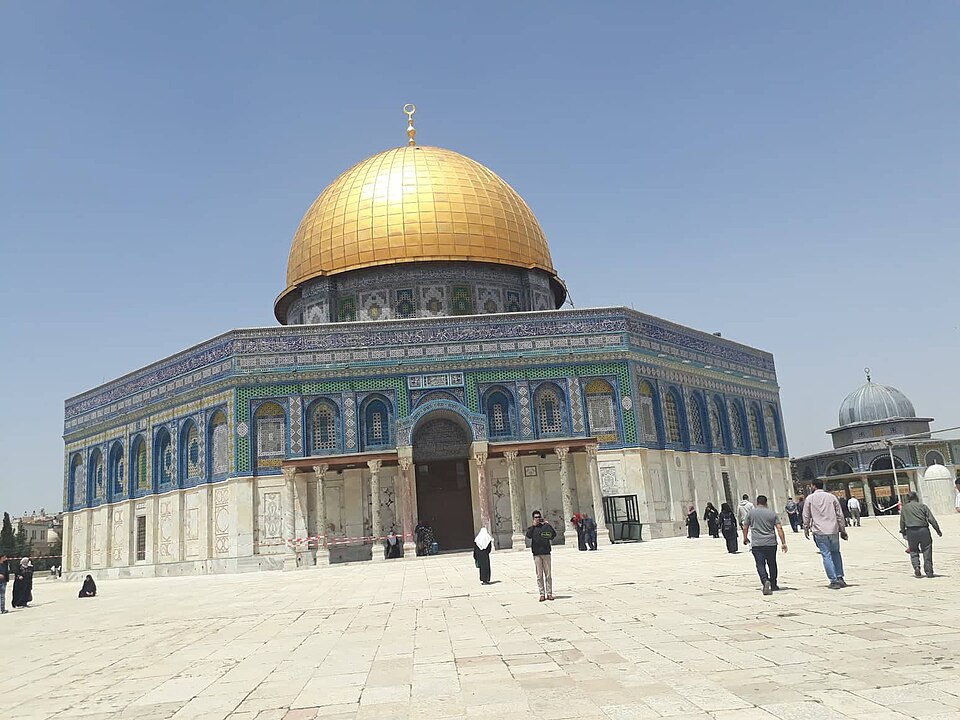
691–692
An octagonal shrine crowned by a dome and faced with mosaic decoration, standing alone at the centre of a raised, paved platform, built directly over an outcrop of bare rock enclosed within it.
This octagonal shrine at the centre of the Al-Aqsa mosque compound is the world's oldest surviving work of Islamic architecture. The Umayyad Caliphate built it on the orders of Caliph Abd al-Malik during the Second Fitna, a civil war, raising it over the Foundation Stone. Muslims associate the rock with Muhammad's Night Journey; Jewish and Christian tradition places Abraham's attempted sacrifice of his son at the same spot, and holds it as the site of the destroyed Second Temple.
- It holds the earliest surviving inscriptions proclaiming Islam and the Prophet Muhammad.
- Building work went ahead during the Second Fitna, a civil war within the early Islamic empire.
- Jewish and Christian tradition both place Abraham's attempted sacrifice of his son at this same rock.
Photo: Saifmja (CC BY-SA 4.0)
Western Wall
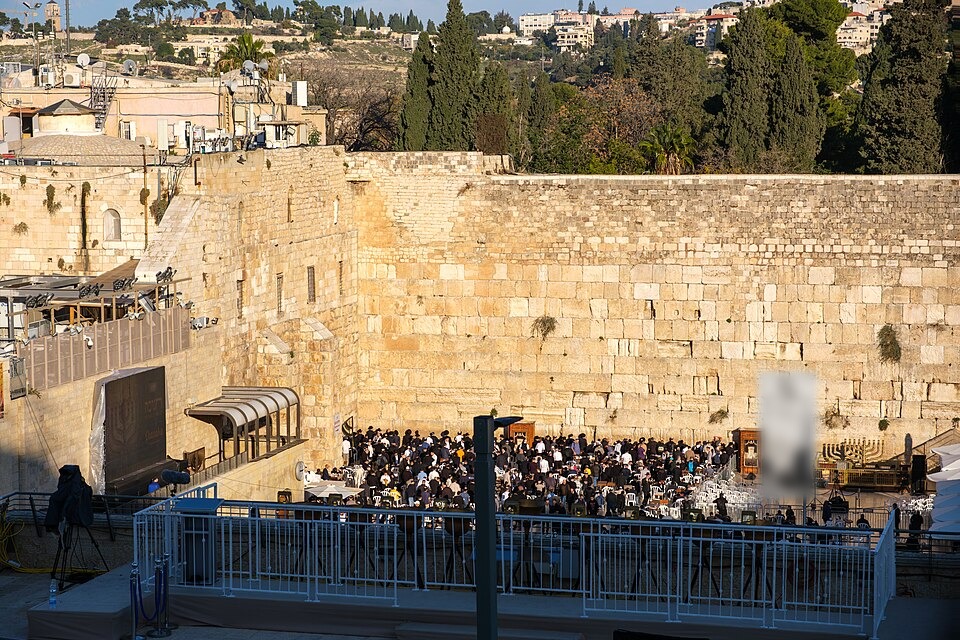
19 BC
Immense, precisely cut pale limestone blocks form its lower courses, some of them very large, giving way higher up to progressively smaller stones added in later centuries; a plaza runs along the base of this short stretch of a much longer 488-metre retaining wall.
This is part of a 488-metre ancient retaining wall built up around the Temple Mount, an artificial platform. Its lower half, of massive dressed stones, dates to the end of the Second Temple period and is believed to have been begun under Herod the Great; medium-sized stones above were added under the Umayyad Caliphate, and the smallest, uppermost courses are Ottoman-era. Jews pray at this section, known as the Kotel; others call it the Wailing Wall or the Buraq Wall.
- Jews call it the Kotel, others know it as the Wailing Wall, and Muslims call it the Buraq Wall.
- The full retaining wall runs 488 metres, though only a short stretch is used for prayer.
Photo: מקף־עברי (CC BY-SA 4.0)
Tower of David
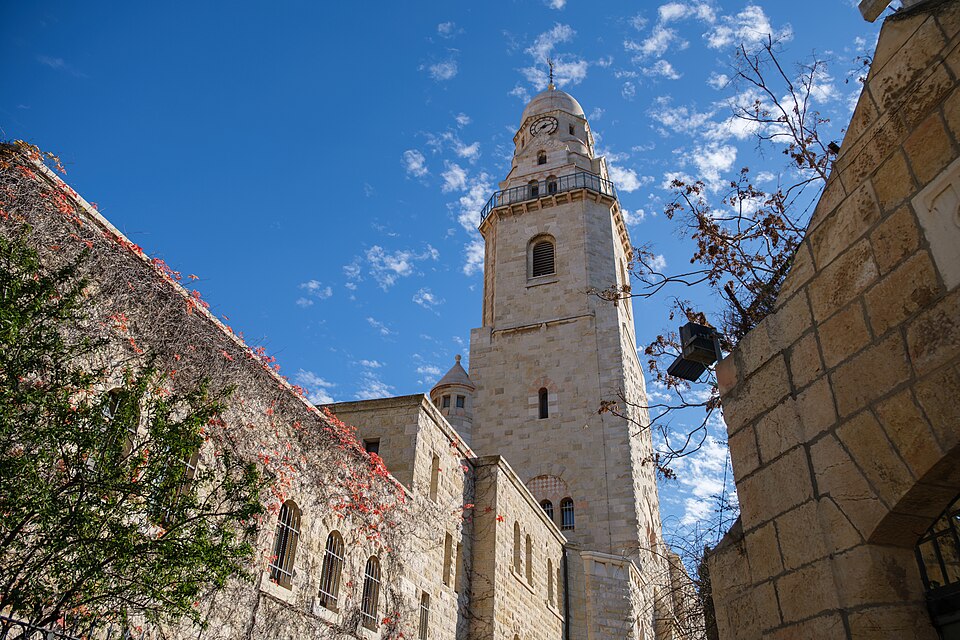
1310–17th century
A squat stone citadel with thick medieval walls, its most visible feature a slender minaret rising from one corner — the minaret, not the tower the site is named for, is the tallest and most conspicuous part of the structure.
This ancient citadel, now a museum, stands near the Jaffa Gate entrance to the Old City. The structure visible today dates to the Mamluk and Ottoman periods, replacing fortifications from the Hasmonean, Herodian, Byzantine and early Muslim eras that were destroyed repeatedly in the last decades of Crusader rule. It hosts benefit events, craft shows, concerts and sound-and-light performances, and held a series of art exhibitions in the 1920s.
- The name first described a Herodian tower on one side of the fortress; by the 19th century it referred instead to a 17th-century minaret on the opposite side, and only after 1967 came to mean the whole citadel.
- It hosted a wave of art exhibitions in the 1920s, a period some historians call the Tower of David Period in Israeli art.
Photo: מקף־עברי (CC BY-SA 4.0)
Temple Mount
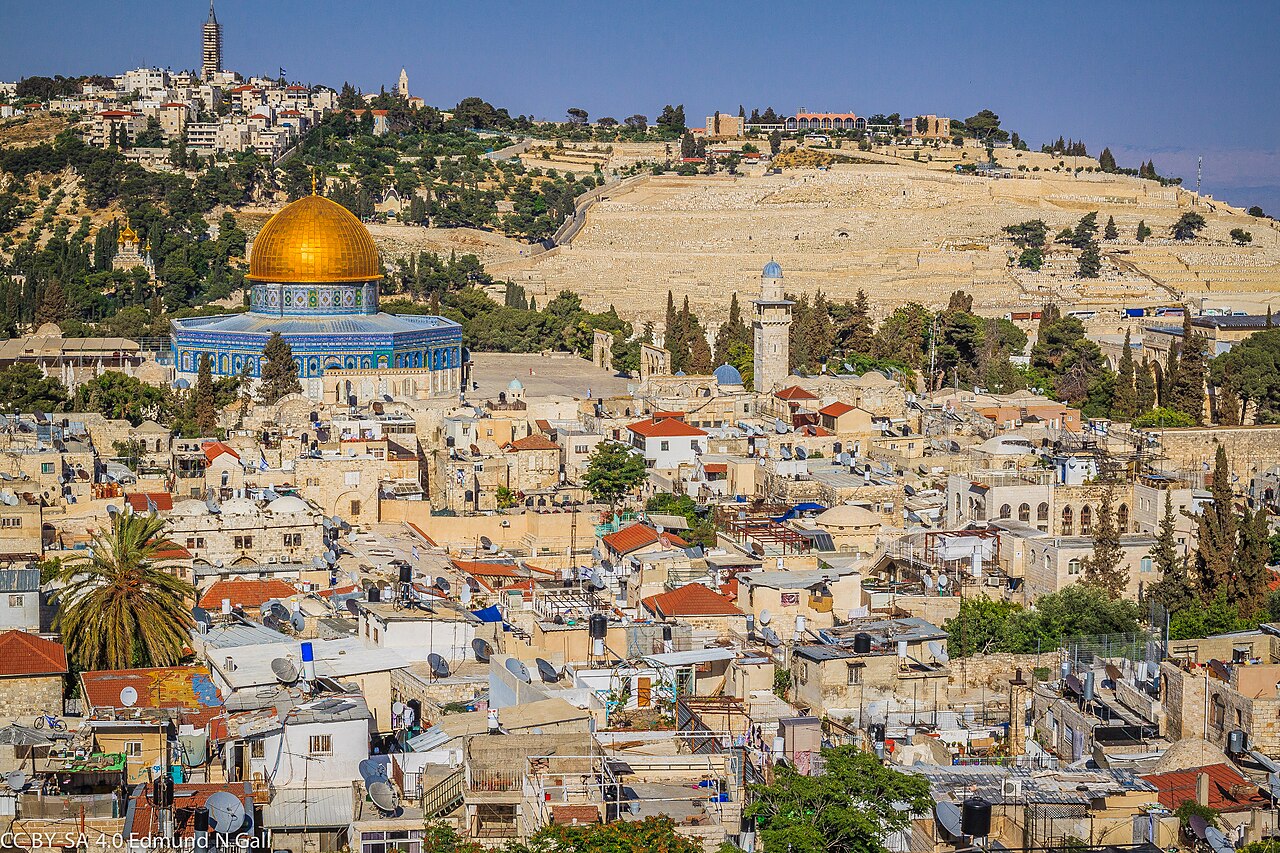
1st century BCE–692
A broad paved esplanade bounded by massive stone retaining walls, entered through arched gatehouses, lined on its northern and western edges by colonnaded porticoes, and marked by four minarets and two domed structures rising near its centre.
A raised, flat plaza in the Old City, venerated for millennia in Judaism, Christianity and Islam. Massive retaining walls enclose its esplanade, expanded by Herod the Great to support the Second Temple, which the Romans destroyed in 70 CE. Two monumental structures completed after the 637 Muslim conquest now dominate the platform, reached through eleven gates — ten for Muslims and one for non-Muslims — each watched by a nearby police post. The Jerusalem Islamic Waqf administers the site under Jordanian custodianship, while Israel controls its security.
- Its courtyard can hold more than 400,000 worshippers, making it one of the largest mosques in the world.
- Ten of its eleven gates are reserved for Muslim worshippers; only one admits non-Muslims.
- The Jerusalem Islamic Waqf has objected to the name "Temple Mount" itself, calling it a "newly-created Judaization term."
Photo: Edmund Gall (CC BY-SA 2.0)
Al-Aqsa Mosque
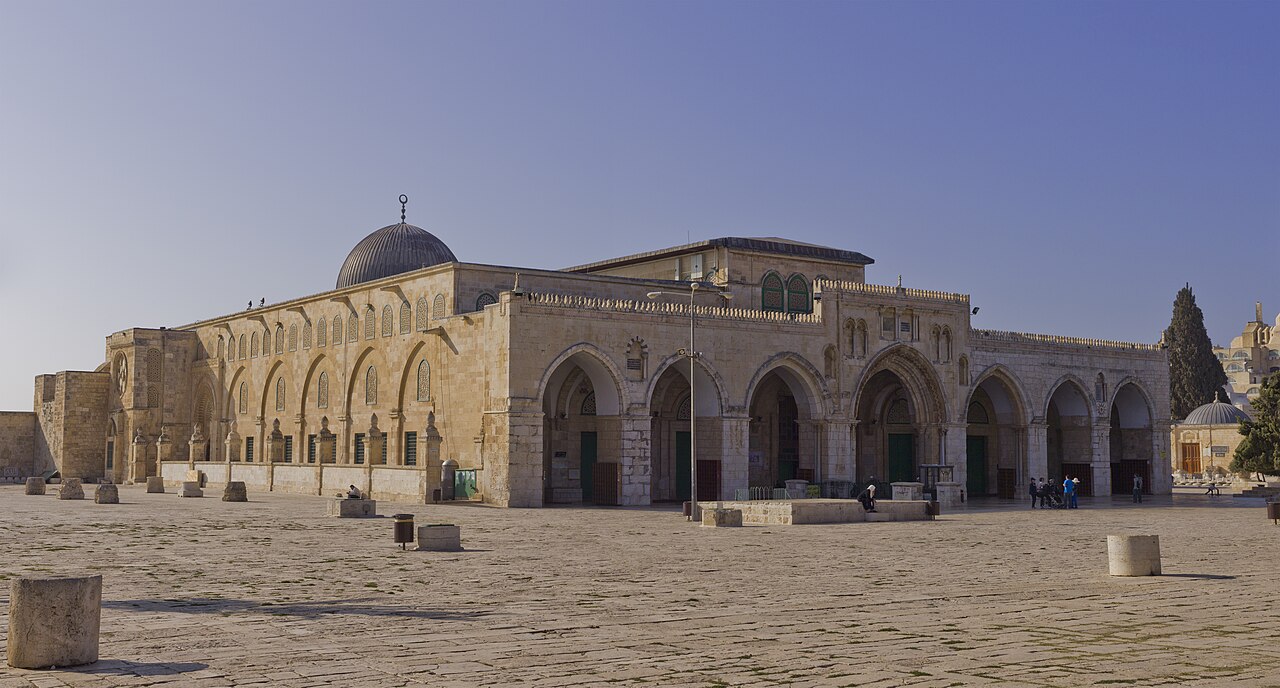
710–11th century
A rectangular hall roofed with a silver-grey dome, set along the southern edge of a paved compound, its colonnaded interior culminating in an elaborately mosaicked archway.
Earthquakes destroyed this prayer hall twice before the version standing today took its present form. Umayyad caliphs built the original congregational mosque here, on the south side of the compound, between 685 and 715; an earthquake toppled it in 746, and a second in 1033 brought down its Abbasid-era rebuild. The Fatimid caliph al-Zahir then rebuilt it with seven aisles and a mosaic-covered archway, an eleventh-century plan the building still follows. Crusaders later used it as a palace and a Knights Templar headquarters before Saladin restored its role as a mosque in 1187.
- Wooden roof beams removed during 1930s renovations were radiocarbon dated to as old as the ninth century BCE, showing they had been reused from far older buildings, though later re-examination pointed instead to a Byzantine origin.
- After the Crusader conquest of 1099 it served as a royal palace and then as the headquarters of the Knights Templar.
- A multicoloured mosaic floor uncovered beneath the mosque in the 1930s was never published, and its date is still disputed between Byzantine and Umayyad origins.
Photo: Godot13 (CC BY-SA 4.0)
Church of the Holy Sepulchre
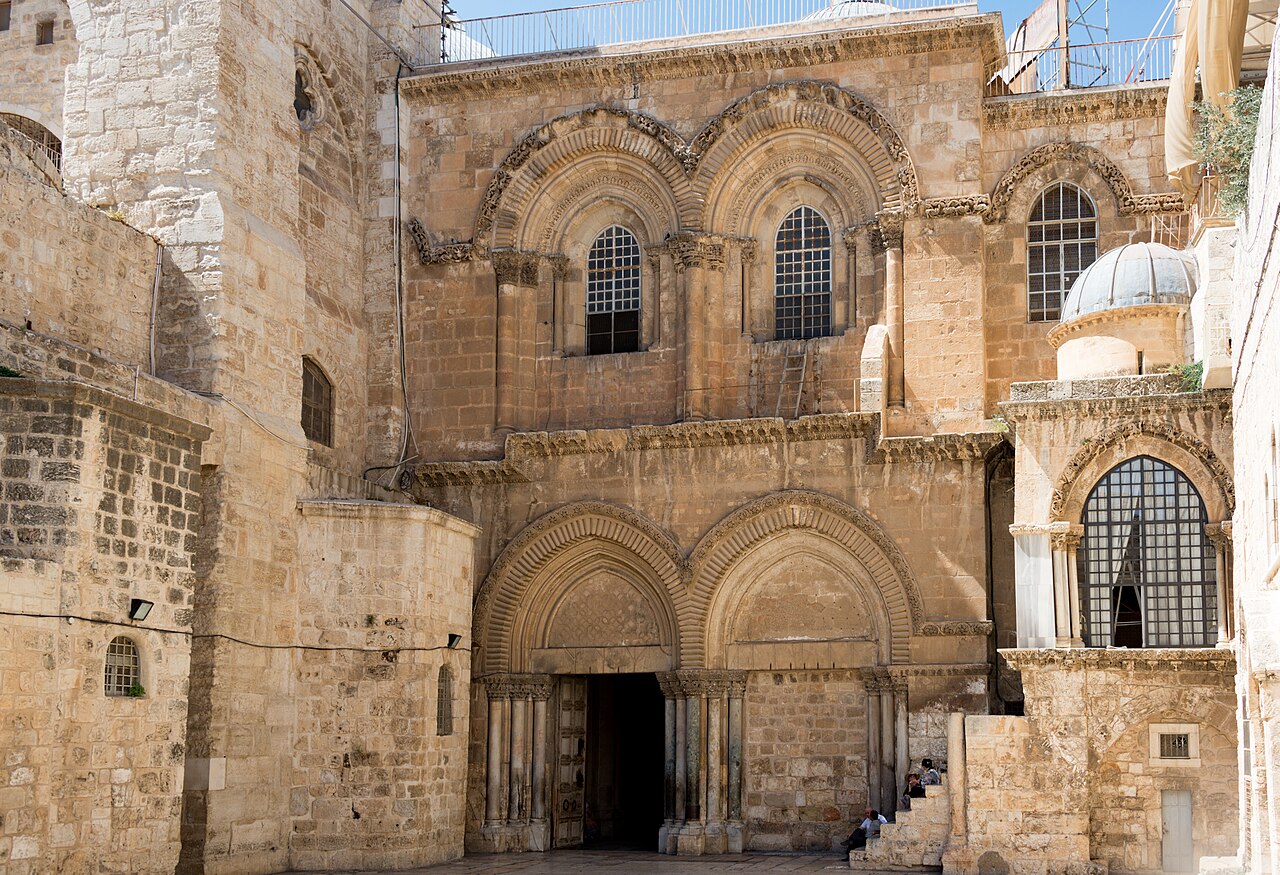
335–1048 · Zenobius
A domed rotunda, known as the Anastasis, shelters a free-standing marble shrine built in the nineteenth century over the tomb; adjoining it to the east, across a courtyard, stands the basilica known as the Martyrium, with the traditional site of Calvary in one of its corners.
Destroyed once and substantially rebuilt, this church marks the traditional sites of Jesus's crucifixion and burial. Consecrated in 335 under a design by the architect Zenobius, it was raised for Constantine the Great over a site earlier covered by a Roman temple. The caliph al-Hakim ordered it destroyed in 1009; Byzantine emperor Constantine IX Monomachos rebuilt it by 1048, and Crusader-era changes after 1099 departed significantly from that plan. A nineteenth-century marble shrine, the Aedicule, now encloses the tomb, and the building today is shared among six Christian denominations under a centuries-old status quo agreement.
- An earlier Roman temple to Venus, built around 135 CE, stood on the site until Constantine's builders uncovered the tomb beneath it around 325.
- Sharing of the church among denominations follows a 1757 arrangement known as the Status Quo, largely unchanged for more than 160 years.
- When the caliph Umar visited during the early Islamic period, he deliberately prayed outside rather than inside, fearing later generations might turn the church into a mosque.
Photo: xiquinhosilva (CC BY 2.0)
Walls of Jerusalem
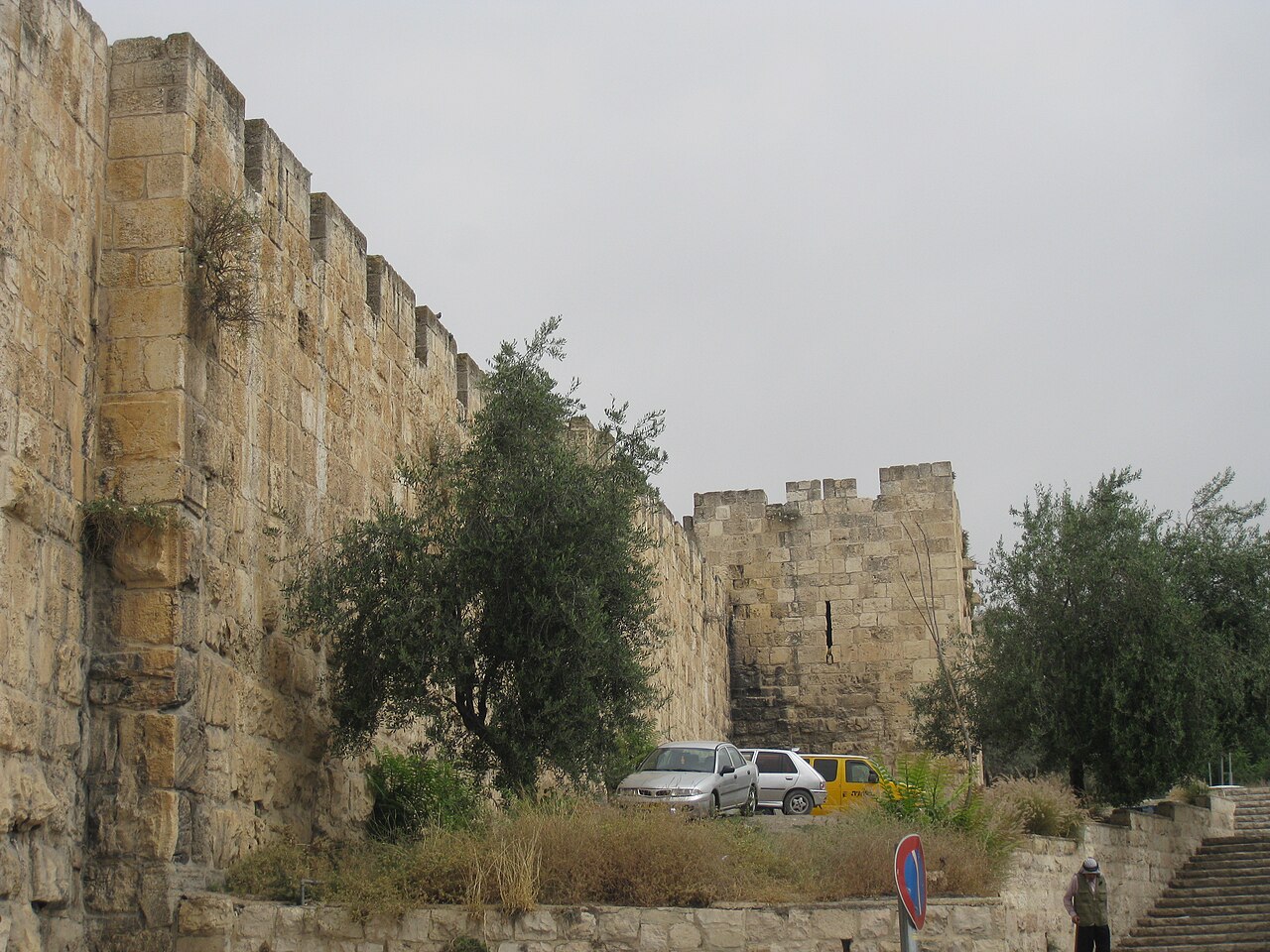
1537–1541
A continuous stone rampart just over four kilometres long and about twelve metres high, punctuated by 34 square watchtowers and pierced by seven main arched gates, with two further minor gates uncovered by archaeologists in modern times.
These fortifications encircle the roughly one-square-kilometre Old City. Jerusalem had stood without protective walls for nearly three centuries — since 1219, when a nephew of Saladin tore down earlier defences for fear Crusaders might reoccupy them — until Ottoman sultan Suleiman the Magnificent ordered the ruined walls rebuilt between 1537 and 1541, partly reusing older remains. The rebuilt walls run just over four kilometres, averaging twelve metres high and two and a half metres thick, with 34 watchtowers and seven main gates. They were added, together with the Old City, to the UNESCO World Heritage list in 1981.
- The city stood without any protective walls for nearly three centuries, from 1219 until the Ottoman rebuild of 1537–41.
- Two minor gates sealed for centuries have since been reopened by archaeologists.
Photo: Deror Avi (CC BY-SA 3.0)
Israel Museum
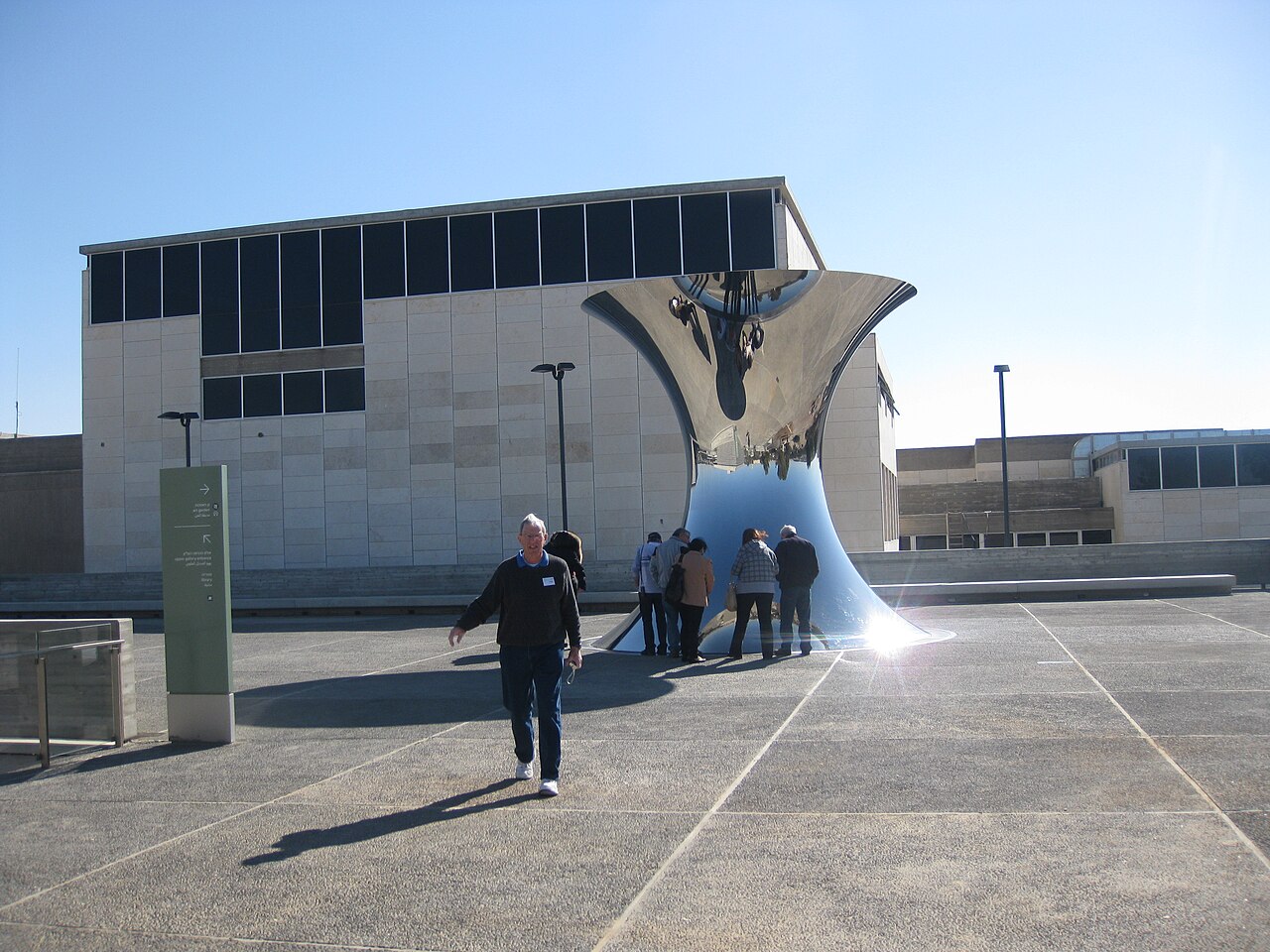
1965–2010 · Alfred Mansfeld
A cluster of low white masonry pavilions spreads across a hillside, linked since a 2010 renovation by a shared entrance pavilion and connecting passageways; nearby on the same grounds, a separate white dome shaped like a great urn lid rises from the ground to mark an underground shrine.
Established in May 1965 to designs by the Russian-born architect Alfred Mansfeld, this encyclopaedic museum grew into a collection of roughly 500,000 objects spanning prehistory to the present, including the world's most extensive holdings of Holy Land archaeology and of Jewish art and life. A hundred-million-dollar renovation led by Efrat-Kowalsky Architects, completed in 2010, rebuilt its archaeology, fine arts and Jewish life wings and linked them through a new entrance pavilion, with connecting passageways designed by James Carpenter. A separate urn-shaped building elsewhere on the grounds houses the Dead Sea Scrolls.
- In 1968 the museum paid a million dollars, raised through donations, for a thousand items from a collection assembled by Moshe Dayan, some of which had been acquired illegally.
- Its 2010 renovation, costing about a hundred million dollars, doubled the museum's gallery space.
- Annual attendance had doubled to more than 800,000 by the time its director completed a twenty-year tenure in 2017.
Photo: deror_avi (CC BY-SA 3.0)
Knesset
Israel's unicameral parliament, which meets in its building in the Givat Ram neighborhood of Jerusalem. It passes the country's laws and elects both the president and the prime minister.
Mount of Olives Jewish Cemetery
The oldest and most important Jewish cemetery in Jerusalem, its present grounds first leased from the Jerusalem Islamic Waqf in the sixteenth century. It holds between 70,000 and 150,000 tombs, making it the largest historical Jewish cemetery in the world.
Abbey of the Dormition
A Benedictine Catholic abbey on Mount Zion, just outside the Old City walls near the Zion Gate, said to mark where Mary ended her earthly life. It marked its centenary in 2006, having briefly been known as the Abbey of Hagia Maria Sion between 1998 and that year.
Via Dolorosa
A processional route through the Old City tracing the path tradition holds Jesus walked to his crucifixion, running about 600 metres from the former Antonia Fortress to the Church of the Holy Sepulchre. The current route, marked by 14 Stations of the Cross, has been fixed since the 18th century.
Gethsemane
A garden at the foot of the Mount of Olives where, according to the Gospels, Jesus underwent the Agony in the Garden before his arrest. Several small olive groves on adjoining church properties are identified with the biblical site today.
Four Sephardic Synagogues
A complex of four adjoining synagogues in the Jewish Quarter, the oldest of them, Eliahu Ha'navi, established around 1586. Built to serve Jerusalem's Sephardic community with each congregation following a different rite, most remain in active use today.
Tomb of Absalom
A monumental rock-cut tomb with a conical roof in the Kidron Valley, traditionally attributed to Absalom, the rebellious son of King David. Recent scholarship instead dates its construction to the first century AD.
Church of Saint Anne
A French Catholic church in the Muslim Quarter, near the start of the Via Dolorosa beside the Lions' Gate. It is also known as al-Madrasa as-Salahiyya, or Saladin's madrasa, reflecting an earlier use of the site.
Montefiore Windmill
A flour mill built in 1857 by the British philanthropist Moses Montefiore, facing the Old City's western walls. Restored in 2012 with new sails, it now houses a small museum on Montefiore's achievements.
David's Tomb
A shrine on Mount Zion traditionally linked, since the ninth century, to the burial of King David. It served as a major Islamic shrine under Ottoman and British rule, and occupies the ground floor of a former church whose upper story holds the Cenacle.
Cenacle
A room on Mount Zion, just outside the Old City walls, traditionally held to be the site of the Last Supper. According to the New Testament it was also where the Holy Spirit descended on the apostles at Pentecost, and it sits above the site known as David's Tomb.
Wilson's Arch
An ancient stone arch springing from the Western Wall, the first in a row that once supported a bridge linking the Temple Mount to the Upper City. Spanning 13 metres, the bridge carried both a street and an aqueduct, and the hall beneath the arch today serves as a synagogue.
Tomb of the Virgin Mary
A Christian church built around an ancient rock-cut tomb in the Kidron Valley, at the foot of the Mount of Olives. Believed by Christians to be the burial place of Mary, the mother of Jesus, it is governed by a 250-year-old Status Quo agreement between religious communities.
National Library of Israel
Israel's national library, formerly the Jewish National and University Library, located in the government complex near the Knesset. It holds more than five million books and owns the world's largest collections of Hebraica and Judaica.
Supreme Court of Israel
The highest court in Israel, with ultimate appellate jurisdiction over all other courts. Its 15 judges sit in the Givat Ram governmental campus, about half a kilometre from the Knesset, and serve until the mandatory retirement age of 70.
Rockefeller Archeological Museum
An archaeology museum beside Herod's Gate, funded by a donation from John D. Rockefeller Jr. and designed by the British architect Austen Harrison, blending Western and Eastern styles. Opened in January 1938 as the Palestine Archaeological Museum, it houses artifacts unearthed mainly in the 1920s and 1930s.
Monastery of the Cross
An Eastern Orthodox monastery in the Valley of the Cross, near the Nayot neighborhood, below the Israel Museum and the Knesset.
Knesset Menorah
A 4.3-metre bronze menorah opposite the Knesset, designed by the sculptor Benno Elkan and presented as a gift from the British Parliament in 1956. Modeled on the candelabrum that stood in the ancient Temple, its bronze reliefs depict episodes from Jewish history.
Dome of the Chain
A small free-standing domed structure beside the Dome of the Rock, erected by the Umayyads in 691-92 CE and among the oldest surviving buildings in the Al-Aqsa compound. It became a Christian chapel under the Crusaders before being restored as an Islamic prayer house by the Ayyubids.
Mamilla Cemetery
A Muslim cemetery in West Jerusalem dating back to the Crusades, its identity as an Islamic burial ground recorded by writers as early as the eleventh century. It holds Sufi shrines and Mamluk-era tombs around the central Mamilla Pool, and was used for burials until 1927.
History
The area's oldest visible stonework belongs to the Second Temple period: a retaining wall begun under Herod the Great supported the platform of a temple that stood until it was destroyed by the Romans in 70 CE. The site remained sacred afterwards, and in 691–692 CE the Umayyad Caliphate, on the orders of Caliph Abd al-Malik, raised a domed shrine over the exposed bedrock at the platform's centre during a civil war known as the Second Fitna. Later builders added to what already stood rather than starting again: Umayyad-era masons heightened the retaining wall with new stone courses, and after centuries of destruction and rebuilding through the Crusader period, the Mamluks and Ottomans raised the citadel and its minaret that still stand by the old gate today.