Landmarks in Amman
A Roman theatre, nymphaeum and citadel hill mark Amman's Philadelphia-era downtown core.
Amman's three catalogued landmarks cluster on and around Citadel Hill in the old downtown, the site of the ancient acropolis when the city was the Roman and later Umayyad settlement of Philadelphia. The Citadel itself spans the longest history, with Bronze Age fortifications overlaid by Roman, Byzantine and Umayyad building; the Temple of Hercules, a Byzantine church and the Umayyad Palace are what remain visible today. Downhill, the Roman Theatre and the Nymphaeum belong to the same 2nd-century building phase, cut and built into limestone slopes a short walk apart, alongside a vanished forum and Odeon. Everything the game shows from Amman predates the Ottoman abandonment and 1878 Circassian resettlement that reshaped the modern city around these ruins.
Amman Citadel
1800 BCE–8th century CE
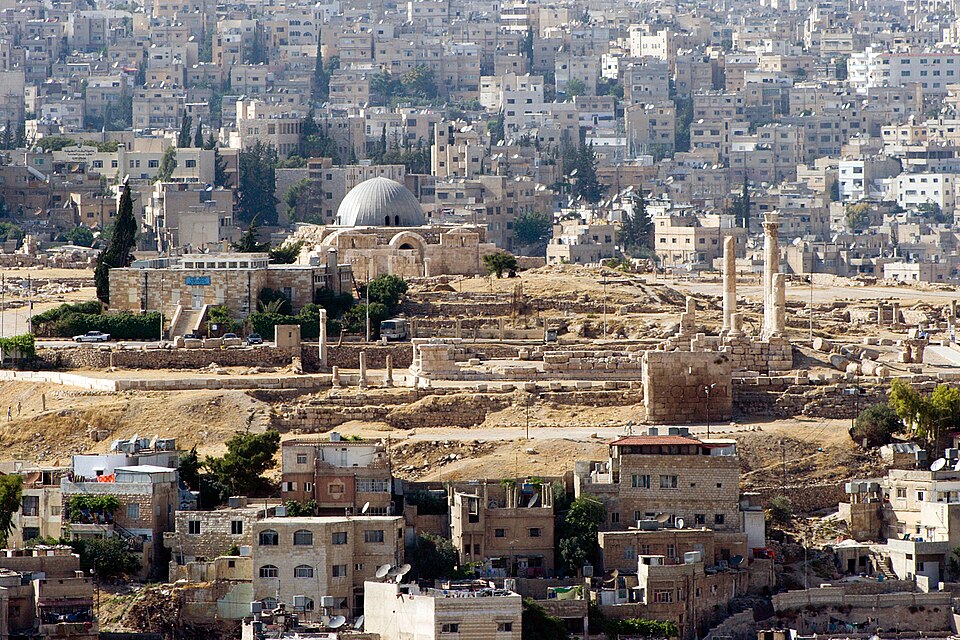
A broad, L-shaped hilltop platform overlooking the old town below, holding the ruins of a Roman temple, the walls of a Byzantine church, and the remains of an Umayyad palace complex laid out across the same ridge.
The Amman Citadel occupies an L-shaped hilltop that has been fortified since the Bronze Age and served as the capital of the Iron Age Kingdom of Ammon. Successive powers, including the Assyrian, Babylonian, Ptolemaic, Seleucid, Roman, Byzantine and Umayyad empires, built on the site, though the ancient city itself later spread across the surrounding valley while the hill functioned as an acropolis. Most of what survives today, the Temple of Hercules, a Byzantine church and the Umayyad Palace, dates from the Roman through Umayyad centuries. After the Umayyad period the site fell into ruin until Circassian refugees resettled in 1878.
- It is considered one of the world's oldest continuously inhabited places, with evidence of occupation since the Neolithic period.
Photo: David Bjorgen (CC BY 2.5)
Roman Theatre
138
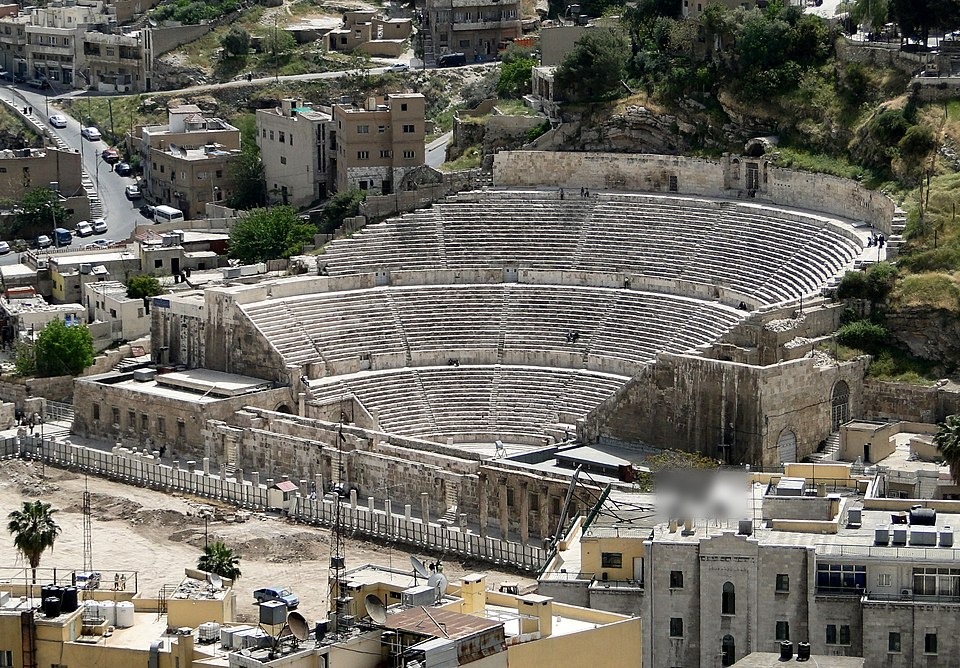
A steeply raked, semicircular bank of stone seating cut into a hillside and built to hold six thousand spectators; it flanks the modern Hashemite Plaza to the south, with the smaller Odeon across the same plaza and the Nymphaeum a short walk to the north-west.
The Roman Theatre is a 6,000-seat theatre built in the 2nd century AD, when Amman was known as the Roman city of Philadelphia. Cut into a hillside in the historic centre, it flanks the modern Hashemite Plaza to the south, with the smaller Odeon theatre across the same plaza to the east. The Nymphaeum, a ruined Roman public fountain, stands a short walk to the north-west. Together the three sites mark the core of Roman-era Philadelphia that survives in modern Amman.
Photo: Bernard Gagnon (CC BY-SA 4.0)
Nymphaeum
191
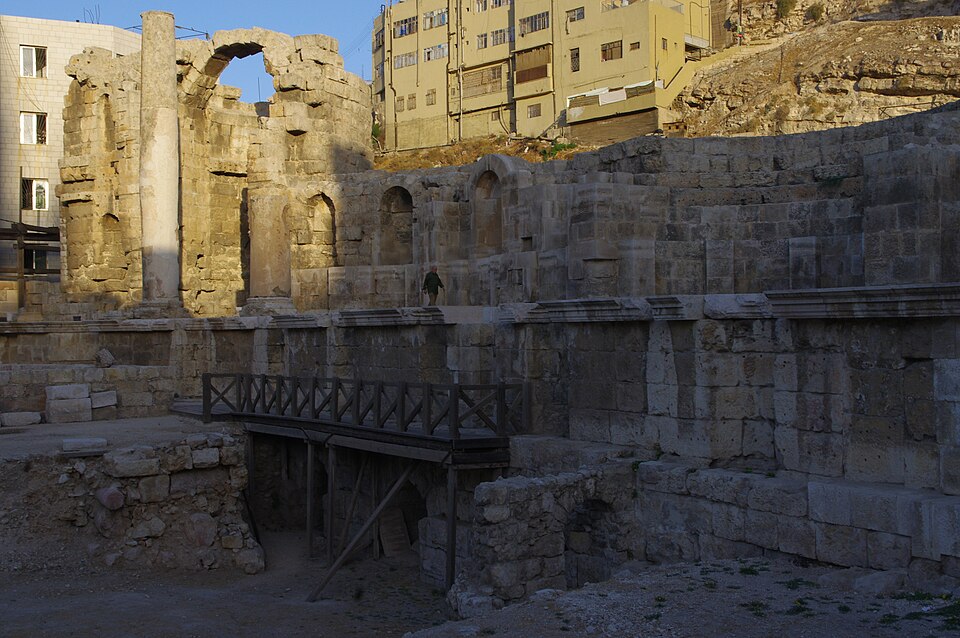
The partially preserved remains of a monumental Roman fountain beside a dried-up streambed in the old downtown, close to a Roman theatre and the site of the ancient forum, at the crossing of two streets named Ibn al-Atheer and Quraysh.
The Nymphaeum is a partially preserved Roman public fountain built in the late 2nd century AD, when such monumental fountains were common across Roman cities. It stood beside the Seil Amman, a stream that ran through the city until it dried up in the 20th century, close to the Roman Theatre, the Odeon and the city's ancient forum, on the site of the Hashemite Plaza. The fountain is thought to have held a pool of about 600 square metres, three metres deep, continuously refilled with water. It stands at the crossing of Ibn al-Atheer and Quraysh streets in Amman.
Photo: Ken and Nyetta (CC BY 2.0)
Grand Husseini Mosque
A Friday mosque built as an Omari mosque during the Umayyad Caliphate in the 7th century, on the site of an older Byzantine basilica. Demolished in 1924 on the orders of Abdullah I, it was rebuilt and renamed for his father, Sharif Hussein bin Ali.
King Abdullah I Mosque
Built between 1982 and 1989 in the Abdali area, this mosque is capped by a blue mosaic dome sheltering space for 3,000 worshippers. Tourists may visit if dressed modestly; a free hooded gown is provided to cover heads, arms and legs.
Royal Tank Museum
A military museum in Al Muqabalain, inaugurated on 29 January 2018, spanning some 20,000 square metres. It displays around 110 tanks and armored vehicles from Jordan and abroad in chronological order, designed by Jordanian architect Zaid Daoud.
Raghadan Palace
Jordan's first Hashemite royal residence, built from 1924 on an elevated site overlooking downtown after King Abdullah I secured British recognition of an independent government in Eastern Jordan. Its name, Raghadan, means prosperity and comfort.
Cave of the Seven Sleepers
An archaeological and religious site in ar-Rajib village east of Amman, rediscovered in 1951. Tradition holds it sheltered the Seven Sleepers, young men who fled the persecution of Roman emperor Decius around AD 250 and, by one account, emerged 309 lunar years later.
King Hussein Mosque
A mosque that also functions as a religious museum, combining a place of worship with exhibition space. It is the largest mosque in the country of Jordan.
Roman Baths
Roman bath ruins uncovered in downtown in 2020 during work on an underground rainwater drainage system. Two Roman statues and ceramics spanning the Roman, Byzantine, Umayyad and Ottoman eras were found, then the site was reburied in silica-rich sand for lack of excavation funds.
Abdoun Bridge
The country's only cable-stayed bridge, built across Wadi Abdoun between 2002 and 2006 by the Indian firm Larsen & Toubro. Part of Amman's Beltway project, it links South Amman to the Fourth Circle and Zahran Street.
St. George's Cathedral
A Melkite Greek Catholic cathedral on Mansour Street, seat of the Archeparchy of Petra and Philadelphia since it was created as the Archeparchy of Transjordan in 1932. Pope Benedict XVI visited the cathedral on 9 May 2009.
Raghadan Flagpole
A 126.8-metre steel flagpole at the Raghadan Palace compound, its flag hoisted by King Abdullah II on 10 June 2003. Visible up to 20 kilometres away, it held the world record for tallest free-standing flagpole, surpassing one in Abu Dhabi held since 2001.
Ayn Ghazal
A Neolithic archaeological site near Amman Civil Airport, on the banks of the Seil Amman stream close to its confluence with the Zarqa River. It is best known for the Ain Ghazal statues found there, among the oldest large human figures ever discovered.
Martyrs' Memorial
A memorial and museum next to Amman Sport City, inaugurated by King Hussein on 25 July 1977. It displays Jordan's military weapons, clothing and vehicles, honoring those lost since the 1915 Great Arab Revolt, and draws about 70,000 free visitors a year.
Rujm al-Malfouf
A round stone tower with storerooms in Jabal Amman, built around the 7th century BC by the Ammonite Kingdom. Reused in Roman and Islamic times and excavated between 1969 and 2022, it is now seen as serving agricultural and military roles beyond a simple fort.
Jordan Museum
Jordan's largest museum, built in 2014 in the Ras al-Ein district and established by a committee headed by Queen Rania. Its permanent exhibitions include the Dead Sea Scrolls, among them the Copper Scroll, and the 9,000-year-old Ain Ghazal statues, among the oldest human statues made.
Ten Arches Bridge
A viaduct completed in 1904 as part of the Ottoman-era Hejaz Railway, among the oldest in the city. Allied forces targeted it for destruction in a failed World War I attack, and a 2022 analysis found it sound but at risk from a strong earthquake.
King Abdullah II Stadium
A multi-purpose stadium in Amman, used mainly for football matches. It holds 13,265 people.
Friday Market
A flea market on Al-Talyani Street that runs every Friday from dawn prayer until midday prayer. On market day the street turns from used-clothes trading into public auctions selling birds, dogs, reptiles and even foxes, drawing shoppers from every class.
Jordan National Gallery of Fine Arts
A contemporary art museum in Jabal al-Luweibdeh, established by the Royal Society of Fine Arts and inaugurated in 1980 under King Hussein and Queen Noor. Its permanent collection holds over 2,000 works by more than 800 artists from 59 countries, mostly in Asia and Africa.
Royal Automobile Museum
An automobile museum in Amman. It was the first public automotive museum to open in the Arab region.
St. Joseph's Church
A Catholic church in Jabal Amman, also called the Latin Church of Jabal Amman and dedicated to Joseph of Nazareth. In 2015 it sheltered refugees who had fled the war in Iraq, part of an effort after King Abdullah II invited Iraqi Christians to Jordan.
Al-Mufti House
A house at the intersection of Rainbow Street and Mango Street in Jabal Amman, roughly 70 years old. A stair-stepped stone wall covered in ivy, fronted by a heavily wooded yard, separates it from the street.
Al Hussein Public Parks
A public park, still under construction, planned around a cultural village, sports fields, an amphitheater and decorated gardens. It is also meant to house a memorial building and a historical passageway, alongside the Royal Automobile Museum, King Hussein Mosque and the Children's Museum Jordan.
Rotana
A 188-metre glass-clad hotel tower in Al-Abdali, managed by Rotana Hotels and the tallest building in Jordan. Aluminum panels run up its facade as sun breaks, and its pool sits on the sixth floor atop a five-storey podium.
History
Settlement here reaches back to the 8th millennium BC at 'Ain Ghazal, but the hill above today's downtown became a capital in the Iron Age, when Rabat Aman ruled the Ammonite Kingdom. Greek conquerors renamed the city Philadelphia in the 3rd century BC, and it passed through Nabataean and Roman hands before the Rashidun Caliphate restored the older name Amman in the 7th century. Prosperity and devastation alternated through the following Islamic centuries, and by the 15th century the city stood largely abandoned; it stayed that way until 1878, when the Ottoman Empire resettled Circassian refugees on the site. A rail connection to the Hejaz line and a first municipal council in 1909 set off renewed growth, which accelerated sharply after Amman became the capital of Transjordan in 1921 and absorbed successive waves of Palestinian, Iraqi and Syrian refugees.