Landmarks in Accra
Dutch, British and Danish forts still stand along Accra's shoreline within a few miles.
Every landmark covered here is a seventeenth-century coastal fortification standing within a few kilometres of the others, in the old quarters of Ussher Town, Jamestown and Osu that later merged into modern Accra. Three rival trading powers built them in close succession: the Dutch raised Fort Crèvecœur, now Ussher Fort, in 1649; England's Royal African Company built Fort James in 1673; and Denmark–Norway raised Fort Christiansborg, now Osu Castle, in the 1660s. Each anchored its own settlement and its own share of the gold and slave trade moving through the coast. All three remain walled and defensive rather than civic in form, and all three are inscribed together on the UNESCO World Heritage List.
Osu Castle
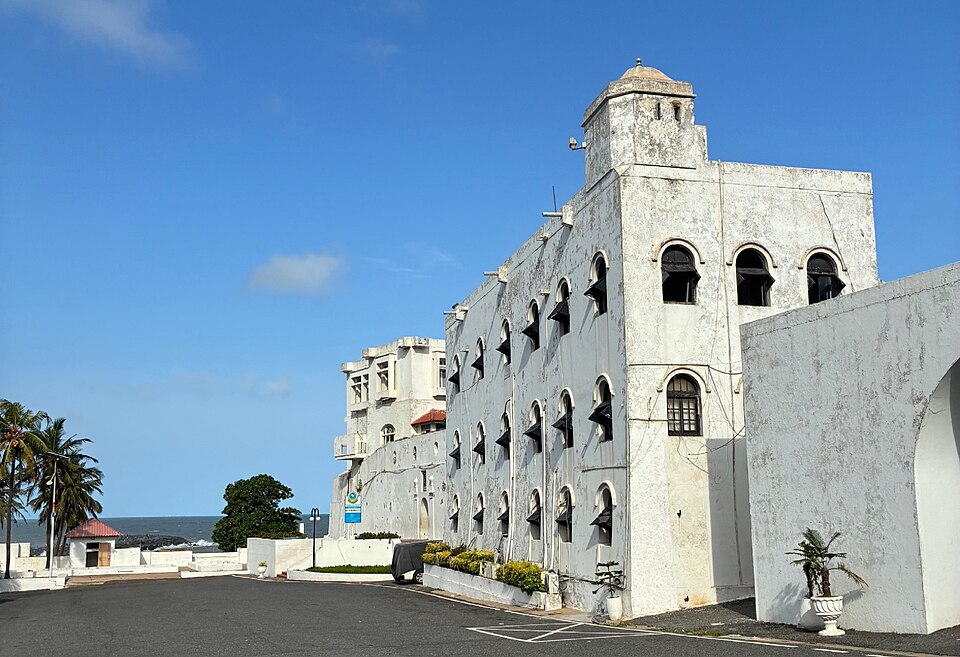
1661
The largest and most elaborate of the area's three colonial coastal fortifications — a walled castle rather than a small trading fort — standing directly on the shoreline facing the Gulf of Guinea.
Raised by Denmark–Norway in the 1660s as Fort Christiansborg, this coastal castle changed hands repeatedly afterward, passing between Denmark–Norway, Portugal, the Akwamu kingdom, Britain and, eventually, independent Ghana. Under Danish control it served as capital of the Danish Gold Coast and was used to hold and dispatch enslaved people across the Atlantic. In 1902 it became the seat of government of the Gold Coast, a role it kept until Ghana's government moved to Jubilee House. It was inscribed on the UNESCO World Heritage List in 1979 with several other Ghanaian forts.
- It changed hands between five different rulers, including the Akwamu kingdom, before Ghanaian independence.
- It served as the seat of Ghana's government until the role passed to Jubilee House.
Photo: Twi inaccr (CC0)
Ussher Fort
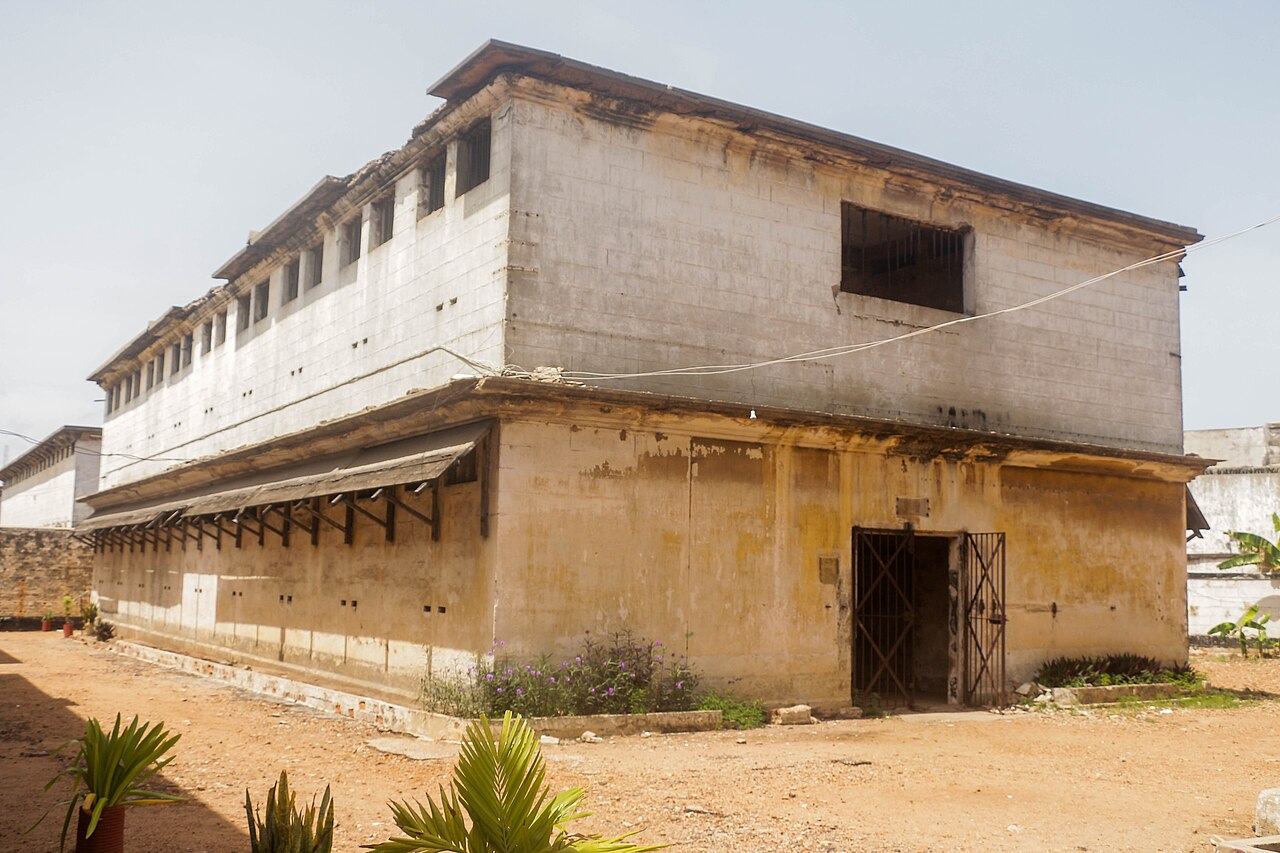
1649
Standing on a rocky point pinched between two lagoons, the smallest and plainest of the area's three colonial forts, its low walls set apart from the neighbouring castle and fort along the same shoreline.
Built by the Dutch in 1649 as Fort Crèvecœur, this fort sat two days' march from the Dutch stronghold at Elmina and was one of three forts European traders raised along this stretch of coast in the mid-seventeenth century. It formed part of the Dutch Gold Coast until the Anglo-Dutch Gold Coast Treaty of 1867 transferred it to Britain the following year. Renamed Ussher Fort, it was inscribed on the UNESCO World Heritage List in 1979 alongside the region's other colonial-era forts and castles.
- It stood two days' march from Elmina, a larger Dutch stronghold further along the coast.
- A treaty signed in 1867 handed it from Dutch to British control, more than two centuries after it was built.
Photo: RoySST (CC BY-SA 3.0)
Fort James
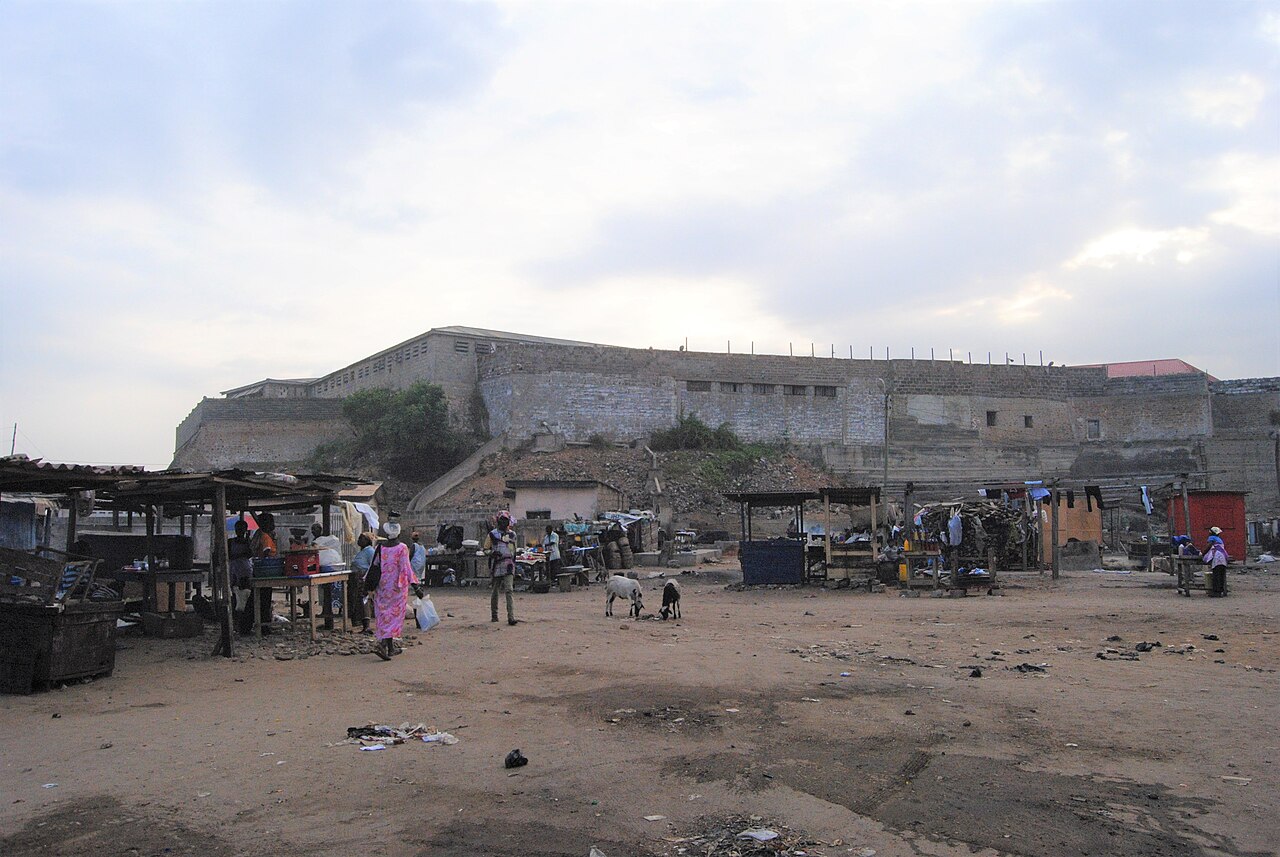
1673
A fort standing immediately beside a lighthouse, the two structures forming a paired landmark on the point where the surrounding neighbourhood takes its name.
Built in 1673 by the Royal African Company of England as a trading post for gold and enslaved people, Fort James joined the nearby Dutch and Danish forts along the same coast. It was likely named after James, Duke of York and later King James II, governor of the company at the time, and gave its name to the surrounding Jamestown neighbourhood. From the colonial era until 2008 it served as a prison; Ghana's first president was held there in 1950 and 1951. It was inscribed on the UNESCO World Heritage List in 1979.
- It held Ghana's first president as a prisoner in 1950 and 1951.
- It gave its name to the surrounding Jamestown neighbourhood.
- It served as a prison from the colonial era until 2008, more than three centuries after being built as a trading post.
Photo: Synth85 (CC BY-SA 4.0)
Independence Arch
An arch monument at Black Star Square, part of a complex commemorating Ghana's 1957 independence from British colonial rule. It stands alongside the Black Star Gate and the Liberation Day Monument at the center of the square.
Black Star Gate
A monument at the center of Black Star Square, formerly known as Independence Square. It is topped with the five-pointed Black Star of Africa, symbolizing Ghana's independence and sovereignty.
Black Star Square
A public square in Accra bordered by the Accra Sports Stadium and the Kwame Nkrumah Memorial Park, completed in 1961 in time for Queen Elizabeth II's state visit. It hosts Ghana's annual independence celebrations and all national civic and military parades.
Kwame Nkrumah Memorial Park
A mausoleum and park in downtown Accra, designed by E. G. A. Don Arthur. Its mausoleum holds the remains of Ghana's first president, Kwame Nkrumah, and his wife, Fathia Nkrumah.
National Theatre of Ghana
A multi-functional theatre that opened in Accra in 1992, built to host concerts, dance, drama and musical performances. It is home to the resident National Dance Company, National Symphony Orchestra and National Drama Company.
Ghana National Mosque
A mosque and Islamic complex in Accra's Kanda district, serving as the national mosque since 2021. Funded by Turkey's Hudai Foundation at a cost of $10 million, it seats 15,000 worshippers, the second-largest capacity of any mosque in West Africa.
Makola Market
A market and shopping district in central Accra where traders sell everything from fresh produce and clothing to car parts and land snails. Dominated by women, the market also carries locally handcrafted beaded jewelry alongside imported goods.
Jamestown Lighthouse
A 28-meter lighthouse in Accra's Jamestown district, built in the early 1930s to replace an 1871 structure. It has long served as a key navigational aid for vessels entering the port of Accra.
National Museum of Ghana
Ghana's largest and oldest museum, established in Accra in 1957 and reopened in 2022 after a restoration that began in 2015. It holds about 10,000 objects spanning archaeology, ethnography and fine art.
Ebenezer Presbyterian Church, Osu
A historic Protestant church in Osu, founded by the Basel Evangelical Missionary Society in 1847 as the Basel Mission Church, Christiansborg. It moved to its present site near Salem School when a new chapel was consecrated in 1902.
Holy Trinity Cathedral
An Anglican cathedral in Accra, formally the Cathedral Church of the Most Holy Trinity, completed in 1894. It belongs to the Anglican Diocese of Accra within the Church of the Province of West Africa.
Jubilee House
The presidential palace in Accra, serving as residence and office to Ghana's president, built on the site of an old British Gold Coast Government administrative building. Named Golden Jubilee House in 2008 to mark 50 years of independence, it was previously called the Flagstaff House.
Parliament House of Ghana
The official seat of the Speaker of Parliament and the building that houses Ghana's Parliament. It also contains offices used by members of parliament for their parliamentary work.
Accra Sports Stadium
A 40,000-capacity, all-seater multi-use stadium in Accra, formerly named the Ohene Djan Stadium. It is used mostly for football matches, though rugby union is also played there.
Accra International Conference Centre
An events venue in Accra, one of three major venues in the city alongside the Ghana Trade Fair Center and the National Theatre. It is the most popular of the three, being larger than the National Theatre but smaller than the Trade Fair Centre.
Statue of Mahatma Gandhi
A statue of Mahatma Gandhi installed at the University of Ghana in 2016 and relocated to the AITI-KACE in 2018. At its unveiling there, Ghana's foreign minister Shirley Ayorkor Botchwey called Gandhi a "great son" of India.
La Tante DC10 Restaurant
A restaurant built inside a retired Ghana Airways McDonnell Douglas DC-10 that had flown as a passenger jet from 1983 to 2005. Known locally as The Green Plane, it served Ghanaian dishes until closing in 2023, after which the aircraft was scrapped.
Bukom Boxing Arena
Ghana's first purpose-built boxing arena, commissioned in Bukom in November 2016 with seating for 4,000. Built in a district that has produced numerous world boxing champions, it also includes a sports hall, an Olympic-size pool and hosts basketball tournaments.
Abossey Okai Central Mosque
A mosque in the Abossey Okai community of Accra, also known as the Accra Central Mosque, built in the 1970s. It serves the Muslim community of Abossey Okai and neighboring areas such as Sabon Zango.
The Octagon
A business and retail center in Tudu, Accra, opened in 2013 near Independence Avenue and Barnes Road. The complex offers about 75,000 square meters of luxury office and retail space, including a five-star hotel.
History
Accra began as three separate fortified trading posts built along this stretch of coast within a single generation. The Dutch built Fort Crèvecœur in 1649, later renamed Ussher Fort; the Royal African Company of England built Fort James in 1673, giving its name to the adjoining Jamestown; and Denmark–Norway raised Fort Christiansborg, today's Osu Castle, in the 1660s. Ownership of the forts shifted repeatedly among Denmark–Norway, the Netherlands, the Akwamu, Britain and, eventually, Ghana itself, as the Anglo-Dutch Gold Coast Treaty of 1867 and other transfers redrew control of the coast. The settlements around the three forts grew together into a single town, which became the capital of the British Gold Coast in 1877 and remained so until Ghanaian independence in 1957. That threefold origin left the old town with three separate forts rather than one dominant monument.