Landmarks in Utrecht
A medieval religious capital where a lone Gothic tower still outlines the skyline.
Utrecht's landmarks cluster tightly around its medieval core, where the country's tallest church tower stands apart from the truncated cathedral it once adjoined, the nave gone since a seventeenth-century storm. Nearby, an open square holds Roman remains beneath the same ground. A short distance from the centre, an early twentieth-century house built without walls demonstrates De Stijl's geometric ideas on a domestic scale, while a former nineteenth-century railway station has been converted whole into the national collection of historic trains. Further out, at Haarzuilens on the edge of the municipality, a Gothic Revival château built at the end of the nineteenth century is the largest castle in the country, its far greater scale and revivalist ornament a deliberate contrast with the plainer Gothic tower and church at the centre.
Dom Tower
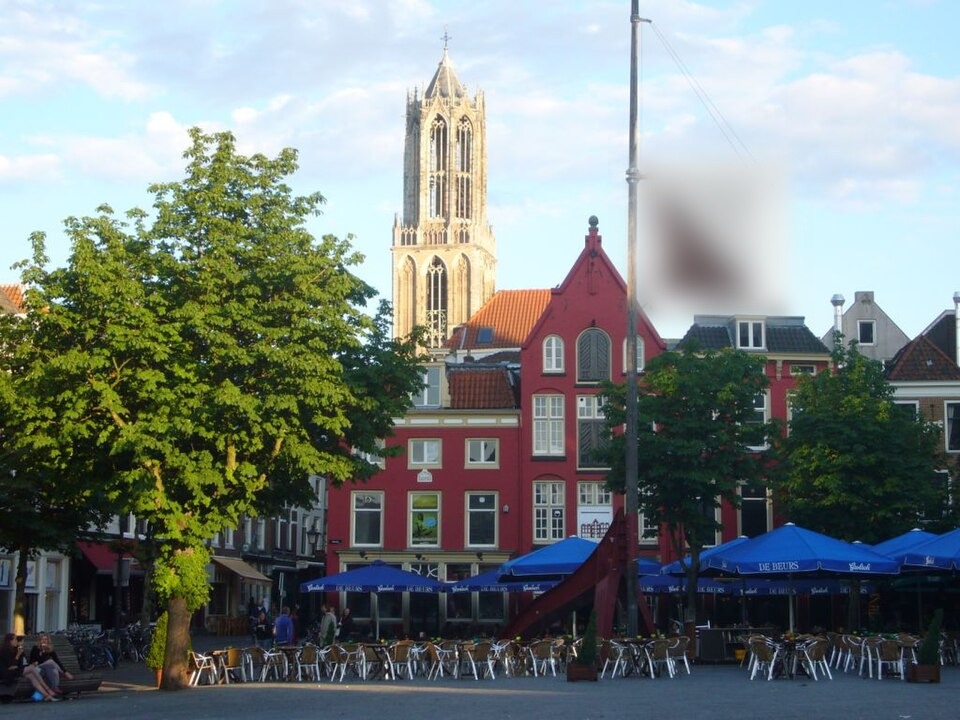
1321–1382 · John of Hainaut
A tall, freestanding Gothic tower, the tallest church tower in the country, rising directly beside an open square where the church it once adjoined used to continue.
Built between 1321 and 1382 to a design attributed to John of Hainaut, this is the tallest church tower in the country, at just over 112 metres. It formed part of St. Martin's Cathedral, dedicated to Saint Martin of Tours, of which only the choir and transept now remain: the nave collapsed in a storm in 1674 and was never rebuilt, leaving the tower standing on its own. The wider cathedral around it was never fully completed for lack of money, well before that later collapse.
- It stands on the spot where the settlement that grew into the city is thought to have begun, almost two thousand years ago.
Photo: Pepijntje (CC BY-SA 3.0)
Rietveld Schroder House
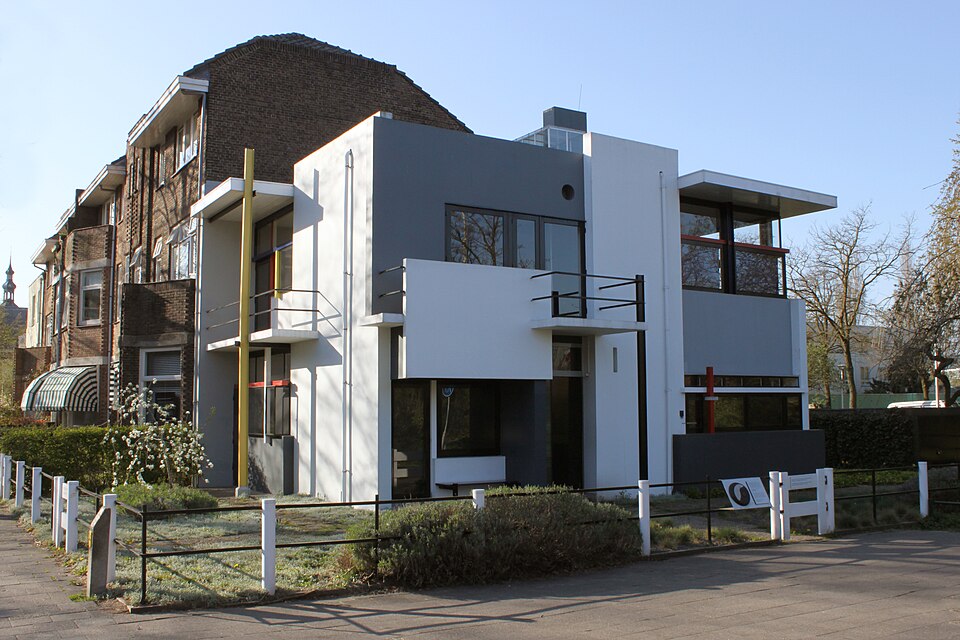
1924 · Gerrit Rietveld
A small, low house built as flat rectilinear planes in white, grey, black and primary colour accents, with lines and balconies that appear to float free of the walls behind them, in the style associated with De Stijl.
Designed in 1924 for Truus Schröder-Schräder, who asked for a house built with as few walls as possible and worked closely with Rietveld throughout, rejecting his first sketch before the pair developed the version that was built. Movable partitions on the upper floor let its layout be reshaped from one open room into several separate ones, blurring the line between inside and outside. It stands as one of the clearest built expressions of the De Stijl movement. Schröder-Schräder lived there until her death in 1985; the house was later restored and opened as a museum.
- Rietveld's first sketch for the house did not satisfy the woman who commissioned it, and the design that was built came from the two of them working side by side.
- It was listed as a national monument in 1976 but only gained UNESCO World Heritage status in 2000.
Photo: User:Husky (CC BY 3.0)
De Haar Castle
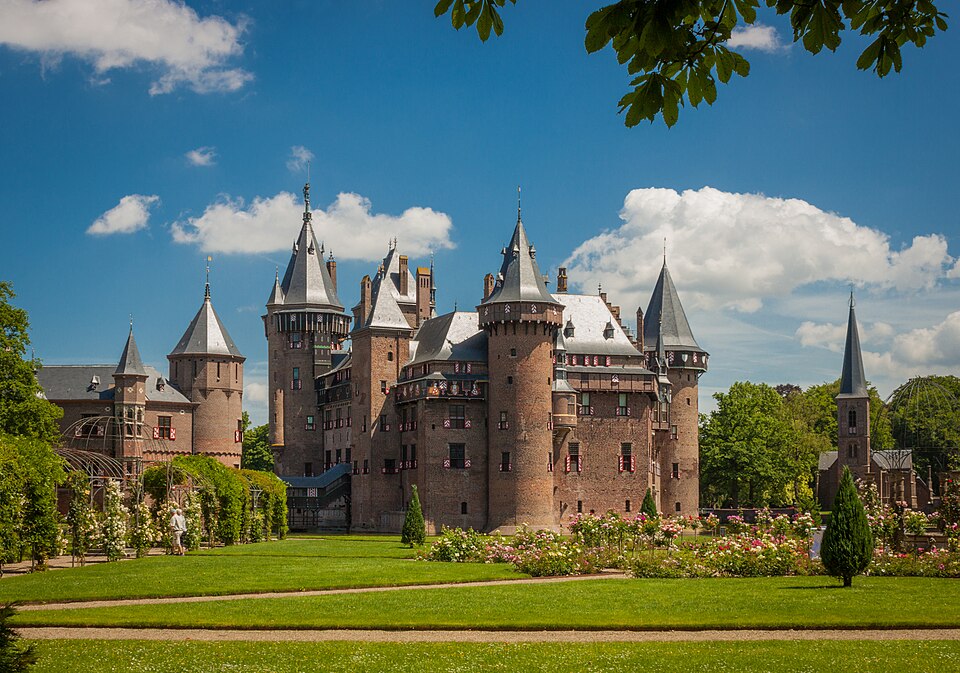
1892 · Pierre Cuypers
A very large, symmetrical stone château with turrets, towers and Gothic Revival detailing, set within its own grounds well outside the surrounding town, on a scale far larger than any other castle nearby.
This château, built in 1892 to a design by Pierre Cuypers in the Gothic Revival style, is the largest castle in the country. It stands in Haarzuilens, part of the Utrecht municipality but outside the city's historic core, and forms part of a wider architectural ensemble rather than a single free-standing building. Instead of being a purely private residence, it now also operates as a museum, and the whole complex is protected as a Rijksmonument.
Photo: Rafa.rivero (CC BY-SA 4.0)
St. Martin's Cathedral
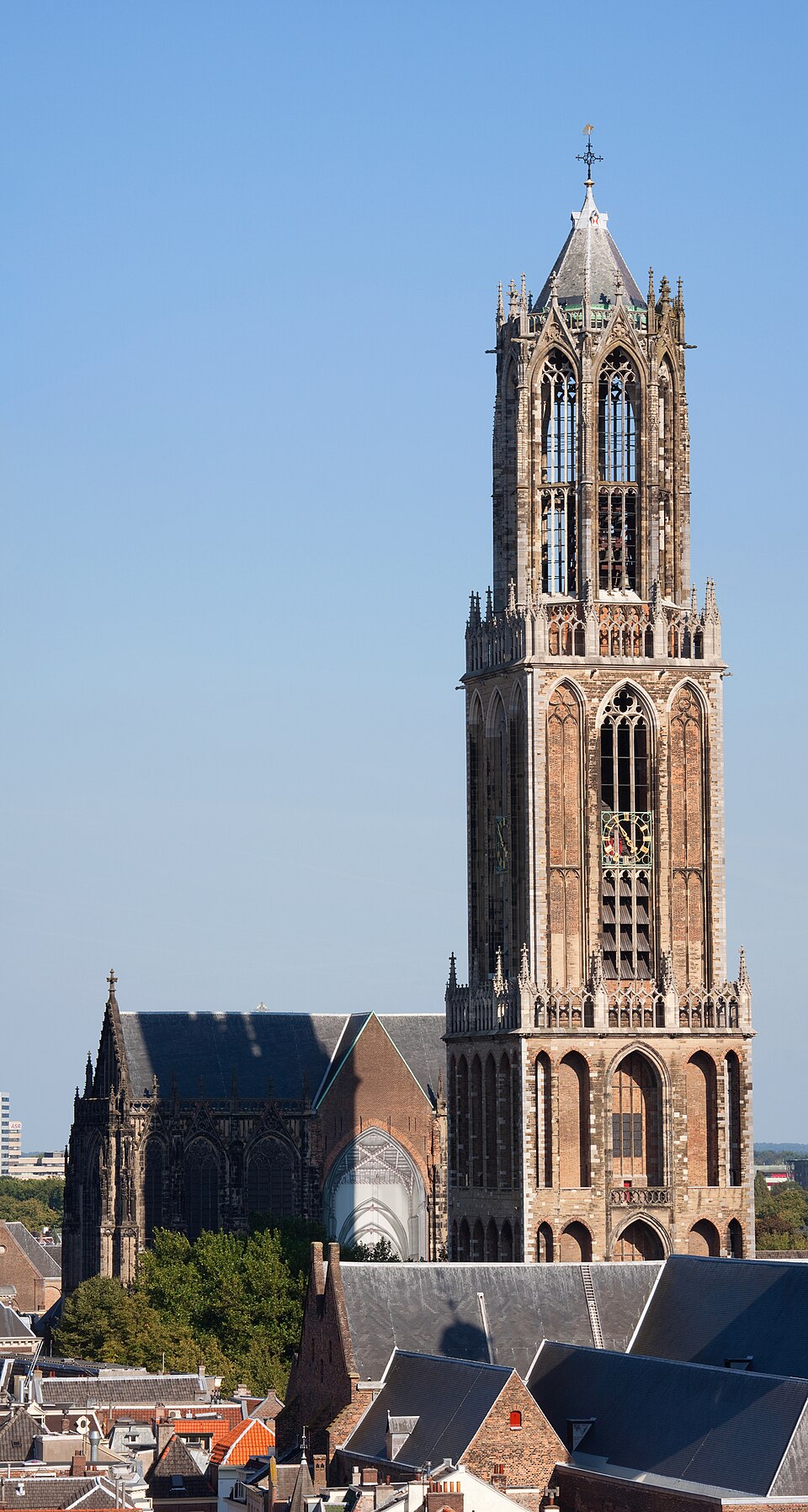
1254
A Gothic church with only one tower, unlike the paired towers common in French cathedrals it was modelled on, its choir and transept ending abruptly where a collapsed nave once continued the building.
Dating from 1254, this was the country's only pre-Reformation cathedral, seat of the Diocese of Utrecht through the Middle Ages, and has served as a Protestant church since 1580. Its Gothic design closely follows French models, unlike the regional variants found elsewhere in the country's Gothic churches, and unusually it carries only a single tower rather than a matching pair. The nave beside that tower collapsed in a storm in 1674 and was never rebuilt, leaving the choir isolated from it. In 2021-2022 the cathedral, tower and adjoining square were jointly inscribed as a UNESCO World Heritage Site.
- Roman archaeological remains found beneath the adjoining square were part of the reason for its UNESCO listing, as part of a wider Roman frontier site.
Photo: Massimo Catarinella (CC BY 3.0)
Railway Museum
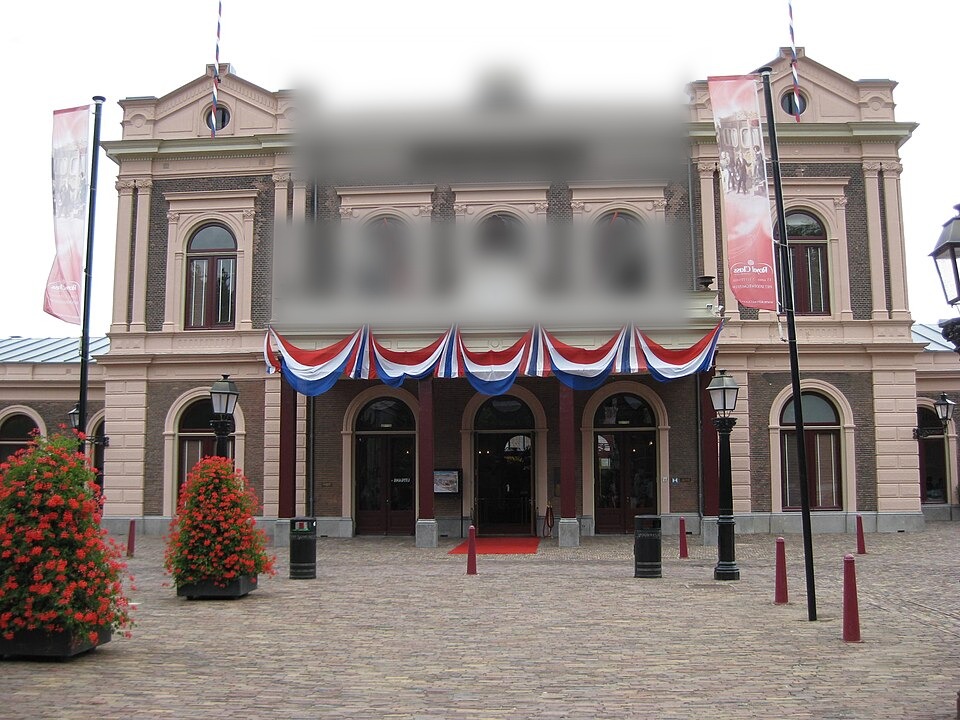
1874
Historic steam and other locomotives, carriages and rolling stock displayed inside and around the platforms and buildings of a former working railway station.
Built in 1874 as the Maliebaan railway station, this building was taken over by the Dutch national railway museum, founded in 1927, which moved its collection here in 1954. The museum now displays historic locomotives, carriages and other rolling stock inside and around the former station, tracing the history of railways in the Netherlands from the nineteenth century onward, in the country's only national museum devoted to the subject.
- The museum was founded in 1927, more than a quarter-century before it moved into this former station building in 1954.
Photo: Marion Golsteijn (CC BY-SA 3.0)
Grand Hotel Karel V
A hotel in the Duitse Huis complex, part of a Teutonic Knights monastery founded in 1348. Its rooms occupy a former military hospital dating from 1823 and a modern wing added in 2008, set within extensive grounds.
Post Office
The former main post office of Utrecht, completed in 1924 on Neude square. Since 2020 it has served as the headquarters of the Utrecht Public Library.
TivoliVredenburg
A contemporary music complex with five halls, each acoustically designed for a specific genre. It opened in 2014 as a merger of the former Tivoli Oudegracht and Muziekcentrum Vredenburg, and now draws about 1.3 million visitors a year.
Amsterdamsestraatweg Water Tower
A water tower built in 1916 in the Amsterdam School style. It fell derelict in 1986 and was repeatedly squatted before redevelopment into apartments began in 2020.
Winkel van Sinkel
The first department store in the Netherlands, built between 1837 and 1839 on the Oudegracht. Its Utrecht branch became so well known that "Winkel van Sinkel" entered Dutch as a general term for a shop selling all kinds of goods.
St. Eloy's Hospice
A guildhall between the Dom tower and the Mariaplaats, occupied by the Smedengilde, the guild of smiths, since 1440. Documents record the guild's existence since 1304, and the house can still be visited free of charge on the second Saturday of September.
Kasteel Heemstede
A fine-dining restaurant in Houten, opened in 2002 by owner-chef André van Doorn in the souterrain of an estate house long known as a castle, though it was in fact a country estate. It has held a Michelin star for 2003-2008 and again since 2011.
Museum Speelklok
A museum of self-playing musical instruments, housed since 1984 in the former Buurkerk church in central Utrecht. Its collection of music boxes, pianolas, barrel organs, and a carillon clock has made it popular with visitors nationally and internationally.
Stadion Galgenwaard
A football stadium that has been home to FC Utrecht since 1970, notable after a 1982 renovation for the moat surrounding the pitch. Rebuilt in stages from 2001 onward, it now seats 23,750 and has hosted seven Netherlands national team matches.
Centraal Museum
Utrecht's main museum, founded in 1838, with a collection focused mainly on locally produced work. It holds the world's largest collection of paintings by Joachim Wtewael, alongside major works by the Utrecht Caravaggisti Gerard van Honthorst and Hendrick ter Brugghen.
Double House
A house in Utrecht designed in 1997 by Bjarne Mastenbroek and Winy Maas of MVRDV, overlooking the Wilhelminapark. It was built to house two families jointly, the Koeks and the Wesselings, in a single 300-square-metre structure divided between them.
Sonnenborgh Observatory
An astronomical observatory and museum inside one of the stone forts built by Charles V to defend Utrecht. Founded in 1853 by C. H. D. Buys Ballot as a university observatory, it also sits atop the remains of the city's first chemical laboratory, found during works in 2001.
Begijnhof
A former beguinage in Utrecht.
Hamtoren
The surviving remains of Den Ham Castle in Vleuten, standing north of the Utrecht-Rotterdam railway line. It lies on an old road that once connected Harmelen and Utrecht.
Oudegracht
A canal running through central Utrecht, its northern stretch dating from around AD 1000 and its southern section begun in 1122 after the Rhine's water level dropped following a new dam upstream. Earth dug from the canal was used to raise its banks against flooding.
Museum Catharijneconvent
A museum of religious art housed in the former St. Catharine convent since 1979. Its collection includes artifacts from the Catholic Archbishopric of Utrecht's own museum, which had occupied the convent until that year.
History
Utrecht has been a religious centre since the eighth century, and its cathedral quarter grew accordingly: a Gothic tower begun in 1321 and finished in 1382 was raised as part of a cathedral whose nave collapsed in a storm in 1674 and was never rebuilt, leaving the tower to stand alone. The city was the most important in the Netherlands until the Dutch Golden Age, when Amsterdam overtook it. The nineteenth century brought a railway station, built in 1874 and later turned into a museum, and a Gothic Revival château at Haarzuilens, completed in 1892 to a design by Pierre Cuypers. In 1924, a small house built without interior walls introduced De Stijl's ideas into a residential street, a design later recognised with UNESCO status.