Landmarks in Ulaanbaatar
Gilded Buddhist monasteries and a classicist palace survive amid Soviet-era blocks.
Ulaanbaatar's oldest landmarks sit on low ground beside the Tuul River, survivors of a religious capital that Soviet-era planning otherwise cleared and rebuilt from the 1950s onward. Gandantegchinlen Monastery and the Choijin Lama Temple complex are both timber Buddhist compounds raised in the early twentieth century, gilded statues and painted halls behind plain walls; one still functions as a monastery, the other has been a museum since 1938. The Winter Palace of the Bogd Khan stands apart in style, a classicist building raised for the country's last ruling lama at the edge of what was once a larger residence. Apartment blocks and former ger districts now fill the ground around these three survivors.
Gandantegchinlen Monastery
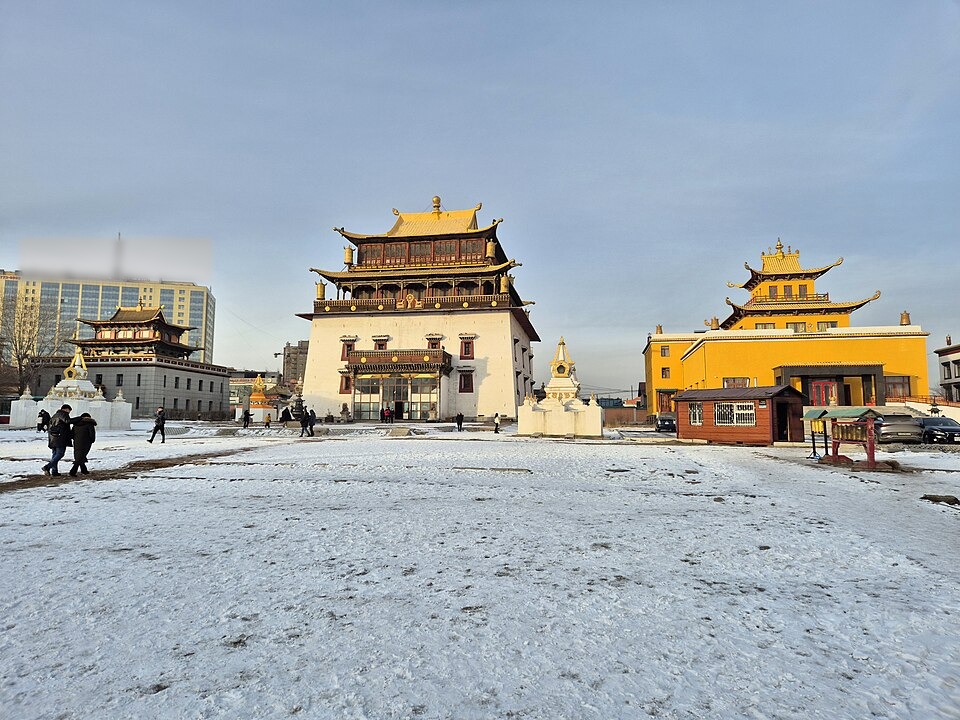
1809
A working Buddhist monastery whose main hall holds a 26-metre statue of a bodhisattva cast in gilded bronze and set with precious stones, rising above the surrounding temple roofs.
Founded in 1809 in what is now Bayangol District, the monastery was closed amid religious persecution in 1939. From 1944 to 1989 it operated as the country's only active monastery, a single concession maintained through the communist period. It has since become the country's centre of Buddhist practice, home to more than 100 resident monks and a collection of religious treasures, chief among them a 26-metre statue of Avalokiteśvara cast in gilded bronze and set with precious stones.
- It was the country's only functioning monastery for 45 years, from 1944 to 1989.
- Its central statue of Avalokiteśvara stands 26 metres tall, cast in gilded bronze and set with precious stones.
Photo: Chongkian (CC BY-SA 4.0)
Choijin Lama Temple
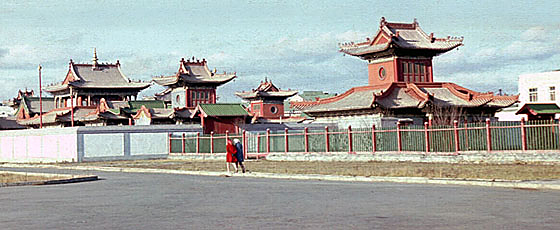
1904–1908
A compound of six low temple buildings in gilded, painted timber style, its dim main hall dominated by a large gilt Buddha flanked by a preserved embalmed body.
One main temple and five subordinate halls were built between 1904 and 1908 for the state oracle Choijin Lama Luvsankhaidav, brother of the reigning Jebtsundamba Khutuktu. The complex functioned as an active Buddhist site until 1937, when it was shut during the height of communist repression, then reopened the following year as a museum, a change that ultimately preserved the buildings through decades of anti-religious policy. Its main hall still keeps an 18th-century gilt statue of the Buddha beside the embalmed body of the monk Baldan Choephel.
- Its main hall holds the embalmed body of the monk Baldan Choephel alongside the Buddha statue.
- Its official name was bestowed by the Qing Guangxu Emperor, who died in 1908, the same year the complex was completed.
Photo: Vadas Róbert (Vadaro) (CC BY-SA 3.0)
Winter Palace of the Bogd Khan
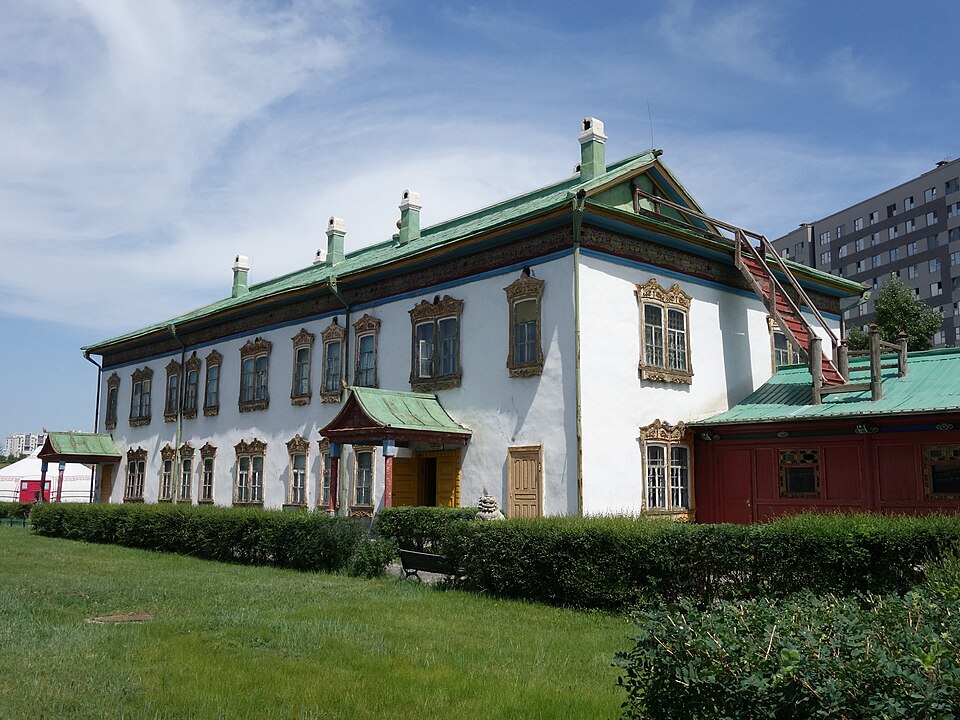
1903
A classicist stone building inside a walled palace complex, its style at odds with the ger camps and Buddhist temples nearby — the only one of four original residences on the site still standing.
Part of a larger complex known as the Green Palace, the building served as the residence of the eighth Jebtsundamba Khutughtu, later proclaimed Bogd Khan, ruler of Mongolia. It is the only one of his four original residences still standing, the other three having been lost. The complex now operates as a museum and is considered both the oldest museum in the country and the holder of its largest collection.
- It is the only surviving one of four residences originally built for the same ruler.
- It is considered the oldest museum in the country and holds the largest collection of any museum there.
Photo: Chongkian (CC BY-SA 4.0)
Sükhbaatar Square
The central square of the capital, named after revolutionary hero Damdin Sükhbaatar following his death in 1923 and marked by his equestrian statue. Renamed Chinggis Square in 2013 in honor of Genghis Khan, it reverted to its original name in 2016.
Zaisan Memorial
A memorial in Khan-Uul honoring allied Mongolian and Soviet soldiers killed in World War II.
Government Palace
The seat of Mongolia's government, on the north side of Sükhbaatar Square, housing the unicameral parliament and the offices of the president and prime minister. Once known as the Gray Palace for its former color, it was repainted white in 2007.
Mongolian State Academic Theatre of Opera and Ballet
A theater on the eastern side of Sükhbaatar Square, established on 15 May 1963 as the State Musical Drama Theatre before splitting into separate opera-ballet and drama companies. It held its opening ceremony on 18 May 1963 with Tchaikovsky's Eugene Onegin.
Blue Sky Tower
A 25-storey, 105-metre mixed-use skyscraper directly south of Sükhbaatar Square. It contains a 200-room hotel, luxury apartments, restaurants, and office and conference spaces.
State Department Store
A shopping mall in Chingeltei District. It was the country's first shopping mall.
Chinggis Khaan National Museum
A museum about Genghis Khan, located in the Chingeltei district.
Narantuul Market
A marketplace in Bayanzürkh District, also known as the Black Market. It is the largest outdoor market in the country.
National Museum of Mongolia
A history museum in Chingeltei focusing on Mongolian history, formerly known as the National Museum of Mongolian History. It describes itself as a cultural, scientific and educational organization responsible for collecting, caring for and interpreting its objects.
National Library of Mongolia
The largest and oldest library in Mongolia, holding more than three million books and publications. A million of these are rare manuscripts and sutras, including the world's only surviving copies of many ancient Buddhist texts.
Fine Arts Zanabazar Museum
An art museum in Chingeltei District, founded in 1966, exhibiting works by Mongolian masters of fine art from the 18th to 20th century. It works with UNESCO to improve the presentation of its collections.
Mongolian Military Museum
A military museum in Bayanzürkh District, also known as the Museum of the Mongolian Armed Forces, tracing Mongolian military history back to the Mongol Empire. Located across from an army barracks, it is part of the Ministry of Defense.
Marshall Zhukov House Museum
A museum in Bayanzürkh commemorating Soviet Marshal Georgy Zhukov.
National Sports Stadium
A multi-purpose stadium in Khan Uul District with a capacity of 12,500, used mostly for football. It hosts the Naadam festival celebrating Mongolian independence every July, and hosted the 2016 World University Archery Championship.
National Garden Park
A park in Bayanzürkh, and the largest in the city.
Holy Trinity Church
A Russian Orthodox church whose parish traces to 22 March 1864, when the first priest arrived to serve the Russian consulate opened after the 1860 Convention of Peking. Left without a priest from 1927 and closed to worship, the building was demolished in the 1930s.
Ulaanbaatar City Museum
A museum dedicated to the history of the capital, housed in a landmark of early 20th-century Mongolian architecture.
Bogd Khaan Memorial Garden
A memorial garden in Khan Uul District dedicated to Bogd Khan.
Saints Peter and Paul Cathedral
A Roman Catholic cathedral designed by Serbian architect Predrag Stupar in the shape of a yurt, consecrated in 2003 by Cardinal Crescenzio Sepe. It serves as the episcopal see of the Apostolic Prefecture of Ulaanbaatar.
National Art Gallery of Mongolia
A government-supported art gallery exhibiting Mongolian modern art, with about 4,200 pieces in its permanent collection, only 7 to 8 percent of which are on display. It also organizes temporary exhibitions, some shown abroad.
Bökhiin Örgöö
A sports arena in Bayanzürkh District whose name literally means 'Wrestling Palace.' Home to Mongolian wrestling competitions, it also hosts music concerts under lease.
History
Ulaanbaatar began in 1639 as a mobile Buddhist monastic camp, relocating twenty-nine times before it settled permanently on its present site in 1778. Known then as Örgöö, it grew into Mongolia's chief religious centre, seat of the Jebtsundamba Khutuktu, and a stop on the caravan route between Beijing and Kyakhta opened after the 1727 Treaty of Kyakhta. When the Qing dynasty collapsed in 1911, the city became the base of the Bogd Khanate, and a communist revolution followed in 1921. The Mongolian People's Republic, proclaimed in 1924, renamed the city Ulaanbaatar and made it the national capital. Large-scale Soviet-style urban planning began in the 1950s, clearing most of the old ger districts in favour of standardised apartment blocks that still shape much of the city today.