Landmarks in Seoul
Joseon palaces and a city gate here were burned, demolished and rebuilt more than once.
The three heritage landmarks catalogued for Seoul all began within a single half-century, 1395 to 1447, when Joseon's founders raised royal palaces and a walled gate at the new capital's heart. None of that fabric survived intact: the Imjin War of 1592 burned every palace to the ground, Japanese colonial administrators after 1910 dismantled what had been rebuilt, and the Korean War left the wider city in ruins. What stands today is largely reconstruction: Gojong's late-nineteenth-century rebuilding of Gyeongbokgung, restoration work continuing into the 2040s, and a 2013 replacement of Namdaemun's wooden pagoda after a 2008 arson fire. The result is a compact historic core of walled, wood-and-tile dynastic architecture surrounded by the dense, largely postwar city that grew up around it.
Gyeongbokgung
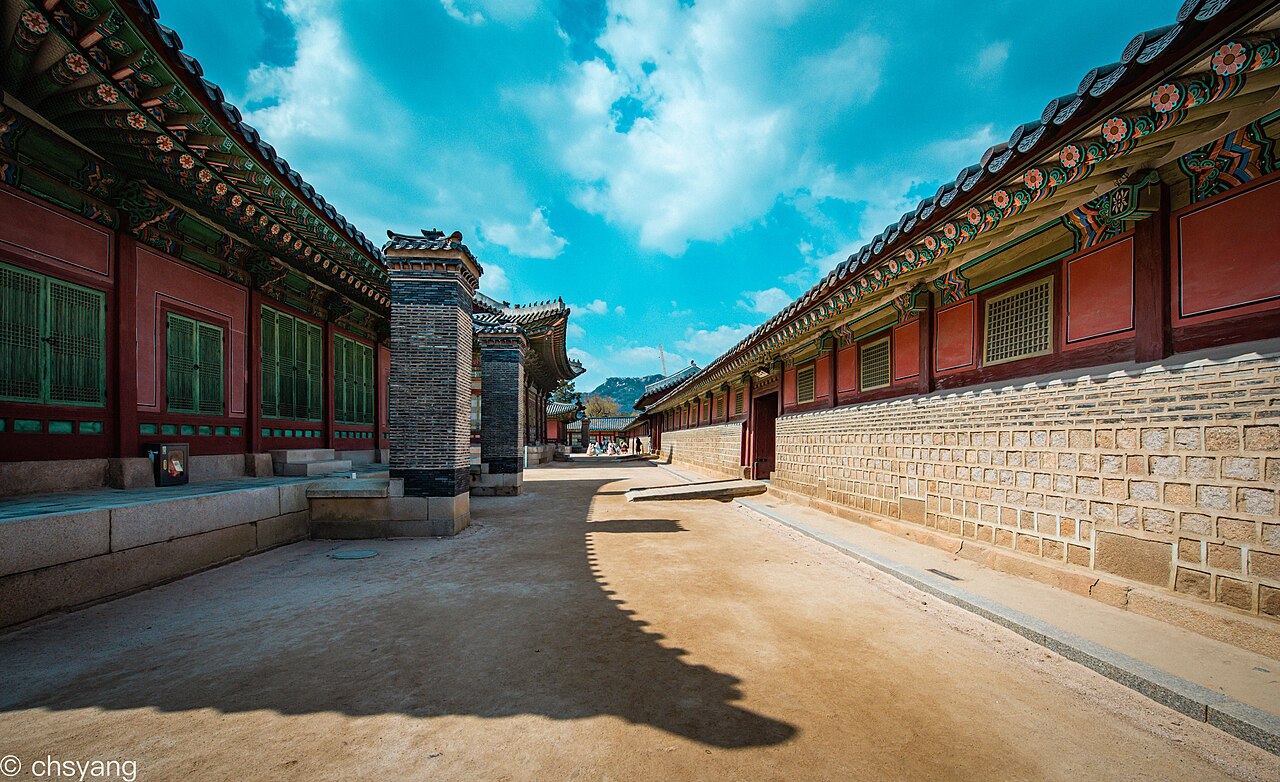
1395
A sprawling walled compound of low wooden halls with curved, heavily tiled roofs and painted eaves, arranged around courtyards behind a stone gate flanked by a broad paved plaza and mountains rising directly behind the walls.
Gyeongbokgung was the first royal palace of the newly founded Joseon dynasty, established in 1395 as the seat of the Korean monarchy. It flourished under King Sejong, who oversaw the creation of the Hangul script there, before being burned down during the 1592 Imjin War and left unrepaired for lack of funds. Reconstruction under King Gojong began in the late nineteenth century, only for Japan's colonial administration to demolish most of its roughly 500 buildings after 1910, leaving forty structures standing by 1945. Restoration has continued since the 1980s under two long-running government plans.
- At its peak the palace held around 500 buildings; only 40 remained after Japan's colonial demolition.
- A second restoration plan for the palace is scheduled to run until 2045.
- King Sejong's creation of the Hangul script is credited to work done inside these walls.
Photo: chsyang (Public domain)
Changdeokgung
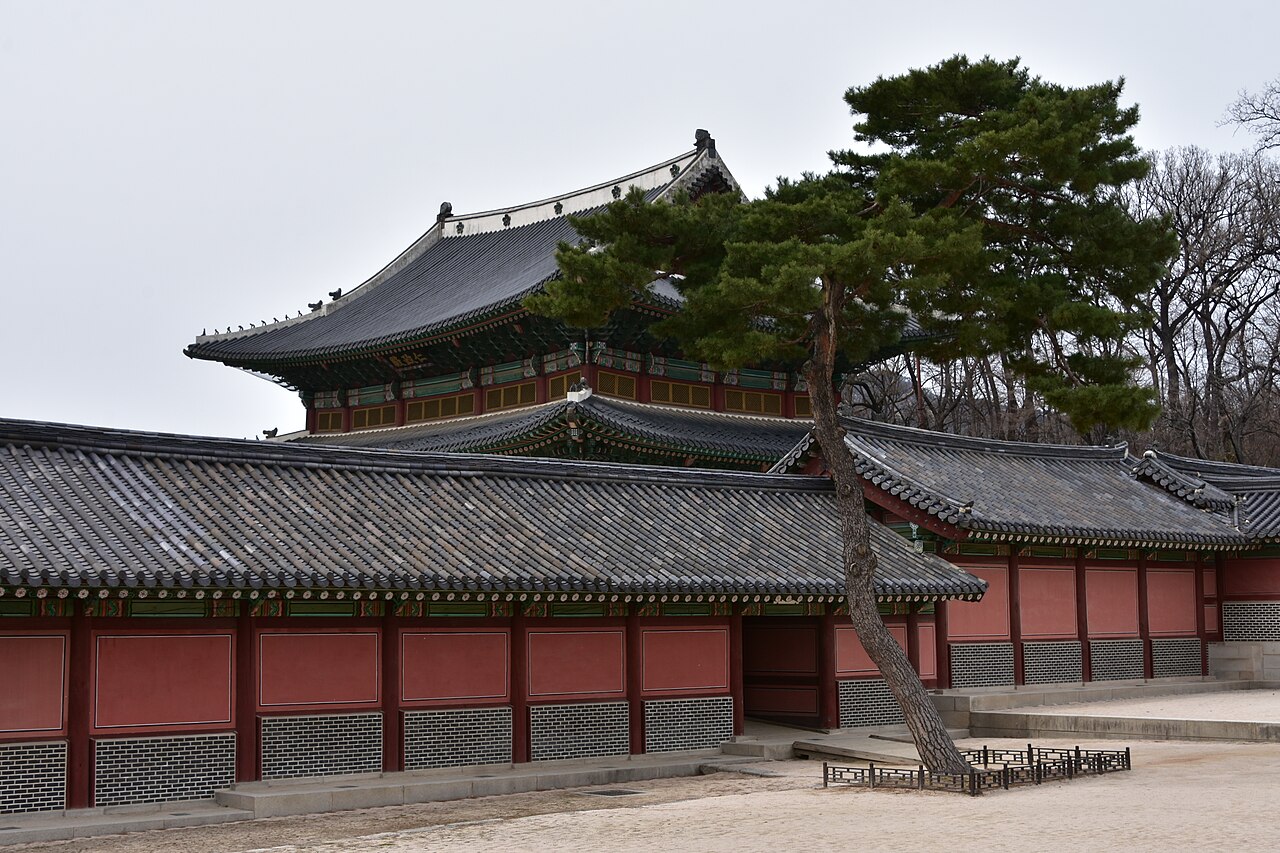
1405
Wooden halls and pavilions follow the natural contours of a wooded hillside rather than a strict grid, with a rear garden of ponds and pavilions that sets it apart from the more symmetrical palace nearby.
Changdeokgung was Joseon's second royal palace, established in 1405 to supplement the officially superior Gyeongbokgung. Most kings preferred living here, and after the 1592 Imjin War destroyed every palace in the city, budget shortfalls left Gyeongbokgung unrepaired while Changdeokgung was restored, making it the dynasty's de facto main residence for centuries. Gojong later rebuilt Gyeongbokgung and moved the court there, then to another palace in 1897. His son Sunjong made Changdeokgung his official palace after 1907, and the royal family continued living within its walls even after Japan's 1910 colonization.
- Despite ranking below Gyeongbokgung, it was the palace most Joseon kings actually chose to live in.
- It and its neighbour Changgyeonggung are together known as the "East Palace".
- It is a UNESCO World Heritage Site, a status its larger, officially senior neighbour does not share.
Photo: Richard Mortel from Riyadh, Saudi Arabia (CC BY 2.0)
Namdaemun
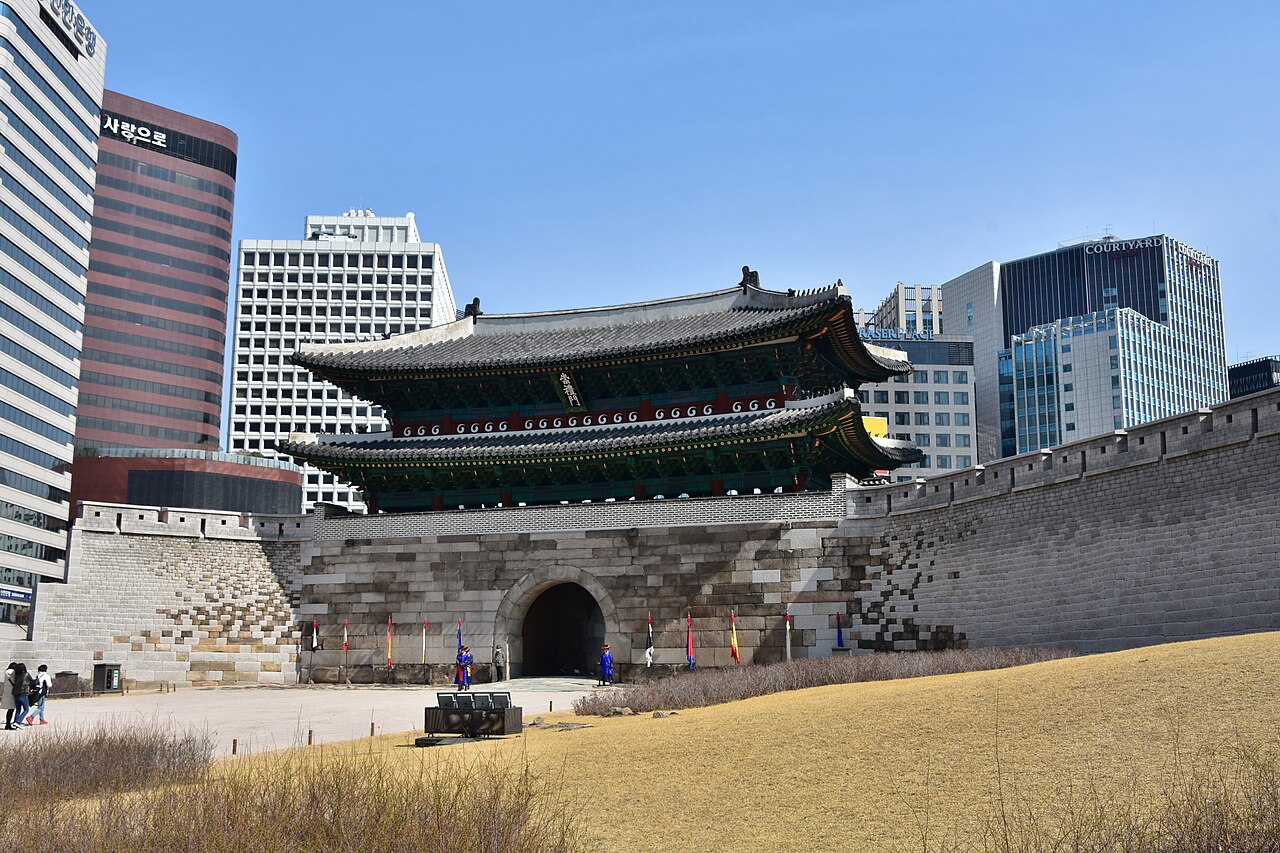
2013
A granite base pierced by a single arched passage carries a two-storey wooden pavilion with a steep, upturned tiled roof, standing isolated on a traffic island where the old city wall once ran.
Namdaemun, also known as Sungnyemun, is the southern of the Eight Gates of Seoul, built into the city's Joseon-era wall in 1398 and rebuilt in 1447. Designated South Korea's first National Treasure, it stood as the country's oldest wooden structure until an arsonist severely damaged its wooden pagoda in 2008. The stone base and surrounding wall had marked the historic city's southern edge, though Seoul long since outgrew that boundary. Restoration work began in February 2010 and finished in April 2013, and the gate reopened the following month.
- It was South Korea's first-ever designated National Treasure.
- It remained the oldest wooden structure in Seoul until an arsonist set fire to it in 2008.
- The city wall it once guarded ran for 18.2 kilometres and stood up to 6.1 metres high.
Photo: Richard Mortel from Riyadh, Saudi Arabia (CC BY 2.0)
Cheong Wa Dae
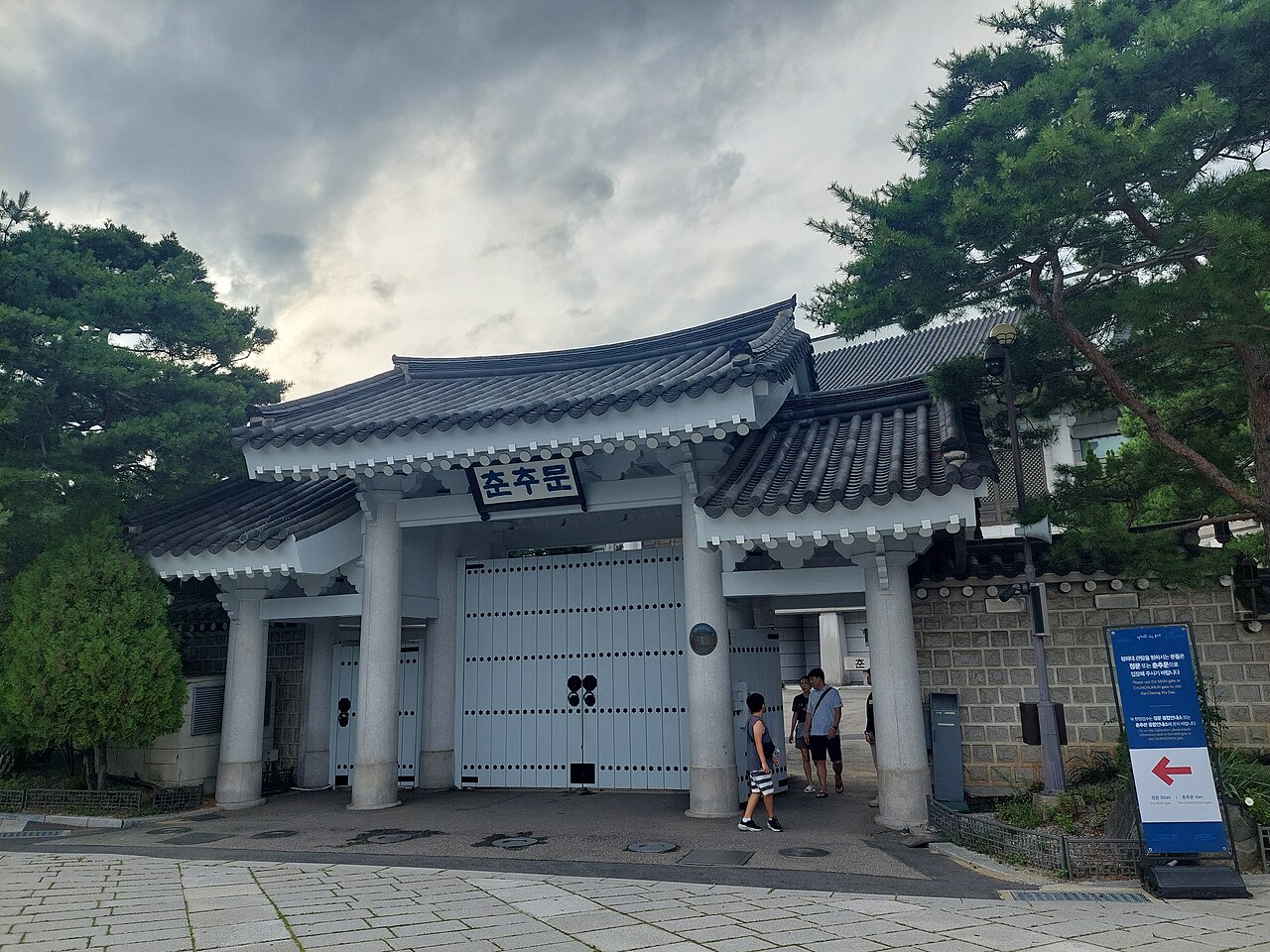
1991
Grouped single-storey halls with steeply pitched, tiled roofs sit within a walled compound behind a former royal palace; the roof tiling's colour gave the whole complex its literal name, meaning "cyan-tile pavilion."
Cheong Wa Dae served as the office and residence of South Korea's head of state from 1948, standing on the site of a royal garden immediately behind the former main Joseon palace. Its current main hall dates to 1991, replacing a Japanese-built residence used since 1939 that was dismantled in 1993. Relieved of its official duties in 2022, the complex spent three years open to the public as a museum and park before the president returned to it in December 2025. The grouped buildings cover roughly 250,000 square metres.
- An assassination attempt on the president by infiltrators in 1968 left 28 infiltrators, 26 South Koreans and four Americans dead.
- The name translates literally as "Cyan-tile Pavilion."
- The site traces back to a royal villa built in 1104 by a Goryeo-dynasty king.
Photo: Junseooo (CC BY-SA 4.0)
Deoksugung
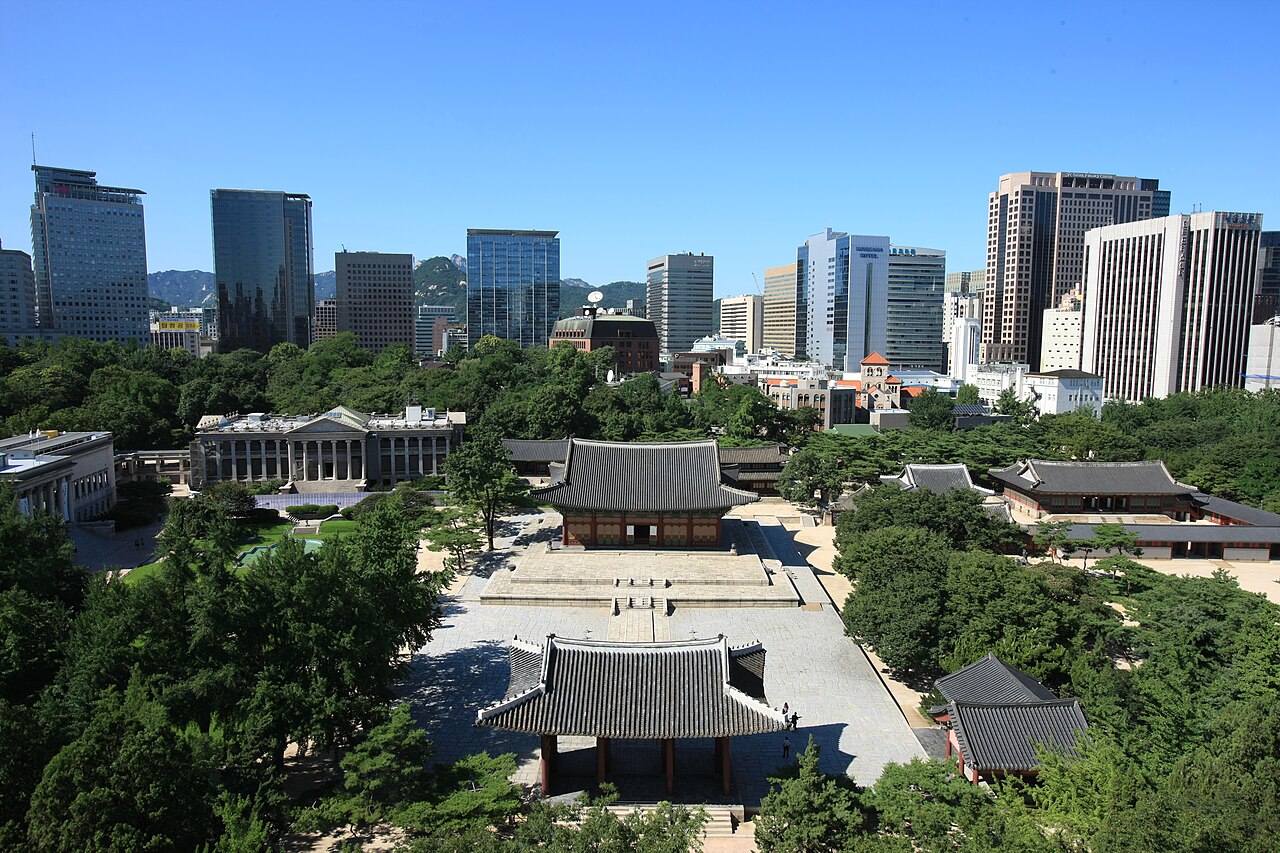
1897–1938
Wood-and-tile halls in the traditional style stand alongside a stone Western-style building, the two contrasting wings of a palace now reduced to about a third of its former size amid the surrounding city.
Deoksugung began as temporary royal lodging after invaders burned Seoul's palaces in the 1590s, becoming an official palace in 1611 under the name Gyeongungung. Emperor Gojong made it the seat of the Korean Empire in 1897, expanding it with new stone buildings such as Seokjojeon alongside traditional halls such as Junghwajeon. After Gojong's death in 1919 the colonial government sold and dismantled much of the property, and restoration of the surviving buildings has continued since the 1980s under a 2004 plan.
- The palace was renamed Deoksugung only in 1907, after nearly three centuries under the name Gyeongungung.
- Gojong lived there until his death in 1919, even after being forced to abdicate in 1907.
- Its current size is estimated at about a third of its extent at Gojong's peak.
Photo: 서울특별시 소방재난본부(Seoul Metropolitan Fire & Disaster Headquarters) (CC BY-SA 4.0)
Namsan Seoul Tower
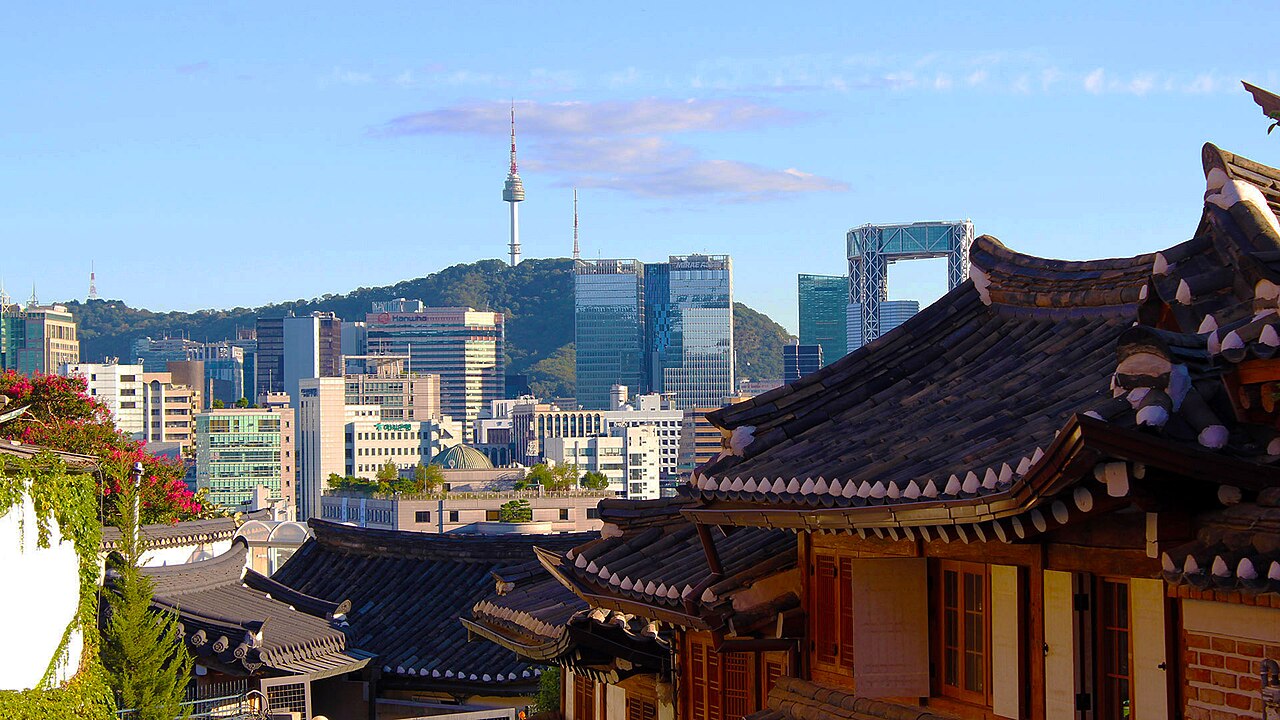
1969–1975
A tapered concrete shaft and broadcast mast rise 236 metres from a hilltop to an observation deck, reached by cable car, inclined elevator or a steep uphill approach on foot.
Proposed by a consortium of broadcasters and the government, the tower was built to carry television and radio transmission equipment alongside public observation decks, a museum and a coffee shop. Construction began in December 1969 and finished in 1975, but a safety review kept the decks closed over concern that photographs from them could compromise nearby government security; they finally opened to visitors in 1980. Ownership passed from a pension association forced to sell in 1999 to its current broadcaster owner, which leased the observation levels out for a 2005 renovation.
- The tower has also housed equipment used to jam broadcast signals from North Korea.
- Its observation decks stayed closed to the public for five years after completion, opening only in 1980.
- About 12 million people visit the tower each year.
Photo: Carkbs (CC BY-SA 4.0)
Gwanghwamun Square
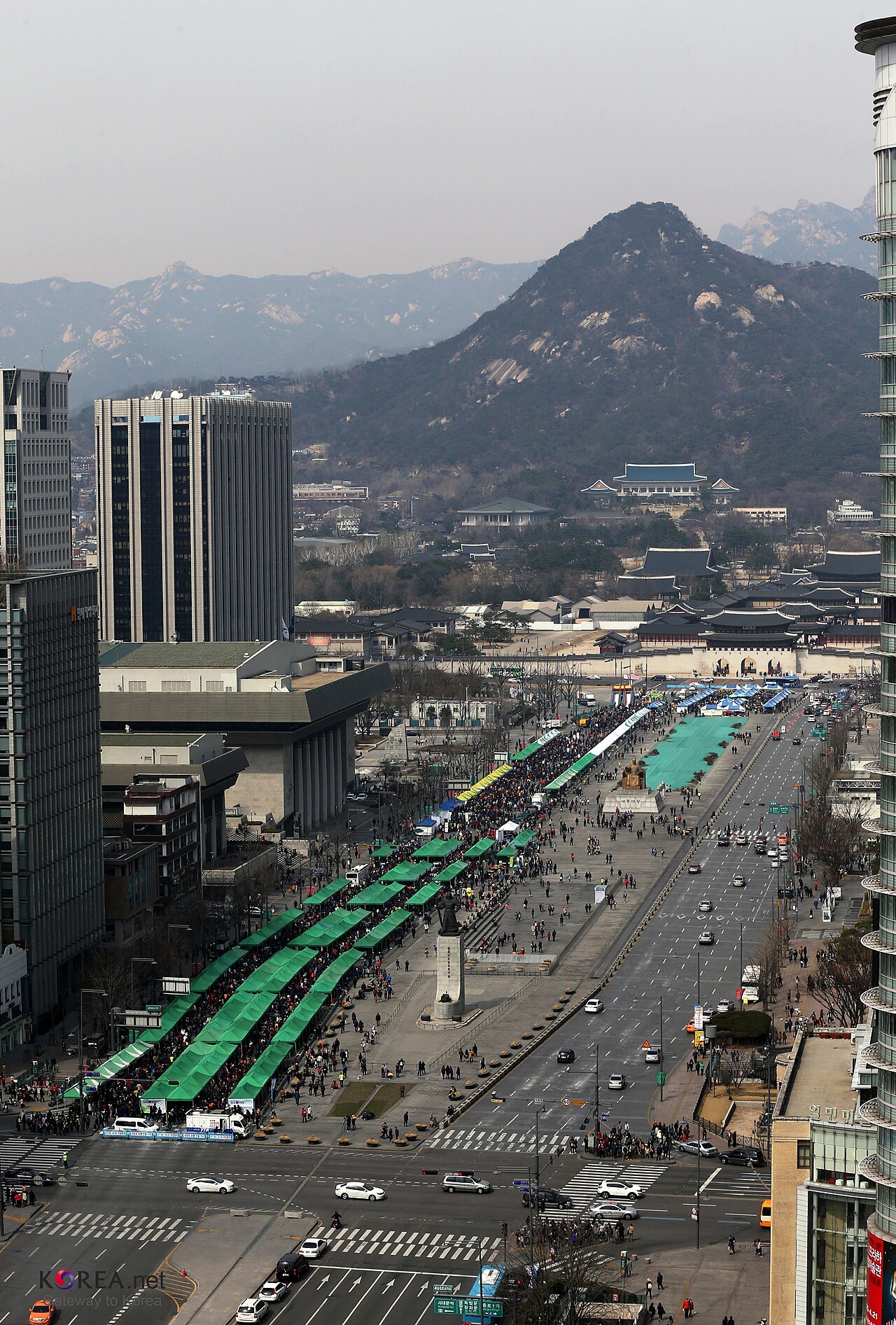
2009–2022
A long paved plaza runs down the centre of a narrowed boulevard, marked by a fountain whose jets rise to 18 metres, a shallow inlaid waterway lined with engraved stones along one side, and statues of two historical figures spaced along its length.
The square occupies ground that once held a street of royal government ministries, later used for centuries as a public space and a road. Its modern form opened in 2009 after the road above it was narrowed from sixteen traffic lanes to ten, adding a fountain and a new seated statue alongside an older standing statue erected in 1968. A second redesign closed the square from late 2020 to August 2022, narrowing the road further and doubling the size of the pedestrian plaza.
- The 2009 opening was marked by a flower carpet of 224,537 blooms, one for each day since the city's designation as capital in 1394.
- The fountain's jets symbolise 23 naval battles fought with only 12 warships.
- A waterway along the square holds 617 stones recording major events from 1392 to 2008.
Photo: Korea.net / Korean Culture and Information Service (Jeon Han) (CC BY-SA 2.0)
Dongdaemun Design Plaza
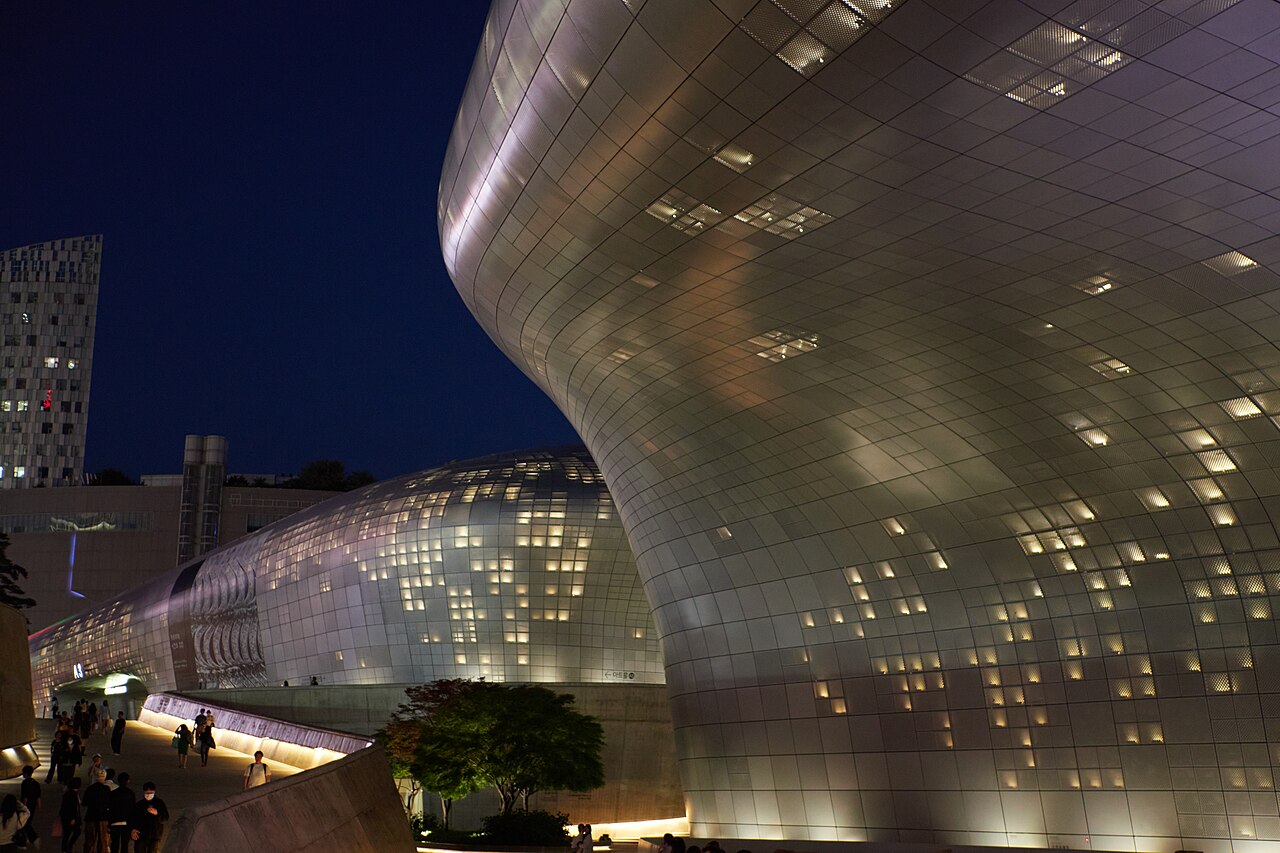
2009–2014 · Zaha Hadid
A smooth, mushroom-like shell of riveted aluminium panels curves without straight edges or right angles, appearing to float above a plaza that also holds a walkable rooftop park and excavated sections of an old fortress wall.
Dongdaemun Design Plaza is an exhibition, retail and design centre that replaced Dongdaemun Stadium, Korea's first modern stadium, standing on the site from 1925 until its 2007 demolition. Zaha Hadid won an open 2007 design competition for the site with a concept she called "Metonymic Landscape," realised through a mega-truss roof and building information modelling that lets the structure's underground and above-ground levels flow as one continuous curved shell. Construction began in 2009 and the complex opened on 21 March 2014, helping earn Seoul the 2010 World Design Capital title.
- Zaha Hadid had already won the Pritzker Prize in 2004, three years before winning the design competition for this site.
- The stadium the plaza replaced was built in 1925 to celebrate a Japanese prince's wedding, and stood until its demolition in 2007.
- Excavation for the project uncovered sections of the old city fortress wall, parts of which had already been cut through as early as 1889 for a trolley railway.
Photo: lumoplank (CC0)
Gwanghwamun
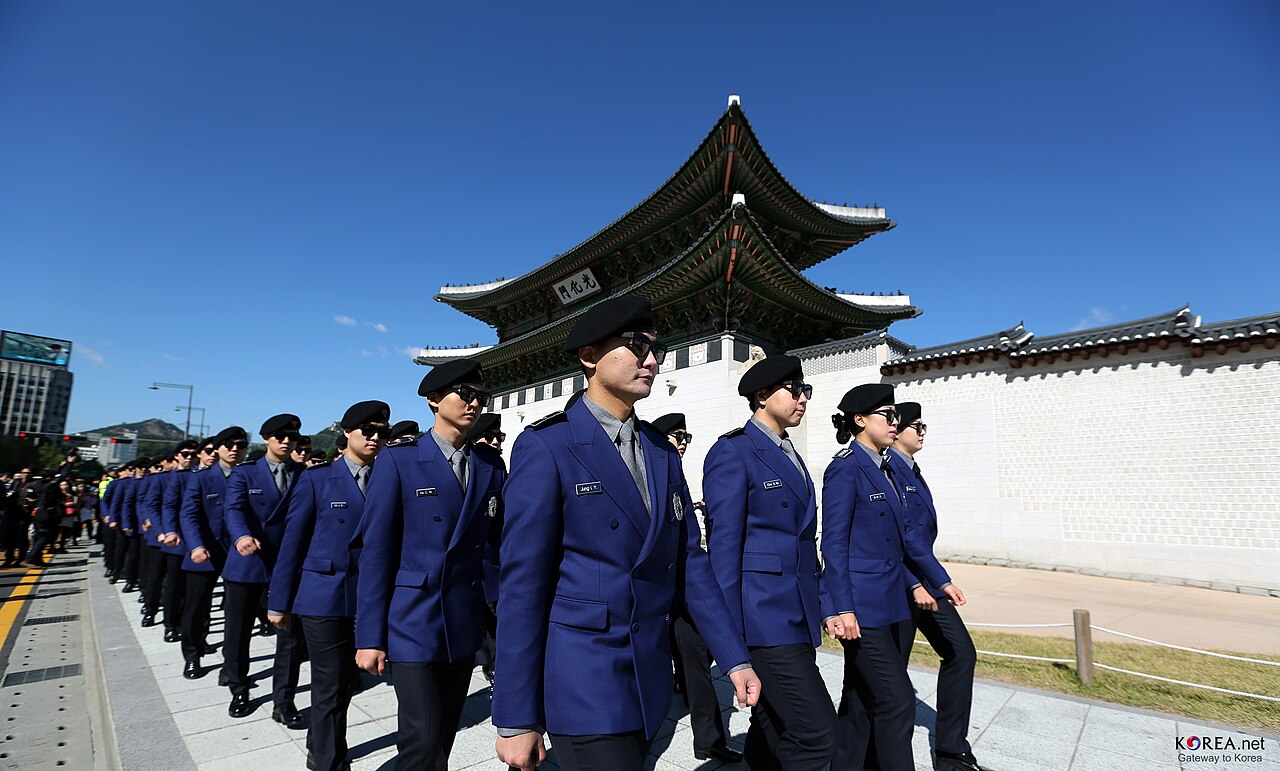
1395–2010
A stone base carries a two-storey wooden pavilion topped by a steeply curved tiled roof; a stone guardian animal, a xiezhi, sits in front, believed to ward off fire and evil spirits, while the underside of the roof is painted with pairs of mythical birds, dragon-horses and turtles.
Gwanghwamun is the main south gate of a walled palace compound, completed in 1395 and given its current name by King Sejong in 1426. Destroyed during the 1592 Imjin War, it was eventually rebuilt taller under Gojong, only to be relocated in 1927 under Japanese colonial rule; its wooden top then burned away during the 1950–1953 Korean War, leaving just the stone base. A 1968 reconstruction under Park Chung-hee used concrete and steel instead of timber, a choice later criticised, before the gate was disassembled and rebuilt entirely in wood between 2006 and 2010, restored to its original site.
- The gate's wooden nameplate cracked within months of its 2010 unveiling, reportedly because immature pine had not been given enough time to dry.
- A public survey on replacing that nameplate found 58.7 percent favoured Hangul lettering, but the panel opted to keep the Hanja style of the lost 1395 original.
- A 2023 renovation reworked the nameplate again, this time in gold characters on black, and restored the elevated stone platform in front of the gate.
Photo: Korea.net / Korean Culture and Information Service (Jeon Han) (CC BY-SA 2.0)
Gyeonghuigung
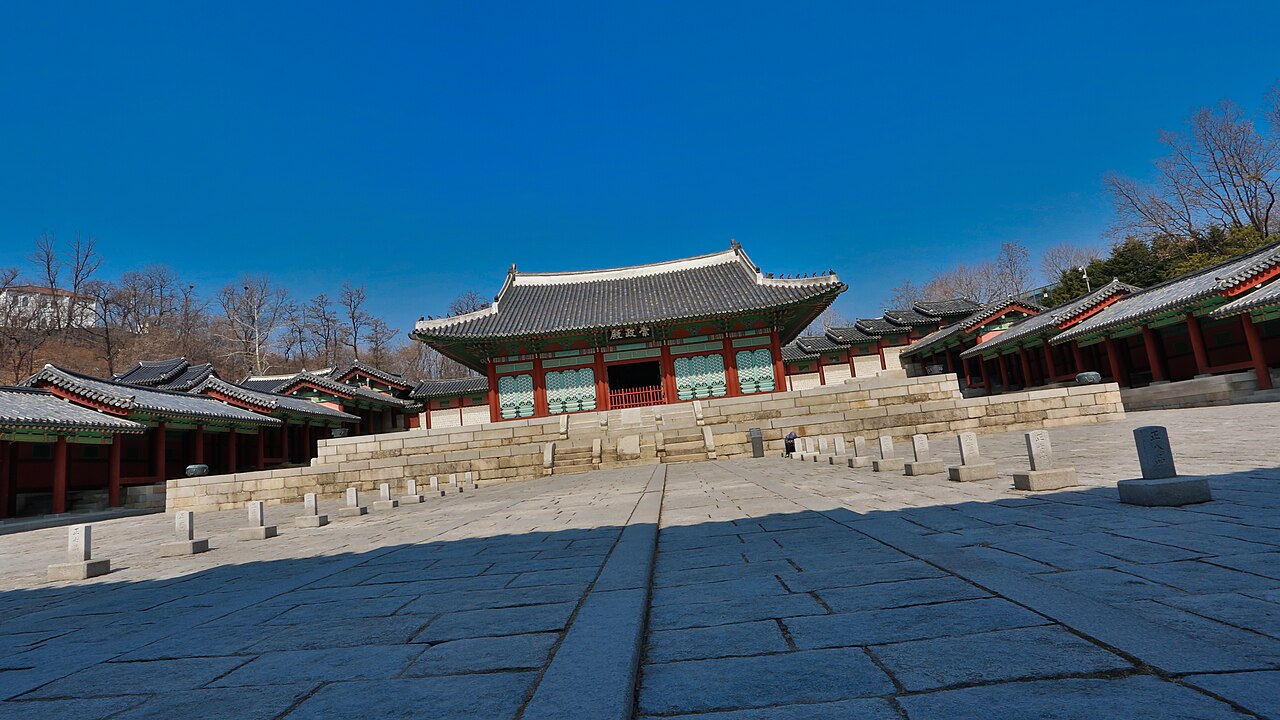
1617–1994
Wooden halls with tiled roofs and painted eaves stand within a walled compound on sloping ground, occupying only a fraction of their historic footprint; the ornate gate at the entrance returned here after decades spent serving as a hotel's doorway elsewhere in the city.
Gyeonghuigung was built in the 1600s as a secondary residence for the Joseon king, on land that had belonged to the father of King Injo. About ten kings stayed there over the following two centuries, and at its largest the complex held around 100 buildings. Most were lost during the nineteenth century, dismantled either for building material to rebuild Gyeongbokgung or, later, by Japan's colonial administration, which built a school on the cleared site. Reconstruction began after that school relocated in 1980, restoring structures including the main hall, returned and renovated between 1988 and 1994.
- Its main gate spent decades serving as the entrance of a Seoul hotel before being restored to the palace.
- A stone bridge at its entrance, buried during the Japanese occupation, was not excavated and restored until 2001.
- The palace grounds hosted a temporary art installation by the fashion house Prada in 2009.
Photo: Johnny Silvercloud (CC BY-SA 2.0)
Myeongdong Cathedral
The national cathedral of the Archdiocese of Seoul, in the Myeongdong neighbourhood, dedicated to the Virgin Mary as Korea's principal patroness under an 1841 papal decree. The South Korean government declared it a historic site on 22 November 1977.
Jogyesa
The chief temple of the Jogye Order of Korean Buddhism, first established in 1395 and rebuilt in 1910 as Gakhwangsa. Renamed Taegosa under Japanese rule, it took its present name in 1954 and holds Natural Monument No. 9, an ancient white pine.
Seokjojeon
A Western-style neoclassical château of granite and brick inside Deoksugung, completed in 1910 as a royal residence. Designed and furnished by British designers, it now houses the Daehan Empire History Museum, and its 1938 West Wing holds a modern art museum branch.
Gwanghuimun
One of the Eight Gates of the Seoul Fortress Wall, also known as the Southeast Gate or Namsomun. It was originally called Sugumun, meaning Water Channel Gate.
Namdaemun Market
A large traditional market beside Namdaemun, the old city's main southern gate, among Korea's oldest markets, opened in 1414 during the Joseon period. It survived repeated attempts to shut it down during the 1910–1945 Japanese colonial period and has been destroyed several times by fire.
National Museum of Korea
The flagship museum of Korean history and art, established in 1945 and relocated to Yongsan District in 2005. On 24 June 2021 it opened a branch inside Incheon International Airport to mark the museum's 20th anniversary.
Ihwa Mural Village
A neighbourhood near Naksan Park revitalized in 2006 through the government's Ihwa-dong Naksan Project, with paintings and installations by about 70 artists. It has since become a popular destination for locals and tourists drawn to its murals and scenic hillside setting.
Seoul City Wall
A defensive wall first built by King Taejo of Joseon to protect the capital city of Hanseong. It was designated a Historic Site of South Korea in 1963 and is now a tourist attraction around downtown Seoul.
Unhyeongung
A former royal residence in Jongno-gu, once home to Heungseon Daewongun, the 19th-century prince regent and father of Emperor Gojong. Gojong himself lived there until age twelve, and the residence is now a museum, open to the public free of charge.
Dongdaemun
Officially named Heunginjimun but commonly called Dongdaemun, or Great East Gate, one of the Eight Gates of the Seoul City Wall. It was the main eastern gate of the wall surrounding Seoul during the Joseon period, and stands at Jongno 6-ga.
Sŏnggyun'gwan
The foremost educational institution in Korea during the late Goryeo and Joseon dynasties, its Joseon-era site now part of Sungkyunkwan University. Twice a year, in May and September, the Seokjeon Daeje rite is performed at its Munmyo Shrine to honour Confucius and the Confucian sages.
Wongaksa Pagoda
A 12-metre, ten-story marble pagoda in Tapgol Park, designated a National Treasure of South Korea in 1962. In 1999 it was enclosed in a protective glass wall, which experts have since been discussing whether to remove.
Chungdong First Methodist Church
Korea's first Methodist church, founded by American missionary Henry Appenzeller with a congregation established on 11 October 1885. Its 1897 building, the country's first Western-style chapel, is the oldest extant church in Korea and the only one built in the 19th century.
Hyochang Park
A park in Yongsan District established in 1876 as a royal cemetery, later turned into Korea's first golf course by Japanese colonial authorities in 1921. Designated a park in 1940 and a Historic Site in 1989, it now memorializes Korean independence activists.
War Memorial of Korea
A museum in Yongsan-dong that opened in 1994 on the former site of the army headquarters, built to memorialize Korea's military history. Its six indoor exhibition rooms and outdoor centre display war memorabilia and equipment from Korea, its allies, and captured communist forces.
Seodaemun Prison
A former prison in Seodaemun District, built by Imperial Japan from 1907 and opened on 21 October 1908 as Gyeongseong Gamok. Renamed Seodaemun Prison in 1923, it was where many Koreans who opposed Japanese colonial rule were tortured or executed.
Seoullo 7017
An elevated linear park built atop the disused Seoul Station Overpass, about a kilometre long and lined with 24,000 plants, designed by MVRDV. Opened in May 2017, its name combines 1970, when the flyover was dedicated, with 17 for its walkways and opening year.
Dongmyo Flea Market
A flea market in Sungin-dong, Jongno District, named for and located next to the shrine Dongmyo. It sits just outside exit 3 of Dongmyo Station on Subway Line 1.
History
Seoul was founded in 18 BC by the Baekje kingdom, but its architectural character comes from the Joseon dynasty, which made it capital and built Gyeongbokgung in 1395, Changdeokgung in 1405, and the walled city gates soon after. The Imjin War of 1592 destroyed every palace; only Changdeokgung and its neighbour were repaired, leaving Gyeongbokgung derelict for three centuries until Gojong rebuilt it in the late 1800s. Japan's 1910 colonization brought systematic demolition of royal buildings, stripping Gyeongbokgung down to a fraction of its original halls. The Korean War of 1950-53 left much of the city in ruins as it changed hands four times. Postwar reconstruction and rapid urbanization since then have surrounded the surviving dynastic core with a much larger modern city, even as some government functions later moved to the planned city of Sejong.