Landmarks in Fukuoka
A port city where a 757 shrine, a 1607 castle and a 1989 broadcast tower mark three eras.
Fukuoka's landmarks trace the city's long role as a gateway to the Asian mainland, spanning a Shinto shrine founded in 757 to a broadcasting tower raised on reclaimed bay-front land in 1989. Kushida Shrine sits inland in Hakata-ku, the old core of the city, while Fukuoka Castle occupies Fukusaki hill at the centre, its early-1600s walls, gates and watchtowers now enclosed within a public park after most of the keep disappeared. Fukuoka Tower stands apart from both, on land pushed out into Hakata Bay during the city's later growth into an industrial and commercial hub. Between them the three sites span thirteen centuries, setting an old inland core against a manufactured seafront skyline.
Fukuoka Tower
1989 · Nikken Sekkei
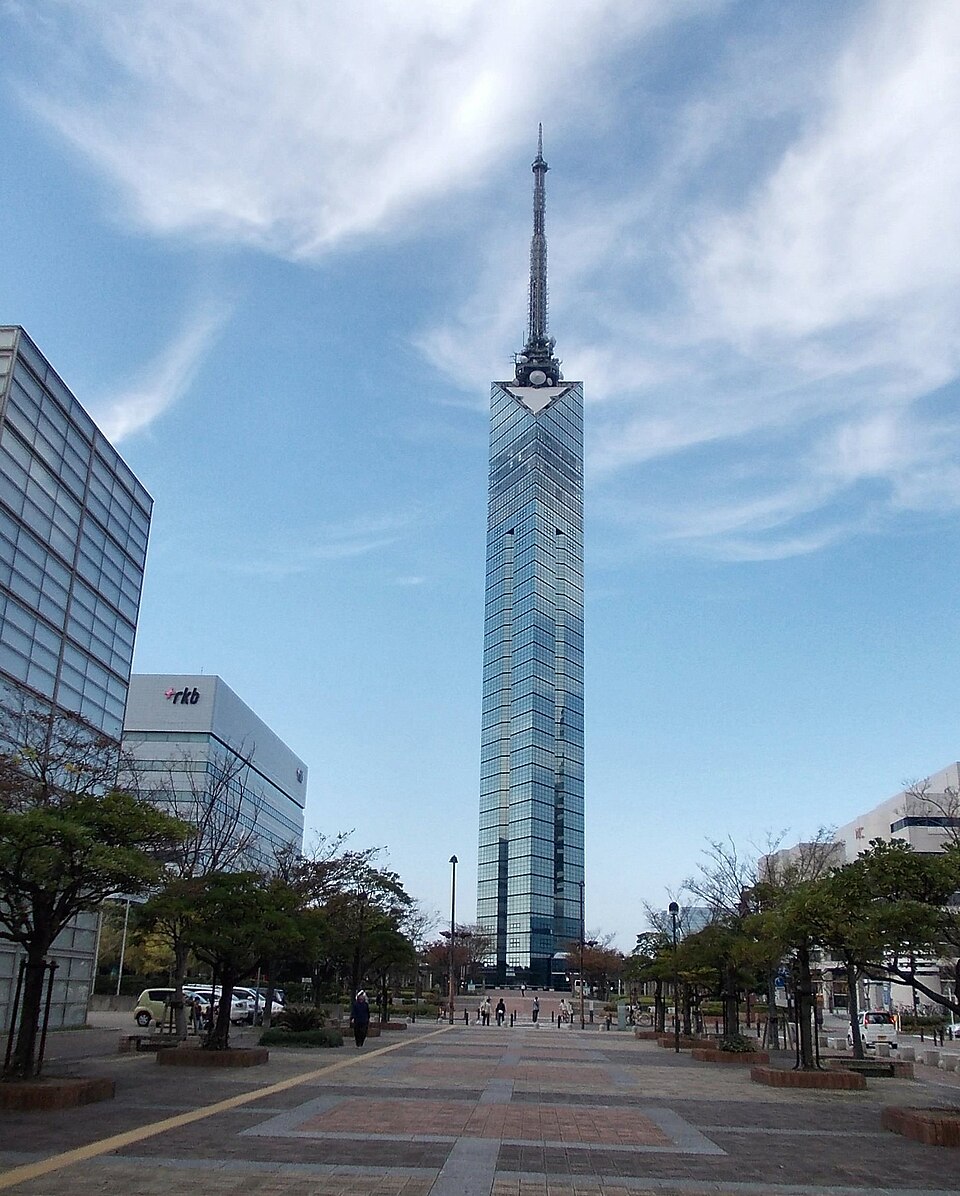
A single slender tower rising 234 metres straight out of a flat reclaimed shoreline, with nothing of comparable height nearby; its main observation deck sits about halfway up, at 123 metres, giving a 360° view over the bay it stands beside.
Fukuoka Tower is a 234-metre broadcasting and observation tower in the Momochihama district, built on land reclaimed from Hakata Bay. Completed in 1989 after fourteen months of construction, at a cost of about ¥6 billion, it was designed by the firm Nikken Sekkei. Its main observation deck, at 123 metres, offers a 360° view of the surrounding area and is busiest at sunset. It is described as the tallest seaside tower in Japan.
- Construction took only fourteen months and cost roughly ¥6 billion, about US$45 million at 1989 prices.
- It was built on land reclaimed from Hakata Bay in the Momochihama district.
- It is described as the tallest seaside tower in Japan.
Photo: STA3816 (CC BY-SA 3.0)
Fukuoka Castle
1607
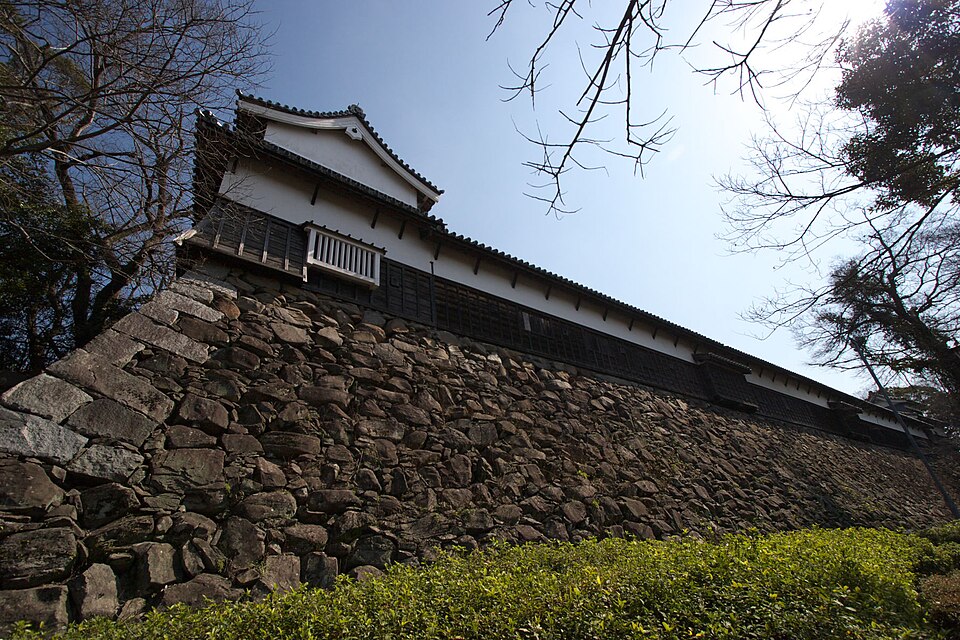
Set on a low hill with a river forming a moat along one side and a mudflat along the other, the site today shows earthworks and approach paths rather than a tall keep; the surviving structures are a scatter of gates and wooden yagura watchtowers, including a roofed one completed in 1854, standing inside what is now a park.
Fukuoka Castle, also known as Maizuru Castle or Seki Castle, was completed in the early 1600s for the tozama daimyo Kuroda Nagamasa on Fukusaki hill in the centre of the city. The Naka River formed a natural moat to the east and a mudflat to the west, with a castle town laid out toward the sea. Most of the original buildings are gone; the grounds are now Maizuru Park, home to sports facilities, a courthouse and an art museum, though several gates and watchtowers survive, including one dated to 1854.
- Excavations begun in 1987 uncovered the remains of a korokan, an ancient guest house for foreign diplomats, beneath the castle grounds.
- The site once held Heiwadai Baseball Stadium, former home ground of the Nishitetsu Lions and Fukuoka Daiei Hawks.
- One surviving watchtower, the Minamimaru Tamon Yagura, was completed in 1854 and is designated an Important Cultural Property.
Photo: Pontafon (CC BY-SA 3.0)
Kushida Shrine
757
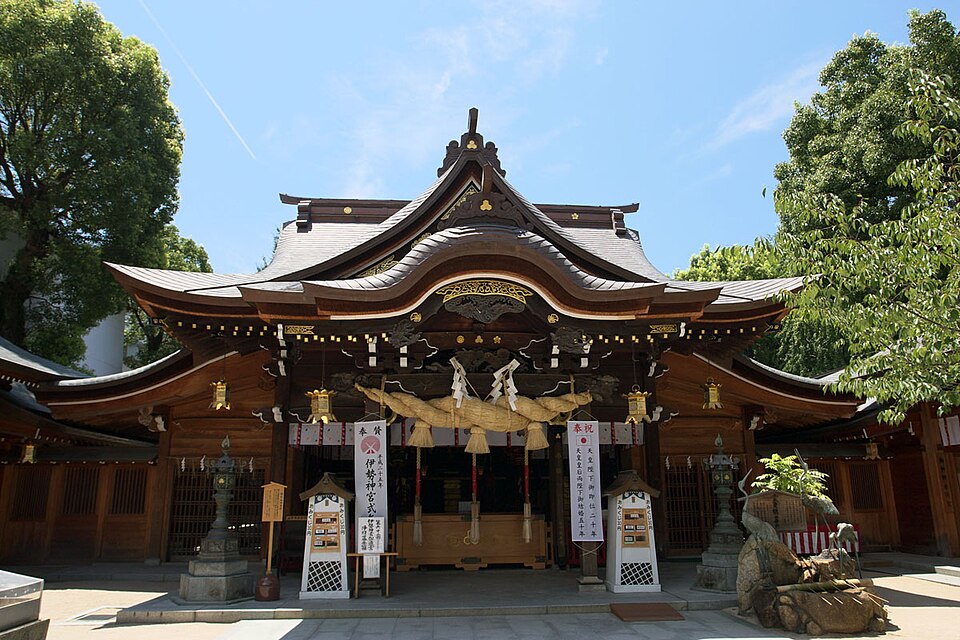
The shrine's visible identity is tied less to its buildings than to the festival built around it: its grounds are the starting point for the Hakata Gion Yamakasa, an annual procession of tall decorated floats, and it is dedicated jointly to Amaterasu and Susanoo.
Kushida Shrine stands in Hakata-ku, a historic port ward and one of Fukuoka's oldest districts, and is dedicated jointly to the sun deity Amaterasu and the storm deity Susanoo. Tradition dates its founding to 757. Its present-day identity is closely tied to the Hakata Gion Yamakasa, an annual festival centred on the shrine, in which tall decorated floats are paraded through the surrounding streets.
Photo: Pontafon (CC BY-SA 3.0)
Mizuho PayPay Dome Fukuoka
A domed baseball stadium in Chūō-ku, built in 1993 as Fukuoka Dome and home to the Fukuoka SoftBank Hawks. It was Japan's first stadium with a retractable roof, a distinction it held alone until 2023, and seats 40,000.
Canal City Hakata
A shopping and entertainment complex nicknamed the "city within the city," built around an artificial canal with hotels, cinemas and a theater. At $1.4 billion for 234,460 square metres, it was the largest private development in Japanese history.
Ōhori Park
A park in Chūō-ku, Fukuoka, registered as a Place of Scenic Beauty.
Hakozaki Shrine
A Shinto shrine located in Fukuoka.
Sumiyoshi Shrine (Fukuoka)
A Shinto shrine in the Sumiyoshi neighborhood of Hakata-ku, the ichinomiya of the former Chikuzen Province. It is one of Japan's "Three Great Sumiyoshi" shrines, alongside those in Osaka and Shimonoseki.
Tōchō-ji
A Shingon Buddhist temple in Hakata, founded by Kūkai in 806. It is the oldest Shingon temple on the island of Kyushu.
Shōfuku-ji (Fukuoka)
A Buddhist temple in Hakata founded by Eisai with the support of Minamoto no Yoritomo. It is considered the oldest Zen temple in Japan, and its grounds were designated a National Historic Site in 1969.
Jōten-ji
A Rinzai Zen temple in Hakata, founded by Enni Ben'en on his return from China with the support of the merchant Xie Guo Ming. Construction was completed in 1242.
Sōfuku-ji (Fukuoka)
A Rinzai temple founded in Dazaifu in 1240 by the monk Tan'e. It moved to its present site in Hakata-ku in 1600 after becoming the temple of the Kuroda clan.
Our Lady of Victory Cathedral, Fukuoka
A Catholic cathedral in Fukuoka also known as Daimyomachi Church, dedicated to Our Lady of Victory.
Fukuoka Art Museum
An art museum in Fukuoka with a collection of Western and Asian works, including Salvador Dalí's Madonna of Port Lligat. It hosted a major Marc Chagall exhibition in November 2010.
Fukuoka Mosque
A mosque in the Hakozaki area of Higashi-ku, officially the Fukuoka Masjid Al Nour Islamic Culture Center. Opened in 2009, it was the first mosque built on Kyushu and serves the prefecture's roughly 1,000 Muslims.
Fukuoka Municipal Zoo and Botanical Garden
A zoo and botanical garden established in 1953 within Minami-kōen park. Its grounds hold about 1,300 kinds of outdoor plants, and its greenhouse contains over 1,200 species including orchids, ferns and cacti.
Genkō Bōrui
A defensive stone wall built along Hakata Bay after the first Mongol invasion of 1274, originally 20 kilometres long. Sections still stand today despite stones being reused for Fukuoka Castle in the Edo period, and it was designated a National Historic Site in 1931.
Fukuoka Convention Center
A convention center in Hakata-ku made up of three separate buildings, operated by the Fukuoka Convention Center Foundation.
History
Long before it was a modern metropolis, the area around Hakata Bay served as a principal point of contact with the Asian mainland, occupied since the Jomon period and settled early in the Yayoi period. Kushida Shrine, founded in 757, belongs to that ancient port history. Fukuoka Castle followed centuries later, completed in the early 1600s on Fukusaki hill for the daimyo Kuroda Nagamasa, with the Naka River and a mudflat serving as its moats and a castle town laid out toward the sea; most of its buildings are gone today, leaving gates, towers and a public park in their place. The city's later expansion added a different kind of structure: Fukuoka Tower, finished in 1989 on ground reclaimed from the bay, part of growth that made Fukuoka Japan's sixth-largest city by 2015.