Landmarks in Toronto
A lakeside city whose landmarks span a 1914 private castle to 1960s-70s modern towers.
Toronto's landmarks cluster close to the harbour and the downtown core, and they are almost all young: nothing here predates the twentieth century. A Gothic Revival mansion built on a midtown hilltop for a financier sits apart in stone and turrets from the concrete and steel that followed it. Civic ambition after the Second World War produced a curved modern city hall chosen by international competition and built alongside its own public square, and the railway industry then raised a concrete communications tower over the old rail lands that outgrew every earlier structure on the skyline. The mix reads less as continuous growth than as three distinct moments, each stamped in a different material and a different idea of what a landmark should be.
CN Tower
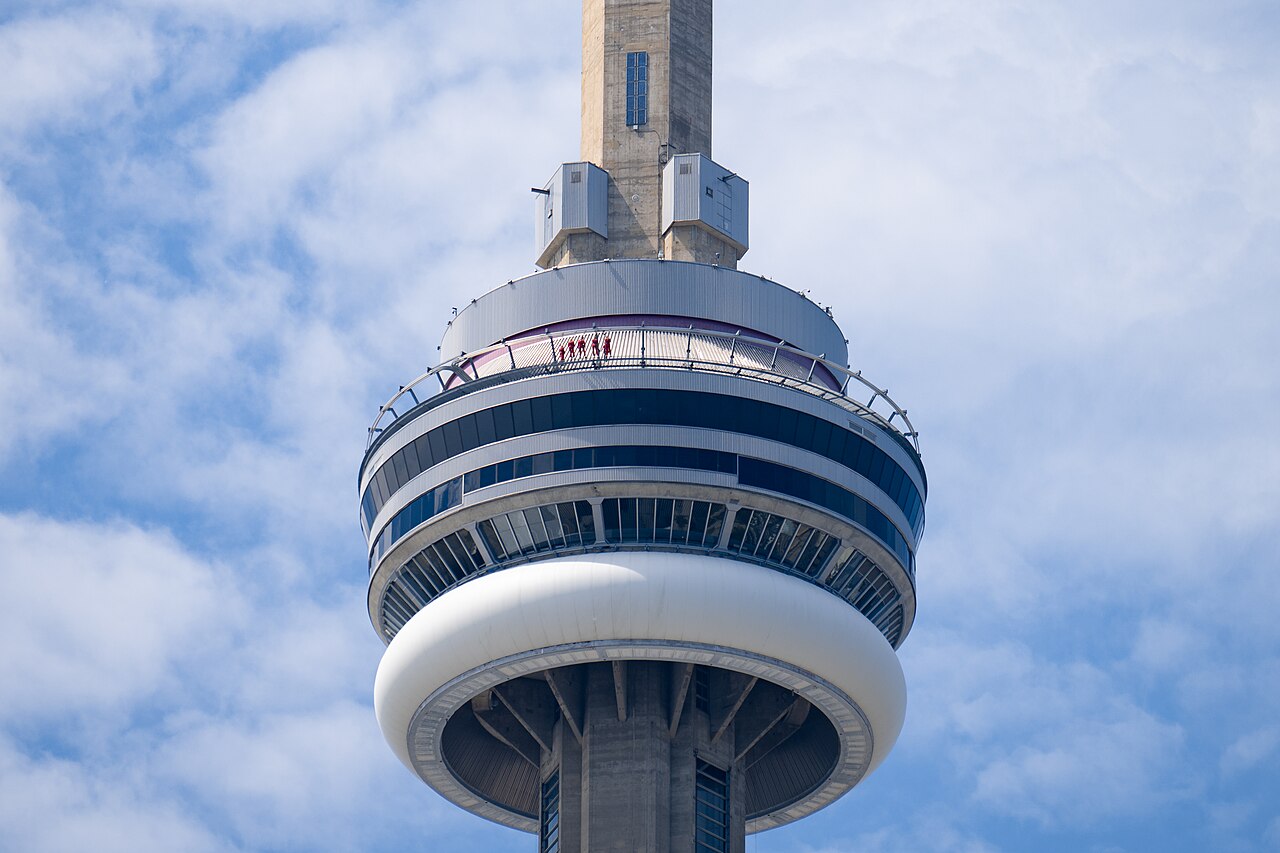
1976 · John Andrews
A grey concrete shaft that swells into a wide, saucer-like pod of observation decks partway up before narrowing to a thin antenna mast, still the tallest free-standing structure on land in the Western Hemisphere.
Canadian National, the railway company, built the tower as a communications and observation structure on former rail lands; it opened in 1976. When the railway divested its non-core assets ahead of privatisation in 1995, ownership passed to the Canada Lands Company, a federal Crown corporation. The tower held the record for the world's tallest free-standing structure from 1975 until the Burj Khalifa surpassed it in 2007, and remained the tallest tower on Earth until 2009. It contains several observation decks, a revolving restaurant roughly 350 metres up, and an entertainment complex.
- It held the record for the world's tallest free-standing structure for 32 years, from 1975 to 2007.
- The American Society of Civil Engineers named it one of the modern Seven Wonders of the World in 1995.
- Its revolving restaurant sits roughly 350 metres above the ground.
Photo: Erik Drost (CC BY 4.0)
Casa Loma
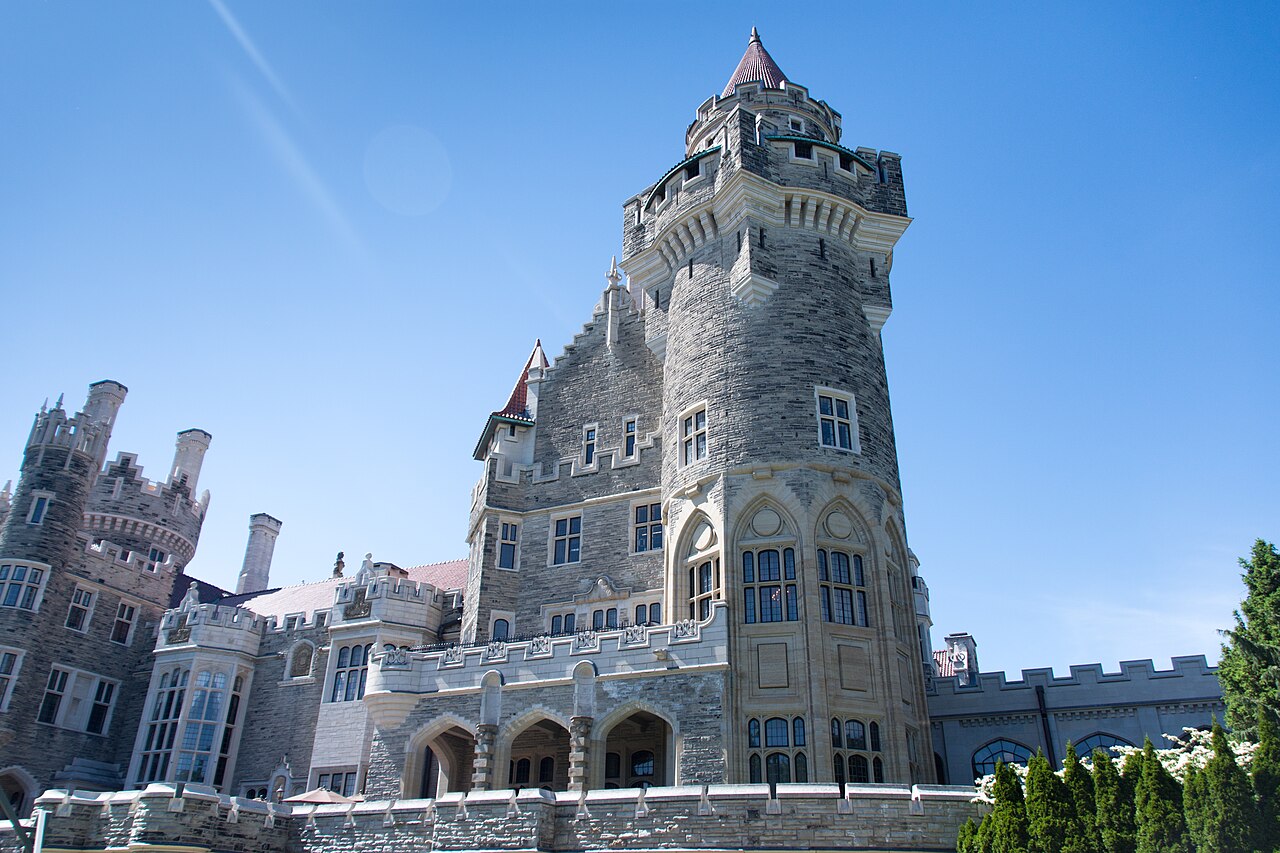
1911–1914 · E. J. Lennox
A turreted grey-stone castle with battlements, towers and a walled garden, standing on a wooded hilltop markedly higher than the streets around it — a castellated silhouette unlike anything nearby.
Built from 1911 to 1914 as a private residence for a financier, this Gothic Revival mansion stands at an elevation of 140 metres, some 66 metres above the lake below it. Its architect, E. J. Lennox, also designed several other landmarks in the city. Long since given up as a home, it now operates as a historic house museum, and its unusual architectural character, rare among its neighbours, has made it a frequent film and television location and a venue rented out for weddings after the museum closes each evening.
- It sits 140 metres above sea level, 66 metres above the level of the lake below it.
- Its architect, E. J. Lennox, designed several other landmarks in the same city.
Photo: Kanuk82 (CC0)
Toronto City Hall
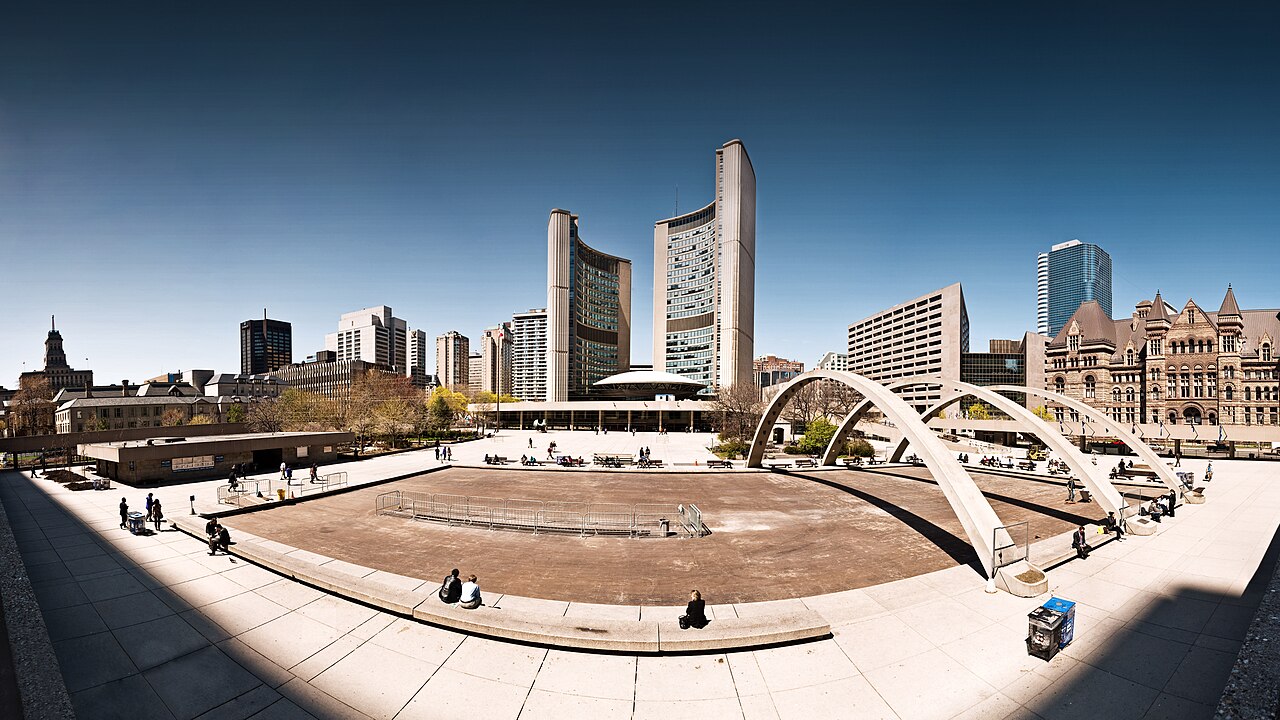
1965 · Viljo Revell
Two unequal curved concrete towers cradle a low, saucer-shaped council chamber, fronted by a public square with a shallow pool — a silhouette often compared to a spacecraft that has set down among older stone buildings nearby.
This Neo-Expressionist Modern building replaced an 1899 predecessor that had grown too small for the municipal government it housed. Designed by Viljo Revell and engineered by Hannskarl Bandel, it opened in 1965 alongside the public square built together with it, later named for the mayor who championed the project. Its design came from a 1958 international competition, the first in the province open to architects from outside the country, which provoked wide debate over what a monumental public building should be and what role open competitions should play in choosing one.
- Its 1958 design competition was the first in the province open to architects from outside the country.
- The adjoining public square was designed and completed together with the hall itself.
Photo: Benson Kua from Toronto, Canada (CC BY-SA 2.0)
Royal Ontario Museum
The largest museum in Canada, drawing more than one million visitors a year to its building north of Queen's Park. Established in 1912 and opened in 1914, it keeps close ties to the University of Toronto.
Queen's Park
An urban park in downtown Toronto, opened in 1860 by Edward, Prince of Wales, and named for Queen Victoria. It is the site of the Ontario Legislative Building, on land given to the provincial government in 1880 after being leased from the University of Toronto.
Old City Hall
A Romanesque-style civic building at Queen and Bay streets, home to the Toronto City Council from 1899 to 1966 and a provincial court house until 2023. Designated a National Historic Site in 1984, its clock tower rises at the head of Bay Street.
Sankofa Square
A public square at Yonge and Dundas streets, formerly known as Yonge–Dundas Square, conceived in 1997 and completed in 2002. Surrounded by landmarks including the Toronto Eaton Centre and the Ed Mirvish Theatre, it has become one of the city's prime tourist attractions.
Nathan Phillips Square
The forecourt of Toronto City Hall, designed by the City Hall's architect Viljo Revell and landscape architect Richard Strong, opened in 1965. At 4.85 hectares it is Canada's largest city square, drawing an estimated 1.5 million visitors a year.
Toronto Sign
An illuminated three-dimensional sign in Nathan Phillips Square that spells out the city's name, originally 3 meters tall and 22 meters long. Lit by LED lights, it can create an estimated 228 million color combinations.
Art Gallery of Ontario
An art museum on Dundas Street West, the second-largest art museum in Toronto after the Royal Ontario Museum. Established in 1900 as the Art Museum of Toronto, it was renamed the Art Gallery of Toronto in 1919 before taking its present name in 1966.
Massey Hall
A performing arts auditorium opened in 1894 as a gift from industrialist Hart Massey. Its capacity was reduced from 3,500 to 2,765 after 1933 renovations, and it closed in 2018 for a two-year restoration that added the Allied Music Centre.
St. Michael's Cathedral Basilica
The cathedral of the Roman Catholic Archdiocese of Toronto, designed by William Thomas, with a capacity of 1,600. A prime example of English Gothic Revival architecture, it was built away from the city centre, though Toronto has since grown to surround it.
Toronto-Dominion Centre
A skyscraper complex of six towers and a pavilion in bronze-tinted glass and black steel, the largest commercial office complex in Canada. Inspired by TD Bank president Allen Lambert, it was designed with Ludwig Mies van der Rohe, its towers completed between 1967 and 1991.
Toronto Eaton Centre
A shopping mall and office complex in downtown Toronto, named after the Eaton's department store chain that once anchored it. Sitting atop two subway stations, it is North America's busiest shopping mall, with more than 230 stores and restaurants as of 2014.
Maple Leaf Gardens
A historic arena at Carlton and Church streets, built in 1931 and considered a 'cathedral' of hockey. It was home to the Toronto Maple Leafs from 1931 to 1999, who won 11 Stanley Cups there, and hosted the first NHL All-Star Game in 1947.
Elgin and Winter Garden Theatres
A pair of stacked theatres, with the Winter Garden Theatre sitting six storeys above the Elgin at street level. They are the last surviving Edwardian stacked theatres in the world.
Osgoode Hall
A landmark building in downtown Toronto, built between 1829 and 1832 by John Ewart and William Warren Baldwin. Named for Chief Justice William Osgoode, it now houses the Ontario Court of Appeal and the offices of the Law Society of Ontario.
Aura
A mixed-use skyscraper near College Park, completed in 2014 after four years of construction, with 80 floors. As of 2018, it was the tallest residential building in Canada and the 38th-tallest in the world.
First Canadian Place
A 298-meter commercial skyscraper at King and Bay streets, serving as the global executive office of the Bank of Montreal. It was Canada's tallest building from its completion in 1975 until June 2025, when it was surpassed by The One.
Bata Shoe Museum
A museum of footwear near the University of Toronto's St. George campus, designed by Moriyama & Teshima Architects with Raymond Moriyama as lead architect. Its collection began with Sonja Bata's personal holdings in the mid-1940s, and the museum opened its permanent building in May 1995.
Gardiner Museum
A ceramics museum on the grounds of Victoria University, established by George and Helen Gardiner and opened to the public on 6 March 1984. Managed by the Royal Ontario Museum from 1987 until 1996, it became an independent institution and closed for renovations in 2004.
The Grange
The oldest surviving brick house in Toronto, built in 1817 for D'Arcy Boulton of the Boulton family, now part of the AGO. It later passed to his son, Toronto mayor William Henry Boulton, then to his widow Hariette, who remarried scholar Goldwin Smith.
Canada's Walk of Fame
A series of maple leaf-shaped stars set into 13 blocks of sidewalk on King and Simcoe streets, in front of Roy Thomson Hall. The first inductees were honored in 1998, and it now includes 204 Canadians from fields ranging from science to entertainment.
El Mocambo
A live music venue on Spadina Avenue that has played an important role in Toronto's popular music scene since 1948. It is best known for a surprise 1977 show by the Rolling Stones, made nationally notorious by the presence of Margaret Trudeau.
Kiever Synagogue
A Modern Orthodox synagogue founded by Ukrainian Jewish immigrants in 1912, its current twin-domed Byzantine Revival building completed in 1927. After membership declined and the building deteriorated, the Canadian Jewish Congress moved to preserve it in 1973, and in 1979 it gained heritage designation.
Hudson's Bay Queen Street
A department store on Yonge Street, designed by Burke and Horwood for Robert Simpson and opened in 1896. Once one of Canada's largest department stores, it was acquired by the Hudson's Bay Company in 1978 and became part of the Toronto Eaton Centre in 2014.
Church of the Holy Trinity
An Anglican church at Trinity Square in Toronto.
St. Patrick's Market
One of three public markets created in 19th-century Toronto, alongside St. Lawrence Market and St. Andrew's Market. The current structure on the site was built in 1912 and designated a heritage site by the city in 1975.
History
Indigenous peoples lived around the harbour for thousands of years before the British founded the town of York in 1793 as capital of Upper Canada; American troops occupied it briefly after the Battle of York in 1812. Renamed and incorporated as the City of Toronto in 1834, it grew into a business and financial centre whose surviving landmarks trace that later prosperity rather than the colonial founding: a financier's private castle raised on a midtown hilltop from 1911 to 1914, a curved city hall that replaced an 1899 predecessor and rose after a 1958 international design competition, and a railway-built communications tower finished in 1976 that briefly outranked every free-standing structure on Earth before passing to a federal Crown corporation once its builder was privatised.