Landmarks in Tokyo
A capital rebuilt in steel and brick after fire and bombing, not preserved intact.
The city's most visited structures cluster in three different eras and districts rather than one historic core. Sensō-ji, in Asakusa, is a Buddhist temple complex whose main hall and pagoda were rebuilt in the 1950s after wartime destruction, keeping a seventh-century foundation in essentially postwar materials. Tokyo Station, in Chiyoda near the Imperial Palace, is a brick terminus from 1914 built in a European revivalist style, with later additions in a plainer postmodern idiom on its eastern side. Tokyo Tower, in Minato, is a white-and-orange steel lattice broadcasting mast from the late 1950s, built for television and radio rather than sightseeing. Together they show a capital rebuilt repeatedly rather than preserved intact.
Tokyo Tower
1958 · Tachū Naitō
A tapering white-and-international-orange lattice tower whose four-legged steel frame and stepped silhouette echo the shape of a much older iron tower in Europe, with two observation decks set partway up its shaft.
Officially called the Japan Radio Tower, this is a communications and observation tower in Shiba Park, completed in 1958 and rising 332.9 meters, which made it the tallest tower in the country until Tokyo Skytree overtook it in 2012. Transmission antennas were added in 1961 and still carry signals for national broadcasters. Below the tower, a five-story base building holds restaurants and gift shops, and two observation decks sit partway up the structure: the Main Deck at 150 meters and the smaller Top Deck at 249.6 meters. It is a Registered Tangible Cultural Property of Japan.
- The tower is repainted in full every five years, and the process alone takes about a year.
- Its lattice design was inspired by the Eiffel Tower.
Senso-ji
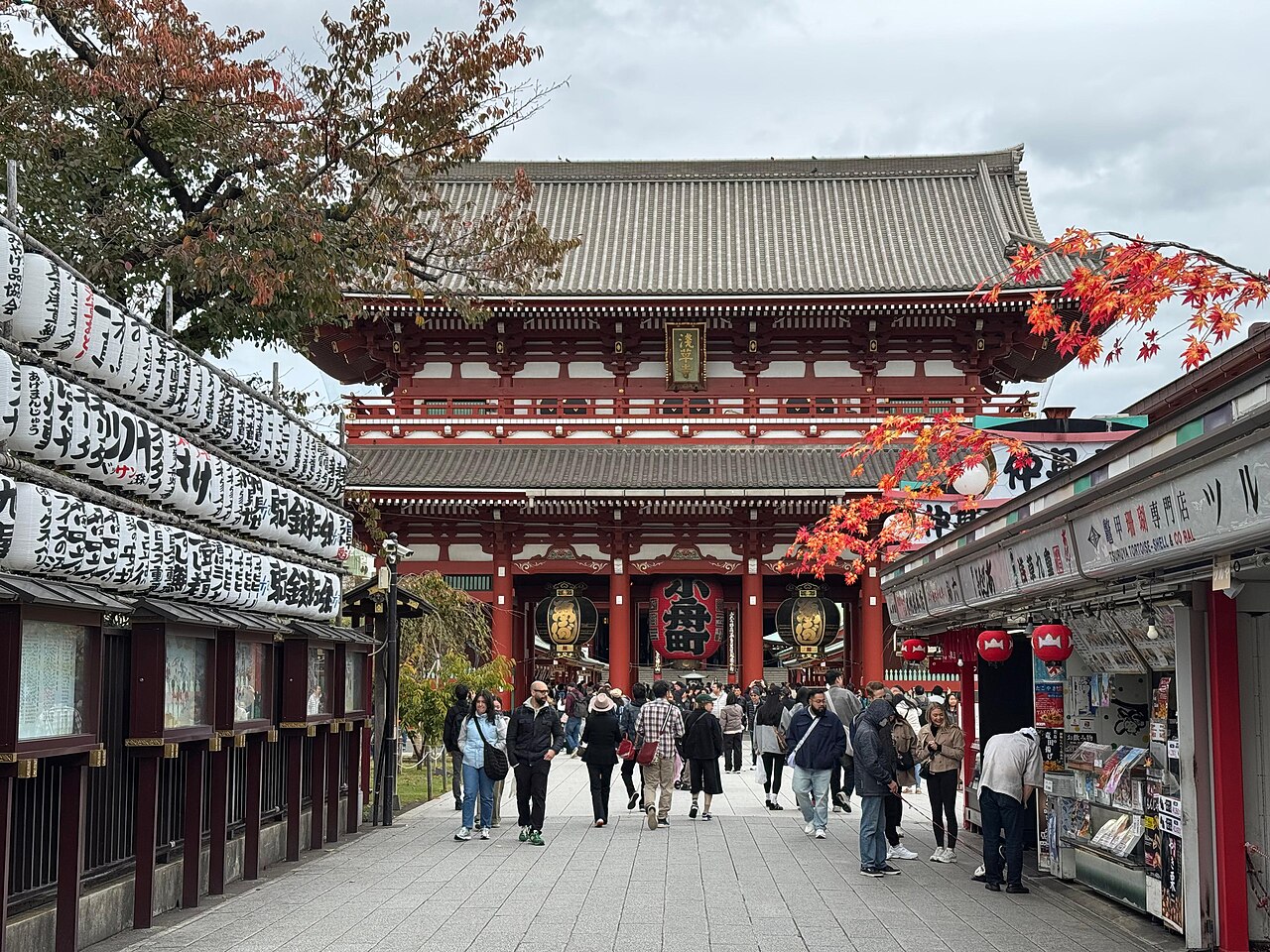
645–1950s
A temple complex built around a main hall and a five-story pagoda, entered through large gates and a covered lane of shops selling traditional goods, with a separate Shinto shrine standing immediately beside it.
Founded in 645, this is the city's oldest Buddhist temple and one of its most important, dedicated to Kannon, the bodhisattva of compassion. It is the most visited religious site in the world, drawing more than 30 million visitors a year, and forms the thirteenth stop on a regional pilgrimage route. Firebombing on 10 March 1945 destroyed the complex during the war, and the main hall was rebuilt in the 1950s. Formerly tied to the Tendai school of Buddhism, it became independent in 1950. A Shinto shrine stands immediately beside it, and a lane of traditional shops leads to its gates.
- It draws more than 30 million visitors a year, making it the most visited religious site in the world.
- It is the thirteenth stop on a regional Buddhist pilgrimage route.
Photo: Joli Rumi (CC BY-SA 4.0)
Tokyo Station
1914 · Tatsuno Kingo
A station building whose original wing carries baroque and Renaissance Revival detailing from 1914, paired with a newer, plainer postmodern wing on its far side, the whole complex split into two distinct fronts facing opposite directions.
Opened in 1914 as a joint terminus for what are now the Tōkaidō, Tōhoku and Chūō lines, the station was designed chiefly by Tatsuno Kingo. Later renovation work involving Helmut Jahn and Werner Sobek is reflected in postmodern elements alongside the original baroque and Renaissance Revival detailing. Bombing on 25 May 1945 badly damaged the building, though it soon reopened. The Tōkaidō Shinkansen, the world's first dedicated high-speed rail line, began running from here to Osaka in 1964, and a northbound extension from Ueno followed in 1991. It is an Important Cultural Property of Japan.
- The Tōkaidō Shinkansen, the world's first dedicated high-speed rail line, began service here in 1964.
- More than 4,000 trains arrive and depart daily, making it the ninth busiest station in the world.
Imperial Palace
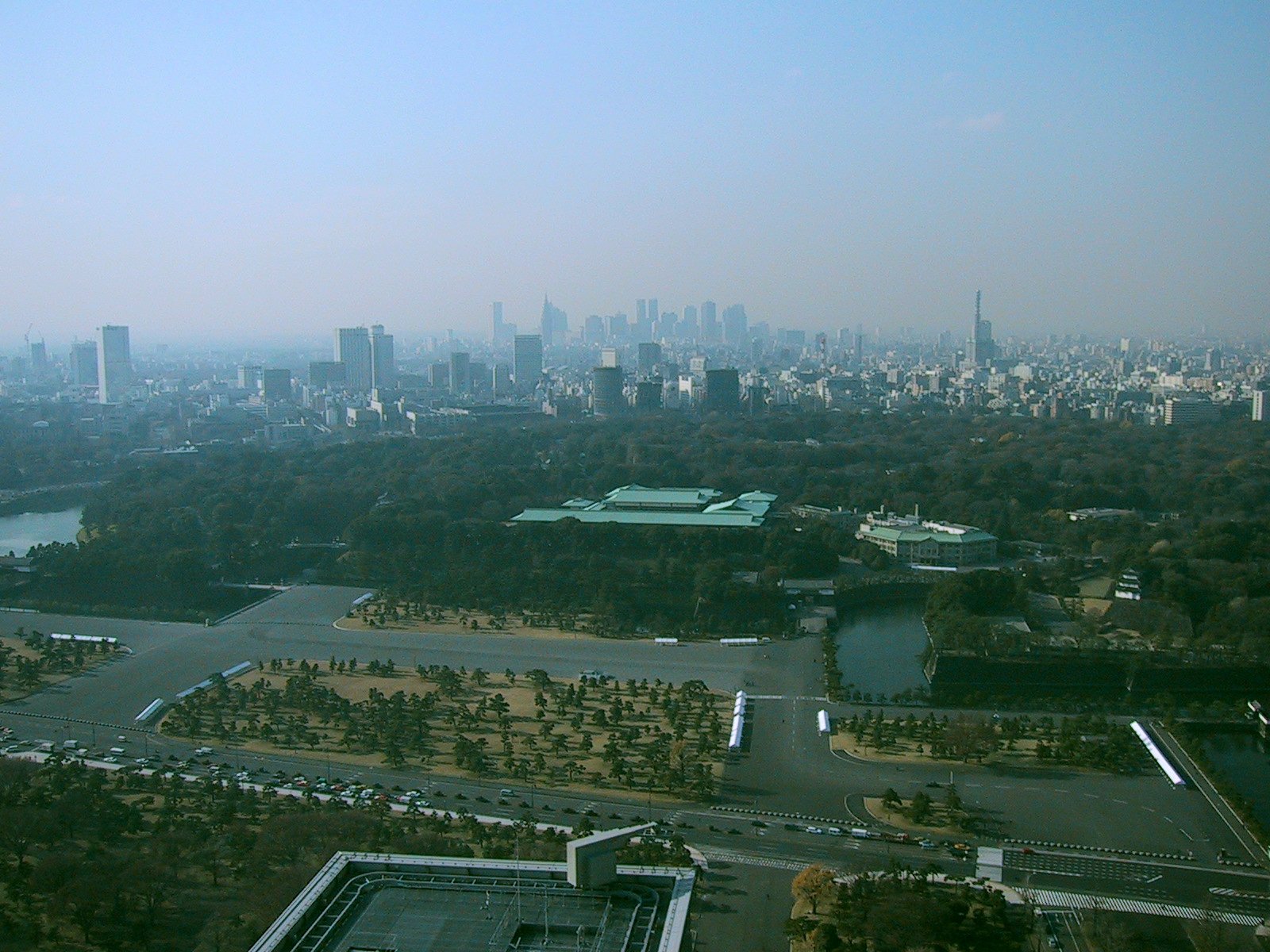
1868–1968 · Junzo Yoshimura
Broad moats and massive stone ramparts from the original fortress enclose a low, wood-toned palace complex with deep tiled roofs, set within landscaped gardens rather than presented as a single freestanding building.
This walled complex occupies the site of the former Edo Castle, becoming the emperor's residence in 1869. Most of its Meiji-era buildings, including a grand audience hall larger than any other in the compound, burned down in an Allied firebombing raid in May 1945. A new main palace hall, designed by Junzo Yoshimura, was built between 1964 and 1968 in traditional style using mostly domestic materials, and a separate residence by Shōzō Uchii followed in 1993. Part of the former grounds opened to the public as a garden in 1968.
- On two separate occasions, in 2008 and 2013, tourists stripped and swam across the palace moat trying to avoid arrest or sneak inside.
- The wooden double bridges over the moat, once called Nijūbashi, were later rebuilt in stone and iron.
- The pre-war audience hall's floor space measured more than 737 square meters before it was destroyed in 1945.
Photo: Chris 73 (CC BY-SA 3.0)
National Diet Building
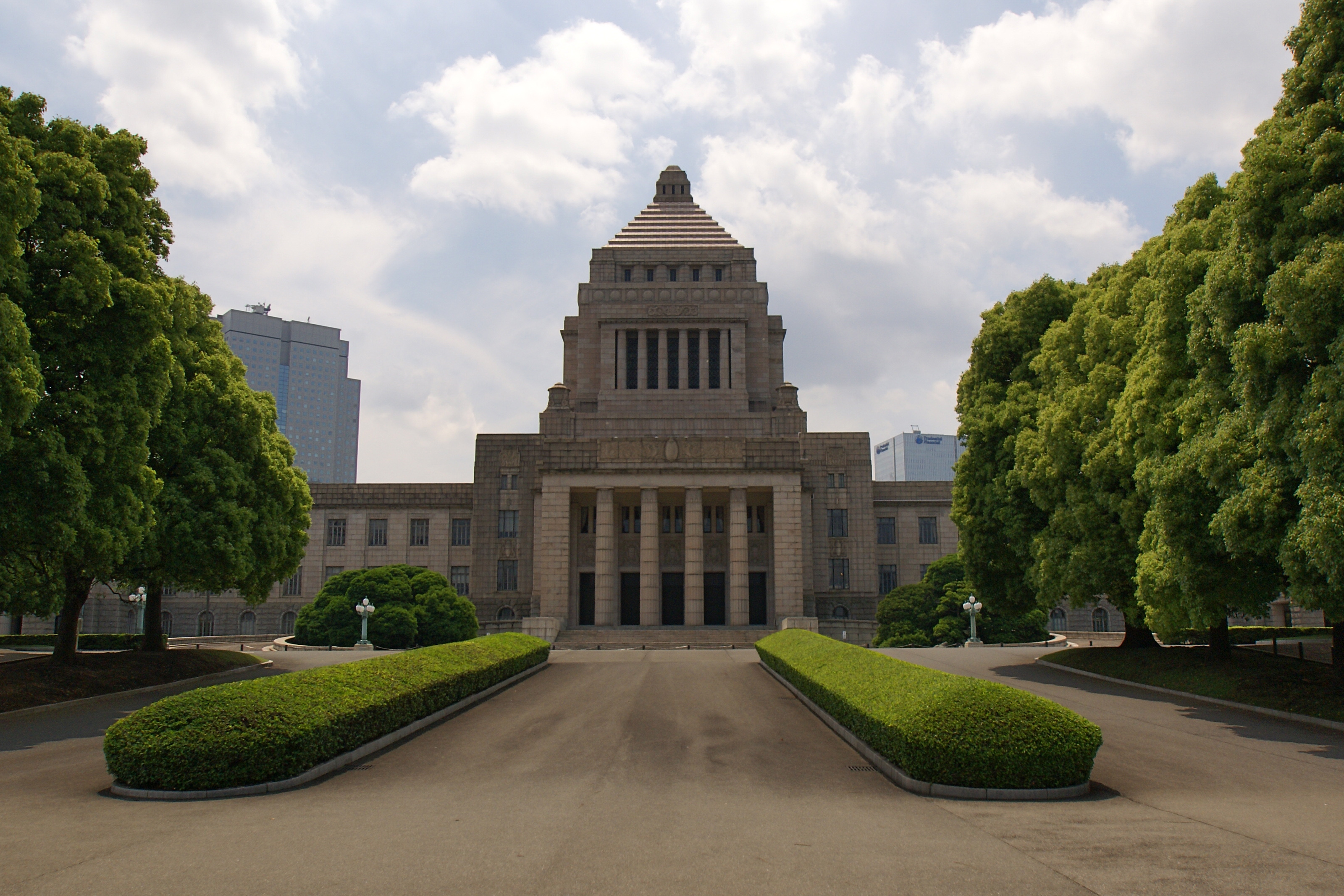
1920–1936 · Ministry of the Treasury
A symmetrical stone building with a stepped, pyramid-shaped tower rising from its center between two matching wings, one on either side of the main entrance.
Plans for this building dated back to the 1880s, but two earlier wooden structures on the site burned down, in 1891 and 1925, before construction of the present building began in 1920. A 1918 design competition drew 118 entries, and the winning floor plan underlies the finished structure, completed in 1936. It was built entirely of Japanese materials except for its stained glass, door locks and pneumatic tube system. Its central tower reaches 65.45 meters, briefly surpassing a department store as the tallest building in the area.
- The central entrance is nicknamed "the door that never opens" because it is used only for rare ceremonial occasions.
- Three statues of Meiji-era statesmen stand in the central hall's corners, but the fourth pedestal has always stood empty for reasons nobody has settled.
- The four seasonal paintings on the central hall's stained-glass ceiling were painted by art students rather than established artists.
Photo: 663highland (CC BY 2.5)
Dome
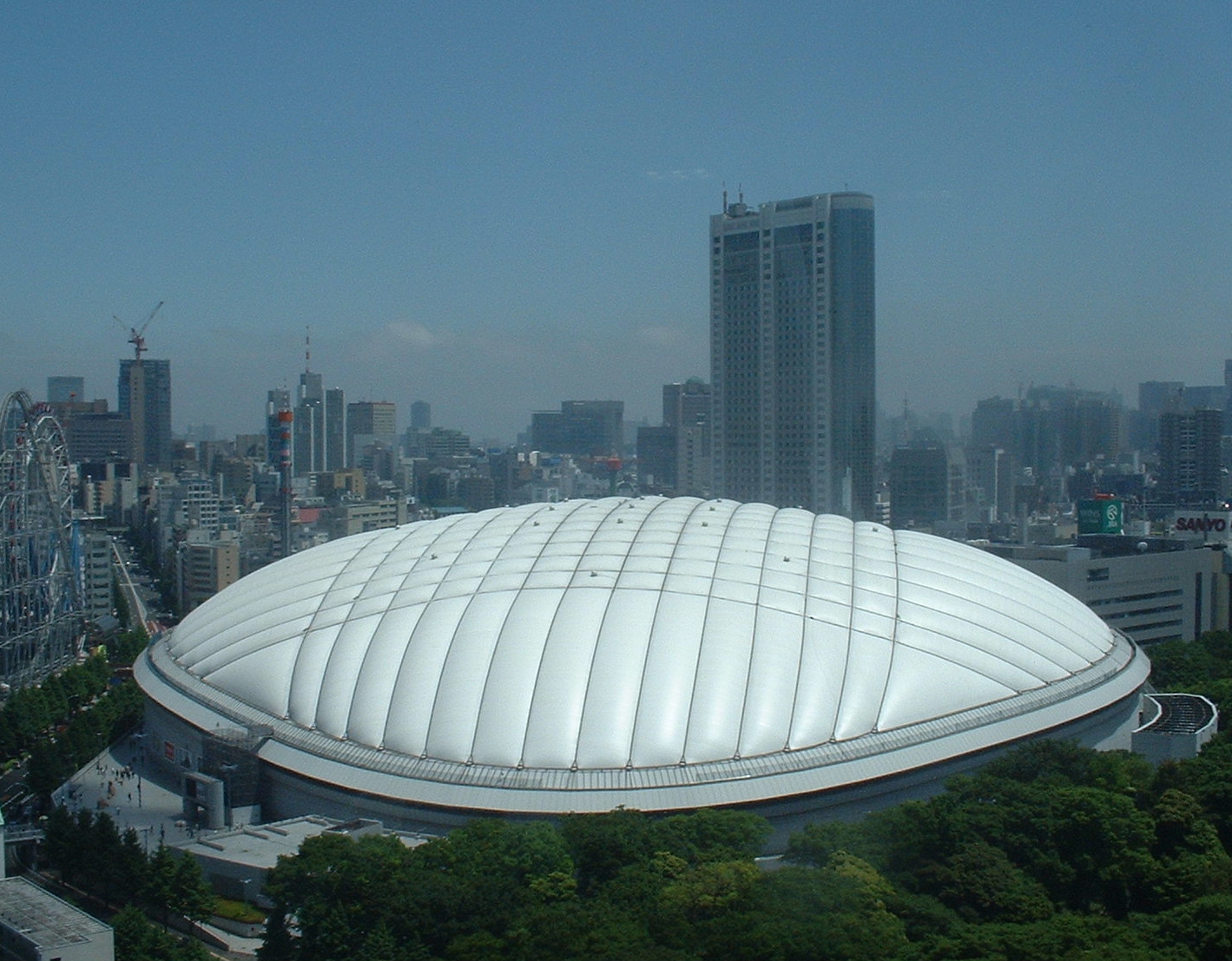
1985–1988 · Takenaka Corporation
A stadium topped by a smooth, rounded white dome kept aloft purely by internal air pressure, giving it an egg-like silhouette that led to an early nickname referencing that shape.
Construction began in 1985 on the site of a velodrome, replacing the open-air Korakuen Stadium as home of the Yomiuri Giants; the earlier ballpark's site is now a hotel and plaza. Developed jointly by Nikken Sekkei and Takenaka Corporation and modeled on the Hubert H. Humphrey Metrodome, the stadium opened in 1988 with a fiberglass membrane roof supported entirely by pressurized interior air. It holds up to 57,000 people and has hosted Major League Baseball season openers, world baseball tournaments, and Japan's Baseball Hall of Fame.
- Its 0.8-millimeter fiberglass membrane roof is held up entirely by pressurizing the stadium's interior air, with no rigid supporting frame.
- It was nicknamed "the Big Egg" for the shape of its dome.
- Games played here between the Chicago Cubs and New York Mets in 2000 were the first Major League Baseball regular-season games held in Asia.
Photo: Carpkazu at Japanese Wikipedia (CC BY-SA 3.0)
Zōjō-ji
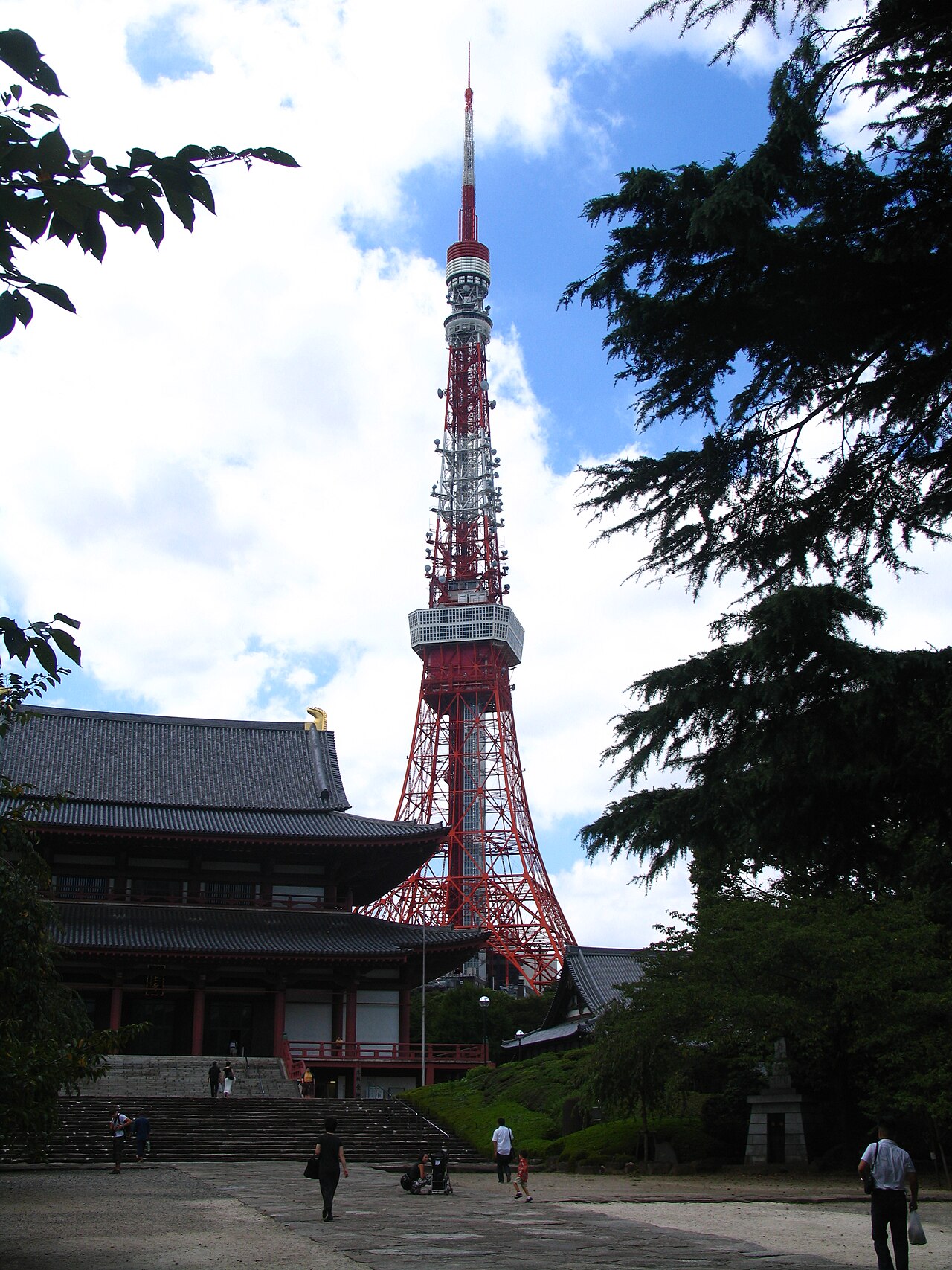
1393–1974
A weathered two-story wooden gate, centuries older than everything around it, stands before a rebuilt great hall, with a tall broadcasting tower rising immediately behind the temple grounds.
Founded in 1393 when its abbot converted the temple from the Shingon to the Jōdo school, this became one of two family temples of the Tokugawa shoguns, moving to its present site in 1590. Six of the fifteen shoguns are buried in a mausoleum here. Its two-story Sangedatsumon gate, built in 1622, is the oldest wooden building in the city and the only original structure to survive wartime bombing; the adjoining great hall was destroyed and rebuilt in 1974. A gallery beneath it, opened in 2015, displays temple treasures.
- The Sangedatsumon gate's name refers to freeing whoever passes through it from three passions: greed, hatred, and foolishness.
- The temple's Treasure Gallery displays a 1/10-scale model of a shogun's mausoleum destroyed in the war, alongside scrolls of 500 Buddhist arhats that survived a fire that destroyed the hall built to house them.
- A section of the temple garden holds rows of small stone statues representing miscarried, aborted, and stillborn children, which parents decorate with clothing and toys.
Photo: Andreas Tack (CC BY-SA 3.0)
Ueno Park
A public park established in 1873 on the former grounds of Kan'ei-ji temple, among Japan's first parks built on the Western model. Home to major museums and famed for cherry blossoms in spring, it draws over ten million visitors a year, Japan's most popular park.
Yasukuni Shrine
A Shinto shrine founded by Emperor Meiji in 1869 to commemorate those who died in service of Japan, from the Boshin War onward. It lists more than 2.46 million names, including 1,068 convicted war criminals, fourteen with Class A convictions at the Tokyo Trial.
Nippon Budokan
An indoor arena in Chiyoda, built for judo at the 1964 Summer Olympics and later hosting judo and karate at the 2020 Games. It also became one of the world's leading music venues, hosting the Beatles' first rock concerts in a series of five shows.
Ueno Tōshō-gū
A Shinto shrine first established in 1627 by Tōdō Takatora and renovated in 1651 by Tokugawa Iemitsu, largely unchanged since as an example of Edo-period architecture. Located inside Ueno Park, it enshrines Tokugawa Ieyasu along with shoguns Tokugawa Yoshimune and Tokugawa Yoshinobu.
International Forum
A multi-purpose exhibition centre generally considered part of the Yūrakuchō business district, though administratively in Marunouchi. It was built on the site of the Old City Hall, whose government functions moved to the Tokyo Metropolitan Government Building in Nishi-Shinjuku.
Imperial Palace East Garden
A historical garden within the Tokyo Imperial Palace, built on the grounds of Edo Castle and first used by the Tokugawa shogunate. Its Ōte-mon Gate once served as the castle's main entrance, and a tea house, Suwa-no-cha-ya, was built there by Emperor Meiji in 1912.
Kanda Shrine
A Shinto shrine dating back 1,270 years, its current structure rebuilt several times after fires and earthquakes. Shōgun Tokugawa Ieyasu once paid his respects here, and its proximity to Akihabara has made it a mecca for technophiles today.
Kabuki-za
The principal theatre in Tokyo for traditional kabuki drama, located in Ginza.
Toranomon Hills
A mixed-use skyscraper complex developed by Mori Building in the Toranomon district, with its Mori Tower completed in 2014 and its other towers in 2023. It was designed by Ingenhoven Associates and Nihon Sekkei, and connects to Toranomon Hills Station on the Hibiya Line.
Edo-Tokyo Museum
A historical museum in the Ryogoku district, opened in 1993 as the first museum dedicated to Tokyo's history, designed by Kiyonori Kikutake. Its 62.2-metre concrete exterior echoes a rice storehouse and matches the height of Edo Castle, and displays a replica of the Nihonbashi bridge.
National Museum of Nature and Science
A science museum in the northeast corner of Ueno Park, with exhibitions on pre-Meiji science in Japan. It displays the taxidermied bodies of the famous dogs Hachikō, Taro and Jiro, along with a life-size blue whale model and a steam locomotive outside.
National Museum of Modern Art
Known as MOMAT, the foremost museum of modern Japanese art, in Chiyoda, holding 20th-century works by both Western-style and Nihonga artists. It has a branch, the National Crafts Museum, in the city of Kanazawa.
Yushima Seidō
A Confucian temple established in the late 17th century, during the Genroku era of the Edo period. In the late Edo period, one of the shogunate's most important schools, the Shōheikō, was founded on its grounds.
Yushima Tenmangū
A Shinto shrine established in 458 and devoted to Tenjin, the kami of learning, near Ueno Park and the University of Tokyo. Students seeking exam success leave votive ema tablets here, and its plum trees draw crowds each spring during the Ume Matsuri festival.
Shinobazu Pond
A natural pond within Ueno Park, on the site of the former Kan'ei-ji temple, built by the Tokugawa shoguns to guard Edo Castle's northeast. The temple was destroyed in the Boshin War, but the pond, though modified and once drained, survives as a Shitamachi landmark.
Ginza Six
A luxury shopping complex in Ginza, jointly developed by Mori Building, J. Front Retailing, Sumitomo Corporation and L Catterton Real Estate. Its name reflects its address in Ginza 6-chome and an ambition to offer a "six-star" shopping experience.
History
Tokyo began as Edo, a fishing town that became the seat of the Tokugawa shogunate in 1603 and grew into one of the world's largest cities under two and a half centuries of military rule. Long before that, Buddhist worship had already taken root at Sensō-ji, founded in 645 in what is now Asakusa. The built environment visible today owes more to the twentieth century than to Edo: American bombing raids in 1945 destroyed Sensō-ji's halls and damaged the railway terminus at Tokyo Station, both later rebuilt. Postwar reconstruction also produced Tokyo Tower, raised in 1958 as a shared broadcasting mast for the city's television and radio stations. Reconstruction and repair, more than survival, explain why so much of the city's fabric reads as mid-century rather than ancient.