Landmarks in Taipei
A basin city stacking a 1738 Qing temple, a 1980 memorial hall and a 2004 supertall tower.
Taipei's three catalogued landmarks span three distinct eras of the city's growth. Longshan Temple, raised by settlers from Fujian in 1738 in the low-lying Wanhua district, is the oldest, a folk shrine mixing Buddhist and Taoist worship near the original riverside settlement. Chiang Kai-shek Memorial Hall, completed in 1980 during martial law, stands further east in a formal park square, flanked by a national theatre and concert hall built to the same plan. Taipei 101, opened at the end of 2004 in the Xinyi district still further east, is a postmodern, glass-and-steel supertall that briefly stood as the world's tallest building. Read together, the three sit roughly in chronological order moving east across the basin, from Qing-era settlement through mid-century state monument to a modern financial skyline.
Taipei 101
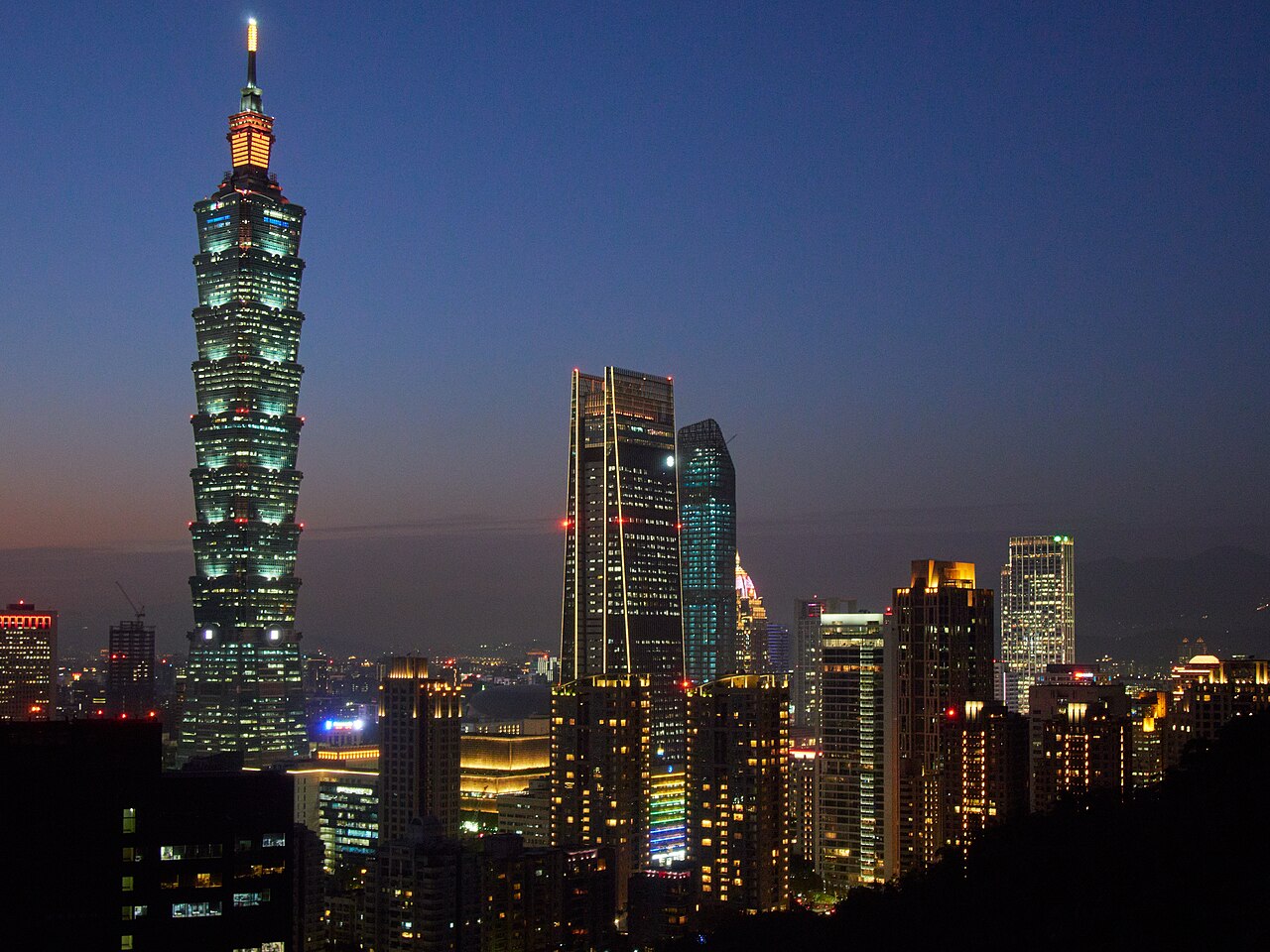
2004 · C. Y. Lee
A very tall, glass-and-metal tower whose postmodern, neo-futurist design draws on traditional Asian motifs within an otherwise industrial structure; at 508 metres over 101 storeys it dwarfs everything around it and was, for years after its 2004 opening, the tallest building on Earth.
A 101-storey supertall in Taipei's Xinyi district, opened at the end of 2004 as the Taipei World Financial Center before taking its current name. It held the record for the world's tallest building until the Burj Khalifa overtook it in 2009, and remains the tallest structure in Taiwan and the eleventh-tallest worldwide. Owned by the Taipei Financial Center Corporation, its postmodern, neo-futurist design pairs industrial materials with forms drawn from traditional Asian aesthetics.
- Its Toshiba-built elevators once carried passengers from the 5th to the 89th floor in 37 seconds, a world speed record at completion.
- In 2011 it earned a Platinum LEED rating, becoming the tallest and largest certified green building in the world at the time.
- Its New Year's Eve fireworks displays are a regular feature of international broadcasts.
Photo: lumoplank (CC0)
Chiang Kai-shek Memorial Hall
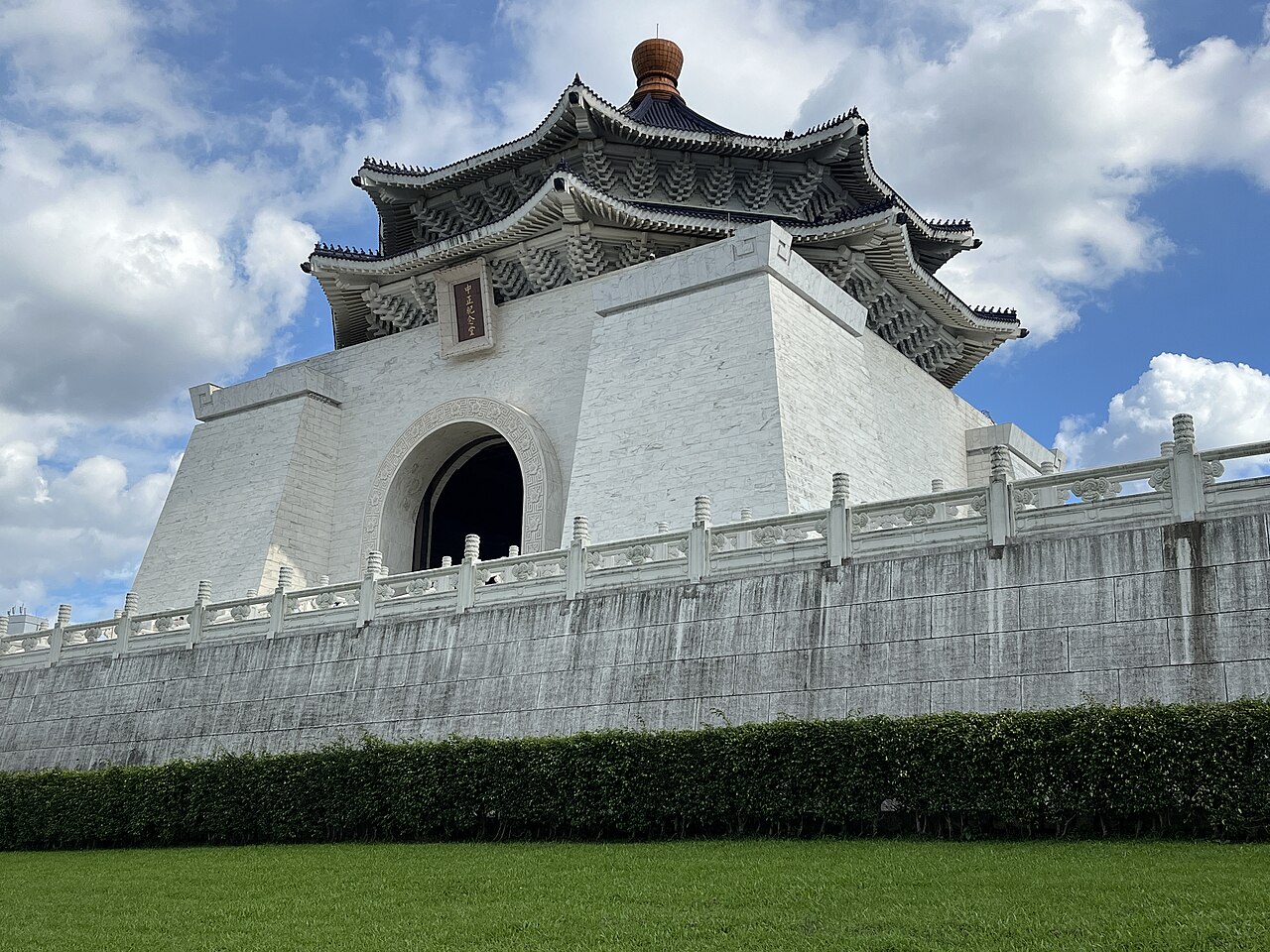
1980 · Yang Cho-cheng
A large stand-alone monument set within a park at the head of a formal square, flanked to the north and south by a national theatre and a concert hall; its scale and civic role have drawn comparisons to the Lincoln Memorial in Washington, D.C.
A national monument built during Taiwan's martial-law period in memory of former president Chiang Kai-shek, standing in a park at the east end of Memorial Hall Square. It is flanked on the north and south by the National Theater and National Concert Hall, part of the same complex. Completed in 1980, it has since also become a site of remembrance for the martial-law period of 1949 to 1987 rather than only for the man it commemorates, and some liken it to a Taiwanese analogue of the Lincoln Memorial.
Photo: Another Believer (CC BY-SA 4.0)
Longshan Temple
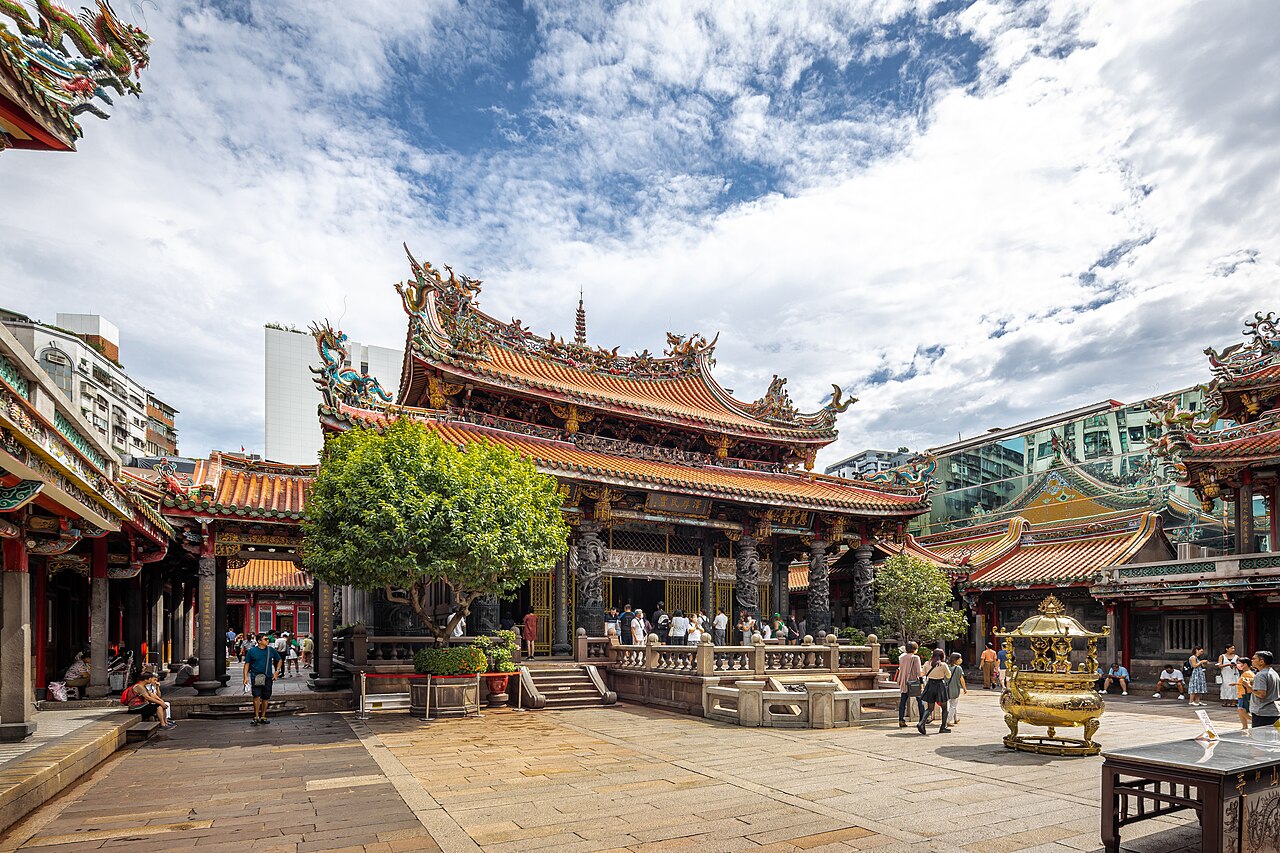
1738
A temple complex holding several forms of worship under one roof: a principal shrine to the bodhisattva Guanyin alongside separate altars to the sea goddess Mazu and the deified general Guan Yu, a mix of Buddhist and folk Taoist devotion unusual within a single building.
A folk temple in the Wanhua district, built in 1738 by Qing-era settlers from Fujian province and dedicated to the bodhisattva Guanyin. It served both as a place of worship and as a gathering place for the Chinese immigrant community that built it. Alongside its Chinese Buddhist elements it holds halls and altars to Taoist folk deities, including Mazu, goddess of the sea, and Guan Yu, a deified general. It is protected as a country-level monument for its heritage value.
Photo: This Photo was taken by Supanut Arunoprayote. Feel free to use any of my images, but please mention me as the author and may send me a message. (สามารถใช้ภาพได้อิสระ แต่กรุณาใส่เครดิตผู้ถ่ายและอาจส่งข้อความบอกกล่าวด้วย) Please do not upload an updated image here without consultation with the Author. The author would like to make corrections only at his own source. This ensures that the changes are preserved.Please if you think that any changes should be required, please inform the author.Otherwise you can upload a new image with a new name. Please use one of the templates derivative or extract. (CC BY 4.0)
Presidential Office Building
A Baroque-style building designed by architect Uheiji Nagano during Japanese rule, originally home to the Governor-General of Taiwan. Its bomb-damaged right wing was restored after World War II, and it became the Presidential Office in 1950 when the capital relocated to Taipei.
National Theater and Concert Hall
Twin performing arts venues completed in 1987, standing on the south and north sides of Liberty Square. Chiang Kai-shek Memorial Hall stands to their east, and the square itself sits near the Presidential Office Building and the National Taiwan Museum.
Grand Hotel (Taipei)
A landmark at Yuanshan established in May 1952, with its main building completed on October 10, 1973. At 87 metres, it is one of the world's tallest Chinese classical buildings and was Taiwan's tallest building from 1973 to 1981.
Liberty Square
A public plaza covering more than 240,000 square metres, completed in the late 1970s as the city's principal gathering place. Its name recalls Taiwan's transition from one-party rule to democracy during the 1990s.
Taipei Grand Mosque
The largest and oldest mosque in Taiwan, and its most important Islamic structure, in the Da'an District. It is also known as the Taipei Zheng He Mosque; as of November 2025 its imam was Abdullah Cheng.
228 Peace Memorial Park
A historic municipal park containing memorials to victims of the 1947 February 28 Incident, including the 228 Memorial Monument at its center. It also holds the Taipei 228 Memorial Museum in a former radio station, with the National Taiwan Museum at the park's north entrance.
National Taiwan Museum
Established in 1908, it is the oldest museum in Taiwan. It was founded by the colonial government during the period of Japanese rule and stands in Zhongzheng District.
Zhongshan Hall
A historic building originally serving as the Taipei (Taihoku) City Public Auditorium, on Yanping South Road in Ximending. It was recognized by the government as a historic site in 1992.
Taipei Fine Arts Museum
Opened on August 8, 1983, at the former site of the U.S. Taiwan Defense Command, it was the first museum in Taiwan built for contemporary art. Designed by architect Kao Er-Pan, its architecture is a local interpretation of the Japanese Metabolist Movement.
Daan Forest Park
A 26-hectare public park near the centre of the Da'an District, bordered by Xinyi, Heping East, Jianguo South, and Xinsheng South Roads. It was created in 1994 after the eviction of longtime squatters and demolition of illegal buildings on the site.
Red House Theater
A historic theater in Ximending, Wanhua District, at 10 Chengdu Road. It is also known by names including Hong Lo Red Play House, Red Theater, and Ximen Honglou.
National Revolutionary Martyrs' Shrine
Built in 1969 on Chingshan Mountain overlooking the Keelung River, its architecture recalls the Hall of Supreme Harmony in Beijing's Forbidden City. It houses the spirit tablets of about 390,000 war dead from conflicts including the Xinhai Revolution and Chinese Civil War.
Taipei Botanical Garden
Established in 1896 in the Nanhai Academy of Zhongzheng District, it covers about 8 hectares. It includes more than 2,000 plant species.
Shilin Night Market
A night market in Shilin District often considered the largest and most famous in Taiwan.
Confucius Temple
A Confucian temple located in the Datong District.
Museum of Contemporary Art
A museum of contemporary art located in the Datong District.
Taipei Dome
A multi-purpose domed stadium in Xinyi, officially known as Farglory Dome, that opened in October 2023 after years of delay. Used mainly for baseball but also football, softball, and esports, it adjoins Songshan Cultural and Creative Park and includes a mall, hotel, and office space.
Snake Alley
A two-block night market in Wanhua, Taipei's oldest district, near the Bangka Lungshan Temple. Nicknamed for stalls once selling snake delicacies such as snake blood and meat, it was formerly a legal red-light district and carries a negative reputation among many Taiwanese.
Dajia Riverside Park
A greening park in Zhongshan District between the Zhongshan and Dazhi Bridges, with grassland offering views of the Miramar Ferris wheel. Its fountain spans 125 metres with a 75-metre water column and 80 underwater lights, spraying for half an hour on the hour.
Songshan Cultural and Creative Park
A multifunctional park located in the Xinyi District.
Taipei Guest House
A historical building at 1 Ketagalan Boulevard in the Bo'ai Special Zone, owned by the Government of the Republic of China. It is used as a state guest house for receiving official visitors and hosting celebration activities.
Taipei Twins
A supertall skyscraper development near Taipei Station, scheduled for completion in 2028 with two towers of 360 and 280 metres. The taller tower will become Taiwan's second-tallest building, surpassing Kaohsiung's 347.5-metre 85 Sky Tower, at an estimated cost of US$1.95 billion.
Treasure Hill
A former illegal settlement founded by Kuomintang military veterans at the end of the 1940s, by the Xindian River. Named one of Taiwan's must-see destinations by The New York Times in 2006, it was closed in 2007 for restoration by the Taipei City Government.
Ciyou Temple
A folk temple in Songshan District built in the 18th century and dedicated to the sea goddess Mazu. On Mazu's birthday each year, believers parade her statue through the streets with decorated floats, and the temple also stands beside the Raohe Street Night Market.
Huashan 1914 Creative Park
A multi-purpose park located in the Zhongzheng District.
History
Taipei began as a Qing-dynasty riverside settlement, where Fujianese migrants built Longshan Temple in 1738, giving the western Wanhua district its oldest surviving structure and a communal gathering place as well as a shrine. The city became Taiwan's provincial seat in 1887, passed to Japanese administration from 1895, and returned to Republic of China rule in 1945, becoming the seat of the central government from 1949. Chiang Kai-shek Memorial Hall, finished in 1980 during the martial-law period, added a large monument and square east of the old settlement, paired with a national theatre and concert hall; the site has since also become a place of remembrance for that period itself. Continued growth pushed development further east into Xinyi district, where Taipei 101 opened at the end of 2004 as the world's tallest building, a title it held until 2009.