Landmarks in Kolkata
Marble Raj monuments and a cantilever steel bridge frame the Hooghly's east bank.
Kolkata's built landmarks cluster on the eastern bank of the Hooghly River, where the city grew as the East India Company's fort town and then as the de facto capital of British India until 1911, for a time the second-largest city in the empire after London. That administrative weight shows in stone and marble: the Victoria Memorial rises in white marble amid the open ground of the Maidan, built in the Indo-Saracenic style favoured for imperial monuments, while St. Paul's Cathedral applies Gothic Revival forms adapted, as Indo-Gothic, to the local climate. The one non-masonry landmark is later and utilitarian: the steel cantilever Howrah Bridge, raised in 1943 to replace a pontoon crossing and still carrying traffic between Kolkata and the Howrah rail terminal across the river.
Victoria Memorial
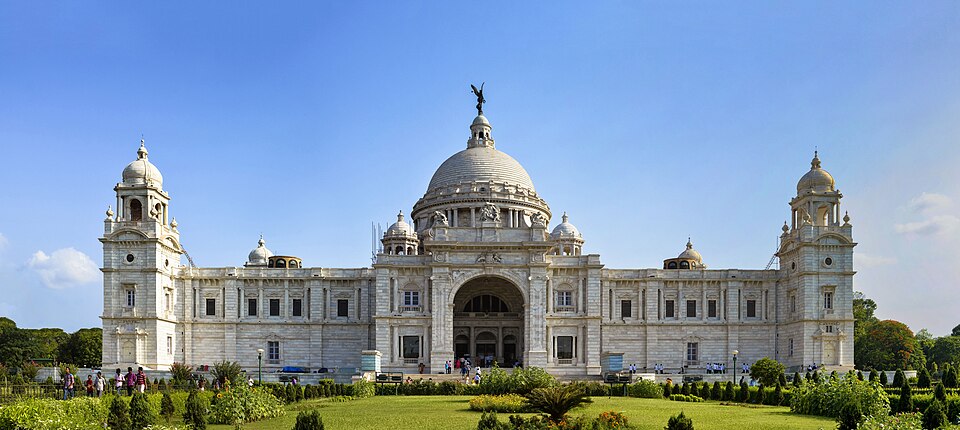
1906–1921 · William Emerson
The building is faced in marble and set within 26 hectares of gardens, its Indo-Saracenic design combining European and Islamic-derived architectural elements across a long, symmetrical structure.
The memorial commemorates Queen Victoria, who reigned as Empress of India from 1876 to 1901, and stands in the Maidan with its main entrance on Queen's Way. Raised between 1906 and 1921, with the superstructure begun in 1910, it was built by Martin & Co. of Calcutta, the firm founded by Rajendranath Mukherjee together with Thomas Acquin Martin. Set within 26 hectares of gardens, it is described as the largest monument built to any monarch anywhere in the world. It now operates as a museum under India's Ministry of Culture.
- It is reckoned the largest monument ever built to a monarch anywhere in the world.
- The firm that built it, Martin & Co. of Calcutta, was founded by Rajendranath Mukherjee together with Thomas Acquin Martin.
Photo: Subhrajyoti07 (CC BY-SA 4.0)
Howrah Bridge
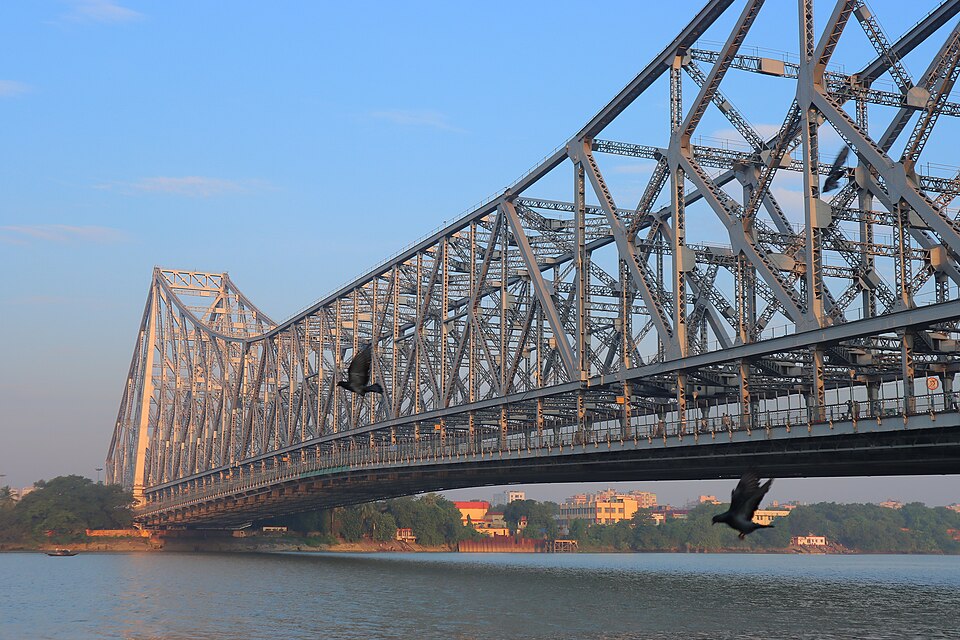
1943
The bridge is built entirely of steel as a cantilever structure, one of the longest of its type when finished, and it still carries the heaviest recorded traffic of any cantilever bridge in the world.
Commissioned in 1943 as the New Howrah Bridge, the structure replaced an older pontoon crossing and links Burrabazar with the Howrah rail terminal on the opposite bank. In 1965 it was renamed Rabindra Setu after the poet Rabindranath Tagore, though the earlier name has stuck. It is one of four bridges crossing the river, alongside Vidyasagar Setu, Vivekananda Setu and Nivedita Setu, and reportedly carries around 100,000 vehicles and over 150,000 pedestrians daily, making it the busiest cantilever bridge anywhere.
- It was renamed Rabindra Setu in 1965, after the poet Rabindranath Tagore, the first Indian and Asian Nobel laureate, though the old name never went away.
- At completion it was the third-longest cantilever bridge in the world; today it ranks sixth-longest of its type.
Photo: Pradip paswan (CC BY-SA 4.0)
St. Paul's Cathedral
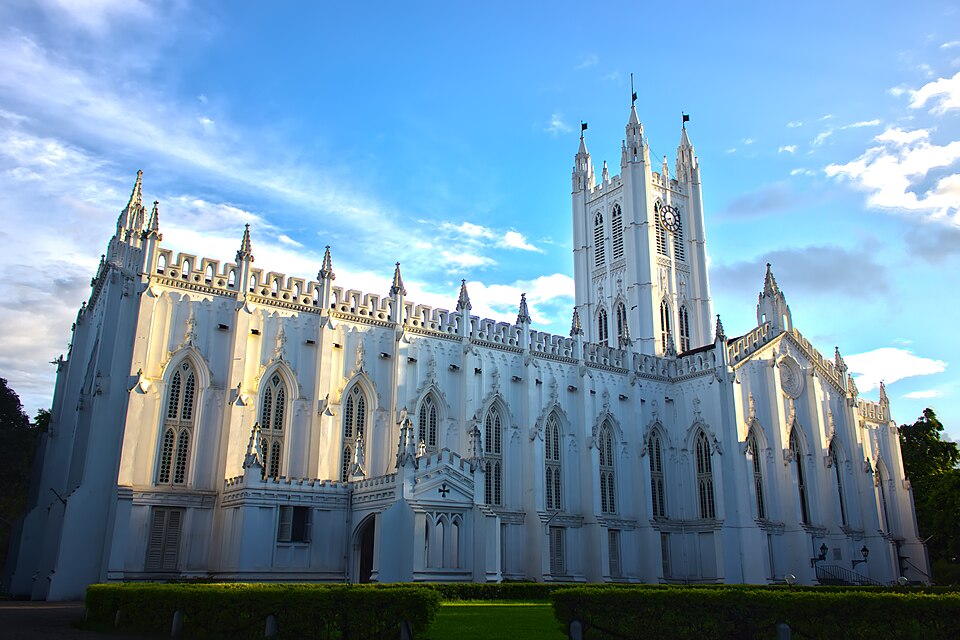
1847
Its Gothic Revival design was adapted, as 'Indo-Gothic', for the tropical climate, and the structure was reworked to a revised plan after later earthquake damage. An unusual library sits above the western porch, a feature that stands out on the exterior.
Its cornerstone was laid in 1839 and the building completed in 1847 as the seat of the Diocese of Calcutta, now part of the Church of North India. Reckoned the largest church in the city and the first Anglican cathedral built in Asia, it was designed in a Gothic style adapted, as 'Indo-Gothic', to the local climate. Earthquakes in 1897 and 1934 damaged the structure, which was subsequently reconstructed to a revised design. A library sits over the western porch, alongside a display of memorabilia.
- It was the first cathedral newly built anywhere in Britain's overseas territories.
- One of its burials is John Paxton Norman, an acting Chief Justice assassinated on the steps of Kolkata Town Hall in 1871.
Photo: Ankitesh Jha (CC BY-SA 3.0)
Calcutta High Court
The oldest High Court in India, a Gothic Revival building completed in 1872 and designed by Walter Long Bozzi Granville. It holds jurisdiction over West Bengal and the Andaman and Nicobar Islands, with a sanctioned strength of 72 judges.
Writers' Building
The 150-meter-long secretariat building of the West Bengal government, built in 1777 as an office for junior clerks of the East India Company. It housed Bengal's provincial government from 1937 to 1947 and the state government from 1947 to 2013.
Indian Museum
The ninth oldest museum in the world and the oldest and largest in Asia by collection size, founded by the Asiatic Society of Bengal in 1814. Its 35 galleries across six sections hold antiques, fossils, mummies and Mughal paintings, under founder curator Nathaniel Wallich.
Kalighat Temple
A Hindu temple dedicated to the goddess Kali, considered one of the 51 Shakti Pithas and one of the four Adi Shaktipeeth. According to legend, the toes of the goddess Sati's right foot fell here, and the temple draws hundreds of thousands of devotees.
New Market
A market complex on Lindsay Street at Dharmatala, formally known as Sir Stuart Hogg Market. Though the name originally referred only to the enclosed market building, locally the whole surrounding shopping area is also called New Market.
Vidyasagar Setu
A 822.96-meter cable-stayed toll bridge over the Hooghly River, linking Kolkata and Howrah, opened in 1992 at a cost of ₹388 crore. It was the first and longest cable-stayed bridge in India at the time, and is named after the education reformer Ishwar Chandra Vidyasagar.
Currency Building
An early 19th-century building in B. B. D. Bagh, built in 1833 for the Calcutta branch of the Agra Bank. It later served as the Reserve Bank of India's first central office from 1935 to 1937, before being saved from demolition by INTACH.
National Library of India
India's largest library, housed since 1953 in the Belvedere Estate, once the residence of British Viceroys. It holds more than 2.5 million books and records, and traces its roots to the Imperial Library, which merged with the Calcutta Public Library in 1903.
St. John's Church
A church modelled on St Martin-in-the-Fields in London, built between 1784 and 1787 with funds raised through a public lottery. It served as the Anglican Cathedral of Calcutta until 1847, the city's third oldest church, after the Armenian Church and the Old Mission Church.
Nakhoda Mosque
The principal mosque of Kolkata, completed in 1926 at the intersection of Zakaria Street and Rabindra Sarani in the Burrabazar district. It is a Sunni mosque affiliated with the Hanafi school.
The Asiatic Society
A learned society founded by the philologist William Jones on 15 January 1784 in Calcutta to advance research into India and the surrounding region. Renamed several times, it took its present name in 1951 and has occupied its Park Street building since 1808.
Armenian Church of the Holy Nazareth
An Armenian Apostolic church first built in 1688 during the Mughal era, then rebuilt in 1724 through the efforts of Agha Nazar after the original wooden structure burned in 1707. It serves as the seat of the Armenian Vicariate of India and the Far East.
Zoological Garden, Alipore
India's oldest formally established zoo, open since 1876 and covering 18.8 hectares. It was long home to the Aldabra giant tortoise Adwaita, reputed to be over 250 years old when he died in 2006, and drew a record 110,000 visitors on 1 January 2018.
The 42
A residential skyscraper on Chowringhee Road, completed in 2019 after being proposed in 2008. It became the tallest building in India at the time, and remains the tallest completed building in the country outside Mumbai.
Lok Bhavan
The official residence of the Governor of West Bengal, built in 1803 during Company rule and known successively as Government House and Raj Bhavan. It served as the Viceroy of India's residence from 1858 until the capital moved to New Delhi in 1911.
Royal Calcutta Turf Club
A horse racing organization founded in 1847, which became the foremost governing body for racing across British India. Its races were leading social events of the era, opened by the Viceroy, and the club's Calcutta Derby Sweeps was the world's largest sweepstake in the 1930s.
East Bengal Ground
The home stadium of the football clubs East Bengal and Aryan, with a capacity of 23,500. Located in the Kolkata Maidan near Eden Gardens, it is a venue for the Calcutta Football League.
Nandan
A government-sponsored film and cultural centre built to encourage cinematic awareness, with several large screens. It served as the main venue for the Kolkata International Film Festival until 2010, and remains its central hub even after the opening and closing ceremonies moved elsewhere in 2011.
Rabindra Sarobar
An artificial lake, garden and park in South Kolkata, formerly known as Dhakuria Lake and renamed after the poet Rabindranath Tagore. It is bounded by Southern Avenue to the north and the Kolkata Suburban Railway tracks to the south.
Scottish Church College
The oldest continuously running Christian liberal arts and sciences college in Asia, affiliated with the University of Calcutta. Its students and alumni are known as 'Caledonians,' and the building was designated a GRADE-I Heritage Building on 8 November 2023.
Maulana Azad College
A government college of arts, commerce and science in central Kolkata, near the junction known as Lotus Crossing. Affiliated with the University of Calcutta, it offers courses in Urdu, Arabic and Persian and holds NAAC's A+ accreditation as of 2025.
History
Calcutta grew from three villages on the Hooghly's eastern bank, which the Nawab of Bengal ruled under Mughal suzerainty. The East India Company secured a trading licence in 1690 and fortified the site as Fort William. Nawab Siraj ud-Daulah seized the fort in 1756 but was defeated the following year at the Battle of Plassey, after his own general, Mir Jafar, mutinied to support the Company and was briefly installed as Nawab in his place. Company and then Crown administration turned the town into the de facto capital of India, a status it held until 1911, and for a period Calcutta ranked as the second-largest city in the British Empire after London. That century of colonial government and commerce funded the marble memorial, the cathedral and, later, the steel bridge that still define the riverfront today.