Landmarks in Kathmandu
Buddhist stupas and a royal Newar square share one valley across fifteen centuries.
Kathmandu's monuments split between a valley-floor royal square and two Buddhist stupas set on higher or outer ground. Durbar Square, at the historic centre, grew over some fifteen centuries: temples from the 16th-century Malla period carry the carved facades typical of Newar architecture, while the nine-story Nautalle Durbar was added under the Shah dynasty after Nepal's unification. Swayambhunath crowns a hill to the west, its stupa sharing a terrace with Hindu shrines. Boudhanath, on the valley's northeast edge, is a vast mandala-shaped stupa that originally rose amid open rice paddies rather than a built-up square. Together the three trace both a royal and a Buddhist building tradition through the same valley.
Kathmandu Durbar Square
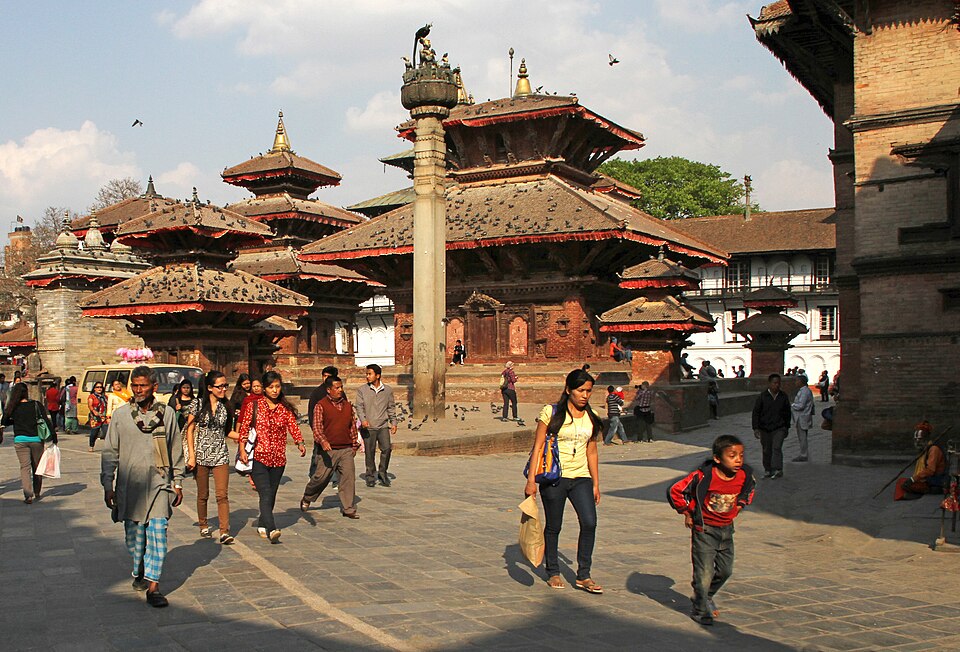
3rd–18th century
A crowded royal square where elaborately carved temple facades in the Newar style surround a nine-story palace tower rising above everything nearby — one of three historic Durbar Squares recognised together as a single UNESCO World Heritage Site.
Kathmandu Durbar Square is a plaza that grew as the royal centre of the Kathmandu Valley, with construction beginning in the 3rd century. Most of its standing temples date from the 16th century, built during the reign of the Malla kings and decorated with the carved facades characteristic of Newar architecture. The surrounding palace complexes were added under both the Malla and Shah dynasties; best known is the nine-story Nautalle Durbar, raised by Prithvi Narayan Shah to mark Nepal's unification. It is one of three Durbar Squares in the valley recognised as a UNESCO World Heritage Site.
Photo: Gerd Eichmann (CC BY-SA 4.0)
Swayambhunath
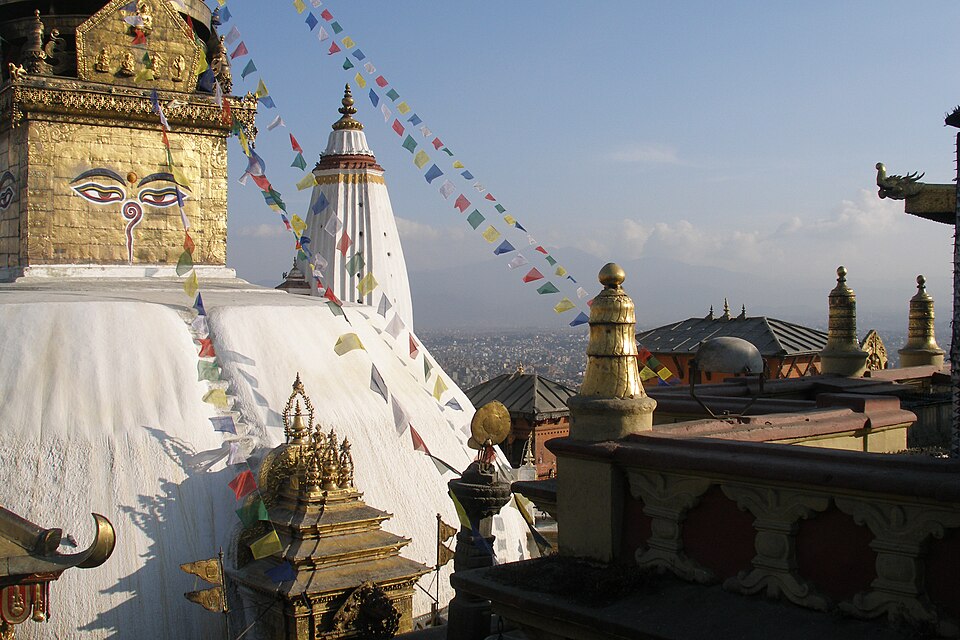
460
A domed stupa on a hilltop with small Hindu shrines scattered around its base rather than confined to a separate precinct — Buddhist and Hindu structures sharing the same platform as a mark of the site's religious mixing.
Swayambhunath is an ancient religious complex on a hill west of Kathmandu, dated in the catalogue to 460. Considered in local tradition to be the home of the primordial Buddha, it is venerated as one of the most ancient and important stupas in the world and ranks among the three most sacred Buddhist pilgrimage sites for the Newar people; for Tibetan Buddhists it is second in importance only to Boudhanath. Hindu temples and deities have been incorporated into the site, and its iconography draws on the Vajrayana tradition of Newar Buddhism. It became a UNESCO World Heritage Site in 1979.
- Tradition holds that the site hosted three Buddhas of a past age — Konagamana, Kakusandha and Kassapa — before the current one.
Photo: Vyacheslav Argenberg (CC BY 4.0)
Boudhanath
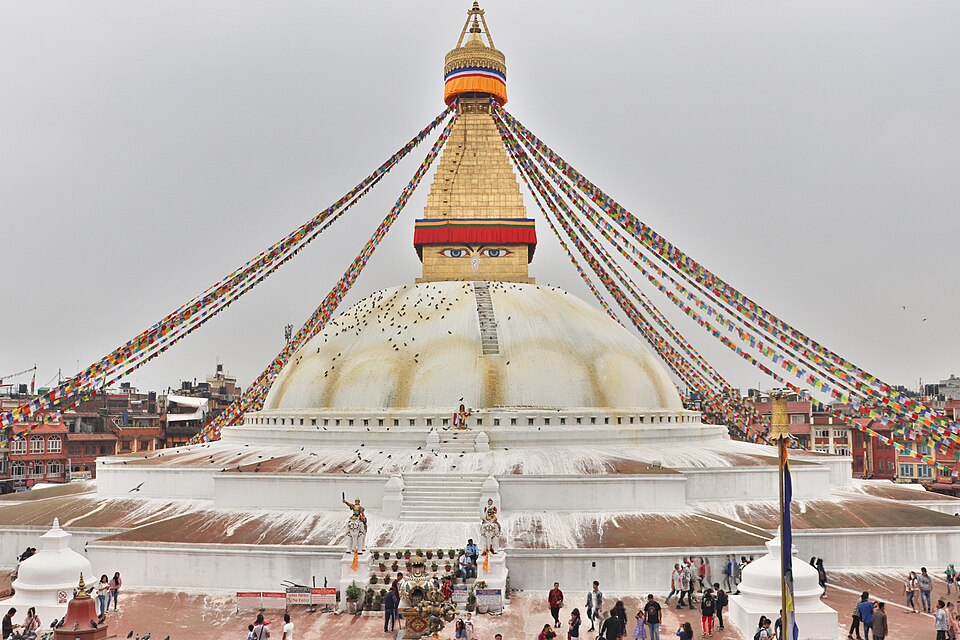
14th century
An enormous hemispherical stupa laid out as a mandala, said to be the largest spherical stupa in Nepal and among the largest of its kind anywhere; it originally rose out of open rice paddies at the edge of the valley.
Boudhanath is a Buddhist stupa in the Boudha area of Kathmandu, regarded as an embodiment of the enlightened mind of all Buddhas. The present structure most likely dates to the 14th century, though Newar chronicles record a stupa on the site as early as the 5th century. Laid out as a massive mandala, it is said to be the largest spherical stupa in Nepal. It is believed to hold consecrated relics, including bone fragments attributed to the Kassapa and Shakyamuni Buddhas, and sits on a trade route linking Tibet and India. It became a UNESCO World Heritage Site in 1979.
- One tradition credits the stupa with having given birth to Tibetan Buddhism itself.
- It sits on the old trade route from Tibet into India, entering the valley near the village of Sankhu.
Photo: Nabin K. Sapkota (CC BY-SA 4.0)
Pashupatinath Temple
A Hindu temple on the Bagmati River dedicated to Pashupati, a manifestation of Shiva, among the oldest significant religious complexes in South Asia. Recognized as a UNESCO World Heritage Site since 1979, it spans 246 hectares with 518 mini-temples around its main pagoda-style shrine.
Kasthamandap
A reconstructed temple and public shelter in Kathmandu Durbar Square, its wooden structure dated in part to the 7th century CE, destroyed in the 2015 earthquake. Its oldest features date to the Lichhavi era, and a shrine to the 11th-century yogi Gorakshanath was added later.
Narayanhiti Palace Museum
A public museum east of the Kaiser Mahal, created in 2008 from the former Narayanhiti Palace following Nepal's 2006 revolution. Before that it was the residence and workplace of the country's monarch, with the existing palace complex built by order of King Mahendra in 1963.
Patan Durbar Square
The centre of Lalitpur, one of three UNESCO Durbar Squares in the Kathmandu Valley, with a medieval royal palace of the Malla kings. Paved in red brick bordered by stone, it holds many temples and statues, and remains a center of both Hinduism and Buddhism.
Taleju Temple
A Hindu temple dedicated to Taleju Bhawani, patron goddess of the Malla dynasty, built by Mahendra Malla in 1564 in Kathmandu Durbar Square. It holds a shrine to the goddess and her embodiment, the Kumari Devi, opened to the public once a year, on Dashain.
Rani Pokhari
A historic artificial pond in the heart of the city, originally known as Nhu Pukhu and dating from the 17th century, built on the eastern edge of the city. The square-shaped tank measures 180 by 140 metres and is one of Kathmandu's most famous landmarks.
Hiranya Varna Mahavihar
A historical Buddhist monastery in Patan, informally known as Kwa Baha or the Golden Temple for its gold coloring.
Guhyeshwari Temple
A Hindu temple on the southern bank of the Bagmati River, about a kilometre east of Pashupati and an important Tantric pilgrimage site. Its name comes from Sanskrit words meaning 'secret goddess', and King Pratap Malla renovated it in the 17th century.
Singha Durbar
A palace, meaning 'Lion's Palace', built by Chandra Shumsher Jung Bahadur Rana in June 1908 and home to offices of Nepal's government, including the Pratinidhi Sabha and Rastriya Sabha. In 2025 its main building was destroyed during the Gen Z protests, prompting discussion of reconstruction.
Kumbheshwar temple complex
One of the oldest and busiest religious sites in old Patan, with shrines to deities including Kumbheshwor Mahadev, Bagalamukhi and Unmanta Bhairava. A natural spring here, said to originate from Gosaikunda Lake, makes bathing there during Janai Purnima believed to equal bathing in that lake.
Bagh Bhairab Temple
A historic Hindu temple in Kirtipur dedicated to Bagh Bhairab, an incarnation of Shiva as a tiger, dating to the 16th century. It displays swords used by King Prithvi Narayan Shah's army during the Battle of Kirtipur, and residents believe it protects the town.
Central Zoo
A 6-hectare zoo in Jawalakhel, home to about 969 animals across 109 species, opened to the public in 1956 after starting as a private zoo. It can draw up to 34,000 visitors in a day during the Bhoto Jatra festival.
Dharahara
A 72-metre tower at the centre of Sundhara, first built in 1832 under Prime Minister Bhimsen Thapa for Queen Lalit Tripurasundari, later destroyed and rebuilt more than once. Most of it collapsed in the 2015 earthquake, and reconstruction begun in 2018 restored its 213-step staircase.
Shahid Gate
A monument inaugurated on 13 April 1961 and designed by Shankar Nath Rimal, officially named Nepal Smarak but commonly known as Shahid Gate. As of 2016 it carried five statues, four honoring men who opposed the 104-year Rana Regime and one of former King Tribhuvan.
Maitighar Mandala
A symbolic monument at the intersection of roads from Thapathali, New Baneshwor and Bhadrakali, at the southeast corner of Singhadurbar, Nepal's administrative centre. Considered an important visual landmark depicting Buddhist relics, it also marks the start of the Araniko Highway linking Nepal with China.
Asan
A ceremonial, market and residential square in central Kathmandu, one of the city's most well-known historical locations, described as a fine Newar example of a traditional Asian bazaar. Six streets converge there, drawing shoppers with merchandise ranging from foodstuffs and spices to electronics and bullion.
Indra Chowk
A ceremonial market square on the historic artery that carried the old India-Tibet trade route, where six streets meet and temples draw pilgrims and shoppers. Named for the god Indra, it hosts festival processions, including the chariots of Kumari, Ganesh and Bhairav during Indra Jatra.
Kaiser Library
A government-run library in the Keshar Mahal palace complex, established in 1907 by Chandra Shumsher Jang Bahadur Rana for his son. It holds rare books on Buddhism, Tantrism and astrology, including a 1,100-year-old copy of the Sushruta Samhita, on UNESCO's Memory of the World Register.
Taragaon Museum
A private gallery in the northern part of the city near the Boudhanath stupa, formerly known as Taragaon Museum. It sits on the grounds of the Taragaon Regency hotel, which owns it, and is supported by the Saraf Foundation.
Pancha Kashmiri Takiya Masjid
One of the oldest mosques in Nepal, built in the 15th century when Kashmiri Muslims arrived for trade, with construction under King Pratap Malla. It comprises a prayer hall, an annexe and a madrasah, holding the tombs of Haji Mishkin Shah and Khwaja Gyasuddin Shah.
Assumption of the Blessed Virgin Mary Cathedral
A Catholic church in Lalitpur, begun as the Church of Our Lady of the Assumption and dedicated by Cardinal Jozef Tomko in 1995, the only place of Catholic worship allowed in the country. A 2009 bomb attack there killed three people and wounded 13.
Tusha Hiti
A sunken bath used by the Malla royal family, in the courtyard of Sundari Chowk in Patan Durbar Square, built in the 17th century by King Siddhi Narasimha Malla. Its walls carry stone and gilt-metal idols of Hindu gods; its golden spout no longer runs.
Kopan Monastery
A Tibetan Buddhist monastery near Boudhanath, established in 1969 by FPMT founders Lamas Thubten Yeshe and Thubten Zopa Rinpoche, who bought the property from Nepal's royal astrologer. Famous for teaching Buddhism to Western visitors, it has held annual month-long meditation courses since 1971.
Patan Museum
A museum in Patan, Lalitpur, inaugurated in 1997 by King Birendra Bir Bikram Shah, in an old residential court of Patan Durbar called Keshav Narayan Chowk. It displays sacred arts of Nepal, restored by architect Götz Hagmüller with its collection curated by Mary Shepherd Slusser.
History
Kathmandu has been continuously inhabited since at least the 2nd century AD, when the valley was known as Nepal Mandala and its Newar population built one of the Himalayan region's major urban civilisations. Construction on what became Durbar Square began in the 3rd century, though the temples still standing mostly date from the 16th century, when Malla kings rebuilt the royal centre and decorated it with carved Newar facades. After Prithvi Narayan Shah united Nepal in the 18th century, the new Shah dynasty added the nine-story Nautalle Durbar to the same square, layering conquest onto the older Malla skyline. Buddhism left an older mark still: Swayambhunath's hilltop shrine is dated to 460, and Boudhanath's mandala-shaped stupa, rebuilt around the 14th century, follows a Newar chronicle tradition reaching back to the 5th century.