Landmarks in Guilin
Karst hills frame a city where landmarks span a 1372 palace and 2001 pagodas.
Guilin's landmarks divide between a natural landscape and a handful of built additions to it. The city sits within a field of eroded limestone karst hills, Elephant Trunk Hill among the best known of them, shapes that owe nothing to any architect and predate every structure in the city by a wide margin. Where building does appear, the record is mixed: a pair of lakeside pagodas trace their origin to the Tang dynasty but stand today as a 2001 reconstruction in bronze and glazed tile, replacing what had been lost, while a princely residence raised in 1372 has been divided between a university and a heritage site rather than preserved whole. Guilin's built landmarks are therefore recent restorations and adaptive reuse layered onto a much older natural setting.
Elephant Trunk Hill
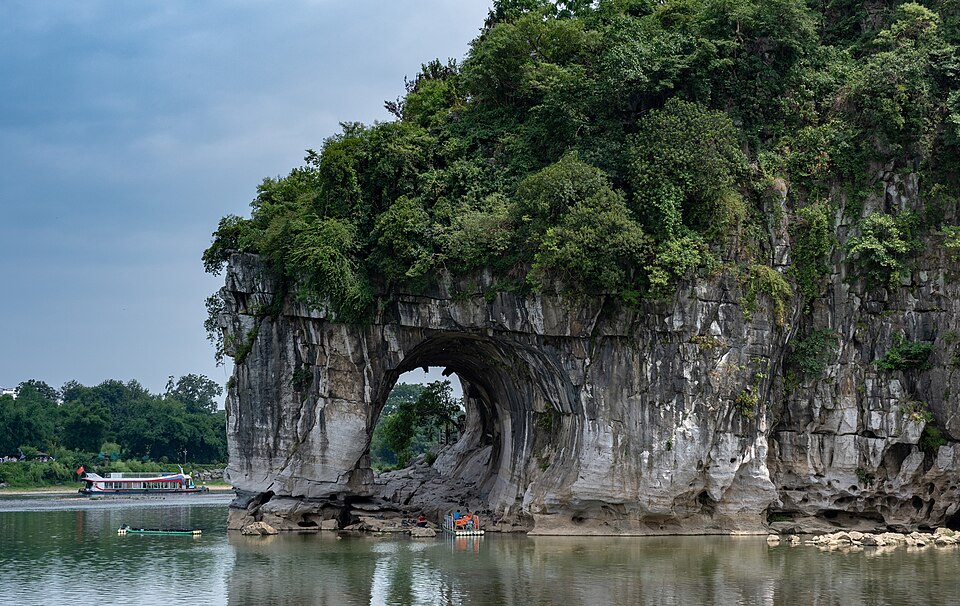
A single limestone hill whose curved silhouette is likened to an elephant's trunk, standing apart as an isolated outcrop among the karst peaks that surround the city rather than forming part of a range.
Elephant Trunk Hill is a limestone formation within Guilin's karst landscape, the type of scenery for which the city is best known internationally. It is treated as a natural landmark and one of the city's principal tourist attractions rather than a built structure, so no construction date, architect, or heritage designation attaches to it. Its identity rests on the shape of the hill itself, which gives the formation its name.
Photo: xiquinhosilva (CC BY 2.0)
Sun and Moon Pagodas
2001
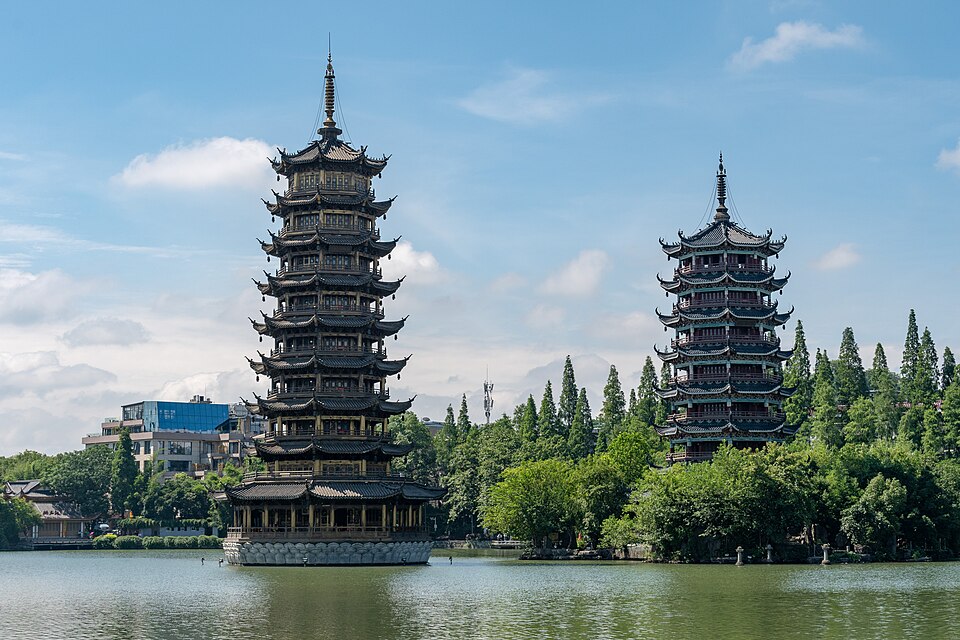
Two octagonal pagodas of unequal height rise from a lake: the taller, nine-storey one is faced in bronze, the tallest bronze pagoda in the world, and stands out in open water, while the shorter, seven-storey one is glazed in tile and sits on a lake island linked to the shore.
The Sun and Moon Pagodas are twin structures on Shan Lake, reconstructed in 2001 using historical records after their Tang-dynasty predecessors, which had stood in Guilin's former city moat. They form the centerpiece of Riyue Shuangta Cultural Park, whose theme unites Buddhism, Confucianism, and Taoism. The taller, nine-storey Sun Pagoda has an octagonal base, is faced with bronze, and reaches 41 metres, the tallest bronze pagoda in the world, and one of few pagodas anywhere fitted with an elevator. The shorter Moon Pagoda, seven storeys and 35 metres, has a glazed-tile exterior and stands on a lake island.
- The Sun Pagoda stands directly in the open water of Shan Lake, while the Moon Pagoda sits on an island beside it.
- It is the tallest bronze pagoda in the world and one of the few pagodas anywhere fitted with an elevator.
- The pagodas were featured as a Pit Stop on the American reality show The Amazing Race in 2009.
Photo: xiquinhosilva (CC BY 2.0)
Jingjiang Princes' City
1372
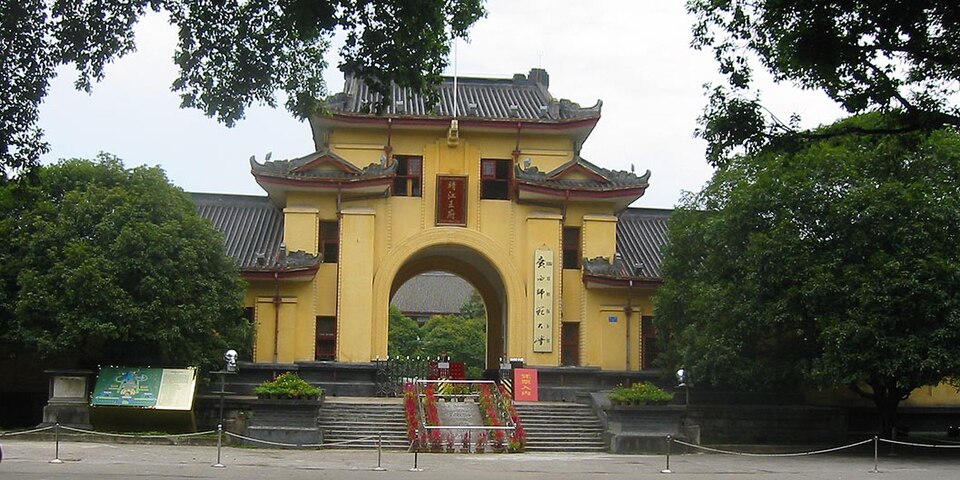
The site's clearest identifying trait is its setting inside a working university campus rather than any single distinctive building; ordinary campus grounds share the ground with the heritage site, with no distinctive architectural form recorded for it.
Built in 1372, this complex served as the residence of local princes and is known both as the Jingjiang Princes' City and, on Wikipedia, as the Jingjiang Princes' Palace. It now leads a double life: part of its grounds house Guangxi Normal University, while the rest remains open to visitors as a tourist attraction. The site is protected as a Major Historical and Cultural Site at the national level, and it is rated AAAAA, the highest classification in China's tourist-attraction system.
Photo: prat (CC BY-SA 3.0)
Zengpiyan
A Neolithic cave site on the southwestern fringes of Dushan Mountain, discovered in 1969, with excavations beginning in 1973. Occupied between 10,000 and 5000 BC, it is one of the most important Neolithic sites in China for early animal domestication and pottery.
History
The oldest structure on record, a princely residence, was built in 1372 and has long outlived its original purpose: part of its grounds now belong to a university, the rest kept open to visitors rather than a court. Guilin's other built landmark has a longer and more broken history. Pagodas first raised in the city's moat during the Tang dynasty were lost, and stood only as a memory for centuries, until 2001, when they were reconstructed from historical records as the centerpiece of a new lakeside park built around the shared ground of three religious traditions. Apart from these two building episodes lies the karst hill country that gives Guilin its scenery and its long-standing reputation, indifferent to both the palace's decline and the pagodas' loss and rebuilding, since it needed no human construction to take its current form.