Landmarks in Georgetown
Timber Gothic Revival churches and Renaissance Revival civic halls define its centre.
Georgetown's protected landmarks are civic and religious buildings from the nineteenth century, clustered on streets such as Church Street, Regent Street, Avenue of the Republic and Brickdam. Two of them, Georgetown City Hall and St. George's Cathedral, share a Gothic Revival vocabulary despite being built roughly a decade apart, while the older Parliament Building of 1834 follows the Renaissance Revival taste that preceded it. Material sets the cathedral apart: built almost entirely of timber, it still reaches 43.5 metres, an unusual height for a wooden structure. City Hall's dense Gothic ornament has drawn comparisons across the wider Caribbean, and both it and the cathedral sit on the tentative World Heritage list, while the cathedral also carries national monument status.
St. George's Cathedral
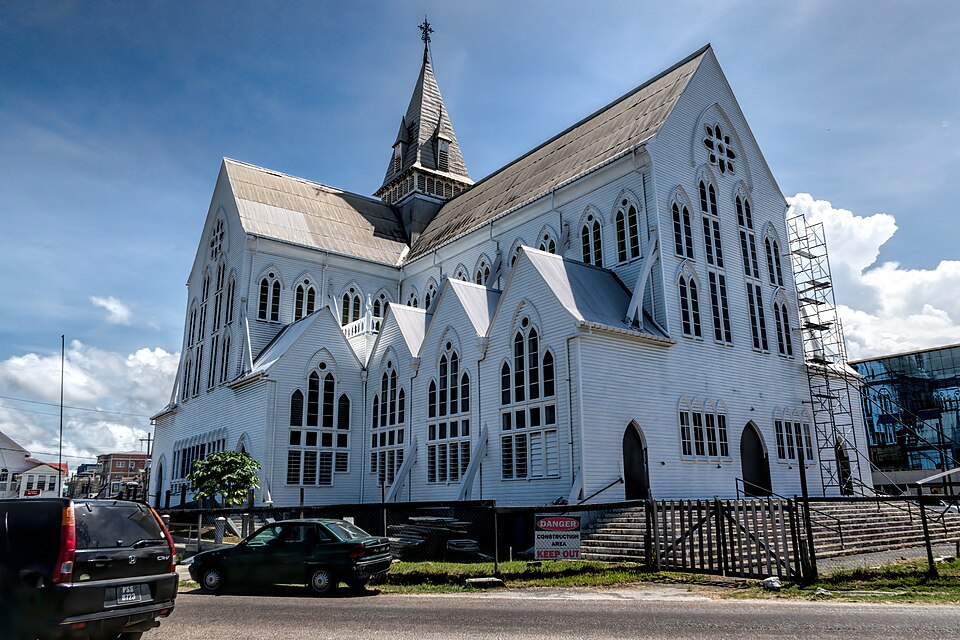
1892–1899 · Arthur Blomfield
Built of timber rather than stone, it follows the Gothic Revival style and stands 43.5 metres (143 ft) tall on Church Street, an unusual height for a wooden building.
St. George's Cathedral is an Anglican cathedral on Church Street and the seat of the Bishop of Guyana. Designed by Arthur Blomfield, it opened for worship on 24 August 1892, though construction continued until 1899. Built largely of timber in the Gothic Revival style, it reaches 43.5 metres (143 ft), an unusual height for a wooden building. It has been designated a national monument and sits on the tentative list for World Heritage status.
- It is built almost entirely of timber yet still reaches 43.5 metres (143 ft), a height rarely attempted in wood.
- Its congregation began worshipping in the building seven years before construction was actually finished.
Photo: Dan Lundberg (CC BY-SA 2.0)
Georgetown City Hall
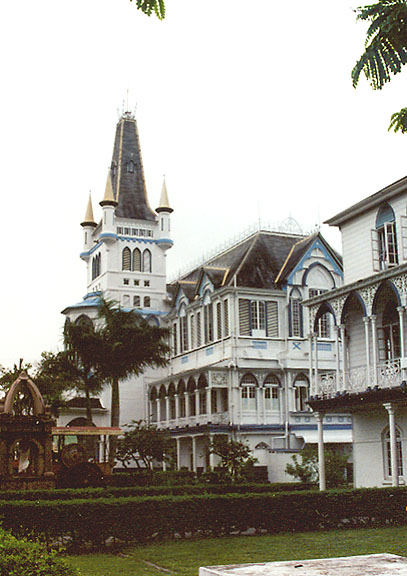
1889 · Ignatius Scoles
Standing at the corner of Regent Street and Avenue of the Republic, it is an elaborately trimmed Gothic Revival building often called the most picturesque structure in the city, and counted among the finest examples of Gothic architecture in the Caribbean.
Georgetown City Hall stands at the corner of Regent Street and Avenue of the Republic. Designed by the Reverend Ignatius Scoles in 1887, it was completed in June 1889 and houses the offices of the Mayor, the City Council and the City Engineer. Its elaborate detailing has led observers to call it the most picturesque building in the city and one of the finest examples of Gothic Revival architecture in the Caribbean. Guyana proposed it for World Heritage status in 1995; it remains on the tentative list.
- Its architect, Ignatius Scoles, was a Reverend rather than a professional builder.
- Guyana nominated it for World Heritage status in 1995, and decades later it remains only on the tentative list.
Photo: JukoFF. (CC BY-SA 3.0)
Parliament Building
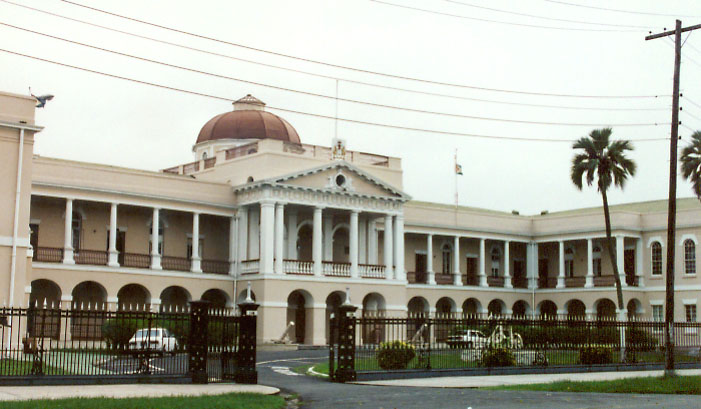
1834 · Joseph Hadfield
Its Renaissance Revival facade at Brickdam sets it apart from the Gothic Revival civic buildings nearby; inside, an elaborately decorated ceiling designed by Cesar Castellani had to be entirely reconstructed between 2000 and 2005 after heat and humidity damage.
The Parliament Building houses the National Assembly of Guyana on Brickdam, on the site once occupied by the Court of Policy. Designed by Joseph Hadfield in the Renaissance Revival style, it was completed on 21 February 1834. Its Parliamentary Chamber has a decorated ceiling by Cesar Castellani, which deteriorated in the humid climate and was reconstructed between 2000 and 2005. A dedicated Parliament Library opened inside the building in 1998.
- It stands on the site once occupied by the Court of Policy.
- Its decorated ceiling deteriorated so badly in the humid climate that it had to be rebuilt between 2000 and 2005.
- A Parliament Library was added only in 1998, more than 160 years after the building was completed.
Photo: Dan Sloan (CC BY-SA 2.0)
Stabroek Market
An iron-and-steel market hall in the center of the capital, identified by its prominent clock tower. It is the largest market in Georgetown, Guyana.
Demerara Harbour Bridge
A floating toll bridge across the Demerara River, 6,074 feet long, commissioned in July 1978 and closed in October 2025. Its 61 spans included retractor sections that opened once a day for large vessels, before the bridge was replaced by a new crossing.
St. Andrew's Kirk
One of Georgetown's oldest buildings still used for worship, begun in 1811 and opened in 1818 by Scottish Presbyterians. It was the first Guyanese church where enslaved people were allowed to worship, and later served as barracks during the 1823 Demerara rebellion.
Castellani House
A large nineteenth-century building designed by Maltese architect Cesar Castellani and built between 1879 and 1882, on the corner of Vlissengen Road and Homestretch Avenue. Originally a residence for colonial officials, it has housed Guyana's National Art Gallery since 1993.
Bourda
The Georgetown Cricket Club Ground, used by the Guyanese team for regional matches and some West Indies Tests. One of only two cricket stadiums on the South American mainland, it is uniquely ringed by a moat for flood control and drainage.
Providence Stadium
Guyana's national stadium, built to host Super Eight matches at the 2007 Cricket World Cup and replacing Bourda in that role. It staged six World Cup matches in 2007, including the game where Sri Lanka's Lasith Malinga took four wickets in four consecutive balls.
State House
The official residence of the president of Guyana, previously home to the governor of British Guiana. Built in 1823 and purchased by the British government in 1853, it was a two-story timber structure on brick pillars, later altered to move its entrance to Main Street.
Arthur Chung Conference Centre
A convention and exhibition center in the capital, located next to the Secretariat of the Caribbean Community.
Guyana Botanical Gardens
A tropical botanical garden in the capital, situated next to the Guyana Zoo and Castellani House.
National Library of Guyana
Guyana's legal deposit and copyright library, founded in 1909 as the Carnegie Free Library on the corner of Church and Main Streets. Also a public lending library heading the country's library service, it held nearly 398,000 books and 22,000 members as of 2007.
Guyana National Park
An urban park opened with Queen Elizabeth II in attendance and originally named after her state visit. Despite its name, it is not a nature reserve, having been built on the site of a former golf club.
Company Path Garden
A small garden on the west side of the Avenue of the Republic, between Church and North Streets. Its site, transferred from the cathedral entrance to the Georgetown Town Council in 1907, was turned into a garden the following year.
Red House
The former official residence of the Colonial Secretary and later the Premier of British Guiana, located in Kingston. Since 22 March 2000 it has housed the Cheddi Jagan Research Centre.
Secretariat of the Caribbean Community
The principal administrative organ of the Caribbean Community, CARICOM, headed by a secretary general who serves as the organization's chief executive officer. Its mission statement commits it to dynamic leadership in partnership with Community institutions toward a sustainable, competitive region.
Walter Roth Museum of Anthropology
A museum of anthropology at 61 Main Street, North Cummingsburg, said to be the oldest of its kind in the English-speaking Caribbean. Established in 1974, it did not open to the public until 1982.
Guyana National Museum
A museum established on 13 February 1868, holding artifacts kept for decades, including a Pork-knocker display over sixty years old. It also shows miniature versions of Transport and Harbours Department ferries and the vehicle used by Prime Minister Ptolemy Reid.
National Cultural Centre
The premier auditorium for cultural events, on Homestretch Avenue in D'Urban Park, officially opened on 16 May 1976. It rises 62 feet, seats about 2,000 people, and houses the National Drama School.
Guyana Zoo
The Guyana Zoological Park, officially opened in 1952 on grounds used as botanical gardens since 1895. Its most popular attractions include harpy eagles and manatees, and as of 2005 it employed about 25 staff.
Queenstown Mosque
A mosque in Georgetown, Guyana, also known as the Queenstown (Jama) Masjid.
History
The oldest of the three, the Parliament Building, was designed by Joseph Hadfield and completed on 21 February 1834 at Brickdam, on the site formerly occupied by the Court of Policy; its Renaissance Revival chamber ceiling, decorated by Cesar Castellani, later suffered so much heat and humidity damage that it was rebuilt between 2000 and 2005, and a Parliament Library was added in 1998. Georgetown City Hall followed in the Gothic Revival style: designed by the Reverend Ignatius Scoles in 1887 and completed in June 1889 at the corner of Regent Street and Avenue of the Republic, it was admired as one of the finest Gothic buildings in the Caribbean and proposed for World Heritage status in 1995. St. George's Cathedral, designed by Arthur Blomfield, opened for worship in 1892 and was finished in timber Gothic Revival form by 1899, reaching 43.5 metres on Church Street.